




Seven Strings, No Mercy: Enter the Extended Range
At some point, six strings were no longer enough.
This was not a failure of the guitar. Six strings had already produced Hendrix, Sabbath, Van Halen, thrash metal, death metal, several million questionable blues solos and enough power chords to permanently alter the structural integrity of rehearsal rooms worldwide.
The instrument had done its part. Guitarists simply wanted to go lower.
Not bass-guitar lower, necessarily. That is a different kingdom, occupied by people with enormous speaker cabinets and an alarming understanding of compression. What players wanted was the familiar geography of the electric guitar — the chords, scales, bends, tapping, harmonics and violently satisfying mechanics of a distorted riff — with another floor built underneath it.
Enter the seven-string guitar. One additional string.
Five extra low notes before you even move your hand.
And an absolutely unreasonable quantity of potential darkness.
The modern seven-string has become one of heavy music's defining instruments, but reducing it to “normal guitar plus chug” misses what makes extended-range guitar playing so interesting. That extra string changes chord voicings, scale patterns, rhythmic possibilities and the physical relationship between the guitarist and the neck. It allows enormous low-register riffs to coexist with the complete upper register of a conventional guitar.
You haven't traded the high notes for lower ones. You've built a basement beneath the house.
And Musicmaker currently has several very interesting ways to get down there.
What Exactly Is a Seven-String Guitar?
The most common modern seven-string guitar takes standard six-string tuning — E A D G B E — and adds a lower B, producing:
B E A D G B E.
That apparently modest addition changes considerably more than you might expect.
Because the upper six strings remain in familiar standard tuning, most of what you already know still works. Your open chords remain where you left them. Your scale shapes still exist. Barre chords, lead vocabulary and muscle memory do not suddenly evaporate because somebody installed another machine head.
Look towards the bass side of the neck, however, and there is now another string extending the instrument's range down to B.
That means a conventional E power chord can still thunder away exactly as before, but the guitarist can descend below it into B, C, C♯, D and D♯ without changing position or retuning the instrument.
For heavy riffing, this is immediately addictive.
For composition, it is much more interesting.
You can pedal against the low B while moving chords above it. You can create wide intervallic shapes that simply aren't available on a conventional six-string in standard tuning. You can voice chords across a broader register, move between subterranean rhythm work and normal lead-guitar territory without changing instruments, and build riffs where the extra string becomes punctuation rather than the entire sentence.
Of course, you can also hit the low B through an obscene amount of gain and stare happily at the amplifier.
This remains an entirely legitimate use.
Steve Vai Opens the Door
The modern solid-body seven-string story has an unlikely godfather. Steve Vai.
Not a downtuned metal guitarist standing motionless in a cloud of dry ice, but one of the most flamboyantly technical players ever to put his hands around an electric guitar.
Working with Ibanez, Vai developed the Universe, which Ibanez describes as its first commercial seven-string electric guitar. The instrument extended the familiar high-performance guitar format downwards without sacrificing the upper range required for Vai's extraordinarily technical playing.
The seven-string was not conceived simply as a device for playing one lower power chord.
It was an extended-range instrument.
More notes. More intervals. More possibilities.
Vai exploited that range on recordings including Passion and Warfare, but something else happened after the Universe entered the world. Other guitarists began looking at that low string and imagining very different things.
Much uglier things.
Wonderful things.
Then Korn Happened
If Vai helped establish the modern seven-string, Korn helped turn it into a cultural event.
Guitarists James “Munky” Shaffer and Brian “Head” Welch became deeply associated with seven-string Ibanez guitars as Korn emerged in the 1990s, using the extended range for riffs that were percussive, dissonant and frequently more concerned with rhythm and texture than conventional metal virtuosity. Both remain listed among Ibanez's artists today.
That was significant because the seven-string began to acquire an identity distinct from the shred guitar that had helped produce it.
The low register could be rhythmic architecture.
Muted strings became percussion. Dissonant intervals became atmosphere. Huge low notes could leave space above them for vocals, effects and strange guitar textures. The guitar could sound less like somebody playing a riff and more like an enormous piece of industrial machinery becoming emotionally unstable.
For a generation of guitarists, that sound changed the furniture.
Then the instrument kept evolving.
Meshuggah and the Mathematics of Violence
You cannot talk seriously about extended-range metal without eventually arriving in Sweden.
Meshuggah's Fredrik Thordendal and Mårten Hagström became enormously influential in the development of low-tuned, rhythmically complex modern metal guitar, and both remain Ibanez artists.
Meshuggah would ultimately become strongly associated with eight-string guitars, but their broader influence on extended-range playing is difficult to miss. Low-register guitar stopped being simply about making a riff heavier and became a place for intricate rhythmic cycles, displaced accents, polymetric ideas and brutally precise interaction between guitar, bass and drums.
That distinction is important. A seven-string can give you heft. It can also give you architecture.
The extra range allows riffs to move through registers without abandoning the physical vocabulary of the guitar. Modern progressive metal, djent, metalcore and technical metal have subsequently pushed that idea in dozens of directions.
The low string is no longer a novelty.
It is part of the grammar.

The 26.5-Inch Question
Now we enter the workshop. Several of the seven-strings currently at Musicmaker — including the JET JS-407, JET JS-507 Stygian, Spira S-407 and Spira S-457 — use a 26.5-inch scale length.
That extra inch over a familiar 25.5-inch scale is not there because metal guitarists are unusually enthusiastic about rulers.
It helps manage the lower register.
Pitch depends on a relationship between string length, mass and tension. Lowering a string's pitch reduces tension if the other variables remain unchanged. Go sufficiently low on a shorter scale and the string can begin to feel loose, while a heavy picking hand may push the initial attack noticeably sharp before the note settles.
Increasing scale length helps restore tension and definition.
This is why 26.5-inch seven-string guitars occupy such a useful middle ground. The scale is extended enough to give the low register greater authority, but it doesn't feel like you've accidentally wandered onto a bass guitar.
The frets are slightly further apart. The low notes feel more composed.
The chug becomes less flub and more THUNK.
This is technical terminology.
Please respect the science.
JET JS-407: Welcome to the Basement
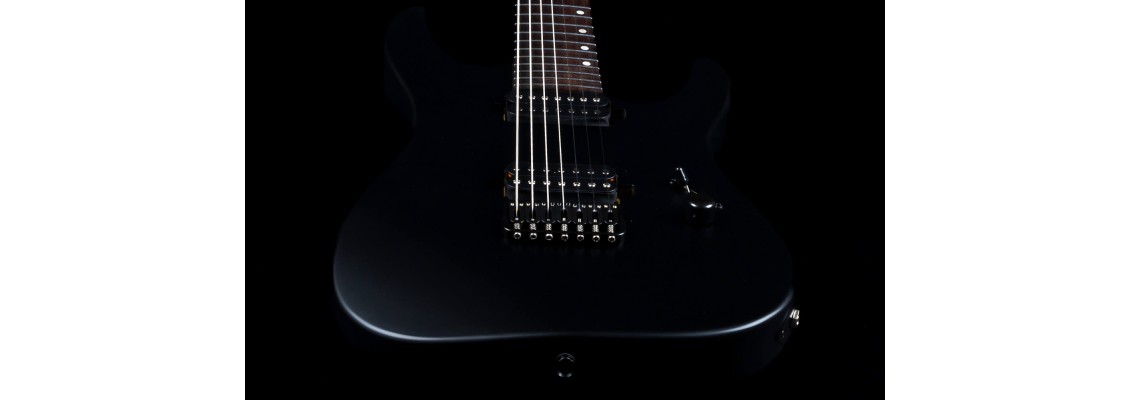
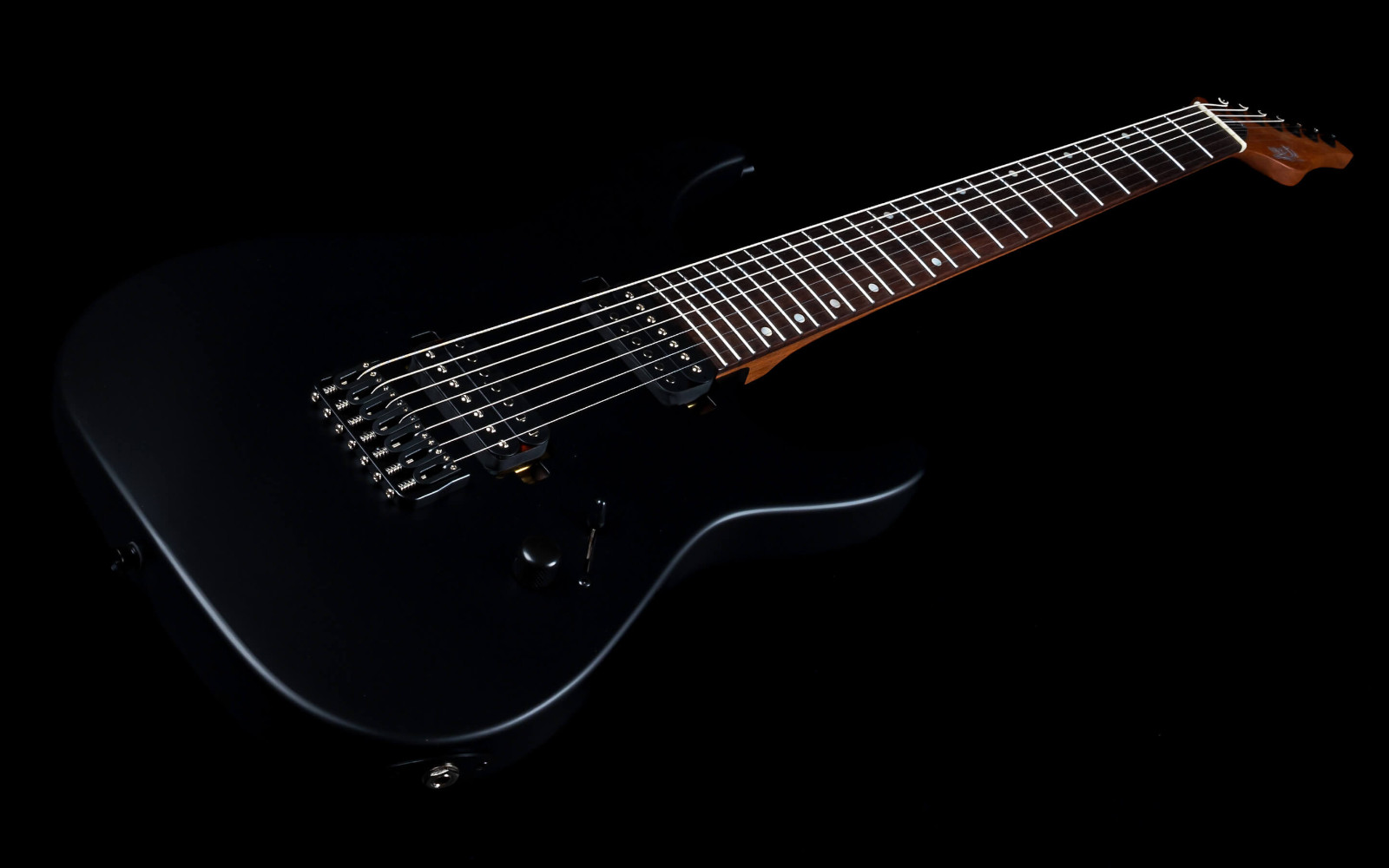
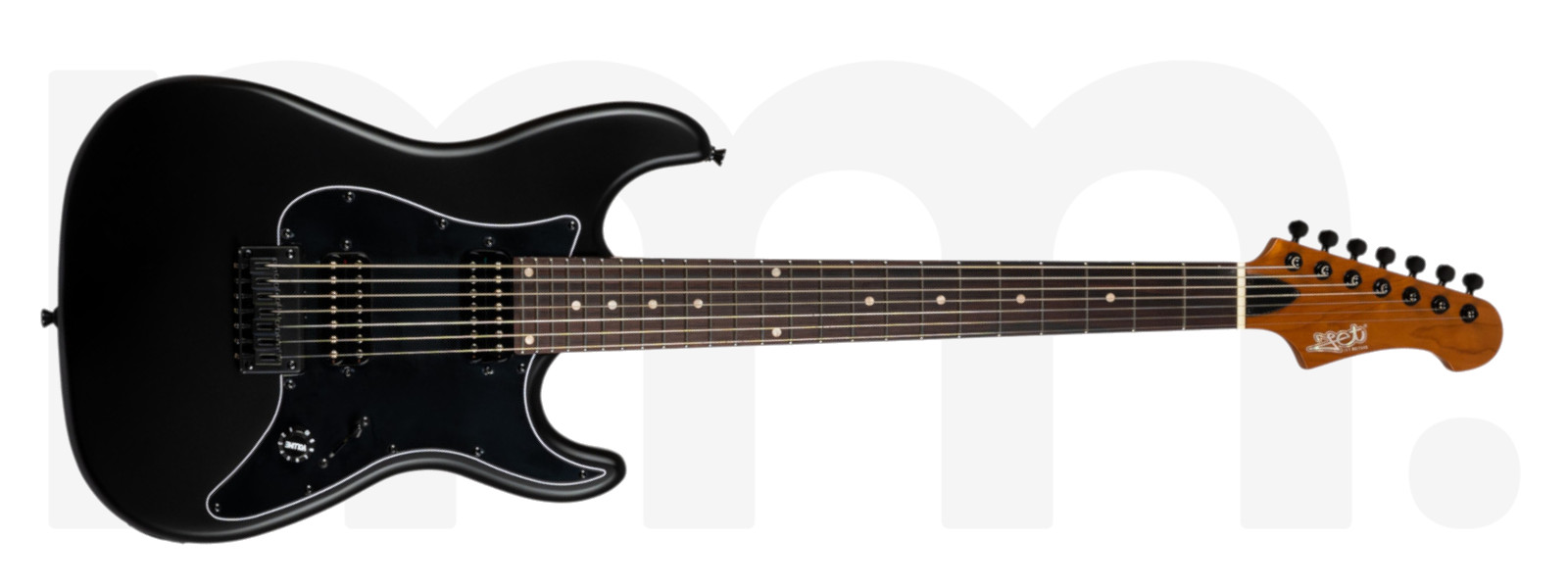
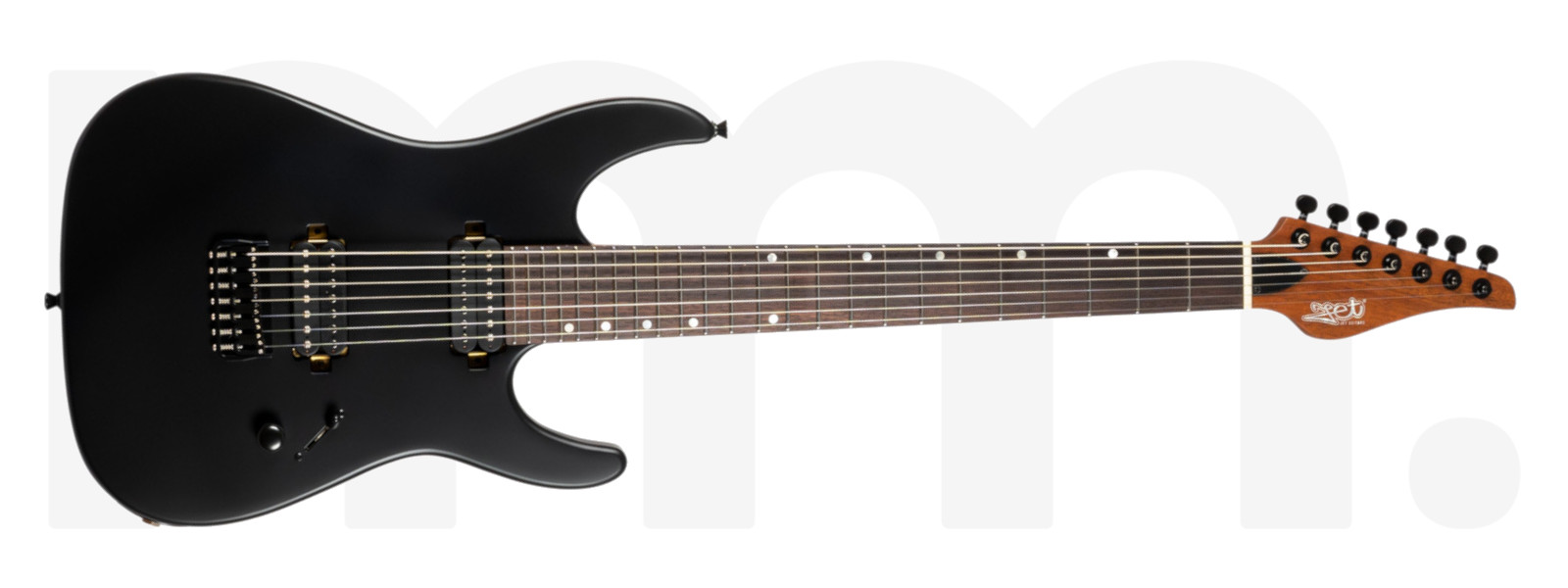
The JET JS-407 MBK R is almost comically purposeful.
Matt Black. Black hardware. Fixed bridge. Two black-covered ceramic humbuckers. One volume control.
That's it.
Apparently tone knobs were deemed an unacceptable delay between the guitarist and the incident.
Underneath the stealth finish sits a roasted poplar body, while the neck is Canadian roasted maple with a Modern C profile and rosewood fingerboard. The seven-string version gets a 48mm nut, 24 frets and that crucial 26.5-inch scale.
The simplicity is part of its appeal.
A fixed bridge makes excellent sense on an extended-range instrument aimed towards heavy playing because it provides a straightforward, stable platform for lower tunings and aggressive picking. The ceramic HH configuration is similarly on-message: ceramic magnets are frequently chosen for high-output guitar pickups because they can support the tight, immediate response required when substantial gain enters the equation.
And gain will enter the equation. Look at it.
The JS-407 appears to regard clean channels as an administrative error.
Yet underneath the aesthetic menace is something genuinely useful: an accessible route into 26.5-inch extended-range guitar without forcing the player into an exotic layout or complicated switching system.
Plug in. Tune down. Find low B.
Begin proceedings.
Spira S-407: The Villain Arrives
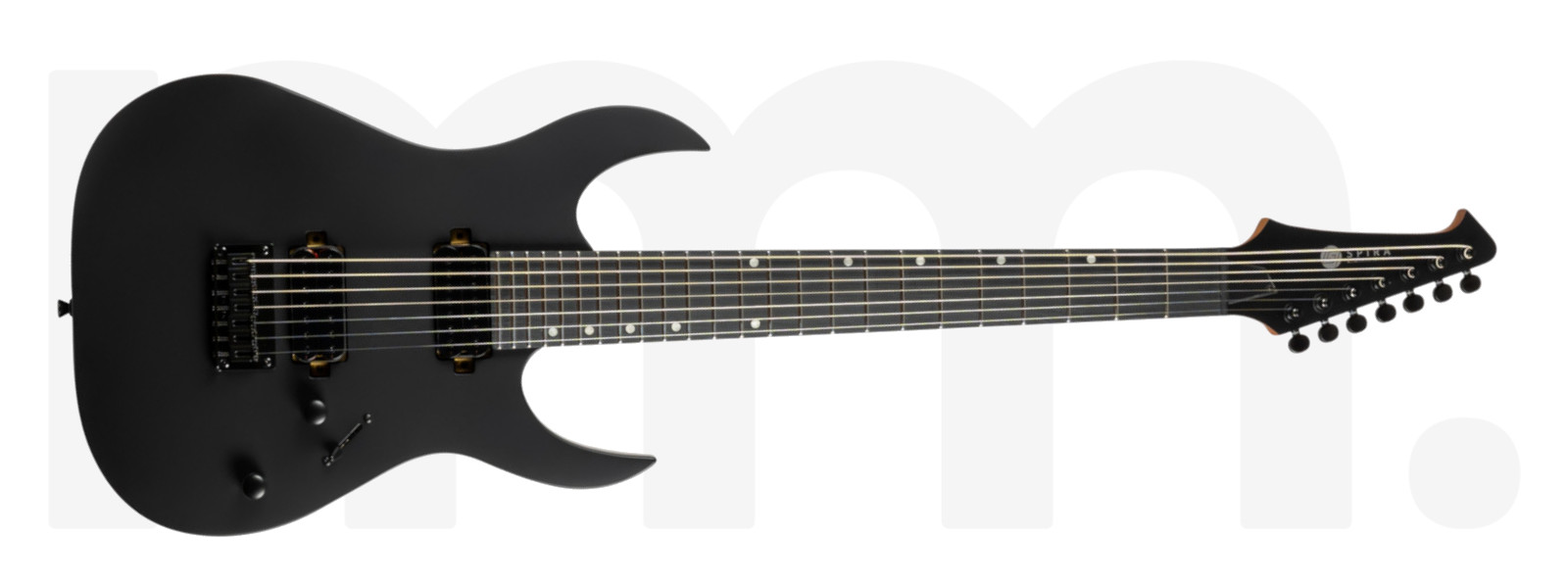
If the JET is stripped down, the Spira S-407 MBK starts adding performance hardware.
Again we have a roasted-poplar body and Canadian roasted-maple neck, but Spira moves to a Modern D profile, a flatter 14-inch-radius Ebony Tech fingerboard and 24 jumbo frets. The 26.5-inch scale and 48mm seven-string nut keep the extended-range geometry firmly in modern-metal territory.
Then there are the pickups.
The S-407 carries a pair of Spira's Villain seven-string humbuckers, custom-made around ceramic magnets and quoted by Spira at 12k output. A fixed bridge and locking machine heads complete a specification designed very clearly around tuning stability, precision and high-gain definition.
The flatter radius deserves attention.
Fingerboard radius describes the curvature across the board. A smaller number means a more pronounced curve; a larger radius means a flatter playing surface. Traditional electric guitars can have considerably rounder boards, while modern performance instruments frequently move towards flatter radii because many players find them comfortable for fast lead work, wide bends and lower action.
At 14 inches, the S-407 is speaking fluent modern guitar.
And with seven strings spread across that board, the extra width starts feeling less like an obstacle and more like a workspace.
Left-Handed Metalheads: We See You
There is another S-407 at Musicmaker that deserves a sentence considerably larger than the amount of fuss normally made about such things.
There is a left-handed version.
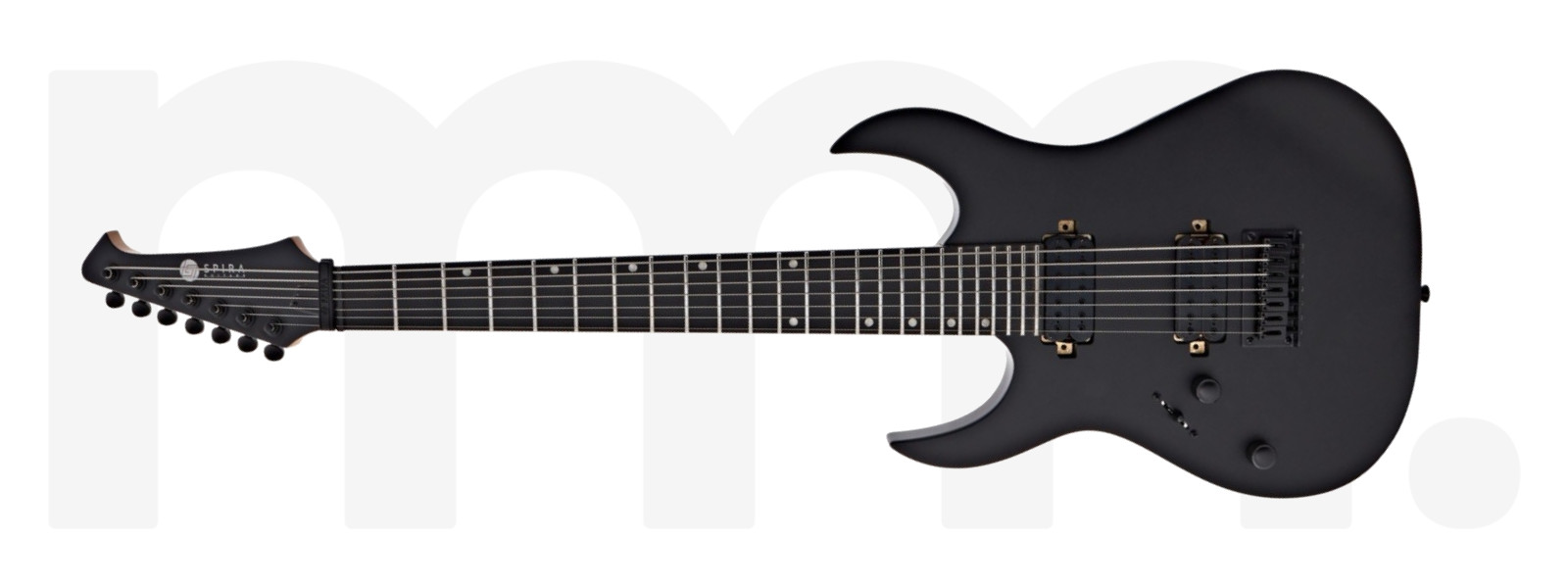
The Spira S-407 MBK LH brings the same seven-string concept to left-handed players rather than offering the traditional industry solution of “perhaps you'd like this one guitar we made in red.”
That matters.
Extended-range guitars are already a specialist category. Left-handed extended-range instruments narrow the field again, which can make finding an affordable instrument with modern specifications unnecessarily difficult. So yes.
Roasted maple. 26.5-inch scale. Villain humbuckers. Seven strings.
Left-handed. Good.
More of this, please.
Spira S-457: Purple Is a Heavy Colour
Metal spent decades establishing black as its official corporate uniform.
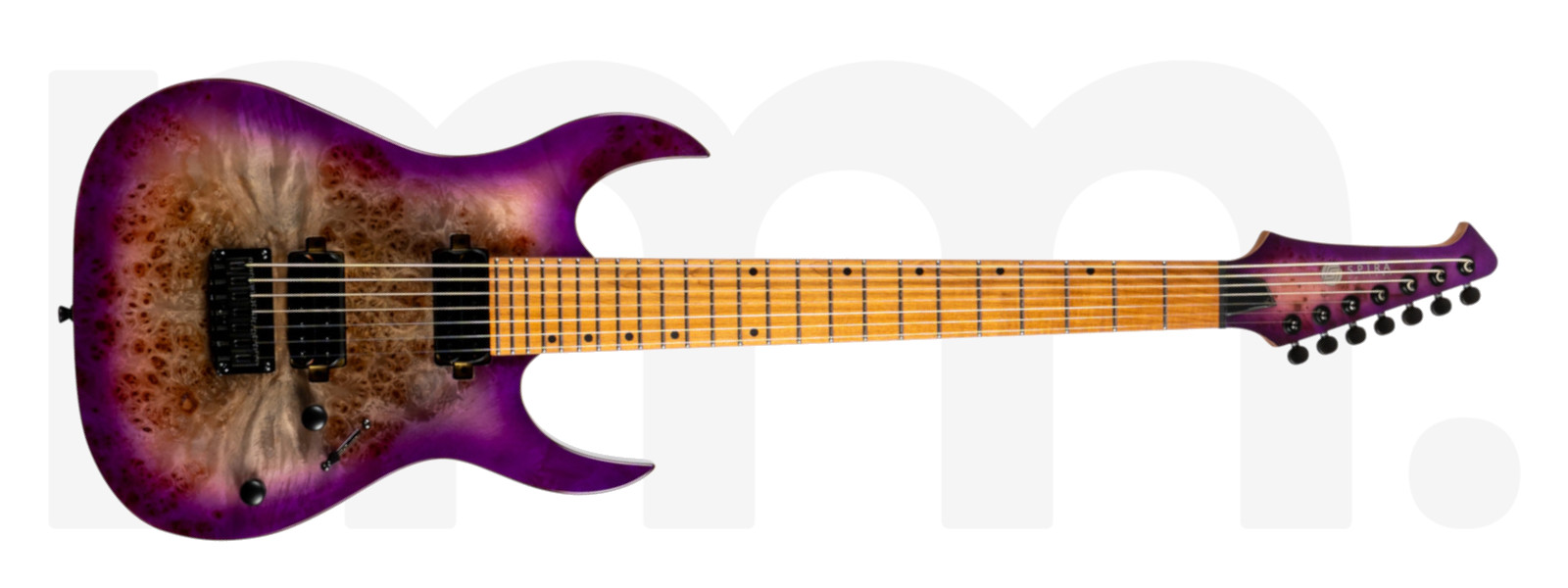
The Spira S-457 TPP has apparently filed an objection.
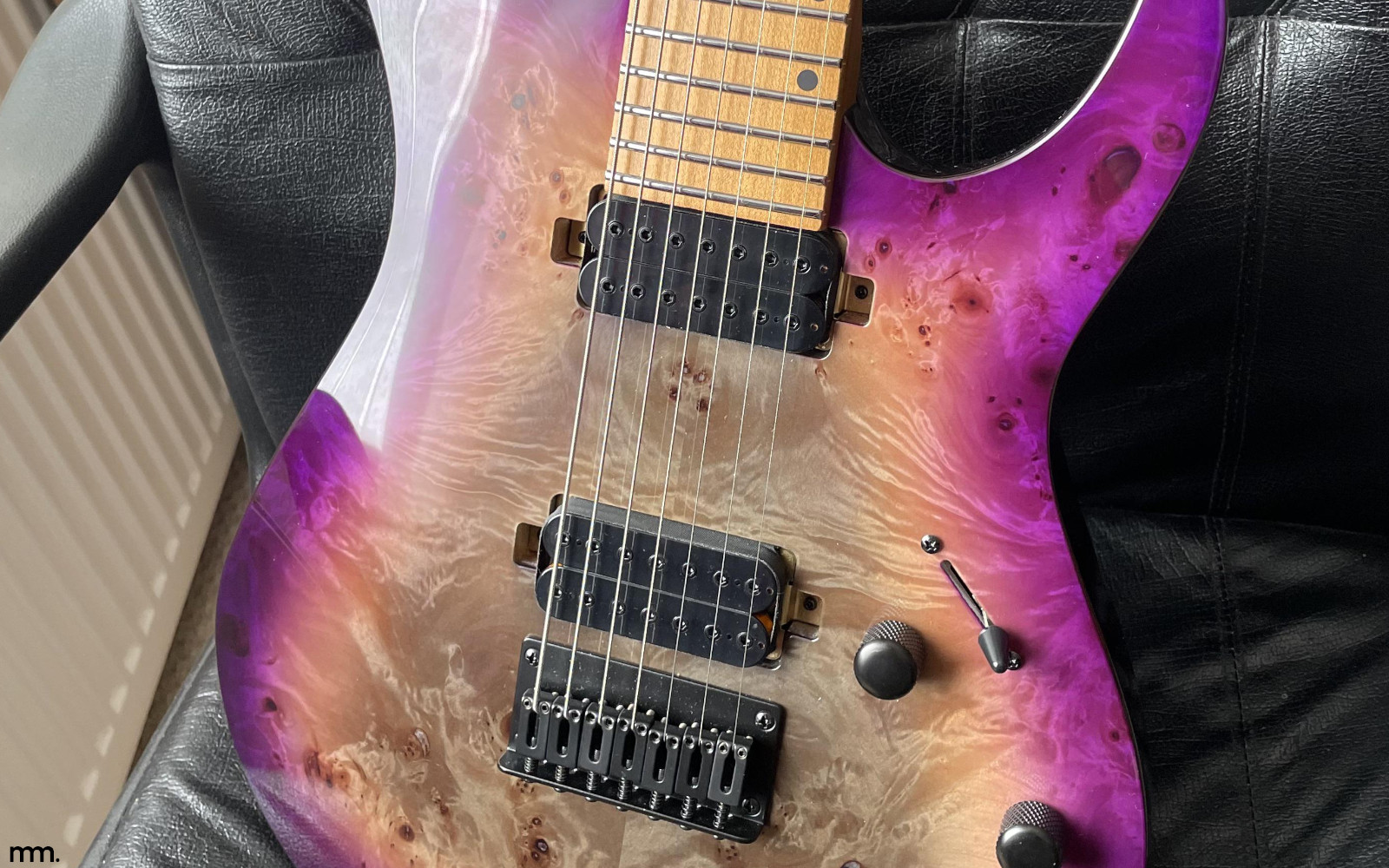
Transparent Purple sits over a flamed maple top and roasted-poplar body, paired with a Canadian roasted-maple neck and matching roasted-maple fingerboard. Under the fabulousness, however, the specification remains brutally functional: 26.5-inch scale, 14-inch radius, 24 jumbo frets, 48mm nut, fixed bridge, locking tuners and the same ceramic Villain seven-string humbuckers.
This is exactly the kind of guitar we enjoy. It looks spectacular without confusing spectacle for purpose.
The longer scale is doing real work. The flatter board is doing real work. The fixed bridge and locking tuners are doing real work. The high-output pickups are doing real work.
The purple is there because you have eyes.
Nobody said sonic annihilation had to dress like a mortician.
JET JS-507 Stygian: Something Darker
And then the JET JS-507 Stygian changes the recipe.
Instead of roasted poplar and roasted maple, JET uses a mahogany body and mahogany neck, with a rosewood fingerboard, 12-inch radius, 24 medium-jumbo frets and the same extended 26.5-inch scale. Locking machine heads and a fixed bridge keep the hardware firmly performance-focused.
But the particularly interesting part is the electronics.
JET specifies direct-mounted, hand-wound Alnico Stygian humbuckers rather than the ceramic pickups found in the JS-407.
Direct mounting fixes the pickups to the guitar rather than suspending them conventionally in pickup rings or a scratchplate, while the Alnico design gives the Stygian a distinct electronics package from its more affordable sibling.
It is still unmistakably a modern seven-string machine.
It simply arrives by a different road.
Mahogany. Alnico. Satin Black.
A name taken from somewhere you probably shouldn't visit without torches.
Excellent.
Seven Strings Does Not Seven-String Music Mean
This is perhaps the most important point in the entire article.
Buying a seven-string does not oblige you to join a djent band.
There is no form. Nobody checks.
The additional range can be useful anywhere a guitarist wants more harmonic or textural territory.
Jazz players have used seven-string guitars for decades, albeit often in different configurations and traditions from the modern metal instrument. Progressive players can exploit wider chord voicings. Ambient guitarists can create enormous low drones beneath delays and reverbs. Session players can use the extended range to occupy registers that would otherwise require overdubbing or retuning.
And clean seven-string guitar is criminally underused. A low B ringing beneath upper-register harmonics through a huge reverb is not a chug.
It is weather. The instrument only becomes stereotypical when the player treats the seventh string as a button marked METAL.
Although, to be fair, it is an extremely good button.
How Do You Actually Play One?
The first encounter can be disorientating. You look down and every familiar visual landmark appears to have moved.
It hasn't. Your high E is still there. So are B, G, D, A and E.
The low B is the newcomer.
One of the easiest ways to adapt is therefore to stop thinking of the instrument as an entirely new tuning and start thinking of it as a six-string with additional territory below it.
Practise material you already know without using the seventh string.
Get accustomed to the wider neck.
Then begin extending familiar scale patterns downwards.
Take riffs you know and investigate what happens when their lowest notes can continue another fourth below E. Build power chords from the seventh string. Use it as a pedal tone. Try skipping over it. Try deliberately not using it for several bars and then introduce one low note exactly where the arrangement needs to become enormous.
That last one is important. Having another string does not mean you must play it constantly.
A chef owns salt.
The meal is not therefore salt.
The Low-End War: Guitar, Bass and Kick Drum
Here is where seven-string players can make enemies.
A low B sounds magnificent by itself.
So does a bass guitar. So does a kick drum.
Then the band starts playing and all three attempt to occupy the same enormous piece of sonic property. Welcome to mixing.
The solution is not automatically more bass.
Heavy guitar tone frequently relies on far more midrange than players expect. Excessive low-frequency content can make high-gain guitar feel huge in isolation but indistinct inside a mix, particularly when palm-muted notes generate a great deal of energy that competes with bass and kick.
This is why extended-range guitar rewards tight gain staging and deliberate EQ.
Use enough distortion to create the saturation you need, but remember that every additional layer of gain can reduce articulation. Control excessive low end before it hits certain gain stages. Let the bass guitar own frequencies the guitar doesn't need. Allow the kick transient enough space to speak.
The objective is not to make every instrument enormous independently.
It is to make the band enormous together.
That is how the chug becomes architecture instead of soup.
Why Ceramic Humbuckers Keep Appearing Here
Notice how often ceramic humbuckers appear across the JET JS-407 and Spira seven-string models.
There is a reason this general recipe is popular in modern high-gain guitars.
Extended-range playing creates a difficult pickup brief. You want authority from the low string, but not so much loose bass that the amplifier turns palm mutes into fog. You want enough output to drive the signal chain confidently, but also enough definition for complex chords and rapid rhythmic work to remain intelligible.
Ceramic magnets can work beautifully in this context, particularly in pickups designed around their characteristics.
But the JET JS-507 Stygian's hand-wound Alnico set is a useful reminder that there is no single compulsory recipe.
Seven-string tone is still guitar tone.
There are choices.
Thank God.
Otherwise we'd have nothing to argue about on the internet.
What Can You Actually Do With a Seven-String?
You can play modern metal. Obviously.
You can play progressive metal, metalcore, djent, technical death metal and all the beautifully specific subgenres whose names occasionally sound like diagnoses.
But the genuinely exciting answer is simpler. You can write differently.
That seventh string creates opportunities for wide chords, pedal tones, low-register counterpoint, enormous interval jumps and riffs that move vertically across a much broader pitch range. It can change your habits. And sometimes that is exactly what a new instrument should do.
You pick up a familiar six-string and your hands know where they are going before your brain gets involved. The same riffs emerge. The same chord shapes. The same comfortable routes around the neck. Then somebody adds another string.
Suddenly the map has changed just enough to make you pay attention again.
There is a B down there.
What are you going to do with it?
Come Down to B at Musicmaker
The seven-string guitars currently at Musicmaker Dublin offer several routes into the abyss.
The JET JS-407 is the stripped-back black machine: 26.5-inch scale, roasted maple, ceramic HH pickups and almost nothing standing between your hands and the riff.
The Spira S-407 turns towards flatter-radius, locking-tuner, jumbo-fret modern-metal performance, with its Villain ceramic humbuckers doing exactly what that name suggests. Its left-handed counterpart means southpaw players get invited to the ritual too.
The Spira S-457 brings the same extended-range intent dressed in glorious Transparent Purple over flamed maple, because darkness does not have to mean monochrome.
And the JET JS-507 Stygian takes us into mahogany, locking hardware and hand-wound direct-mounted Alnico pickups while retaining the 26.5-inch extended scale.
Come in. Wrap your hand around a seven-string neck. Play your normal riffs first.
Then find the low B.
Hit it once. Wait. There.
That tiny involuntary grin.
That's how it starts.
From the Musicmaker Workshop
Since the early 1980s, Musicmaker has helped Irish musicians find instruments and equipment worth falling in love with. We have watched guitar music change, distort, accelerate, detune, reinvent itself and occasionally acquire additional strings.
We approve.
Because the seven-string guitar is not simply about being heavier. It is about having somewhere else to go.
Steve Vai saw additional range. Korn found rhythm and dissonance.
The extended-range metal generation discovered new ways of making guitars interact with time, tuning and sheer physical force.
And now instruments such as the JET JS-407, Spira S-407, Spira S-457 and JET JS-507 Stygian put that extended vocabulary into guitars that don't require boutique-level money to enter the conversation.
Six strings built an empire. The seventh dug underneath it.
Bring a torch.
Check out all our 7-String Guitars HERE.