






Build a Pedalboard Without Emptying Your Wallet
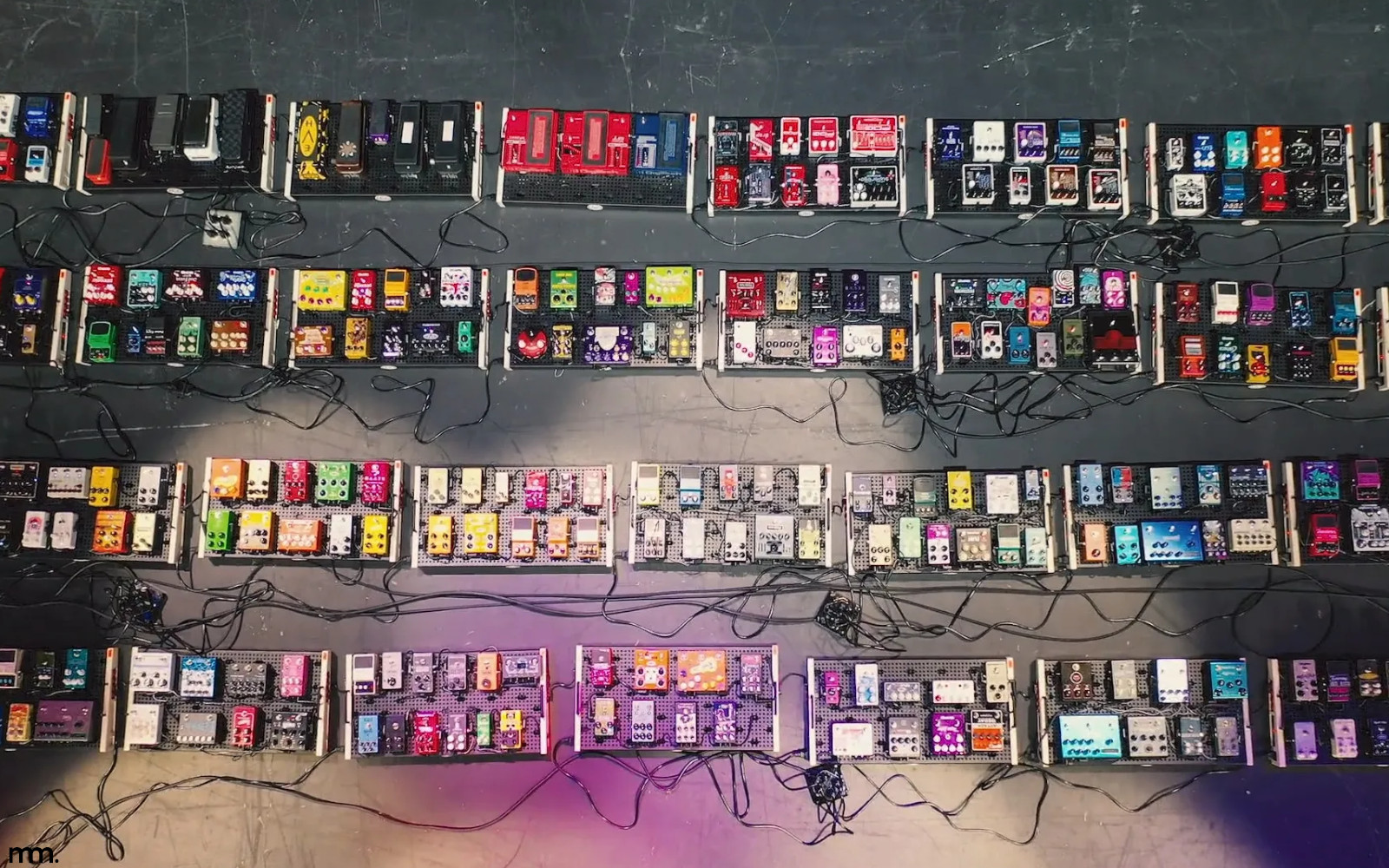
And then, it's only a matter of time......
There comes an inevitable moment in the life of an electric guitarist when plugging directly into the amplifier no longer seems sufficient.
Perhaps you've heard what a little delay can do to a lead line. Perhaps somebody has introduced you to fuzz. Perhaps you stepped on a compressor for the first time, couldn't immediately hear what it was doing, switched it off again and suddenly wanted it back. Or perhaps you've watched a guitarist crouching over seventeen pedals in Whelan's and thought, with the confidence of somebody about to make several financial decisions: I could get into that.
You absolutely can.
The good news is that building a genuinely useful guitar pedalboard does not require a second mortgage, an aerospace engineering qualification or a flight case containing €4,000 worth of boutique electronics named after obscure woodland creatures.
It requires effects that work well together.
That's the thinking behind our Musicmaker Donner pedal bundles. Rather than throwing a random selection of inexpensive guitar pedals into a box and declaring victory, we've grouped effects around sounds musicians actually want to make. One bundle is built around touch, overdrive and ambience for blues and rootsier guitar styles. Another heads directly towards indie, shoegaze, dream pop and the enormous fuzzy cloud beyond. Then we've assembled a practical Power & Patch bundle for the cables and electricity that keep a small pedalboard behaving itself.
They're compact. They're affordable. They're enormous fun.
Most importantly, each bundle teaches you something about how guitar effects interact.
Welcome to the rabbit hole.
It has LEDs.
The Secret Isn't More Pedals. It's the Right Pedals.
(But maybe also more pedals)
A good pedalboard is a signal chain, not a collection.
Every effect receives something from the pedal before it and passes something onwards to the next stage. That means pedal order, gain level and effect intensity all influence the final result. A compressor feeding an overdrive behaves differently from a compressor placed after it. Fuzz sent into delay produces distorted notes followed by repeats; delay driven into fuzz can distort the repeats themselves. Chorus before ambience can spread movement through the echoes and reverberation that follow.
This is where small pedalboards become genuinely interesting.
With three carefully chosen pedals, you aren't limited to three sounds. Each pedal can work alone, two can interact, all three can stack, and every knob introduces another variable. Before long you've gone from “I bought a delay” to sitting on the floor at half eleven discovering that 300 milliseconds of echo completely changes a riff you've been playing for six years.
This is normal. Your dinner may be cold.
Continue.
The mm Donner Blues Bundle: Three Pedals, One Signal Chain
Blues guitar is often discussed as though purity requires plugging a 1959 guitar into a 1962 amplifier using a cable hand-braided by monks.
Actual guitar history is considerably messier.
Blues, blues-rock, soul, country and roots guitar are full of players manipulating gain, sustain, dynamics and ambience to make the instrument respond differently beneath the fingers. The trick is often restraint. The effect should support the player's touch rather than bury it.
That's why our mm Donner Blues Bundle combines three effects that solve three different problems: compression, overdrive and delay.
More importantly, they make tremendous sense in that order.

Donner Lax Comp: The Pedal You Notice When It's Gone
Compression can be confusing because a good compressor isn't necessarily supposed to announce itself with trumpets.
It works on dynamic range.
Hit a guitar string hard and the initial transient can leap out considerably louder than the note that follows. As the string continues vibrating, its level naturally decays. Compression reduces the difference between those louder and quieter portions of the signal, and when output level is compensated accordingly, the practical result can be a guitar sound that feels more even and sustains more consistently.
That makes the Donner Lax Comp an excellent first stage for this kind of board.
Its Level, Comp and Tone controls give you the important variables without turning compression into a postgraduate degree. Used subtly, it can help clean chords sit more evenly, give picked lines additional consistency and let sustained notes remain present for longer.
Country players have understood this forever. Funk players understand it. Clean rhythm guitarists understand it.
Blues players occasionally pretend not to understand it and then quietly leave the compressor switched on for the entire gig.
The interesting part comes when compression feeds overdrive.
A more controlled signal enters the drive pedal, which can create smoother sustain and a more consistent response. Turn the compression too far and you can flatten the dynamics that make blues expressive, so the objective isn't to squash everything into submission. Start gently.
You should still be able to play softly. You should still be able to dig in.
We're helping your fingers.
We're not replacing them.
Donner Blues Drive: Now Make the Amp Slightly Unhappy
This is where the trouble begins. The good kind. Overdrive grew from one of electric guitar's happiest accidents: guitarists discovering that an amplifier pushed beyond its clean operating range could sound considerably more exciting than the manufacturers intended.
Instead of attempting the more extreme clipping associated with distortion or fuzz, an overdrive pedal generally aims towards the character and response of an amplifier beginning to break up. You retain recognisable guitar attack and dynamics, but harmonics accumulate around the note, sustain increases and everything becomes a little more impolite.
The Donner Blues Drive gives you straightforward Level, Tone and Gain controls alongside its Warm and Hot modes.
That makes it useful in two broad ways.
Keep the gain down and use the pedal as a push into an amplifier that is already close to breakup. The guitar retains clarity, but chords acquire hair around the edges and harder picking can produce more aggression. Increase the gain and the pedal contributes more of the drive itself, moving towards thicker rhythm sounds and sustaining lead tones.
The Warm/Hot choice extends that range again, letting the pedal move from gentler breakup towards a more assertive voice.
And now remember what's sitting immediately before it.
The compressor. Sustain meets saturation.
Welcome to Tuesday night.
Donner Yellow Fall: Give the Notes Somewhere to Go
Dry overdrive can be glorious. It can also feel remarkably exposed.
The Donner Yellow Fall Delay adds the third ingredient: time.
A delay records a moment of your signal and reproduces it after a chosen interval. At short settings this can create slapback and thickening effects; increase the delay time and the repeat becomes clearly separate from the original note. Feedback determines how much of that delayed signal is fed back through the delay circuit, creating additional repeats.
The Yellow Fall keeps this delightfully approachable with Time, Echo and Feedback controls and an analogue-style voice.
For blues, you often don't need very much.
A short delay tucked behind an overdriven lead can create depth without screaming HELLO, I HAVE PURCHASED A DELAY PEDAL. A little slapback works beautifully for roots, rock 'n' roll and country-influenced playing. Longer repeats can make slow blues lines feel wider and more atmospheric.
Then, naturally, somebody turns the Feedback knob further.
The evening changes.
Why the Blues Bundle Works
Put the three together and you have a remarkably complete little guitar signal chain: guitar → compression → overdrive → delay → amplifier.
The compressor shapes the dynamics. The Blues Drive shapes the gain and harmonic character. The Yellow Fall shapes time and space.
And because each stage does something fundamentally different, the pedals don't feel redundant.
Need a clean rhythm sound? Compressor. Need a gritty rhythm? Blues Drive. Need an open, spacious clean? Compressor and delay.
Need the solo to arrive wearing a slightly better jacket? All three.
This is precisely why we like small, intelligently assembled pedalboards. You learn what the individual effects do because there aren't fifteen other boxes confusing the issue, but you also begin learning the much more interesting lesson:
effects change when they meet each other.
And this little trio has excellent chemistry.
The mm Donner Indie / Shoegaze Bundle: Things Get Hazy
We now leave the responsible end of the building. Our mm Donner Indie / Shoegaze Bundle begins with a different philosophical position.
What if the effects aren't there to support the guitar sound? What if the effects are the guitar sound?
Shoegaze, dream pop, ambient guitar, post-rock and various branches of indie music have spent decades exploring exactly that question. Distortion becomes texture. Modulation destabilises pitch and movement. Delay multiplies the performance through time. Reverb smears those sounds into an artificial acoustic environment.
A perfectly ordinary guitar chord can enter one end of the signal chain. A small weather system emerges from the other.
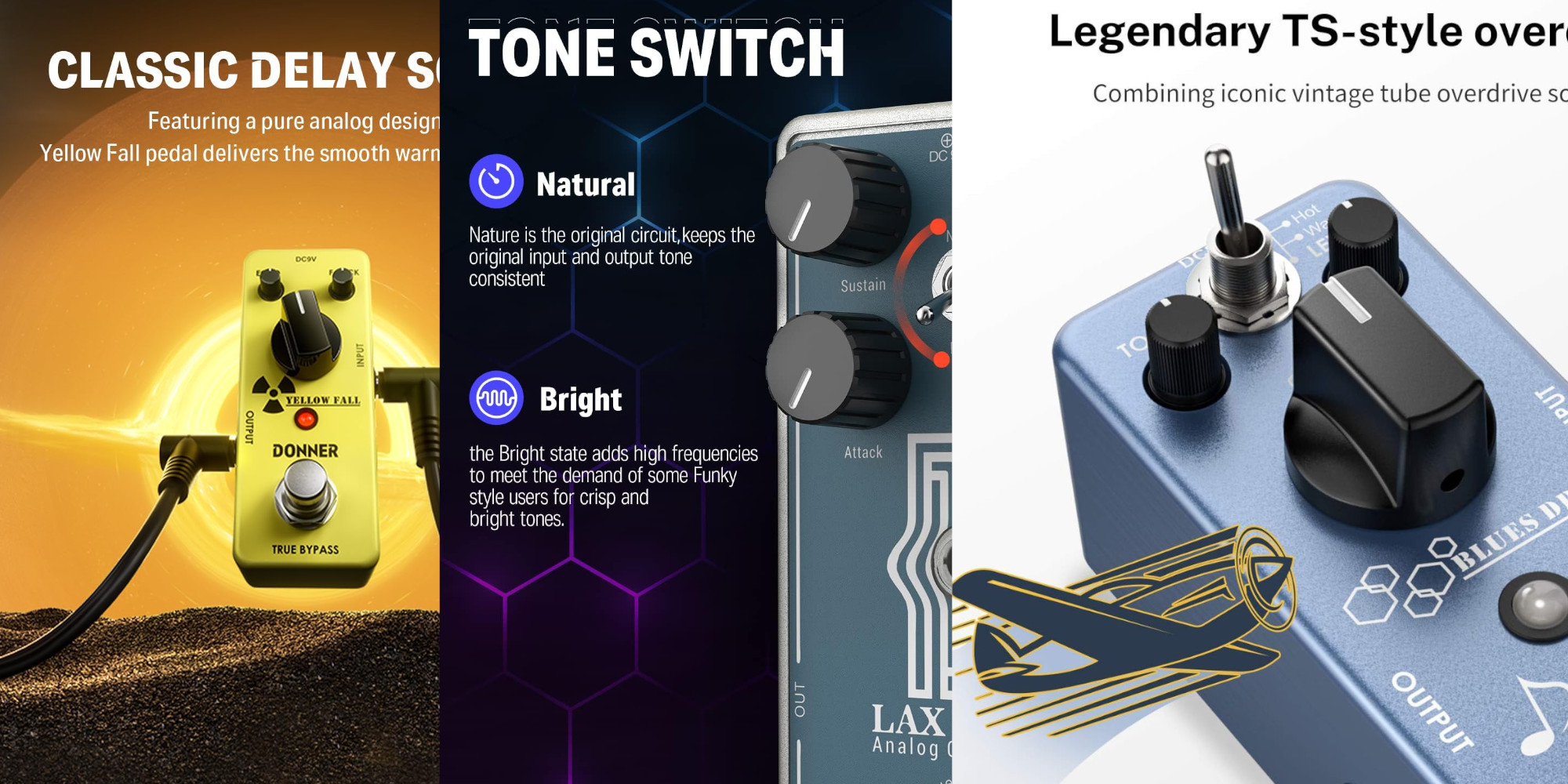
For this particular experiment we've brought together the Donner Stylish Fuzz, Tutti Love Chorus and Yellow Fall II Delay & Reverb.
Three pedals. Four effects.
Several opportunities to become completely unreasonable.

Stylish Fuzz: Stop Being Polite
Overdrive and fuzz are relatives, but they do not attend the same family gatherings.
Where overdrive often tries to preserve some relationship with the sound of an amplifier naturally breaking up, fuzz embraces extreme clipping. The waveform is altered far more dramatically, generating a dense collection of harmonics and the gloriously artificial, saturated character heard across psychedelia, garage rock, alternative music, stoner rock and shoegaze.
The Donner Stylish Fuzz is therefore not here to improve your clean tone.
It is here to vandalise it attractively.
Single notes can become thick and sustaining. Power chords acquire enormous harmonic density. Open chords can turn into glorious slabs of information, particularly when those harmonics are subsequently fed into modulation and ambience.
That last part is where this bundle becomes interesting. Fuzz by itself is dirt. Good dirt though.
Fuzz with somewhere to go becomes landscape.
Tutti Love Chorus: Make the Guitar Wobble Beautifully
Chorus is one of those effects whose name makes considerably more sense once you understand what the circuit is doing.
Broadly speaking, a chorus effect creates a slightly delayed, modulated version of the original signal and combines it with the dry sound. Because that duplicate is being subtly shifted in time and pitch, the result can resemble multiple instruments performing together with tiny differences between them.
The sound becomes wider. It moves. It shimmers.
Push the effect and it can become gloriously seasick.
The Donner Tutti Love Chorus gives this bundle its movement. Used gently with a clean guitar, it can add width to arpeggios and chords without overwhelming them. Add fuzz and the interaction becomes more dramatic because the chorus now has all those additional harmonics to move around.
This is where the phrase “I'll just try one more setting” becomes potentially very time consuming.
Yellow Fall II: Constructing the Horizon
Then we reach delay and reverb. These effects are related to space, but they create it differently.
Delay gives you discrete repetitions. Hit a note and another version arrives afterwards.
Reverb is the dense pattern of reflections we naturally associate with sound occurring inside a physical environment. A small room has one reverberant character. A cathedral has another. Digital reverb allows guitarists to create spaces that don't necessarily need to exist anywhere outside the pedal.
Combining the two gives you enormous control over perceived depth.
The Donner Yellow Fall II Delay & Reverb is therefore doing double duty at the end of our little atmospheric chain. A touch of delay and reverb can make clean chorus tones bloom beautifully; increase the settings and the boundaries between original note, repeat and reverberant tail begin to dissolve.
This is where one chord can indeed occupy several postcodes.
And because you've already fed fuzz and chorus into the pedal, there is plenty for those time-based effects to work with.
Why Shoegaze Players Stack Effects
Shoegaze guitar is sometimes reduced to “lots of pedals on at once”, which is a bit like describing cooking as “several foods in a saucepan”.
The interesting part is interaction.
Fuzz creates harmonic density. Chorus creates modulation. Delay creates repetition. Reverb creates space.
Stack them and each stage transforms material created by the previous one. The resulting sound can be vastly more complex than any individual pedal.
But here's the useful bit: you don't have to use everything simultaneously. Tutti Love plus Yellow Fall II can make a gorgeous dream-pop clean sound.
Stylish Fuzz plus delay gives you an enormous lead voice.
Chorus and fuzz can produce wonderfully unstable alternative textures.
Reverb alone can make a simple clean part sit differently in an arrangement.
Then, when you've spent an hour being tasteful and responsible, turn everything on.
Pedal Order: Rules, Suggestions and Excellent Mistakes
The classic starting point for the Indie / Shoegaze Bundle would be something like:
guitar → fuzz → chorus → delay/reverb → amplifier.
This gives you dirt first, modulation afterwards and ambience towards the end.
But shoegaze has a distinguished history of looking at conventional effect order and asking:
What happens if we do something stupid? This is a valuable question.
Effect order is not law. It is part of sound design. Reverb before heavy distortion, for example, can create an enormous smeared texture because the distorted stage processes the reverberant tail along with the original note. Modulation in different positions can similarly change which part of the signal gets moved around.
Experiment. The worst likely outcome is an unpleasant noise.
You play electric guitar.
You have survived these before.

The Power & Patch Bundle: Glamour Has Left the Building
Right. Electricity. Cables. Stay with us.
There comes a point in every pedalboard's development when the pedals themselves are no longer the problem. The problem is that the board now resembles a plate of electronic spaghetti and somebody has discovered that three pedals cannot occupy the same power connector through positive thinking.
Our mm Power & Patch Pedal Promo Bundle exists for precisely this moment.
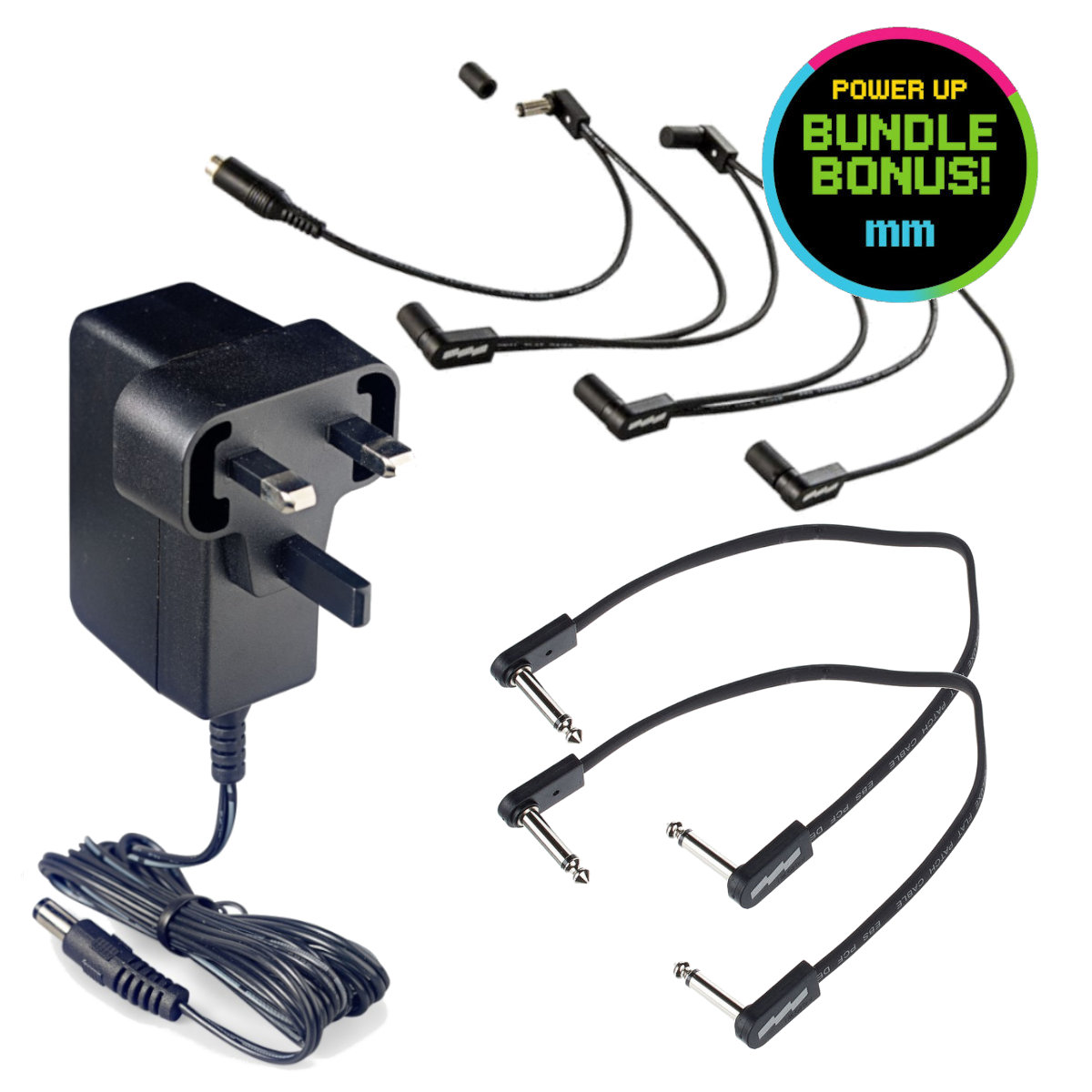
You get two EBS PCF-DL28 Deluxe Flat Patch Cables, an EBS DC-6-90F one-to-six DC daisy chain, and a Stagg PSU-9V1AR 9V/1A power adaptor.
None of these things makes fuzz. None creates glorious echo.
Nobody has ever stared lovingly into the middle distance while describing their transcendent relationship with a 28-centimetre patch cable.
But without this stuff, your pedalboard is furniture.
Flat Patch Cables Are Cleverer Than They Look
Pedalboard space disappears extraordinarily quickly.
Traditional jack plugs protrude from the sides of pedals, meaning two boxes that look tiny on the kitchen table can suddenly require considerably more room once they're connected.
The EBS PCF-DL28 attacks that problem with an extremely compact, angled flat connector.
EBS specifies copper conductors, double shielding, low resistance and 24K gold-plated contact tips, but the immediately obvious advantage is physical: the connector is designed to occupy less precious pedalboard real estate. The DL28 version gives you 28 centimetres of cable, useful when neighbouring pedals need a little more breathing room.
This sounds mundane until you're trying to fit one final pedal onto a board and discover the plugs have collectively annexed County Wicklow.
Then you understand.
One Adaptor, Several Pedals
The EBS DC-6-90F takes one compatible DC power source and splits it across six outputs, using low-profile angled contacts designed to save space around the pedal power sockets.
Pair that with the Stagg PSU-9V1AR, which Stagg specifies as a 9V, 1A reverse-polarity adaptor for effects pedals, and you have a straightforward way to supply several compatible 9V pedals from one mains adaptor.
For a compact board of conventional pedals, that's wonderfully convenient.
There is, however, a small piece of guitar-nerd homework worth doing before plugging everything in.
Voltage, Polarity and Current: Three Things Worth Checking
Pedals require electricity in particular ways, and electricity has very little respect for enthusiasm.
Before connecting a pedal to any power supply, check voltage, polarity and current requirement.
Voltage needs to match what the pedal expects. Polarity needs to be correct. Then look at current consumption, measured in milliamps, and make sure the combined requirements of pedals sharing the supply do not exceed what the adaptor can provide.
Also remember that a daisy chain is shared power, not isolated power.
That's perfectly useful for many straightforward pedalboards, but some combinations of analogue and digital effects can introduce unwanted noise when sharing a supply. If your collection eventually expands into a sprawling board full of high-current digital pedals, an isolated multi-output power supply may become the better solution.
That's not a failure of the starter setup. That's simply the moment you've become a pedal person.
Our condolences.
There is no known cure.
Start Small. Make a Racket.
A pedalboard does not need twelve effects to become creatively useful.
Three good choices can transform your relationship with an electric guitar because they introduce variables that simply weren't there before. Your attack can change the compressor. Your guitar volume can interact with the overdrive. The delay can become part of the rhythm. Chorus can turn a static chord into something moving. Fuzz can turn that same chord into a public-order concern. And once you begin combining those things, the guitar starts suggesting ideas back to you.
That's the real attraction. Pedals aren't merely decorations applied to a finished guitar part. Sometimes the sound creates the part.
You switch on a delay and play fewer notes because the repeats are filling the gaps.
You add compression and discover that a clean picked line suddenly feels effortless.
You step on fuzz and abandon whatever sophisticated chord progression you were working on because apparently we're playing one enormous note for sixteen bars now.
Correct decision.
Come Down the Rabbit Hole at Musicmaker
At Musicmaker Dublin, we've been putting guitarists in front of dangerous little boxes for decades, and we remain convinced that effects are one of the cheapest and most entertaining ways to make an electric guitar feel new again.
That's why we've curated these bundles ourselves.
The mm Donner Blues Bundle is your compact route into compression, overdrive and delay.
The mm Donner Indie / Shoegaze Bundle gives you fuzz, chorus, delay and reverb for everything from shimmering clean guitar to the complete atmospheric destruction of the room.
And the mm Power & Patch Pedal Promo Bundle takes care of the practical business of connecting and powering a compatible compact board.
Start with one sound. Learn what the controls do. Stack another effect.
Move something. Turn something too far. Make a horrible noise.
Back it off slightly. Make an excellent noise.
Write a riff.
Congratulations.
You have a pedalboard.
Your troubles have only begun.
From the Musicmaker Workshop
Since the early 1980s, Musicmaker has helped Irish musicians find instruments and equipment worth falling in love with. Every guitar, drum, piano, microphone, pedal and piece of studio gear we stock is carefully chosen by people who genuinely play, perform, teach and obsess over music.
And sometimes that means obsessing over very small boxes.
We put these Musicmaker Donner pedal bundles together because getting into guitar effects should not require a frightening budget. It should require curiosity, a guitar, an amplifier and the willingness to discover what happens when you press the little metal switch.
The practicalities are vital.
Then plug the whole thing in and make some noise.
Preferably before somebody starts another internet argument about transparent overdrive.