





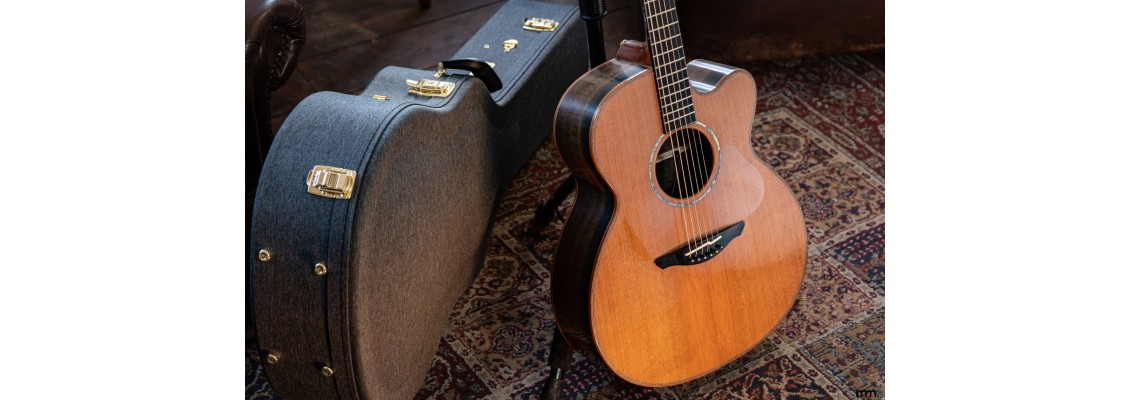
Handcrafted in Northern Ireland: Avalon L590c
Four Thousand Years in the Making
Some guitars begin with a drawing, a specification, a body shape or a particular combination of tonewoods chosen to produce a certain kind of voice. The Avalon Guitars Luthier Series L590c Bog Oak/Cedar Cutaway begins somewhere much further back, long before the workshop, the luthier or the modern acoustic guitar itself existed.
Its story begins beneath the Irish landscape.
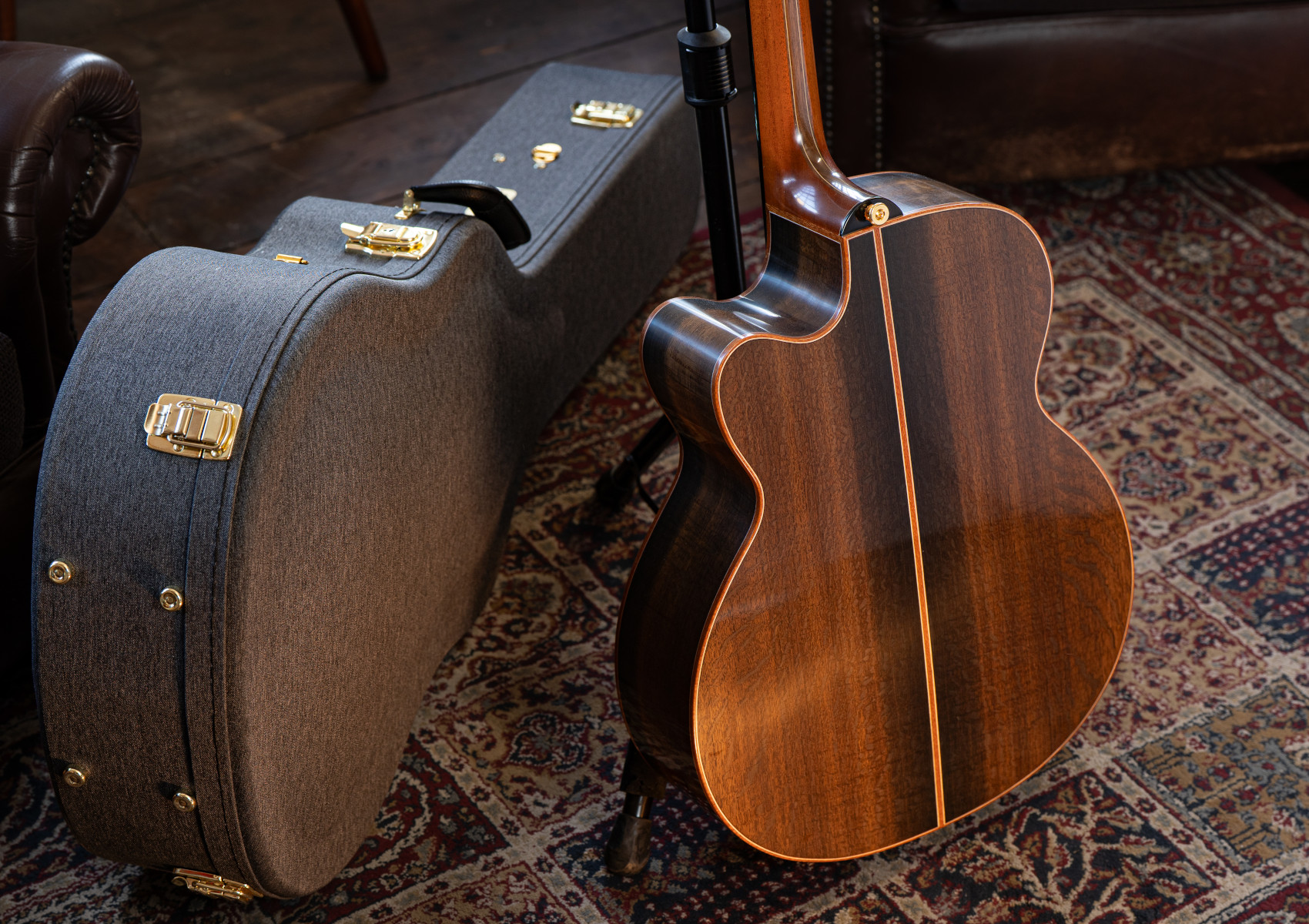
The Bog Oak used for the back and sides of this extraordinary handcrafted acoustic guitar spent more than four thousand years preserved beneath the earth, enclosed within the peculiar environment of the peat bog and slowly transformed by water, minerals, pressure and an almost incomprehensible passage of time. The result is a material that carries its history visibly, with deep, dark colouring and grain that seems entirely appropriate for wood that has already lived through several human ages before arriving on a luthier’s bench.
Four thousand years is an easy phrase to write and a difficult length of time to properly comprehend. This is timber whose story began before the great instruments we now regard as historic had even been conceived, before the steel-string acoustic guitar existed and before much of the modern world had taken recognisable shape.
Now, in Northern Ireland, somebody has made this guitar from it.
Not simply as an exercise in rarity or provenance, but in service of music.
Wood With a Memory
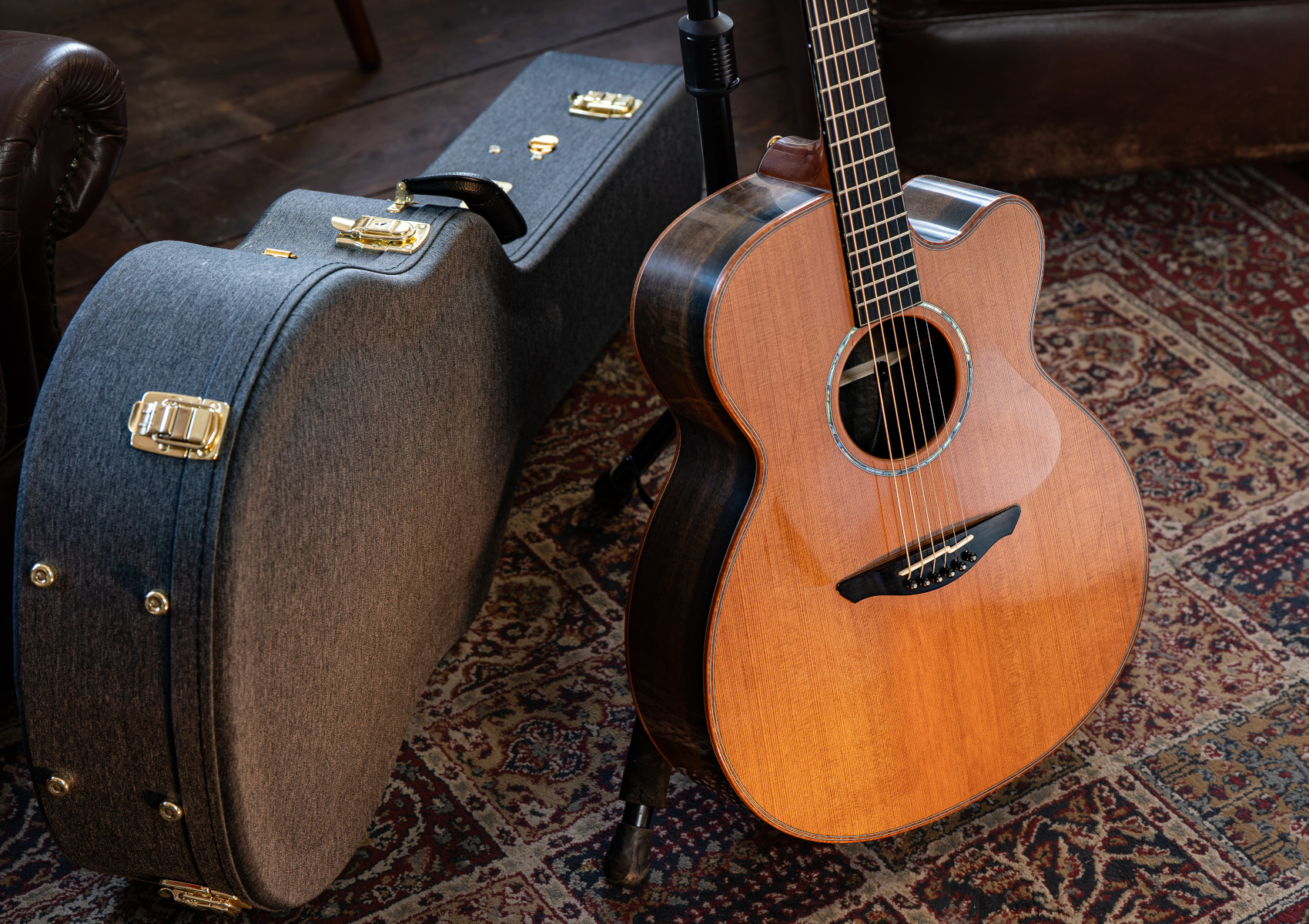
Bog Oak possesses a visual character unlike almost anything else used in contemporary acoustic guitar making. Its darkened colour and expressive grain do not feel decorative or artificially dramatic; they are the physical evidence of what has happened to the material during its long preservation beneath the earth.
That gives the Avalon L590c an extraordinary presence before a note has even been played. Look closely and the back and sides reveal movement, subtle changes in colour and grain that refuses to conform to the predictable uniformity of industrial materials. No two sets of Bog Oak can be precisely identical, and a guitar built from timber like this carries an individuality that begins before the first brace is shaped.
That philosophy sits naturally within Avalon’s Luthier Series, where rare and unusual timbers are given room to determine the character of the finished instrument. Rather than treating the wood as an exotic cosmetic upgrade, Avalon allows the material to become part of the structural and tonal identity of the guitar.
A timber this unusual deserves more than decoration. It needs a builder prepared to listen to what the individual pieces want to become.
And that is where the story moves from the bog to the workshop.
The Avalon Luthier Series
Within the Avalon catalogue, the Luthier Series occupies particularly fascinating territory. These are instruments in which rare tonewoods, individual voicing and the accumulated experience of the maker are allowed to take precedence over the need for endless repeatability.
The Avalon L590c Bog Oak/Cedar could hardly demonstrate that philosophy more convincingly. Its ancient Bog Oak back and sides are paired with a solid Cedar soundboard, creating a combination that is compelling not merely because of the age or provenance of the materials, but because of the musical relationship between them.
Bog Oak contributes focus, definition and a beautifully composed character to the body of the instrument. Cedar approaches the other half of the equation differently, bringing warmth, harmonic richness and an almost effortless responsiveness beneath the fingers.
Together, they create something far more interesting than either material could provide simply as an item on a specification sheet.
Cedar: The Other Half of the Voice
Spruce tends to dominate conversations about steel-string acoustic guitar soundboards, and for good reason. Its combination of stiffness, projection and headroom has made it one of the defining materials of modern acoustic guitar construction. Cedar, however, approaches the job from another direction.
A good Cedar-top acoustic guitar can feel extraordinarily immediate beneath the fingers. It does not necessarily demand a forceful right hand before the soundboard begins giving something meaningful back, and that sensitivity makes Cedar particularly rewarding for players who explore dynamics, fingerstyle technique and the quieter spaces between notes.
On the L590c, the Cedar brings warmth and richness to the initial attack while allowing subtle changes in touch to remain audible. Light fingerstyle playing can produce an almost intimate response, with notes blooming quickly and harmonics developing around them without requiring the player to force the instrument into life.
Yet this is not simply a soft-spoken acoustic guitar. The large Avalon L body gives the sound room to expand, and when the right hand becomes more assertive there is genuine authority available. The Bog Oak helps retain structure as the sound grows, keeping the low end focused, the midrange articulate and the upper frequencies clear rather than brittle.
There is warmth throughout the voice, but there is also architecture beneath it. That balance is what makes the pairing so compelling.
What Does Ancient Bog Oak Sound Like?
Tonewood discussions have a habit of becoming overly simplistic. It is tempting to assign every species a fixed set of sonic adjectives and behave as though the resulting guitar can be predicted from the timber list alone.
Real acoustic guitars are considerably more complicated, and considerably more interesting.
The species and physical properties of the timber matter, but so do the density and stiffness of the individual pieces, their thickness, the bracing, body dimensions, bridge, finish, neck construction and the thousands of small decisions made while the instrument is being voiced. On a handcrafted acoustic guitar such as the Avalon L590c, the luthier’s ability to understand those relationships is every bit as important as the name of the wood itself.
So perhaps the more useful question is not simply what does Bog Oak sound like? It is what has Avalon managed to draw from this particular Bog Oak?
In the L590c, the answer is a voice of remarkable composure. Individual notes carry strong definition, while the bass has depth without spreading uncontrollably across the rest of the frequency range. There is a dry articulation through the middle that helps complex voicings remain intelligible, while the Cedar soundboard surrounds those fundamentals with warmth, colour and immediacy.
Fingerpicked chords can therefore retain their internal structure rather than collapsing into one broad wash of harmonics. Open strings continue to resonate beneath moving lines, and alternate tunings have the space to develop their characteristic overtones without sacrificing definition.
Perhaps most beautifully, the sound does not disappear the moment the fingers leave the strings. There is a natural decay that allows the final moments of a phrase to become part of the performance rather than simply the silence before the next one.
An Acoustic Guitar Built Around Touch
This is perhaps where the Avalon L590c Bog Oak/Cedar begins to reveal its real character. It is an instrument that rewards touch, and the more attention the player gives to the right hand, the more the guitar appears willing to give back.
Move the picking hand towards the bridge and the sound becomes tighter and more immediate. Move towards the neck and the attack softens, allowing more warmth to develop around the note. Change the angle of a fingernail, move from nail to flesh, introduce a pick or simply vary the force behind the string and the L590c responds with meaningful changes in colour.
For fingerstyle guitarists, singer-songwriters, composers and recording musicians, that responsiveness can become enormously addictive. The instrument does not merely reproduce the notes being played; it makes the tiny decisions taking place between those notes more audible.
That is one of the defining differences between a merely impressive acoustic guitar and a truly expressive one. Eventually, you stop thinking about how the guitar responds because that response has become part of your technique.
The Cutaway Matters
Then there is the small but important “c” in L590c.
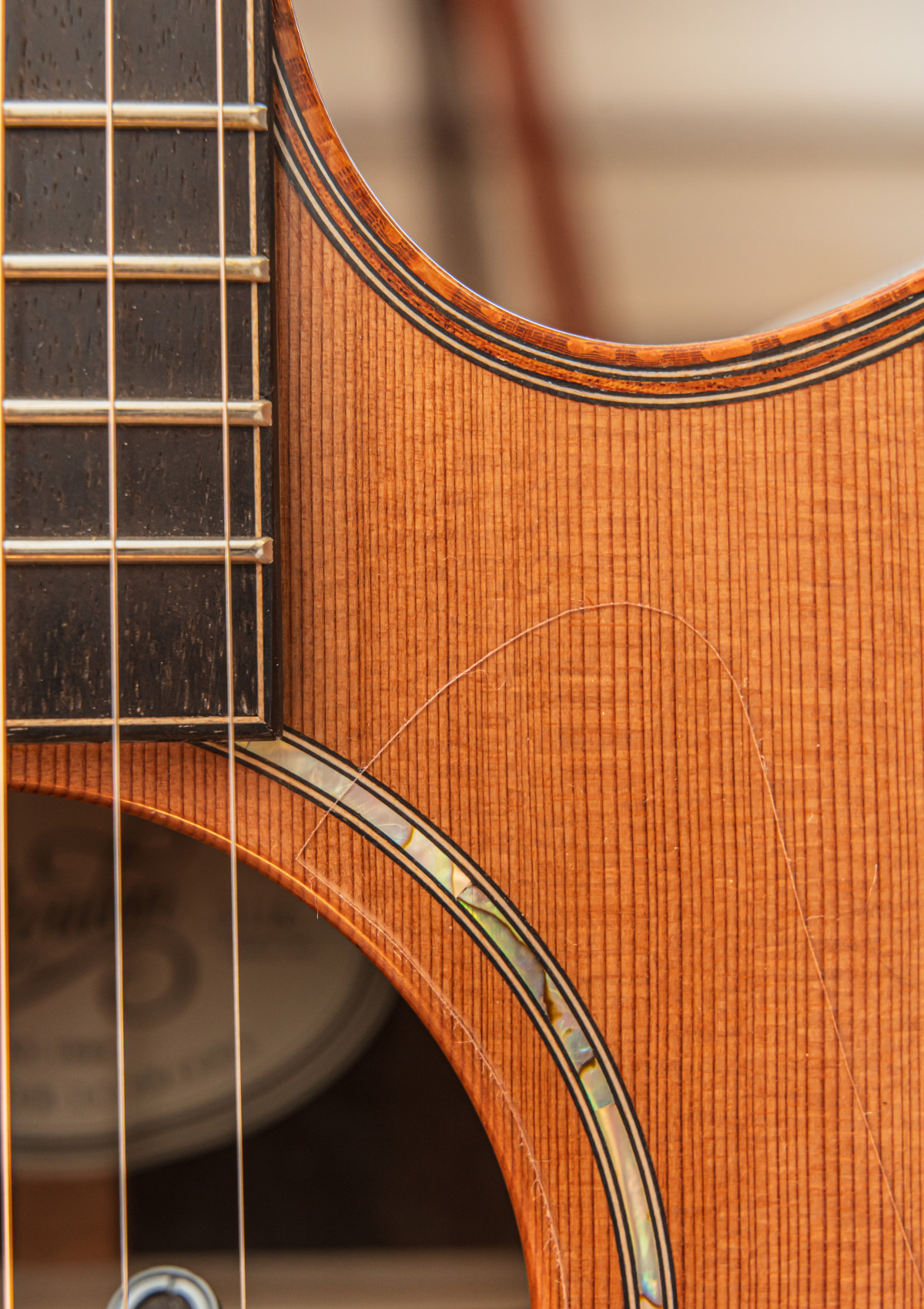
The cutaway is not merely a stylistic flourish. It provides easier physical access to the upper reaches of the ebony fingerboard, making this large-bodied Avalon particularly inviting for contemporary fingerstyle arrangements, melodic playing and extended chord voicings that make use of the entire neck.
It also changes the visual balance of the instrument beautifully. Against the dark Bog Oak, ebony detailing and warm Cedar soundboard, the cutaway gives the L590c a graceful asymmetry that prevents such a substantial guitar from ever appearing cumbersome.
It has size and authority, but it carries both with remarkable elegance.
From Earth to Workbench
This is where the L590c becomes particularly meaningful.
Avalon continues to build its handcrafted instruments in Newtownards, Northern Ireland, where individual luthiers shape, assemble and voice guitars with an approach that places listening and judgement at the centre of the process. On any handmade acoustic guitar, that relationship between material and maker matters. With ancient Bog Oak, it feels fundamental.
You cannot order another four thousand years.
You cannot accelerate the process that created this material, nor can you expect two ancient pieces of timber to emerge from the earth with precisely identical grain, density and physical properties. The task for the luthier is therefore not simply to force unusual wood into a predetermined formula, but to understand what is actually sitting on the bench.
The timber is assessed, worked, flexed and listened to. Material is removed carefully and the response is considered again. The soundboard, bracing and body are not independent components being assembled to a recipe; they are parts of one resonant system that must eventually behave as a whole.
That relationship between material and maker is one of the great attractions of handcrafted acoustic guitars, and it feels especially appropriate here. The wood has already waited millennia. There is little sense in rushing the final part.
Ebony, Mahogany, Bone and Beautiful Restraint
With a material as visually dramatic as Bog Oak, it would have been remarkably easy to over-design the L590c. Avalon has wisely resisted the temptation.
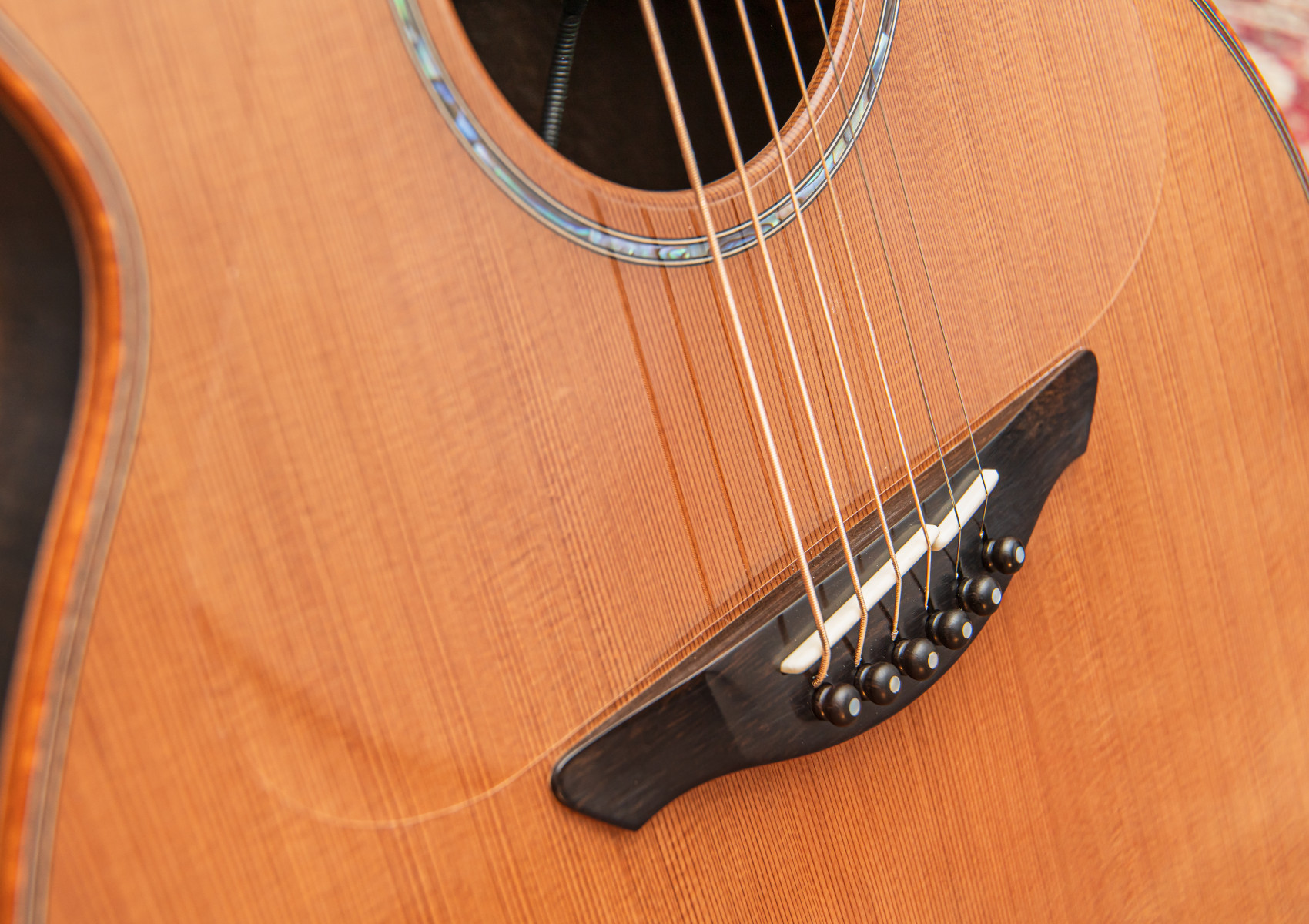
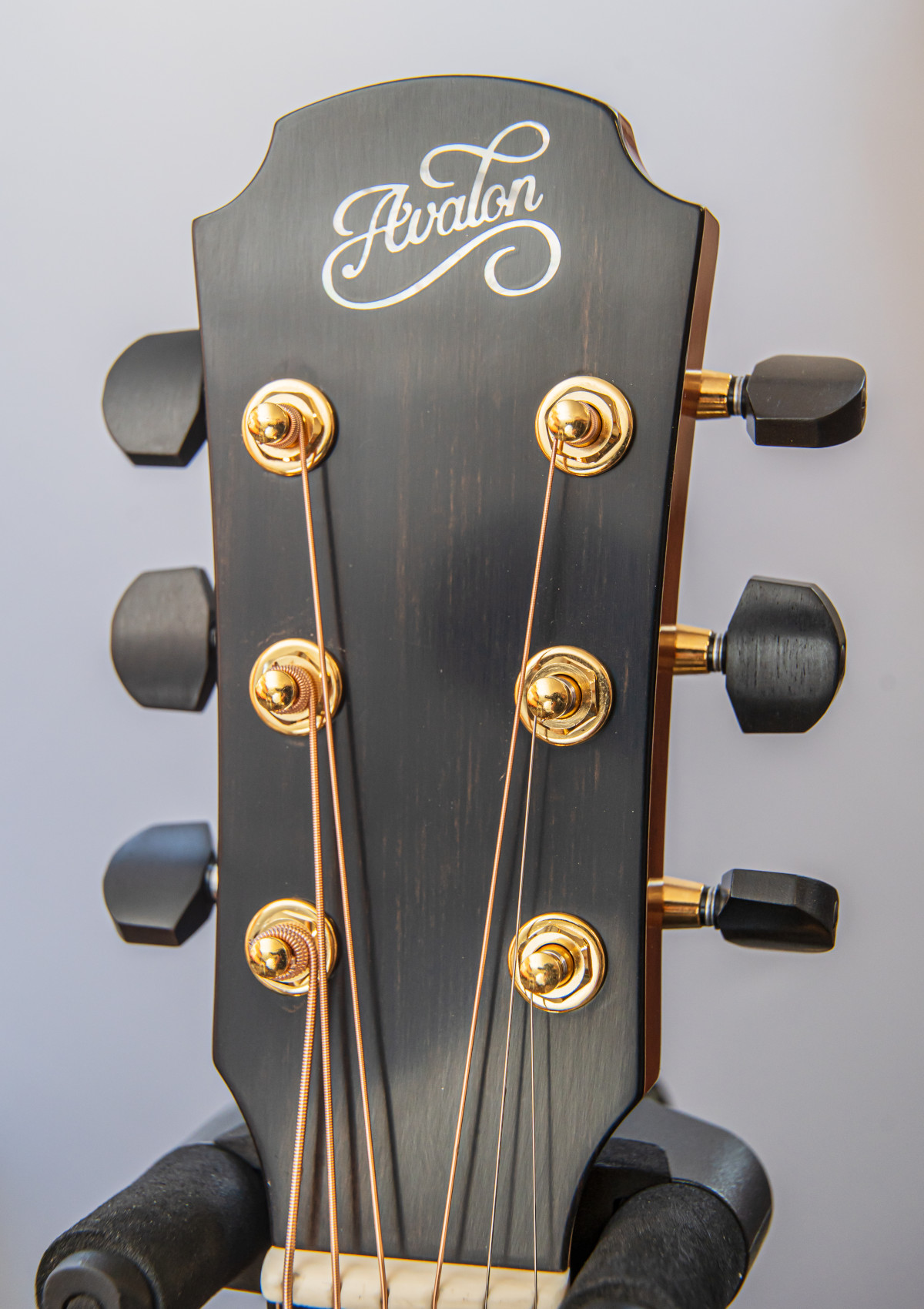
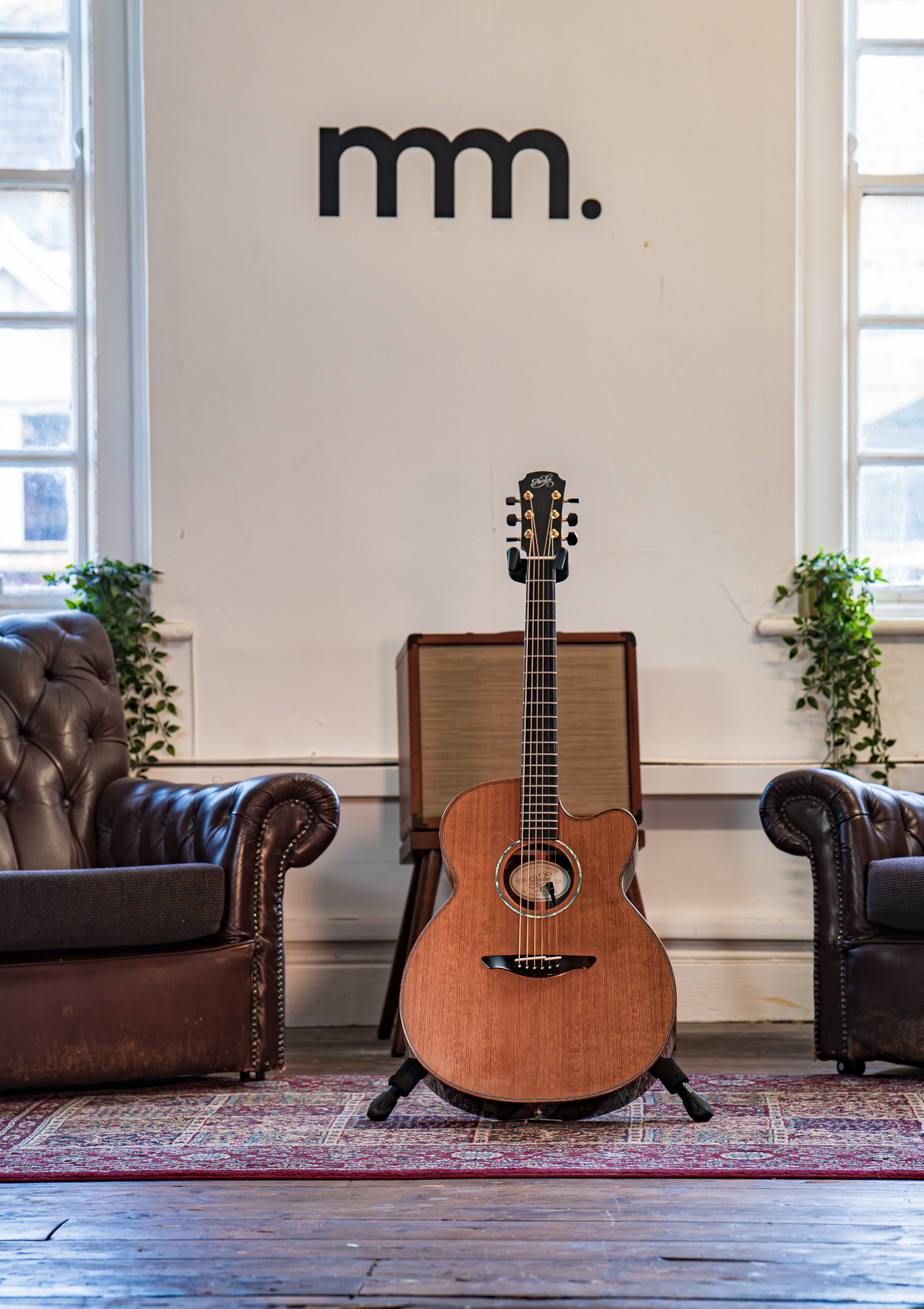
Instead, the detailing frames the natural materials rather than competing with them. Ebony bindings create a dark, elegant border around the body, while ebony continues through the fingerboard, bridge and headplate, giving the instrument a visual continuity that feels considered without becoming ostentatious.
Around the soundhole sits a solid Paua Abalone rosette, introducing colour and movement as the light changes across the top. The Mother of Pearl Avalon logo performs a similar role at the headstock, providing just enough visual luxury to remind you of the instrument’s stature without overwhelming the timber beneath it.
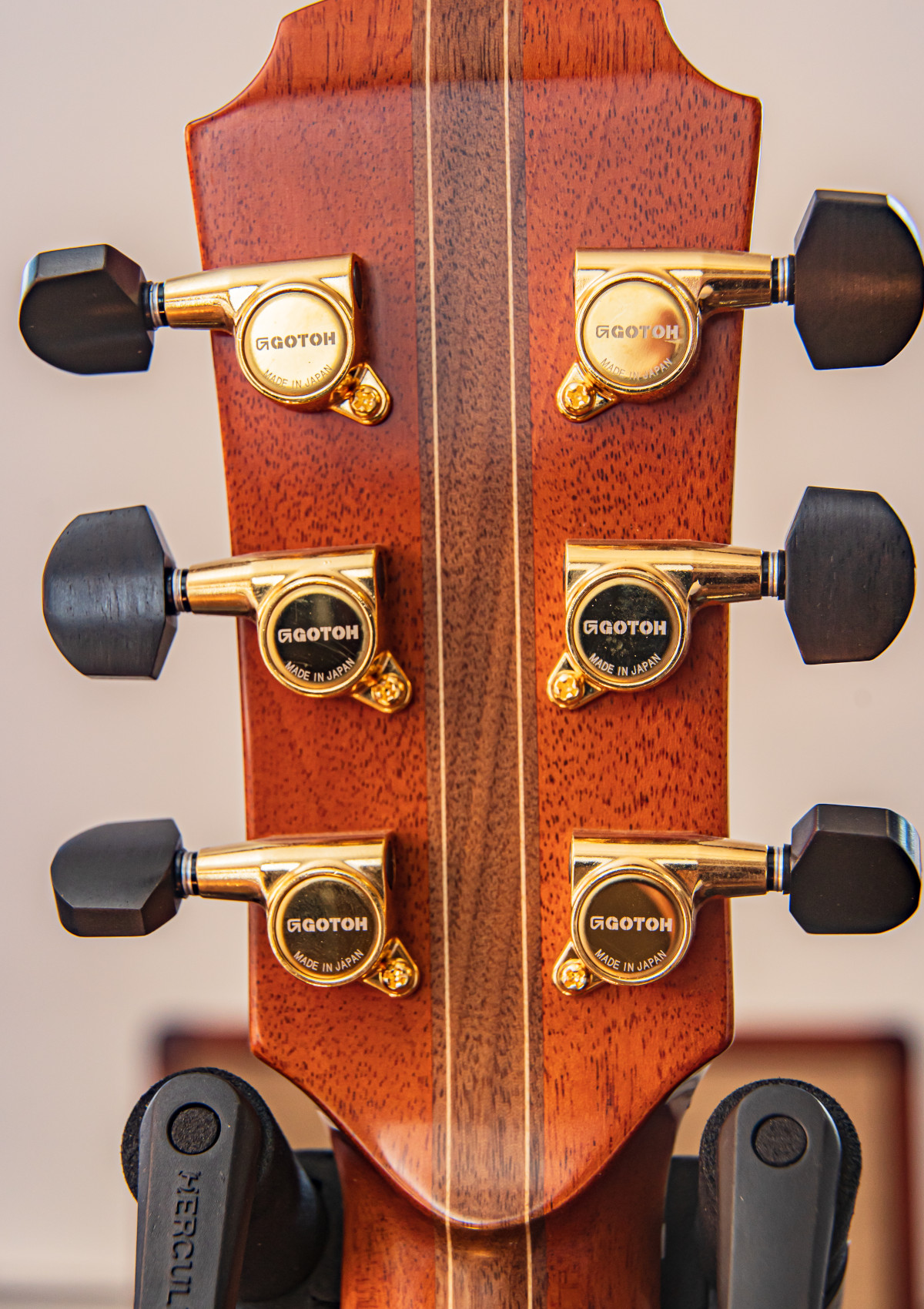
A natural bone nut and saddle provide hard, precisely fitted contact points for the strings, while Gotoh SG381 machine heads handle the considerably less romantic but extremely important job of accurate and stable tuning.
Connecting all of this to the player is the Brazilian Mahogany neck, paired with that smooth ebony fingerboard. On a guitar surrounded by extraordinary materials and a genuinely remarkable story, it is easy to overlook the simple importance of the neck, but this is the part of the instrument a player may hold for hours at a time. Comfort, stability and familiarity matter enormously, and Avalon has not allowed the spectacle of the tonewoods to distract from the physical business of actually playing the guitar.
Four Thousand Years Meets Six New Strings
There is something wonderfully incongruous about fitting modern strings to ancient timber, yet that collision between old material and contemporary guitar making is part of what makes the L590c so fascinating.
The guitar comes strung with D’Addario XS .12–.53 strings, giving the instrument a modern light-gauge platform from which all that old wood can speak. Their job is not to romanticise the material beneath them; it is to transfer the energy of the player into the instrument as efficiently and musically as possible.
And this is where the mythology has to end and the guitar has to prove itself.
Provenance alone cannot make a great acoustic guitar. Rare timber cannot rescue poor voicing, and spectacular figuring cannot make an instrument responsive. The fact that the Bog Oak spent more than four millennia beneath the Irish landscape is a magnificent story, but eventually somebody has to sit down, put their hands on the strings and play the thing.
The L590c earns its story in sound.
That is what matters.
Fishman Ellipse Blend: Taking the L590c to the Stage
An acoustic guitar this complex presents an interesting challenge when amplification enters the picture, because the last thing we want is for all that natural character to disappear the moment a cable is connected.
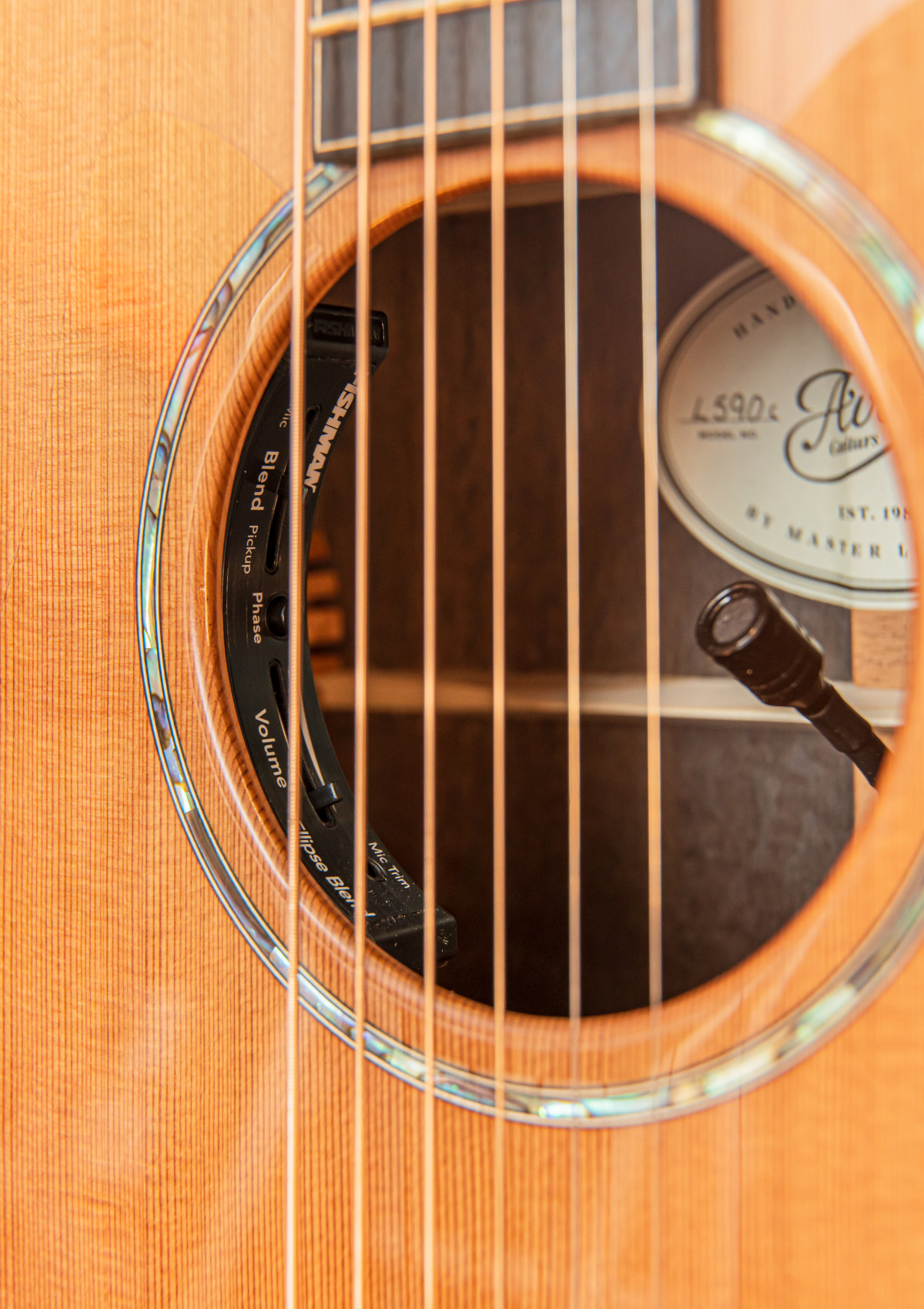
The Fishman Ellipse Blend pickup system is an especially appropriate choice because its dual-source approach combines an undersaddle pickup signal with an internal microphone, allowing the player to balance the directness and consistency of the pickup against the more open, spatial character captured by the microphone.
That combination is particularly valuable on the L590c. The aim is not to manufacture a completely new amplified personality, but to retain as much as possible of the guitar’s existing voice: the definition of the Bog Oak, the warmth and responsiveness of the Cedar, the articulation of individual strings and the natural sense of air surrounding the instrument.
For professional live performance, that flexibility matters. An undersaddle source provides the stability and clarity required on stage, while the microphone can be blended in to restore some of the body resonance and acoustic dimensionality that can otherwise disappear in amplified sound.
A guitar like this should still sound recognisably like itself when somebody plugs it in.
A Fascinating Recording Guitar
In the studio, the Avalon L590c presents an equally compelling proposition.
Its combination of warmth and separation gives a recording engineer something immensely valuable: options. The responsive Cedar soundboard can make intimate fingerstyle passages feel close and dimensional without demanding aggressive playing, while the focus of the Bog Oak helps individual notes retain definition inside more complex arrangements.
For singer-songwriters recording voice and guitar together, that balance could prove particularly useful. For solo acoustic work, the harmonic detail becomes part of the arrangement itself, while contemporary fingerstyle players and composers working in alternate tunings can make use of the guitar’s sustain and separation to create overlapping musical voices without losing clarity.
There will be endless possibilities for microphone placement, stereo techniques and careful experimentation with the onboard Fishman system, but there will also be occasions when the correct recording technique is considerably simpler: find a good microphone, put it in a good room, sit a good player in front of it and resist the urge to interfere.
A guitar this expressive already has plenty to say.
A Guitar About Time
We talk frequently about ageing in acoustic guitars. Solid timber changes as an instrument lives through years of vibration and carefully controlled environmental cycles. Players often describe mature instruments as opening up, developing a different response and becoming increasingly familiar beneath the hands.
With the L590c, that familiar conversation acquires an almost absurd sense of scale.
The finished guitar may continue to develop over the next ten, twenty or thirty years, while the material forming its back and sides has already existed across thousands. That does not mean Bog Oak emerges from the earth magically “played in”, and there is no need to turn acoustics into mythology to appreciate what is happening here.
What it does give the L590c is an extraordinary relationship with time. The material has already had one life within the Irish landscape. Avalon has transformed it into something capable of beginning another, and from this point onwards the player becomes part of that history.
The songs, recordings, gigs, scratches and years that follow are the next layer.
Handcrafted in Northern Ireland
There is another reason an instrument like this means something particular to us at Musicmaker. It was made here on the island.
Not as a replica of some distant guitar-building tradition, but as a world-class acoustic instrument carrying a distinctly local story. Ancient Irish Bog Oak travelled from the landscape to the hands of experienced luthiers in Newtownards, Northern Ireland, where it was paired with Cedar, mahogany, ebony, bone and modern electronics before beginning the journey south to Dublin.
There is something beautifully complete about that progression. The material came from the landscape, the instrument came from the workshop, and the music will come from whoever eventually takes it home.
That is what makes the Avalon Handcrafted in Northern Ireland story so compelling. These guitars carry the fingerprints of individual makers, but they also carry a sense of place, and the L590c expresses that more literally than almost any instrument we have encountered.
Its history is Irish.
Its craftsmanship is Northern Irish.
Its future belongs to a musician.
From the Musicmaker Workshop
We've had extraordinary acoustic guitars pass through Musicmaker over the decades, but every so often an instrument arrives whose story makes even experienced guitar people stop for a moment.
The Avalon L590c is one of those instruments.
There is something difficult to put into words about holding a guitar made from Irish timber that spent more than four thousand years beneath the earth before a group of luthiers in Northern Ireland gave it a voice. But the age of the Bog Oak is only the beginning of the story. What makes this guitar matter is what Avalon has done with it: the sensitivity of the Cedar, the focus and definition of the body, the beautifully judged craftsmanship and the sense that every part of the instrument has been allowed to serve the sound.
We are enormously proud to champion Avalon Guitars in Ireland, and instruments like the L590c explain why. This is local luthiery operating at an extraordinary level, taking material with a history measured in millennia and creating something intended to begin another history in the hands of a musician.
Four thousand years brought the wood to the workshop
What happens next belongs to the player.