



Anyone Can, and Should Learn Piano
Meet the Affordable Donner DEP-1 & DEP-1S Digital Pianos
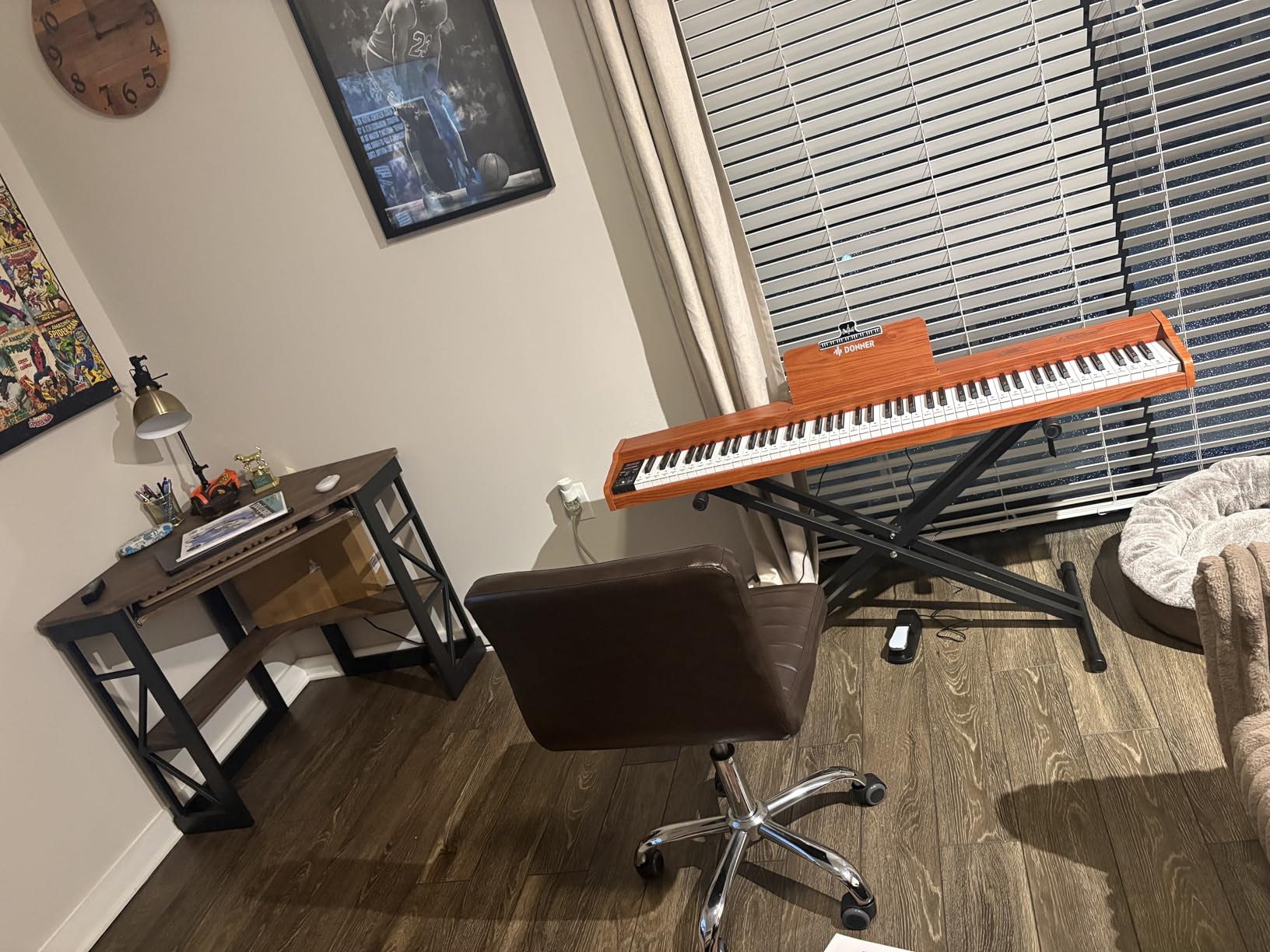
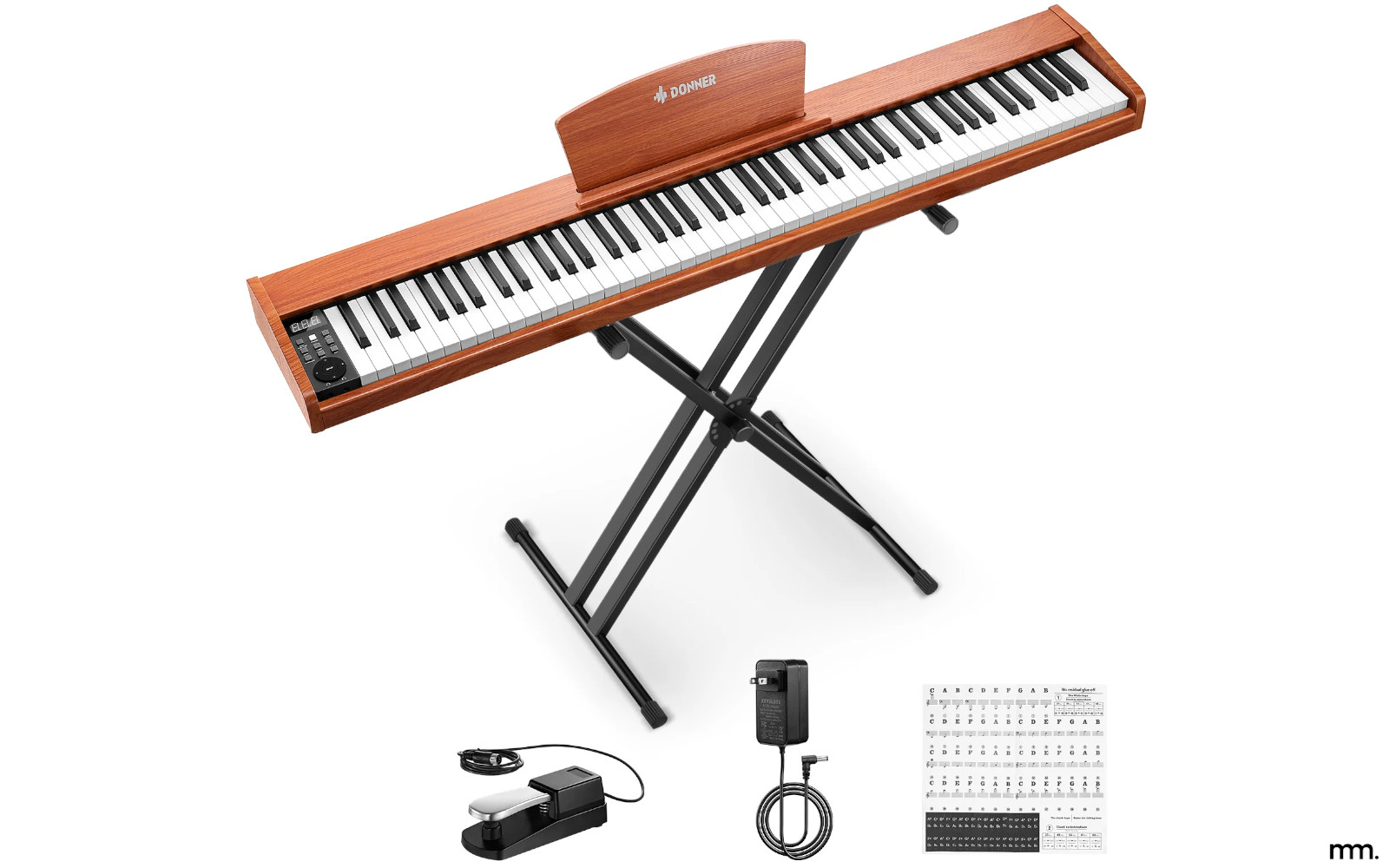
And the Donner DEP-1S looks cool. Try it out in Musicmaker today.
There is a moment at the beginning of learning piano when absolutely nothing makes sense.
There are 88 keys. Far too many of them.
The left hand appears to have no interest whatsoever in cooperating with the right. Reading music feels suspiciously like learning another language, and the simple little piece your teacher demonstrated in approximately eleven seconds has somehow become an impossible feat of human coordination.
And then one day, something happens.
Two hands land together. A chord rings out properly. The melody reaches the end without stopping.
For perhaps thirty seconds, you aren't trying to learn piano anymore.
You're playing it.
That's the moment we want more people to experience.
Because at Musicmaker, after more than four decades of watching musicians begin, stop, return, struggle, improve and occasionally surprise themselves completely, we remain convinced of something wonderfully simple: Piano is for everybody.
And getting started doesn't have to cost a fortune.
The First Piano Doesn't Need to Be the Last Piano
Buying a first instrument can be strangely intimidating.
Search for the best beginner digital piano and you'll quickly find yourself buried beneath discussions about graded hammer actions, sample layers, sympathetic resonance, polyphony counts and instruments costing considerably more than you'd planned to spend.
All of those things have their place.
But a beginner needs something more fundamental.
A piano they can actually start playing.
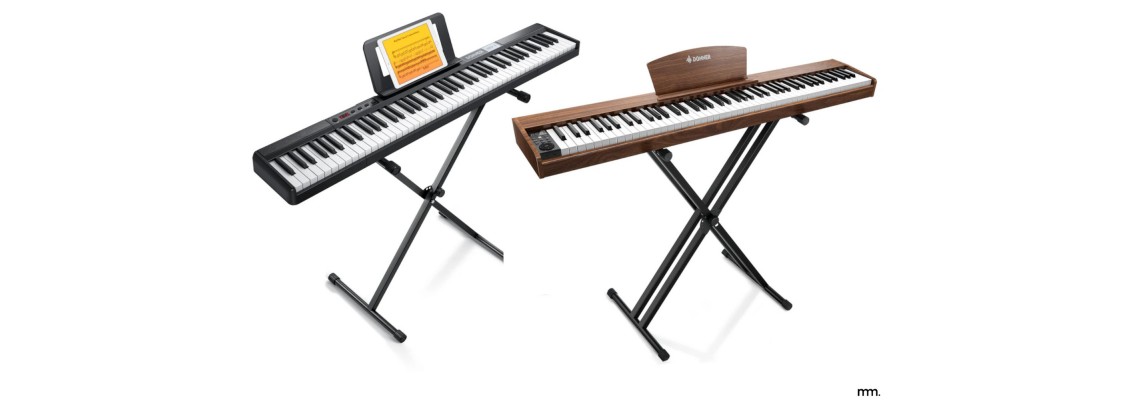
That's precisely where the Donner DEP-1 and Donner DEP-1S become interesting. Both provide a full 88-key keyboard at remarkably accessible prices, but they approach the beginner completely differently.
The DEP-1 prioritises portability and freedom.
The DEP-1S behaves more like a permanent home piano.
Neither asks you to invest professional-piano money before you've played your first scale.
And we think that's important.
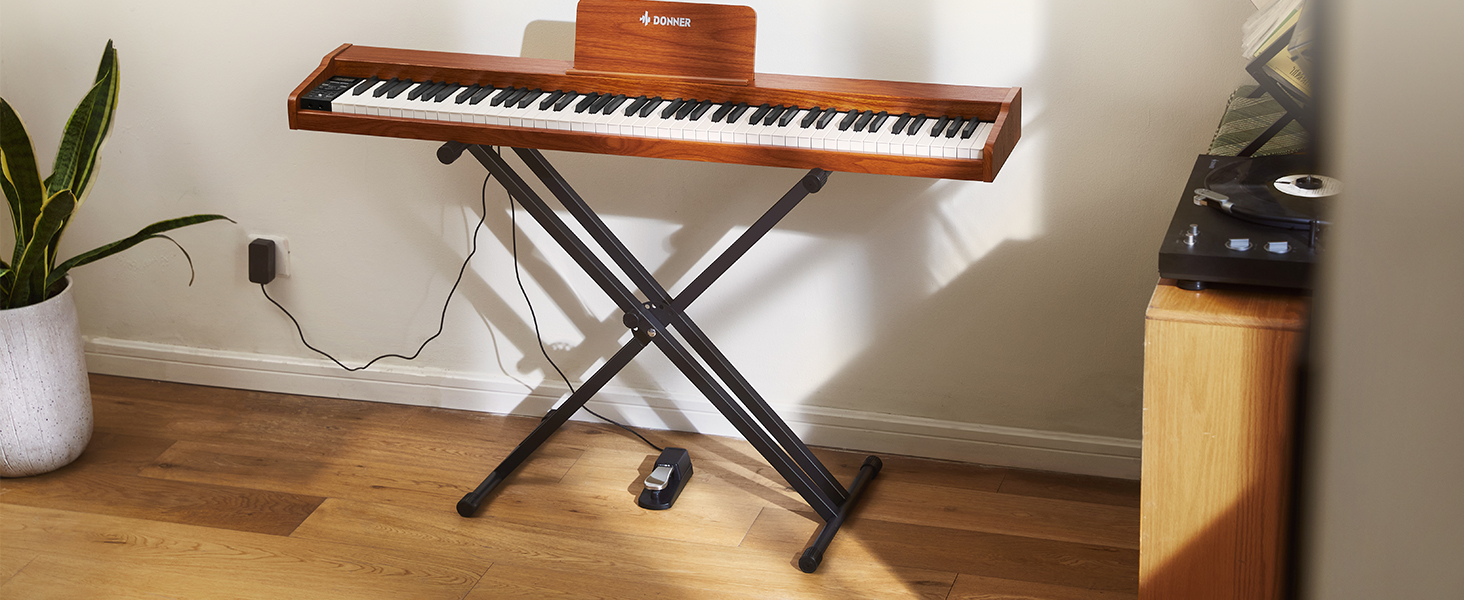
Donner DEP-1
Eighty-Eight Keys. Take Them Anywhere.
The Donner DEP-1 88-Key Digital Piano is almost comically easy to understand.
It's a full-size keyboard designed to remove as many barriers as possible between “I'd love to learn piano” and actually sitting down to play.
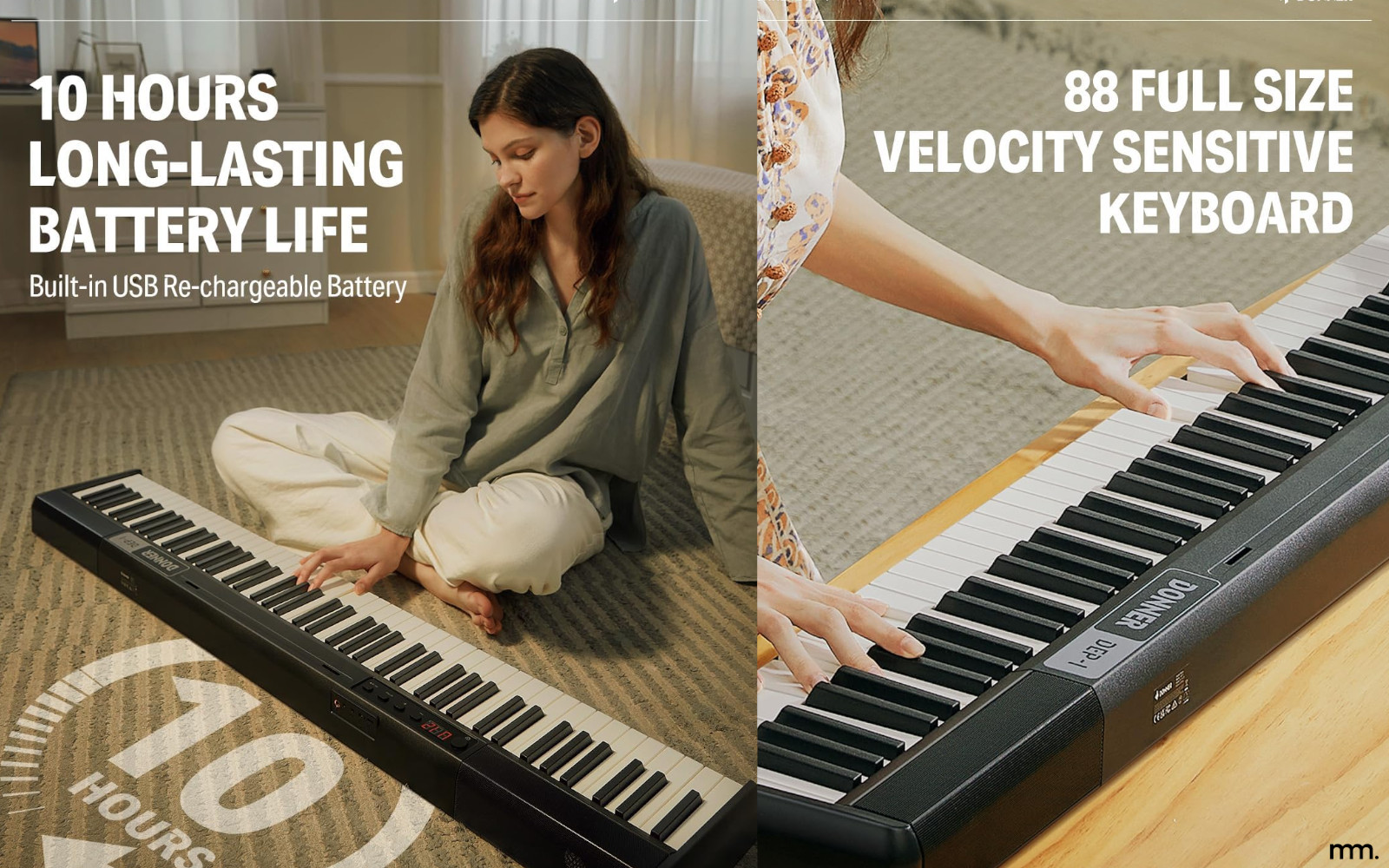
You get 88 full-size velocity-sensitive keys, meaning the instrument can respond to differences in how firmly you play rather than simply producing every note at one fixed level. That's important for a beginner because dynamics are part of music from the beginning. Learning to make a melody sing more loudly than its accompaniment, or allowing one phrase to fall away gently, begins with understanding that the fingers don't merely select notes.
They shape them.
Donner gives the DEP-1 128 tones, 128 rhythms and 21 demonstration pieces, alongside useful learning and creative functions including a metronome, transpose, chord function, vibrato and recording.
Plenty to explore.
But the really clever part is how little the piano demands from the room around it.
The Piano That Doesn't Need to Live Beside a Plug
The DEP-1 weighs only around 7kg and contains a rechargeable lithium-ion battery.
That changes its personality completely.
A conventional home digital piano tends to acquire a permanent address. The DEP-1 can move.
Practise in the bedroom. Bring it downstairs. Take it to a lesson.
Move it out of the way when you need the space.
Set it up somewhere completely different because inspiration has arrived and apparently today we're composing beside the kitchen window.
Power and charging are handled through USB-C at 5V/2A, and Donner specifically notes that high-power fast chargers aren't supported, so this is one occasion where reaching automatically for the most violent laptop charger in the drawer is not the move.
That rechargeable design is more than a nice specification. For students in smaller homes, teenagers moving between rooms, musicians travelling to lessons and anyone without space for a permanent piano setup, it's freedom. Your first piano doesn't need its own room.
It just needs somewhere to play.
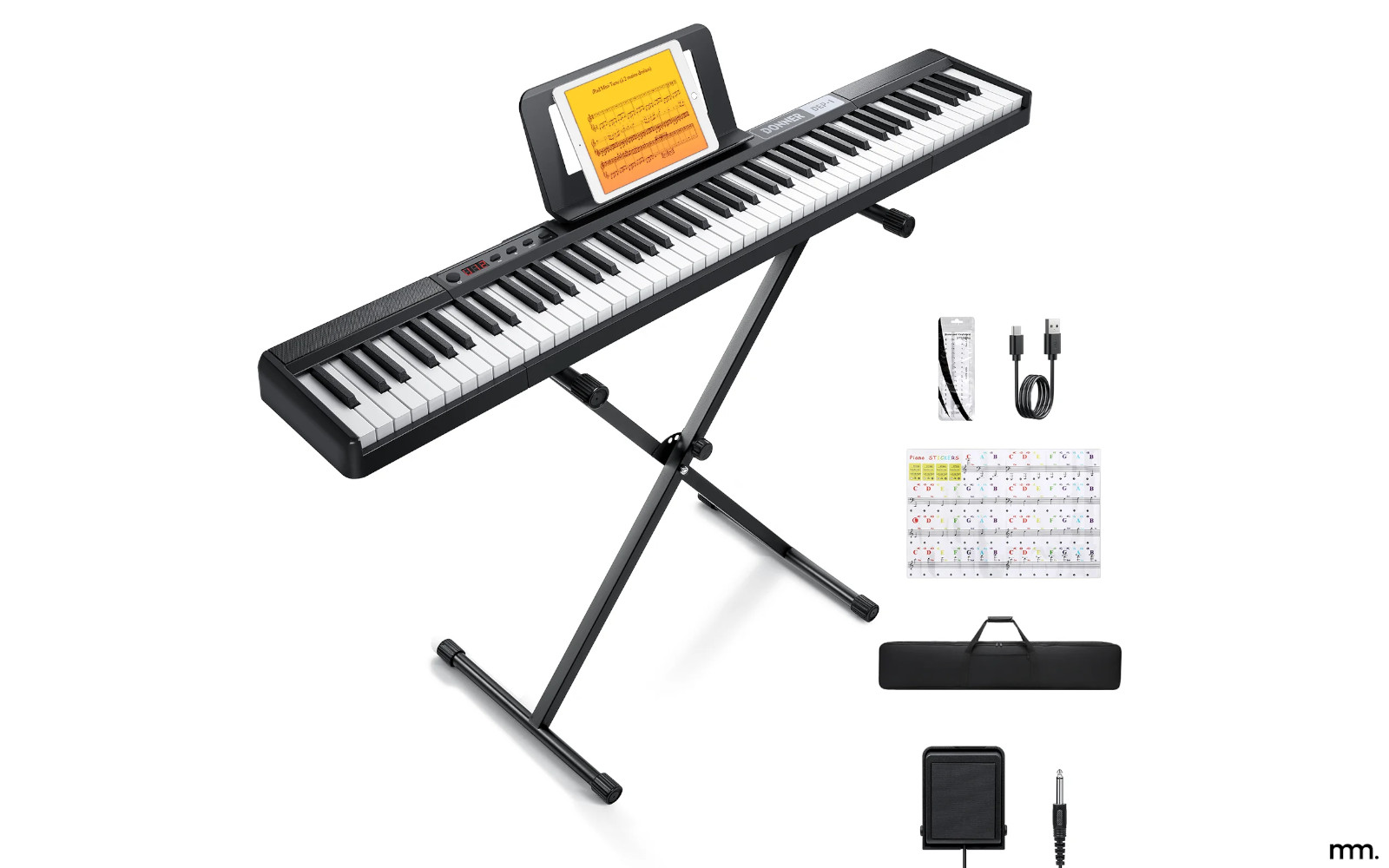
Donner DEP-1S
Same Starting Line. A Different Journey.
The Donner DEP-1S looks at the same beginner and asks a different question.
What if portability isn't the priority? What if you want to establish a proper little piano corner at home — somewhere you can sit down every day, put the music up and practise?
That's the DEP-1S.
Its 88-key semi-weighted, velocity-sensitive keyboard provides five adjustable touch levels, giving beginners the opportunity to develop dynamic control while adjusting the response to suit their developing technique. The sound engine offers 128 voices, 100 rhythms, 88 demo songs and 64-note polyphony.
That last specification deserves translating from Piano Nerd.
Polyphony is simply the number of notes the instrument can reproduce simultaneously. You may reasonably point out that humans generally possess only ten fingers. Correct. But sustained notes continue sounding after your fingers leave them, layered sounds can consume multiple voices, and pedal use allows notes to overlap. A useful polyphony count gives the piano room to handle that increasing complexity as your playing develops.
You don't need to worry about it on day one.
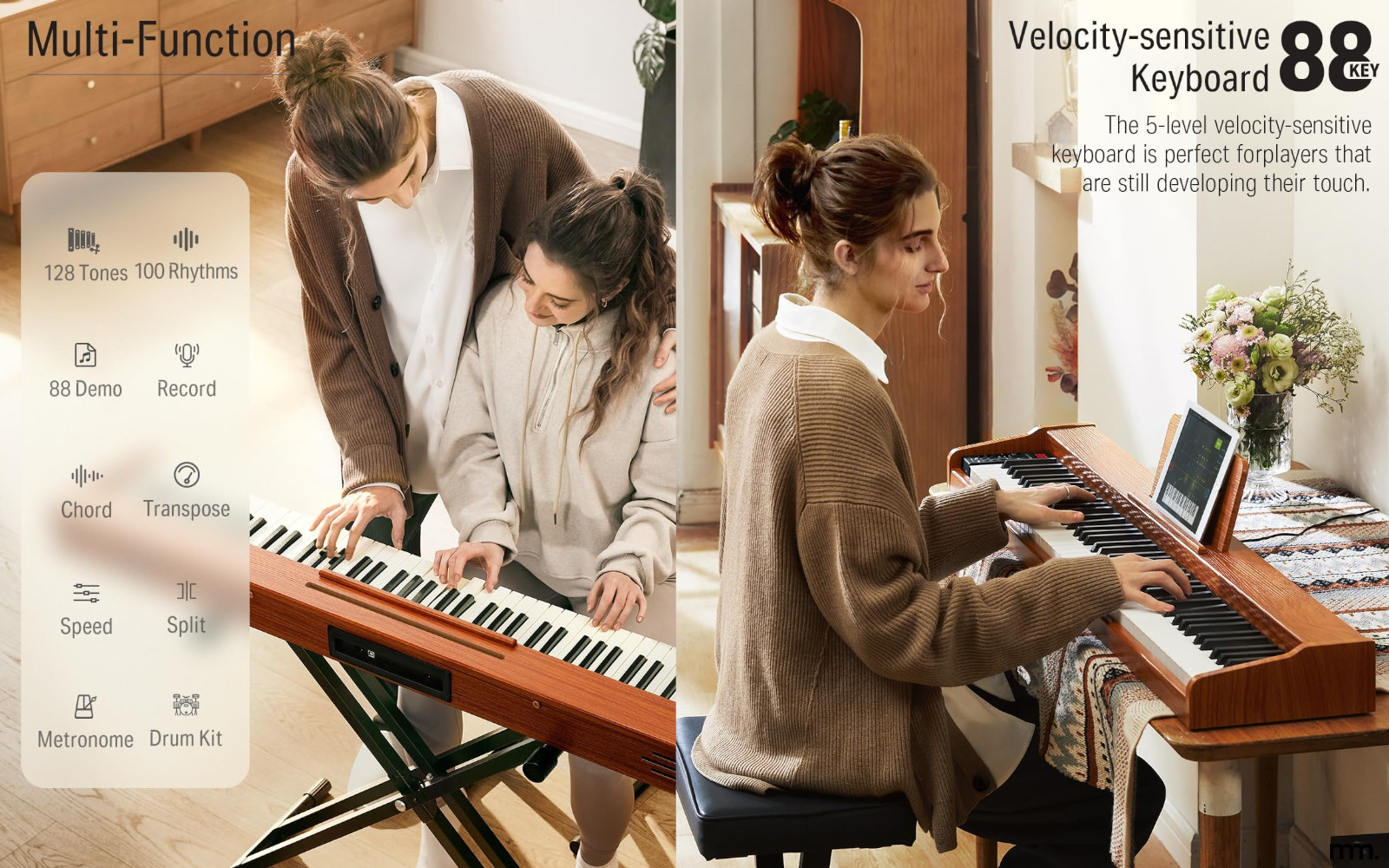
A Beginner Piano That Wants You to Experiment
The DEP-1S also gives beginners considerably more room to explore than its approachable price might suggest.
There's Dual Tone for layering sounds, Split/Dual Keyboard functionality, a built-in metronome, chord functions and recording/playback. The onboard dual 15W speakers provide considerably more acoustic output than you'd expect from an ultra-portable keyboard, making the DEP-1S a much more convincing permanent home instrument.
Then there's connectivity.
The current DEP-1S supports Bluetooth Audio and Bluetooth MIDI, alongside USB-MIDI. That opens the door to learning apps, music software and computer-based production without turning your first piano into a technological obstacle course. Donner specifically highlights compatibility with learning and creative software such as Simply Piano, Flowkey, GarageBand and FL Studio.
Play along with music wirelessly. Connect to an app. Record into a computer.
Use the DEP-1S to control virtual instruments.
Your beginner piano can quietly become your first music-production keyboard too.
That's a lot of growing room.
DEP-1 or DEP-1S?
Here's the Easy Version
Choose the Donner DEP-1 if portability matters most.
It's the one for players who want 88 full-size velocity-sensitive keys without committing a room to a piano. At around 7kg, with its rechargeable battery and USB-C power, it's wonderfully suited to lessons, bedrooms, small apartments and musicians who need an instrument that can disappear when the music stops.
Choose the Donner DEP-1S if you're creating a more permanent practice setup.
Its 88 semi-weighted velocity-sensitive keys, five touch levels, 64-note polyphony, 128 voices, 100 rhythms, 88 demo songs, dual 15W speakers, Bluetooth Audio, Bluetooth MIDI and USB-MIDI give it considerably more of the character of a dedicated home digital piano.
There isn't a winner. That's what we like about them.
They're two answers to the same question: How do we get more people playing piano?
But Aren't Proper Pianos Weighted?
Eventually, perhaps, you'll want to investigate a fully weighted hammer-action digital piano.
Hammer-action keyboards are designed to reproduce more of the mechanical resistance associated with an acoustic piano, and they're extremely valuable for developing classical piano technique and for players progressing seriously through repertoire. But here's the bit that sometimes gets lost in buying guides.
You are allowed to begin before you can afford the perfect instrument. A semi-weighted or velocity-sensitive keyboard can still teach you where the notes live.
It can teach rhythm. Chords. Scales. Sight-reading. Coordination. Harmony and Timing.
It can teach the left hand to stop behaving like it's been borrowed from somebody else.
And, most importantly, it can establish the habit of sitting down and playing.
If that first affordable digital piano carries you far enough that one day you outgrow it?
Brilliant.
That means it worked.
Headphones: The Beginner's Secret Weapon
There's one more piece of equipment we absolutely love for learning piano.
Headphones.
Not because your family hates Für Elise. Although by repetition number 683, negotiations may begin.
Headphones create a little private practice room wherever the piano happens to be. They let beginners repeat difficult passages without feeling self-conscious, practise later in the evening and concentrate on details that can disappear into the acoustics of a busy home.
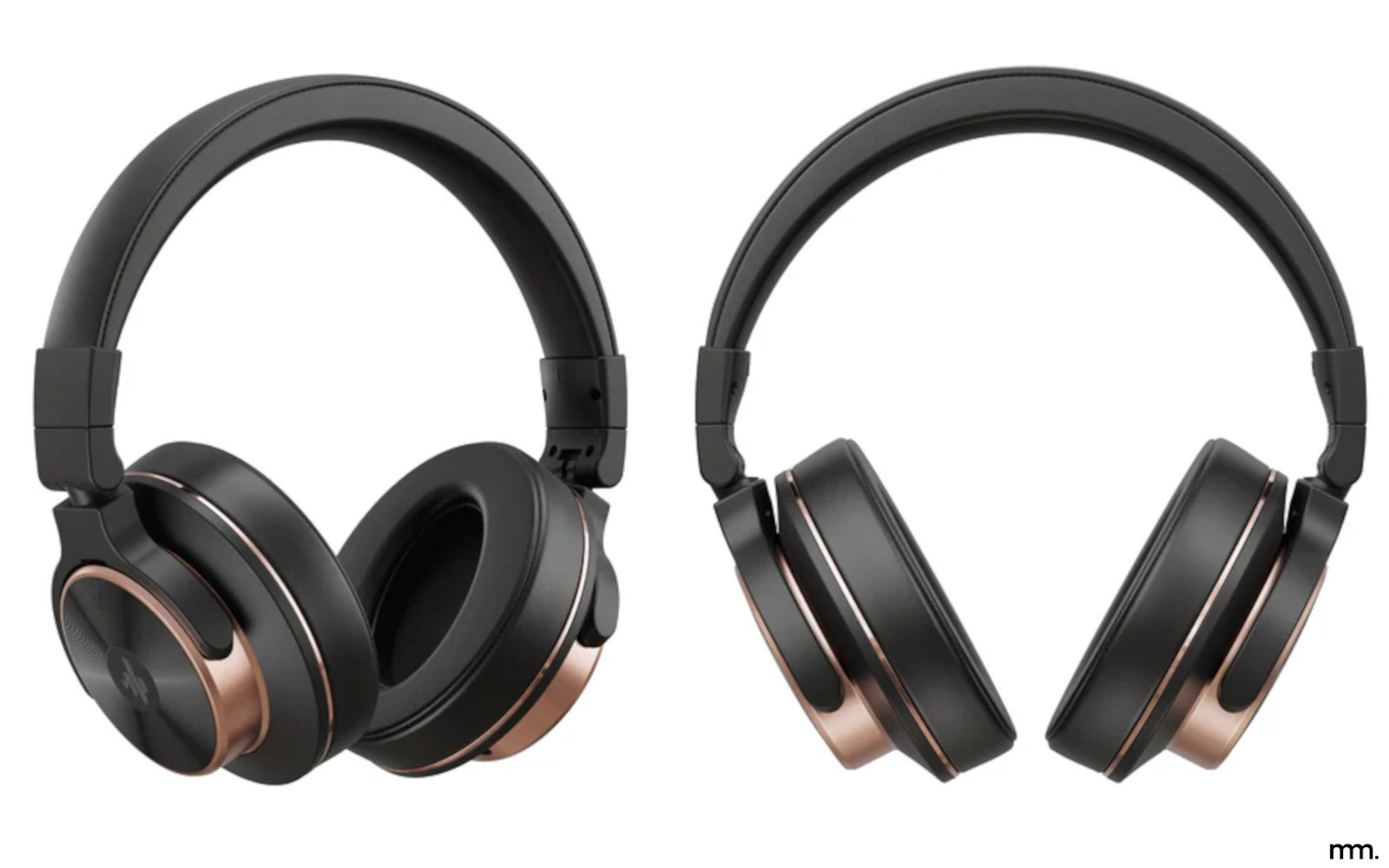
The Donner M100 Studio Monitor Headphones make a particularly tasty companion to either DEP model. Donner fits them with large 50mm drivers, a 20Hz–20kHz frequency response, 32-ohm impedance and a detachable coiled cable that can extend to approximately 3 metres. They weigh around 480g, and both 3.5mm connectivity and a 6.35mm adaptor are supplied.
That low 32-ohm impedance also makes them straightforward to drive from everyday musical equipment without requiring a dedicated headphone amplifier.
Plug in. The room disappears. Now it's just you and the mistake you've made in bar seventeen.
Again.
You'll get it.
You Don't Need Permission to Start
This might be the most important part of the article.
You don't need to have played as a child. You don't need enormous hands. You don't need to read music already. You don't need a conservatory education.
You don't need a beautiful detached house containing an acoustic grand piano and suspiciously good natural light.
And you absolutely do not need to be “musical enough” before you begin learning music.
You begin badly. Everyone does.
The first chord is awkward. The first scale is uneven. The first time you try to make two hands perform different jobs, your brain files a formal complaint.
Then you do it again tomorrow. And something gets slightly easier.
That's learning an instrument.
Affordable Instruments Matter
There is a reason we're excited about genuinely affordable beginner digital pianos.
Price is a barrier. Pretending otherwise doesn't help anybody.
For some people, a premium digital piano is perfectly attainable. For others, even buying a first instrument requires saving, planning and deciding that this dream matters enough to pursue.
Both musicians deserve to play.
That's why instruments like the Donner DEP-1 and DEP-1S matter to us at Musicmaker. They lower the financial barrier without reducing the beginner's ambition.
You can start on an affordable piano and dream about playing Chopin.
You can start on an affordable piano and write your first song.
You can start at forty. Sixty. Eight.
There isn't a correct age.
There is only the day you begin.
Anyone Can, and Should Play Piano
Perhaps you'll become brilliant. Perhaps you'll learn five songs and play them happily for the rest of your life.
Perhaps the DEP-1 becomes the beginning of an obsession that eventually ends with a beautiful hammer-action home piano.
Perhaps you discover songwriting. Production. Jazz. Classical music. Film scoring.
Or perhaps twenty minutes at the piano simply becomes the quietest part of your day.
All of those outcomes count.
Music doesn't belong exclusively to people who do it professionally.
It belongs to people who do it.
And that's why we want more pianos in more homes, more headphones on more heads and more complete beginners staring suspiciously at middle C.
You don't have to be good enough to start.
You start. Then you get better.
One note at a time.
From the Musicmaker Workshop
Since the early 1980s, we've watched thousands of musicians begin at Musicmaker, and almost none of them began with everything figured out. They began with curiosity, an affordable instrument and enough determination to try again tomorrow. That's what we love about the Donner DEP-1 and DEP-1S: they make a full 88-key digital piano accessible to people who might otherwise keep putting the dream off. Add a pair of headphones, find twenty quiet minutes and start. The first piano doesn't have to be the finest piano you'll ever own. It just has to be the one that gets you playing.