





Shut Up and Listen: Headphones for Every Music Lover
From First Practice to Serious Studio Monitoring
We spend an extraordinary amount of time talking about making music.
What guitar are you playing? Which microphone captured the vocal? What preamp did you use? Which synth? Which speakers? Which compressor? How did you tune the snare? What in God's name have you done to that pedalboard?
All excellent questions.
But eventually, every part of that enormous musical chain arrives at the same place.
Your ears.
And a good pair of headphones can change your relationship with music in ways that are surprisingly profound.
They can turn a noisy bedroom into a private practice room. They can reveal a bass part you've somehow never noticed in a song you've known for twenty years. They can let a producer work deep into the night without becoming a neighbourhood issue. They can put a drummer inside a V-Drums kit, a pianist inside a concert hall, or simply give somebody forty minutes alone with a favourite record and absolutely nobody asking them anything.
Right now at Musicmaker Dublin, we've got headphones covering almost that entire journey, from wonderfully affordable Stagg studio headphones through Donner, Sony and Audio-Technica to specialist Roland monitoring models.
So we're going from the cheapest upwards.
Not because more expensive automatically means better.
Because better for what? is the question that actually matters.
Before We Begin: What Makes a Good Pair of Headphones?
Ah. Now we're in dangerous territory.
You'll see numbers everywhere when shopping for studio headphones: 18 ohms, 32 ohms, 45mm drivers, 50mm drivers, 5Hz–40kHz frequency response.
They all mean something. They do not necessarily mean what internet arguments suggest they mean.
Driver size tells us the physical diameter of the transducer producing the sound. Bigger drivers can offer certain engineering advantages, particularly around low-frequency reproduction and efficiency, but a 50mm driver is not automatically "better" than a beautifully engineered 40mm one.
Frequency response describes the range of frequencies the manufacturer specifies the headphones as reproducing. Human hearing is commonly described as roughly 20Hz to 20kHz under ideal conditions, so specifications extending beyond that shouldn't be interpreted as secret ultrasonic music you're finally going to unlock.
What matters is how accurately, smoothly and usefully the headphones reproduce the range that matters.
Then there's impedance, measured in ohms.
Broadly speaking, lower-impedance headphones tend to be relatively easy to drive from everyday equipment, while some high-impedance professional designs benefit from more capable headphone amplification. But impedance is only part of the electrical picture; sensitivity matters too.
And finally: Closed-back or open-back?
Every wired studio model in our particular lineup here is closed-back. That means the rear of the driver is enclosed, helping reduce sound leakage and provide isolation from the outside world.
For recording, practising, DJ work, electronic instruments and general-purpose studio use, that's extremely handy.
Now. Put something excellent on.
Let's listen.
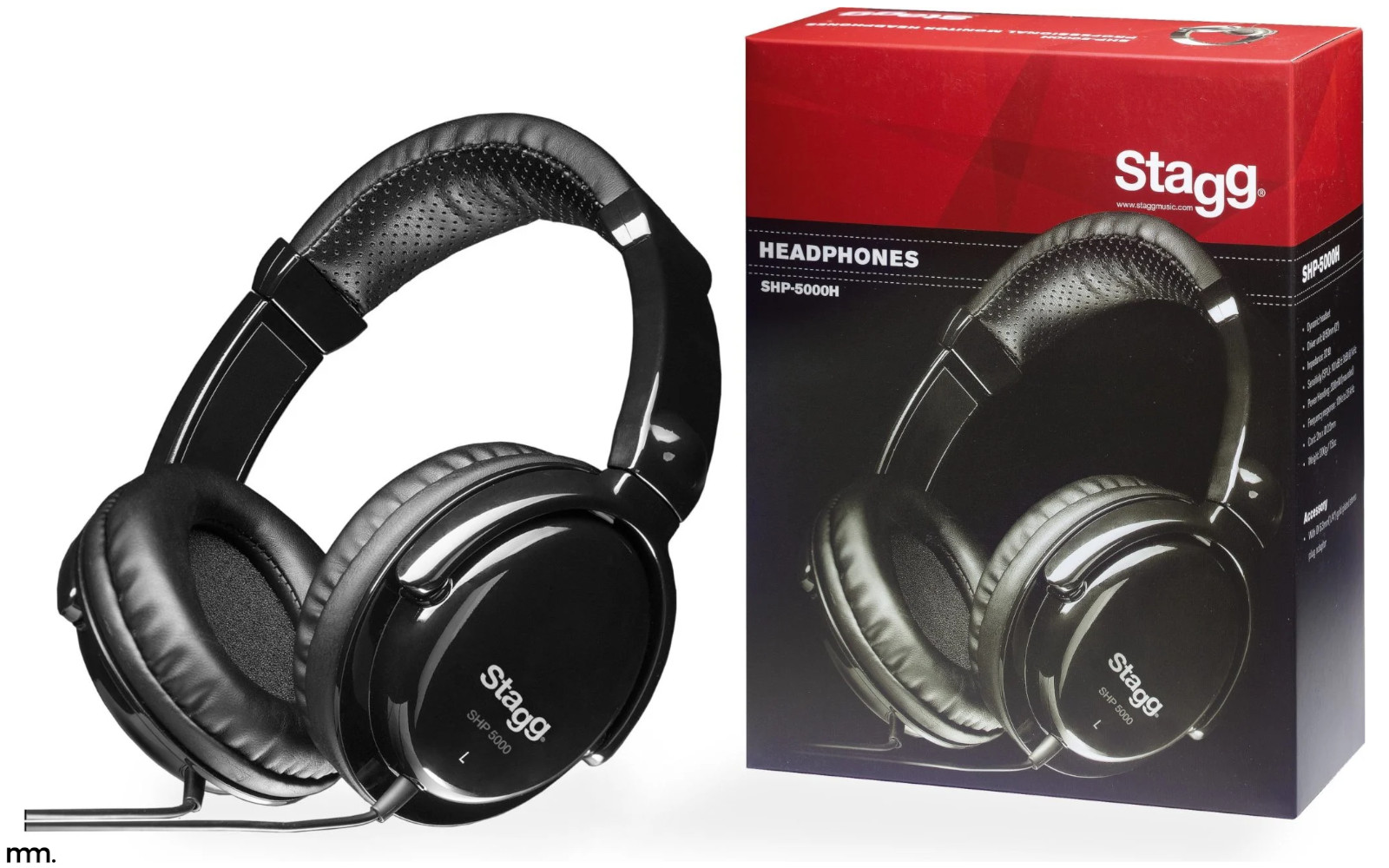
Stagg SHP-5000H
The Affordable Workhorse
At the accessible end of our headphone wall sits the Stagg SHP-5000H. And this is exactly where headphone shopping should begin for plenty of musicians.
The SHP-5000H is a closed-back dynamic headphone built for monitoring, recording, DJ and home applications. Inside are 40mm drivers with neodymium magnets, delivering a specified 20Hz–20kHz frequency response, 18-ohm impedance, 105dB/mW sensitivity and maximum power handling of 1000mW.
Those aren't toy specifications. The low 18-ohm impedance makes the Stagg particularly approachable for musicians plugging into all sorts of everyday equipment, while the closed-back construction is exactly what we want when isolation matters.
There's a 3-metre cable, terminated in a standard 3.5mm stereo connection, and Stagg includes a 6.3mm adaptor for connecting to the larger headphone sockets found across audio interfaces, mixers, digital pianos, electronic drums and other musical equipment. Weight without the cable is 289g.
And that's why we like it. It's uncomplicated.
I need headphones for my keyboard. Grand.
I want to practise electronic drums. Stick them on.
I'm beginning home recording and need closed-back headphones. Here you go.
Not everybody beginning their musical journey needs to spend a fortune on monitoring.
Sometimes you just need to hear what you're doing.
Donner M100 Studio Monitor Headphones
Fifty Millimetres of Affordable Mischief
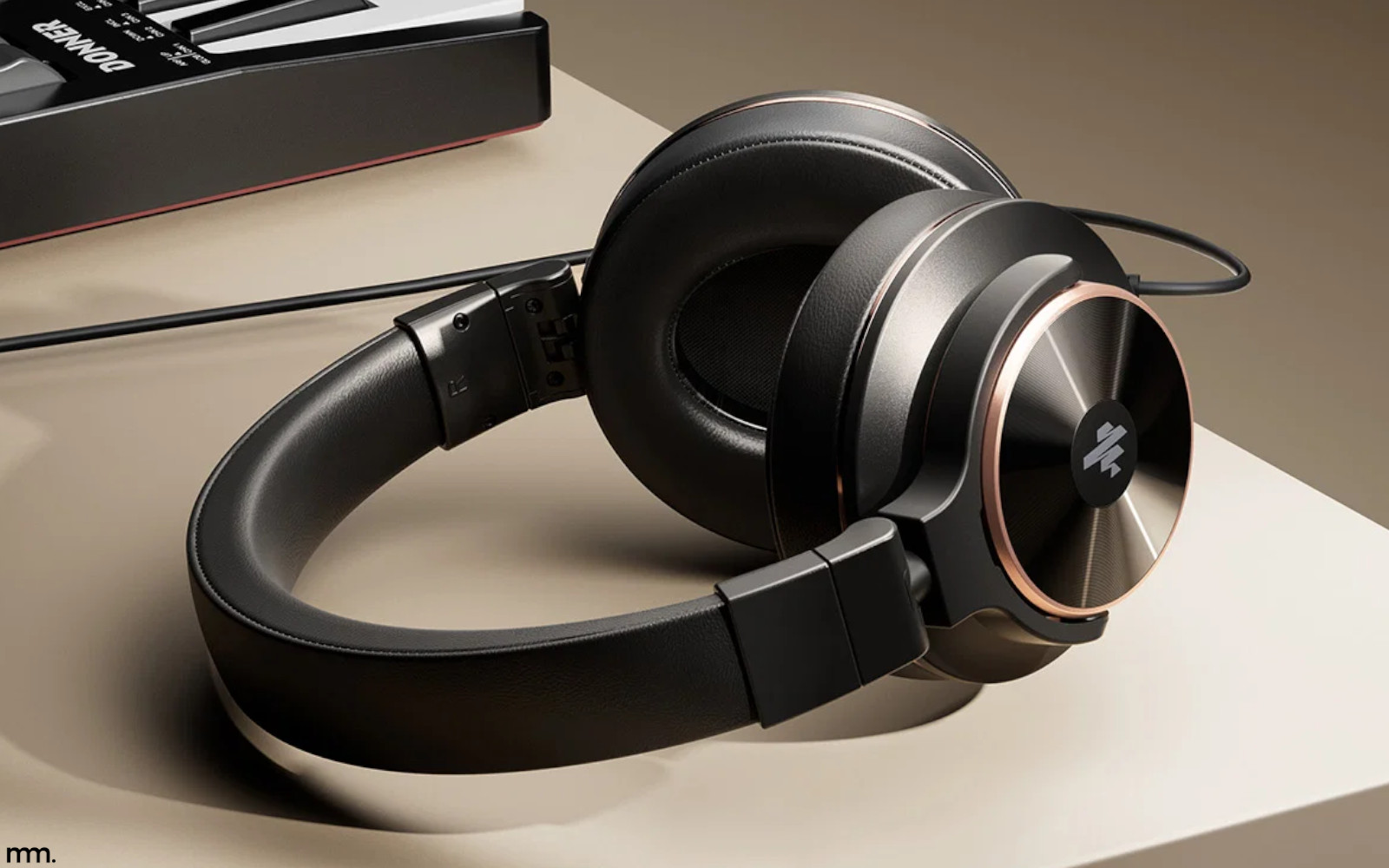
Next comes a headphone we've already encountered in our beginner-piano adventures: the Donner M100 Studio Monitor Headphones. Donner has gone surprisingly substantial here.
The M100 uses large 50mm drivers and covers a specified 20Hz–20kHz frequency range, with 32-ohm impedance, 110dB ±3dB sensitivity, 30mW rated power and 300mW maximum power.
That 32-ohm impedance makes the M100 an easy companion for the sort of equipment many Musicmaker customers actually own: digital pianos, electronic drum kits, audio interfaces, practice setups and home studio equipment.
And Donner has thought about the cable.
The M100 uses a detachable coiled cable that can extend to approximately three metres, giving you room to move around a keyboard or studio setup without dragging your equipment across the room when you stand up and forget you're still plugged in. We've all done it.
Donner also supplies both 3.5mm connectivity and a 6.35mm adaptor, while soft protein-leather earpads are intended to keep things comfortable through longer sessions.
At this level, that's a lot of headphone. For the beginner producer, pianist, electronic drummer or musician putting together an affordable home recording studio in Ireland, the M100 makes a very convincing argument: Spend the money on making music.
You can get remarkably capable headphones without eating next month's food budget.
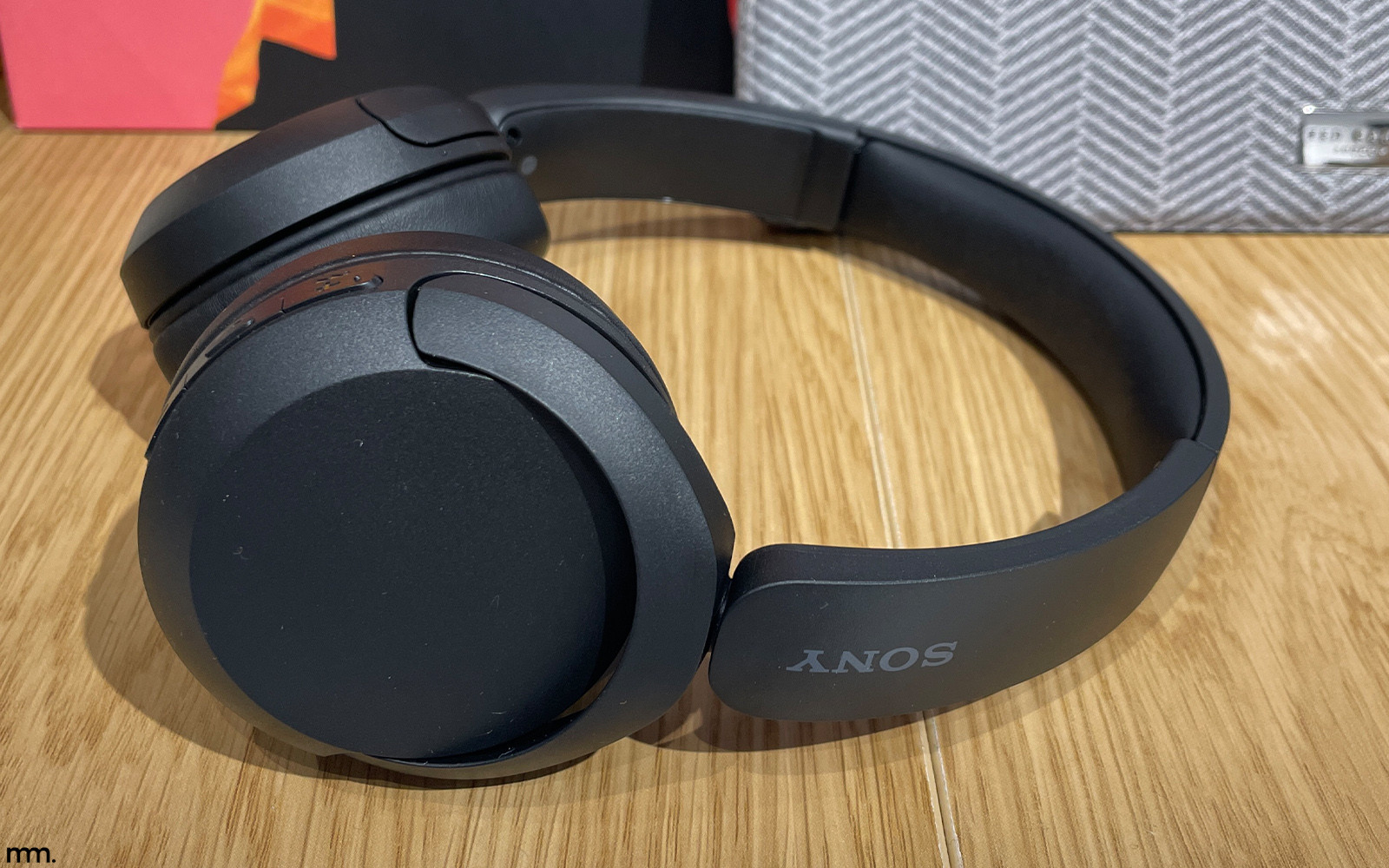
Sony WH-CH520
And Now for Something Completely Different
Then we take a hard left. The Sony WH-CH520 isn't really competing with the studio headphones surrounding it.
This is a wireless everyday listening headphone. And that's important because sometimes we get so obsessed with monitoring accuracy that we forget another perfectly legitimate reason for buying headphones: Listening to music because music is brilliant.
Sony uses 30mm drivers in the WH-CH520, with a Bluetooth transmission frequency response of 20Hz–20kHz at 44.1kHz sampling. Bluetooth 5.2 supports SBC and AAC, and Sony's DSEE processing is included.
But the killer specification is battery life. Up to 50 hours of music playback.
Fifty. Hours.
The headphones weigh only around 147g, charge over USB-C, and Sony specifies approximately three hours for a full charge.
This is your commute headphone. Your college headphone. Your I need everyone on this bus to cease existing for the duration of this album headphone.
There is no wired input and no passive operation, which is precisely why we wouldn't recommend the WH-CH520 as your primary pair of studio recording headphones. Bluetooth introduces a different workflow, and latency alone makes wireless consumer headphones less appropriate for jobs such as live instrument monitoring.
But for listening? Mate. Put the record on. Walk somewhere.
That's allowed too.
Audio-Technica ATH-M20x
Welcome to the Studio
And now we arrive at a name that is deeply woven into modern recording. Audio-Technica.
The ATH-M20x Professional Monitor Headphones are the accessible gateway into Audio-Technica's enormously successful M-Series, and they're a beautiful example of what happens when a company approaches an affordable headphone as a genuine piece of recording equipment.
The M20x is a closed-back dynamic design using 40mm neodymium drivers with copper-clad aluminium wire voice coils. Frequency response is rated at 15Hz–20kHz, impedance at 47 ohms, sensitivity at 96dB, and maximum input power at 700mW.
They weigh just 190g without cable and connector, which matters. Because studio headphones are frequently worn for hours rather than minutes.
The M20x also uses a long 3-metre straight cable with single-sided exit, and Audio-Technica supplies a 6.3mm adaptor alongside the standard connection.
The phrase to pay attention to here is monitor headphones. When you're recording, you don't necessarily want headphones whose entire purpose is making everything sound spectacular.
You want information. Is the vocal too loud? Is there a click at the edit?
Is the bass overpowering the kick? Can the singer hear enough of themselves? Has the guitarist accidentally left something buzzing in the room?
Good monitoring is about making decisions.
The M20x gets you into that world without asking for serious studio money.
A Quick Word About Closed-Back Headphones
By now you'll have noticed a pattern.
Closed-back. Closed-back. Closed-back.
There's a reason. Imagine you're recording a vocal. The singer is wearing headphones while a microphone sits twenty centimetres away.
If loads of sound leaks from the headphones, the microphone can capture some of that playback along with the vocal. Not ideal.
Or imagine playing electronic drums specifically because you would like to hear the enormous sampled drum kit in your headphones rather than the physical tap-tap-tap of sticks hitting pads.
Isolation matters.
Closed-back headphones help keep what's inside inside, while reducing some of what is happening outside. That makes them extraordinarily useful tools.
And it brings us neatly to a headphone built around exactly that problem.
Audio-Technica ATH-M50x
The Modern Studio Staple
There are pieces of studio equipment that become almost part of the furniture. The Audio-Technica ATH-M50x is one of them.
Recording studios, production rooms, home setups, broadcast environments — you've almost certainly seen a pair somewhere. And the specifications explain part of the appeal.
The M50x uses proprietary 45mm large-aperture drivers with neodymium magnets and copper-clad aluminium voice coils, with a specified 15Hz–28kHz frequency response, 38-ohm impedance, 99dB sensitivity and maximum input power of 1600mW at 1kHz.
The circumaural earcups are designed to provide useful isolation in noisy environments, while the cups themselves swivel through 90 degrees for one-ear monitoring.
Then there's one of the M50x's most practical upgrades over cheaper studio headphones: Detachable cables.
Audio-Technica includes three: a 1.2–3m coiled cable, 3m straight cable and 1.2m straight cable, along with a protective pouch and 6.3mm adaptor.
That sounds like boring accessory trivia. It isn't. Cables live hard lives in studios.
They get rolled over by chairs, trapped beneath desks, yanked from sockets and subjected to the unique cable-management technique known as throwing everything into a bag and worrying about it tomorrow. A detachable cable is replaceable.
That's good design.
Why Do Producers Love the ATH-M50x?
Because they're immensely useful. The M50x combines isolation, robust construction, strong low-frequency reproduction and plenty of detail in a package that works for recording, tracking, production, editing and general monitoring.
They're also perfectly enjoyable for simply listening to music. And this is where we should kill another misconception.
A studio headphone doesn't somehow reveal a joyless grey version of your favourite record.
Good monitoring can do exactly the opposite. You start hearing inside recordings. The tiny delay tucked behind the vocal.
The bass player's fingers. A doubled guitar you never realised was there. The room around the snare. The reverb tail after everybody stops.
A favourite album becomes a place you can walk around in.
That's one of the great pleasures of better headphones.
Not simply more bass.
More information.
Roland VMH-D1
Drummers, This One Is Specifically for You
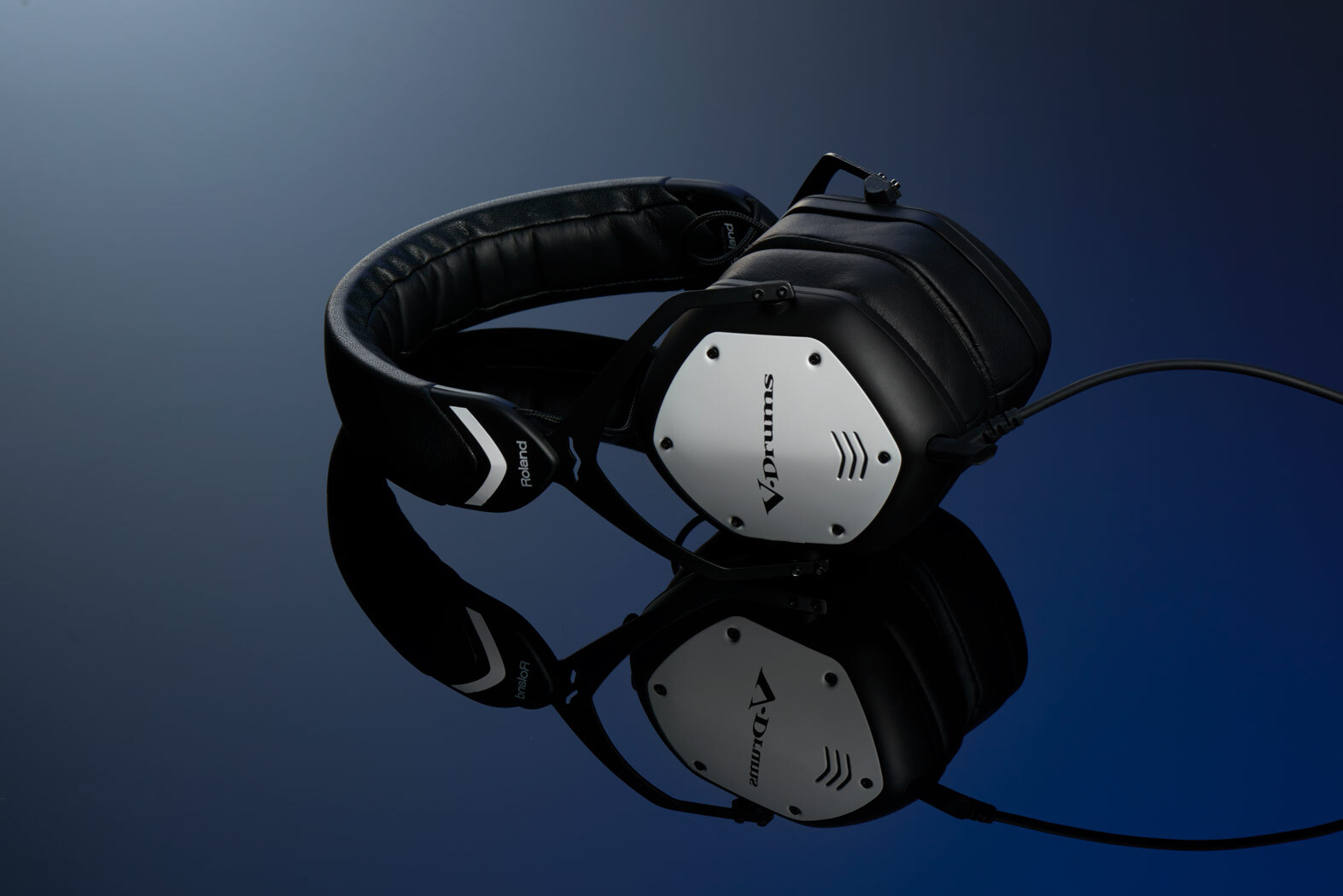
Now things get specialised. The Roland VMH-D1 V-Drums Headphones were developed specifically for electronic drumming, and that changes the engineering priorities.
Roland uses custom 50mm dual-diaphragm drivers, with an enormous specified frequency response of 5Hz–40kHz, 32-ohm impedance and sensitivity of 100dB ±3dB at 1kHz. The headphones weigh approximately 285g.
But those numbers only tell part of the story. When you're playing an electronic drum kit, you're dealing with two sounds simultaneously.
There's the magnificent drum sound coming from the module. And then there's the physical noise of you repeatedly battering rubber or mesh objects with wooden sticks.
The VMH-D1 uses form-fitting earpads designed to provide isolation from acoustic pad noise and outside sound, helping the electronic kit dominate the listening experience.
That's not a generic headphone feature being repurposed for drums. That's a drummer problem being addressed directly.
Somebody at Roland Has Actually Played Electronic Drums
And you can tell. Roland includes two detachable cables.
There's a long 3-metre cable intended for playing drums and a shorter 1.5-metre cable for ordinary music listening. There's even a cable retainer designed to route the lead behind your neck while you're playing. Tiny detail. Huge difference.
Because the last thing you need halfway through an enthusiastic fill is a headphone cable migrating across your chest and attempting to form a meaningful relationship with the drumsticks.
Roland also includes a headphone hanger designed to attach to drum and cymbal stands, plus a carrying pouch and 6.3mm adaptor.
That's thoughtful. Finish practising. Headphones go on the kit.
Tomorrow, they're exactly where you left them.
Electronic drummers deserve nice things too.
Roland RH-300
Now We're Listening Properly
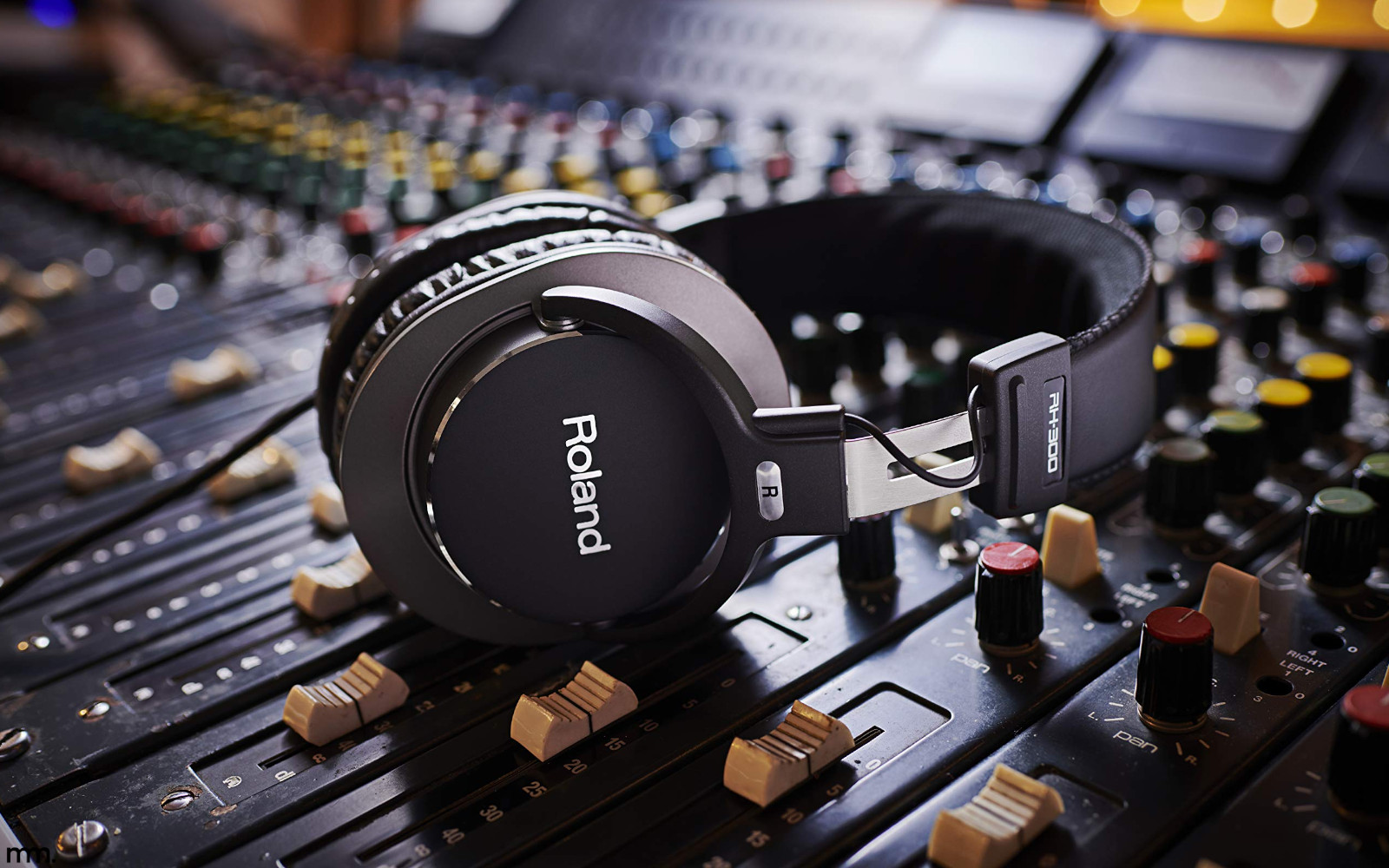
And at the top of this particular ladder sits the Roland RH-300 Monitor Headphones.
These are Roland's premium closed-back monitoring headphones, designed around professional studio work and serious instrument monitoring.
Inside are custom 45mm drivers with neodymium magnets and CCAW voice coils. Frequency response stretches from 10Hz to 25kHz, impedance is 40 ohms, sensitivity is 101dB/mW, and maximum input reaches a substantial 1600mW. Weight is approximately 250g without the cable, while the fixed straight OFC cable runs to 3.4 metres.
But here's the specification that matters most: Roland has designed them towards a natural, flat and accurate monitoring response.
That's the destination we've been travelling towards.
Not "make the bass enormous". Not "make everything shiny".
Tell me what's there.
For producers and engineers, that's everything.
Why Flat Can Be Beautiful
There is a philosophical difference between a headphone designed primarily for enjoyment and one designed primarily for monitoring.
A consumer headphone is perfectly entitled to have a personality.
Perhaps there's more bass. Perhaps the treble has been softened. Perhaps the entire tuning is designed to make music immediately exciting.
Lovely.
But if you're mixing music, there's a danger. Imagine your headphones exaggerate the bass significantly. You mix until the bass sounds perfect.
Then somebody plays the finished track through a more neutral system. Where has the bass gone?
You compensated for the headphones. That's why monitoring accuracy matters.
The closer your listening system gets to giving you trustworthy information, the more confidently you can make decisions that translate elsewhere.
Laptop. Car. Bluetooth speaker. PA. Studio monitors.
A mix has to leave home eventually.
Good monitoring helps prepare it for the journey.
So Which Headphones Do You Actually Need?
This is the question.
Not which headphones are best? Best for what?
If you need affordable wired headphones for practice, keyboards, electronic instruments, DJ use or basic home recording, the Stagg SHP-5000H is an extremely sensible starting point.
If you want affordable studio monitor headphones with big 50mm drivers, low 32-ohm impedance and a detachable extended coiled cable, the Donner M100 offers an enormous amount of practicality for the money.
If your priority is wireless music listening, college, commuting and everyday life, the lightweight Sony WH-CH520 with Bluetooth 5.2 and up to 50 hours of playback makes much more sense than pretending you need studio monitoring on the bus.
For an affordable entry into proper Audio-Technica studio monitoring, the ATH-M20x is a proven, lightweight closed-back option.
Move to the ATH-M50x and you're entering one of the most established professional monitoring designs around, with bigger 45mm drivers, extended response, excellent isolation and wonderfully useful detachable cables.
If you're an electronic drummer, the Roland VMH-D1 makes a completely different argument because it's actually engineered around the physical realities of playing an electronic kit.
And if you're looking for premium closed-back studio headphones for serious monitoring, production and instrument work, the Roland RH-300 sits proudly at the top of our current selection.
Different ears. Different jobs. Different budgets.
That's exactly how it should be.
Don't Forget the Music
And this is perhaps our favourite part.
You don't have to be producing. You don't need to be recording. You don't need to know what impedance means.
You don't need a DAW open. You don't need to be analysing anything.
Sometimes you can just put on a pair of good headphones, sit somewhere comfortable and listen to an album from beginning to end.
Remember that? No skipping after eleven seconds. No scrolling. No notification arriving halfway through the chorus.
Just listen.
Hear where the instruments sit. Notice the decisions somebody made. Listen to the space around the voice. Follow the bass for an entire song. Then the drums.
Then forget about all of that and simply let the record happen.
Headphones can be professional tools.
They can be practice equipment. They can be studio monitoring systems.
But they can also create one of the smallest listening rooms in existence.
One chair. Two drivers. One person.
There is still something rather magnificent about that.
Headphones at Musicmaker Dublin
We've currently got an unusually tasty spread of headphones for musicians, producers, electronic drummers, pianists, home studios and everyday listening at Musicmaker, covering a broad range of budgets.
And we'd strongly recommend trying different pairs rather than shopping entirely by specifications.
Head shape matters. Ear shape matters. Comfort matters enormously.
And your ears are, inconveniently, attached specifically to you.
A specification sheet can tell you the Audio-Technica ATH-M50x uses 45mm drivers. It cannot tell you how the M50x feels on your head after an hour.
It can tell you the Roland VMH-D1 reaches a specified 5Hz–40kHz. It cannot tell you how much you'll appreciate its isolation while playing your electronic kit
And it can tell you the Sony weighs only 147g. It cannot tell you which album you're going to fall in love with while wearing it.
That's the human bit.
And it's rather important.
From the Musicmaker Workshop
We've spent more than four decades helping musicians make sound at Musicmaker, but listening has always been the other half of the equation. A good pair of headphones can make practice more private, recording more precise and familiar music unexpectedly new again. From affordable Stagg and Donner headphones to Audio-Technica studio favourites, Sony wireless listening and specialist Roland monitoring, the right pair isn't necessarily the most expensive one on the wall. It's the pair that suits what you're actually doing — and makes you want to keep listening.
Because before you can decide what the music needs next, you have to hear what's already there.
So put the headphones on. And shut up for a minute.
There's music playing.