



The Mighty MIDI: Donner Controllers Have Arrived
Keys, Pads, Beats and an Entire Studio at Your Fingertips
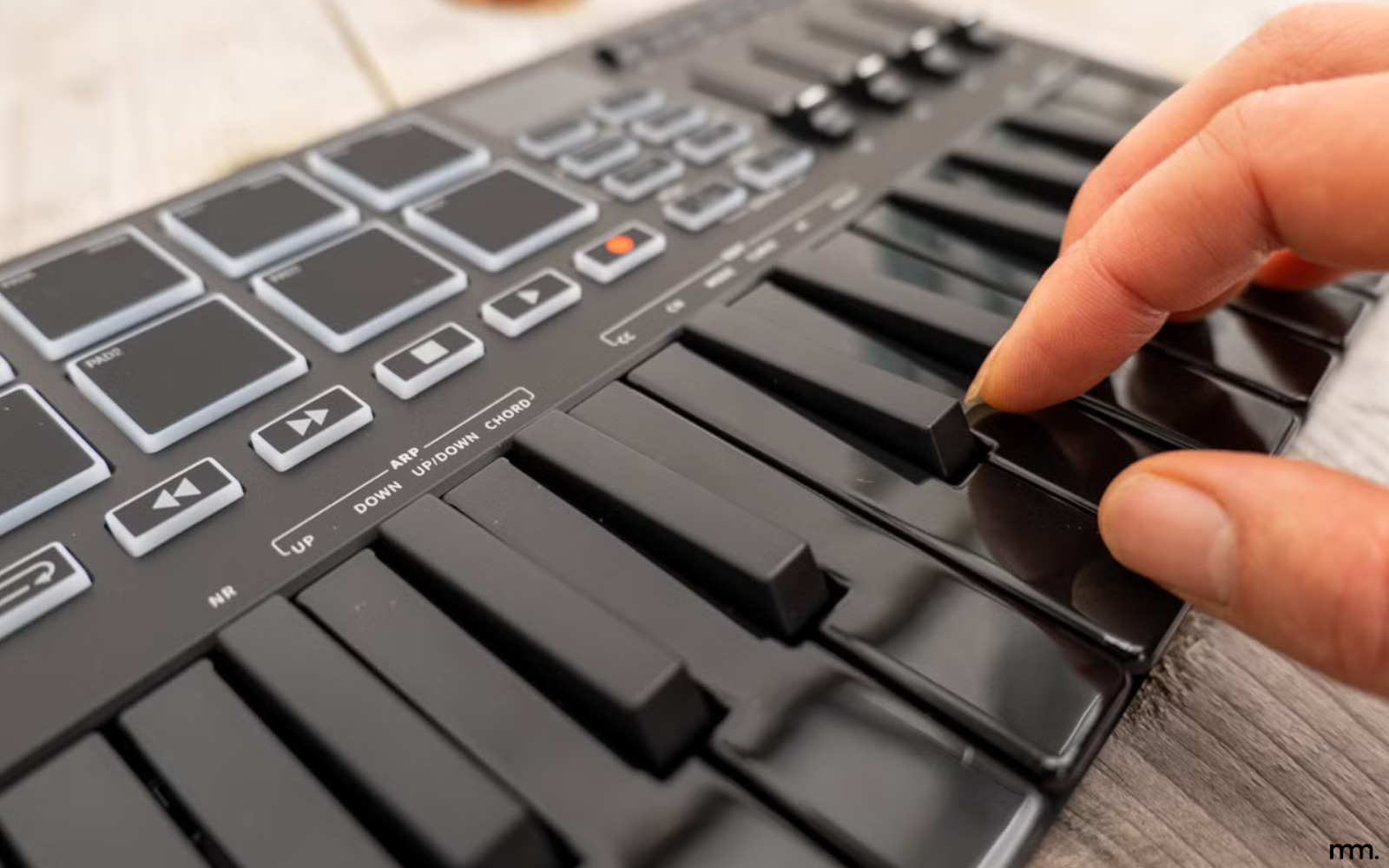
You buy your first MIDI keyboard.
You plug it in. You press a key.
And...
Nothing.
No piano. No synthesizer. No enormous cinematic BRAAAAAAM.
Nothing at all.
Congratulations.
You've just discovered what makes MIDI brilliant.
A MIDI controller isn't really an instrument in the traditional sense. It doesn't necessarily make any sound of its own. Instead, it tells other things what to do — and that beautifully simple idea has become one of the foundations of modern music production.
One little keyboard can play a grand piano in the morning, an analogue-style synthesizer after lunch, a string orchestra that evening and an absolutely disgusting 808 bass at approximately 1:37am.
Same keys. Completely different universe.
And right now, Musicmaker is swimming in some wonderfully accessible new ways to enter it: the Donner N-25 25-Key MIDI Keyboard Controller, Donner N-32 32-Key MIDI Keyboard Controller, Donner STARRYPAD MIDI Pad Controller and the considerably more sophisticated Donner DMK-25 Pro MIDI Controller.
Producers, beatmakers, songwriters, electronic musicians, bedroom studio obsessives and inveterate knob-twiddlers...
This one's for you.
First Things First: What the Hell Is MIDI?
MIDI stands for Musical Instrument Digital Interface, and the clever bit is that MIDI doesn't normally contain recorded audio.
It contains instructions.
Play this note. Play it this hard. Stop it now.
Move this control. Change this parameter.
Sustain these notes.
Start the sequencer. Stop the sequencer.
Go absolutely bananas with the filter.
That distinction is enormously powerful.
Record an acoustic piano with a microphone and you've recorded the sound of that performance. Record a MIDI performance and you've captured information about what you played. That means you can change the sound afterwards.
Played your part using a virtual piano?
Turn it into a Rhodes. Or strings. Or a synth. Or bells.
Or a bass patch from another dimension.
You can change notes, move their timing, alter velocity, transpose the performance, change tempo and automate parameters without asking the musician to play the entire thing again.
MIDI separates performance from sound.
And once that idea clicks, modern music production opens up spectacularly.
Forty Years Old and Still Running the Studio
The really beautiful thing is that MIDI isn't some shiny new invention.
The original MIDI specification emerged in the early 1980s as synthesizer manufacturers sought a common language that would allow electronic instruments from different companies to communicate. That interoperability proved extraordinarily powerful.
More than four decades later, MIDI remains everywhere.
Synthesizers. Drum machines. Digital pianos. Guitar processors.
Electronic drums. Lighting systems. Hardware sequencers.
And, of course, the modern DAW — Digital Audio Workstation.
Open Ableton Live, Logic Pro, FL Studio, Cubase, GarageBand, Studio One, Reaper or another modern production environment and MIDI becomes one of the principal ways human hands communicate with software.
You can draw every note into a piano roll using a mouse.
You can also eat soup with a fork.
There are better tools.
Donner N-25
Twenty-Five Keys. Almost No Desk Required.
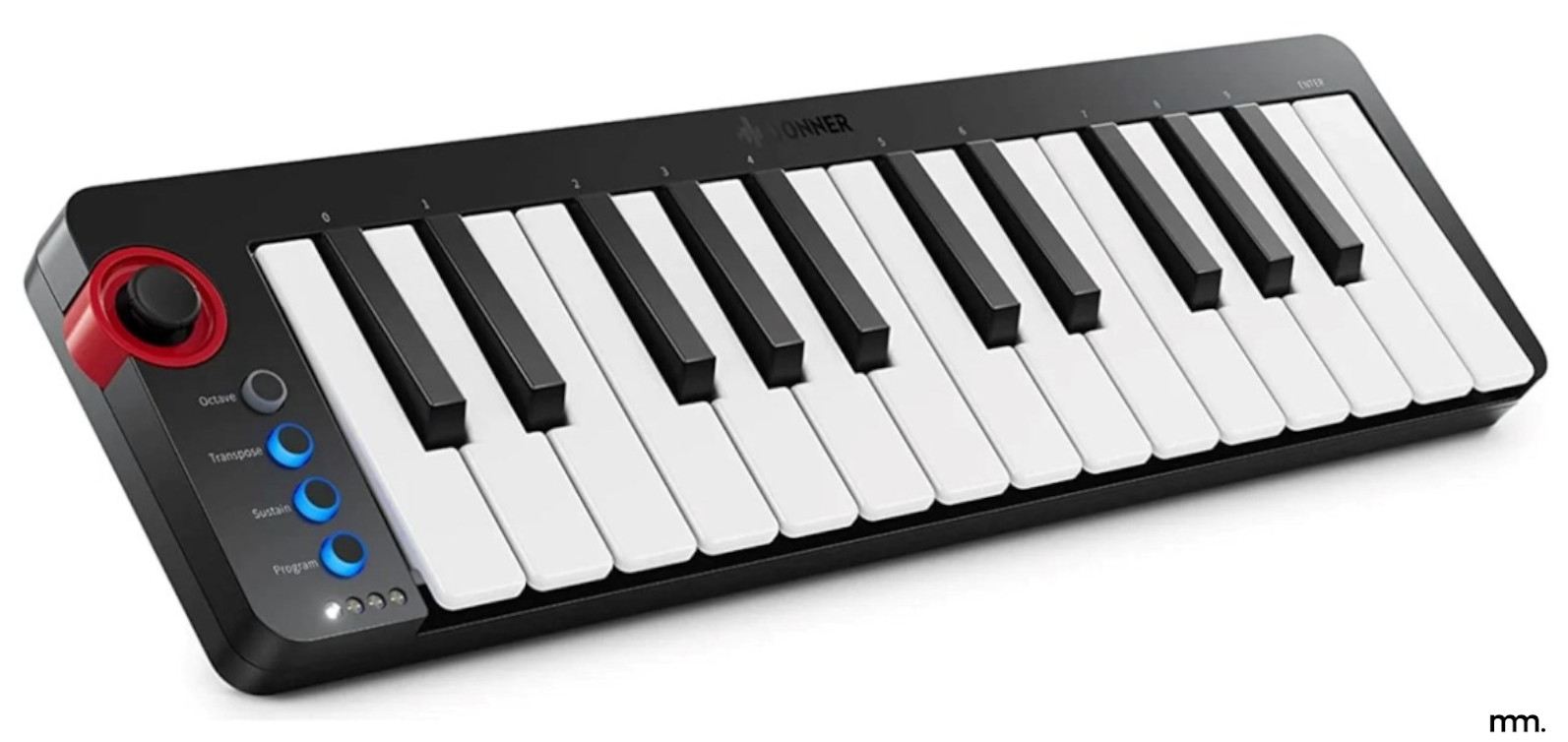
The Donner N-25 MIDI Keyboard Controller is MIDI stripped back to the essentials.
You get 25 velocity-sensitive mini keys in a controller measuring roughly 13 x 4 x 1.3 inches, weighing only 450g. Power and computer communication come through USB-C, while Donner also provides MIDI output for connecting compatible external MIDI equipment.
And that simplicity is exactly the point.
The N-25 isn't trying to become the control surface for Abbey Road. It's designed for somebody who wants to get ideas from fingers into software with the least possible ceremony.
Velocity sensitivity means the controller doesn't merely know which note you've played; it can transmit information about how hard you struck it. Load a responsive virtual piano, drum instrument or synthesizer and that information becomes dynamics, articulation or another mapped parameter.
There are dedicated controls for octave, transpose and sustain, plus program control with four programmable memory banks. That octave control is particularly important on a 25-key controller: you're physically carrying only a couple of octaves beneath your hands, but the button lets those same keys travel across a far wider MIDI note range.
For a first MIDI keyboard for music production, that's an extremely approachable proposition.
Tiny footprint. USB-C. Velocity sensitivity.
Get the melody out of your head before it escapes.
Donner N-32
Seven More Keys. Quite a Lot More Mischief.
Then things become more interesting.
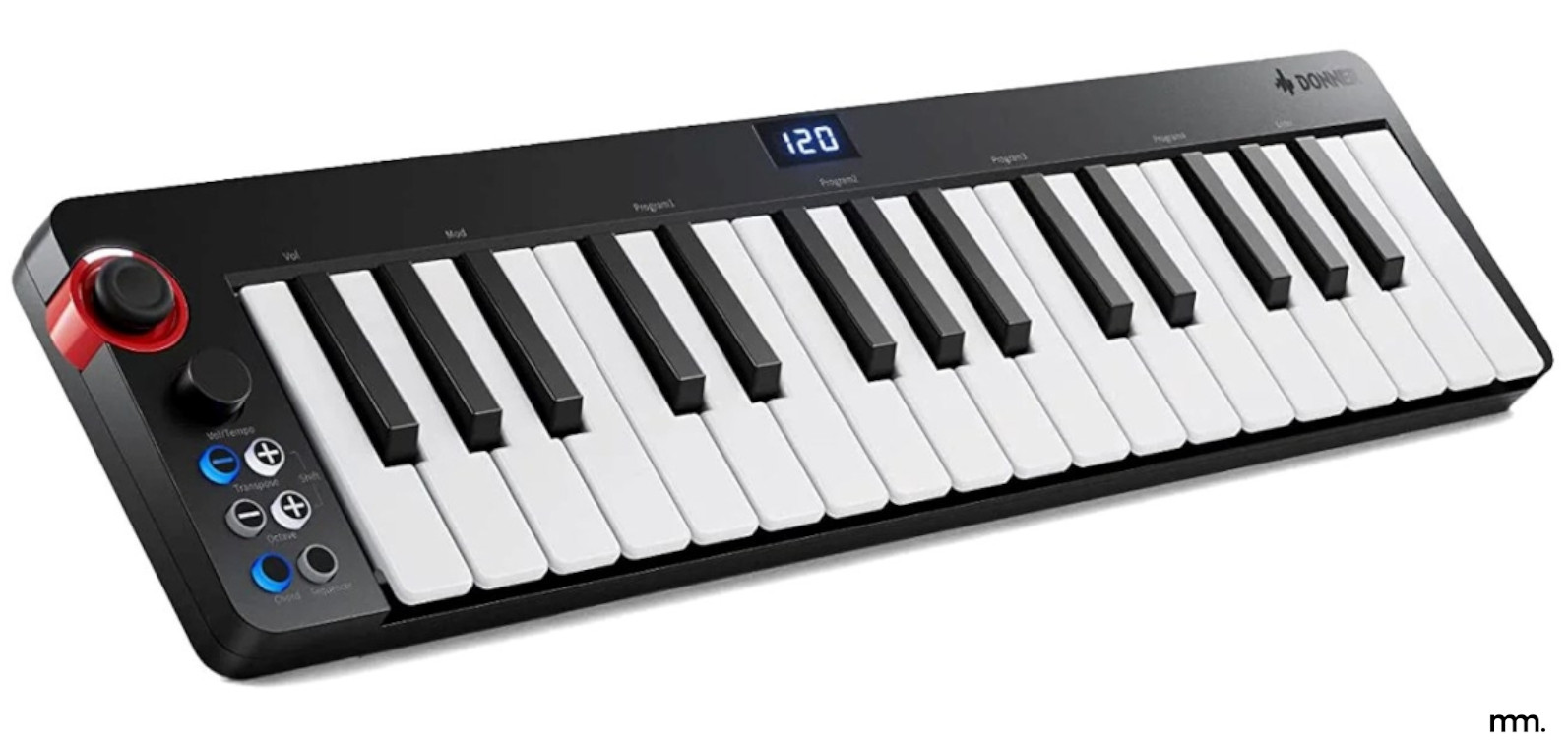
The Donner N-32 MIDI Keyboard Controller expands the physical keyboard to 32 velocity-sensitive mini keys, but the bigger story is what Donner has built around them.
There's a chord function, arpeggiator, sequencer, octave control, pitch control and support for sustain pedal operation, alongside four user-programmable banks. A small display gives useful visual feedback, and the controller provides USB-C plus 3.5mm MIDI output, allowing it to work not only with computer-based production software but also as part of compatible hardware MIDI setups.
It remains wonderfully portable too: Donner lists it at approximately 16.7 x 4.3 x 1.3 inches and just 460g.
That combination makes the N-32 particularly interesting for the songwriter who isn't necessarily a keyboard player.
An arpeggiator can take held notes and turn them into repeating patterns. Chord functions can make harmonic experimentation more immediate. A sequencer introduces the idea of building phrases rather than simply performing everything from beginning to end.
Suddenly the controller isn't only receiving ideas from you.
It's helping you generate them.
And that distinction is enormous.
You Do Not Need to Be a Pianist
This deserves saying loudly. You do not need to play piano to use a MIDI keyboard.
For producers, the keyboard is often simply the fastest interface for finding pitch.
Bassline? One finger will do.
Drum programming? The white and black keys can trigger samples.
Synth pad? Hold three notes and move a filter.
String arrangement? Build it one part at a time.
A small MIDI controller isn't asking you to sit down and perform Rachmaninoff. It's giving you a tactile relationship with software.
And tactile relationships matter.
Music feels different when you're playing it rather than entering coordinates into it.
Donner STARRYPAD
Get Your Fingers Off the Mouse
Of course, not every musical idea wants a piano keyboard. Some need to be hit.
Enter the Donner STARRYPAD MIDI Pad Controller.
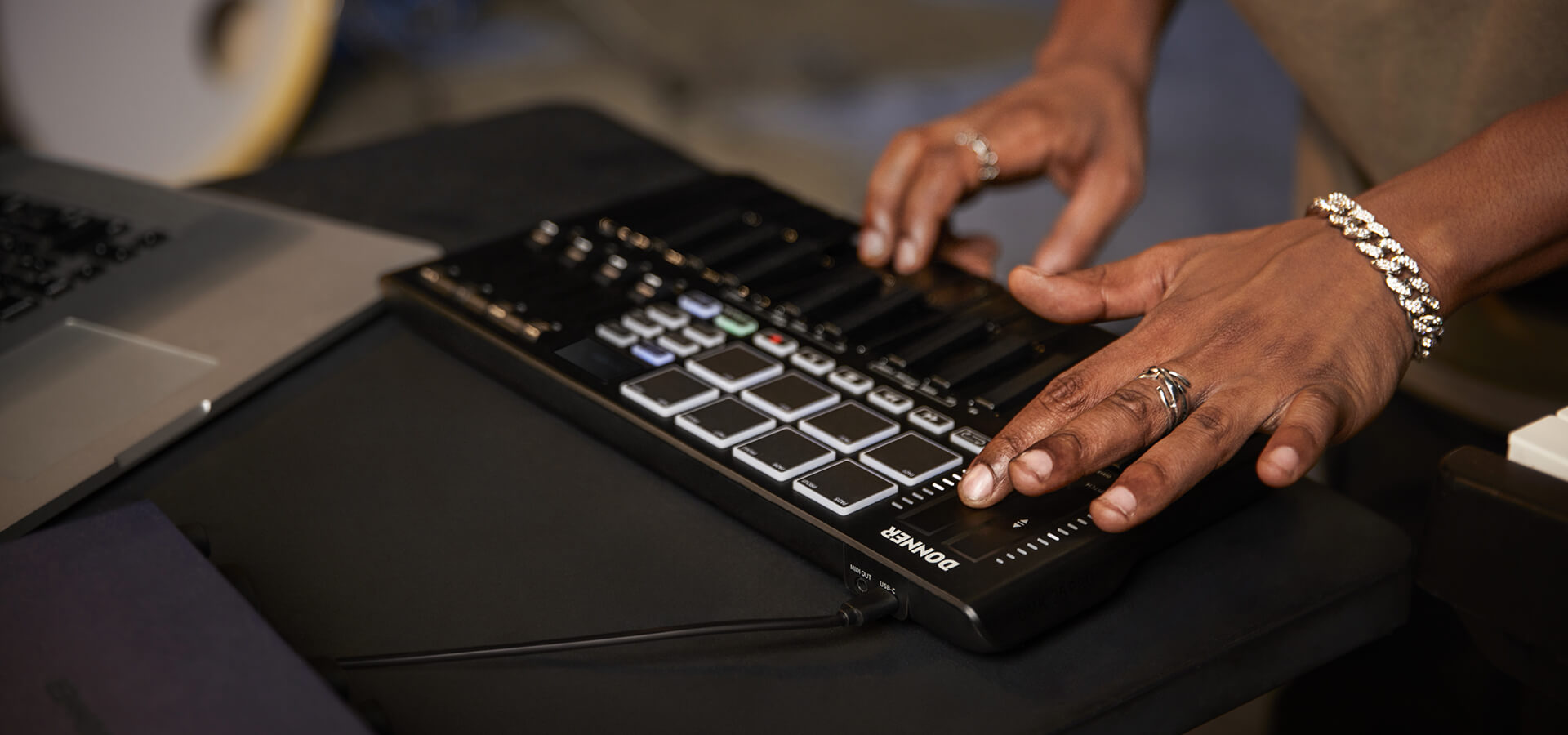
At its centre are 16 soft silicone, velocity-sensitive backlit pads, designed for triggering drums, percussion, samples, loops and effects. Switch through three pad banks and those 16 physical pads provide access to 48 assignable pad positions.
That's where beatmaking becomes physical.
Kick. Snare. Hi-hat. Clap. Percussion.
Sample. Another sample that you promised yourself you weren't going to use.
Now hit everything.
Velocity sensitivity is particularly important here because drums played at identical levels sound relentlessly mechanical. Hit a pad gently and your software can receive a lower velocity value; hit harder and it receives a higher one. With a properly configured drum instrument, those differences can influence volume, sample layers and articulation.
Suddenly the groove has shape.
Sixteen Pads Are Only the Beginning
The STARRYPAD also includes two assignable faders and two assignable knobs, along with customisable controls that can be mapped to functions inside a DAW or virtual instrument. USB-C handles connection and power, while MIDI connectivity allows the controller to become part of a broader hardware setup.
That word — assignable — is one of the keys to understanding MIDI controllers.
A knob doesn't necessarily have to be volume.
Tell the software what you want it to control.
Filter cutoff. Reverb. Delay feedback. Pan.
Synth resonance. Effect depth. Automation.
Now instead of carefully drawing a curve with a mouse after recording, you can grab a physical control and perform the movement.
That's one of those apparently tiny workflow changes that can completely alter how music gets made.
Automation stops looking like accountancy.
It starts feeling like performance.
Donner DMK-25 Pro
Now We're Cooking
And then we arrive at the Donner DMK-25 Pro.
This is where the compact MIDI keyboard starts turning into a proper production command centre.
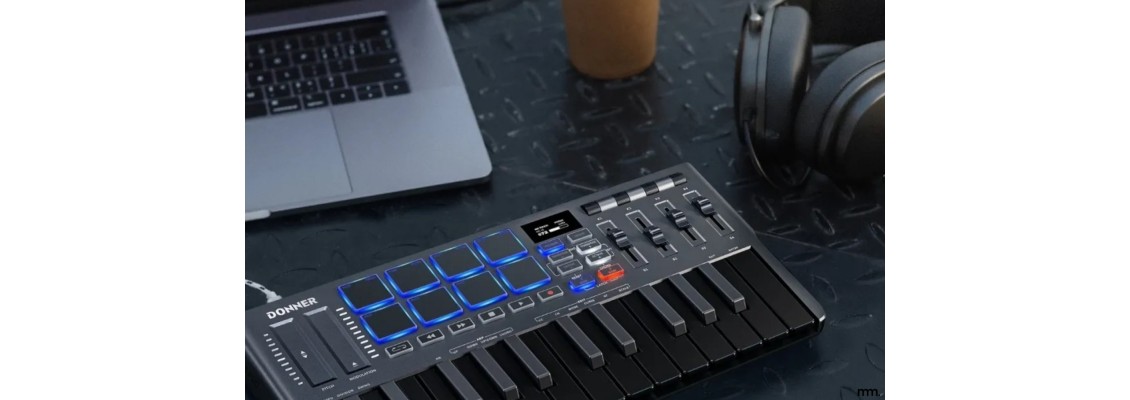
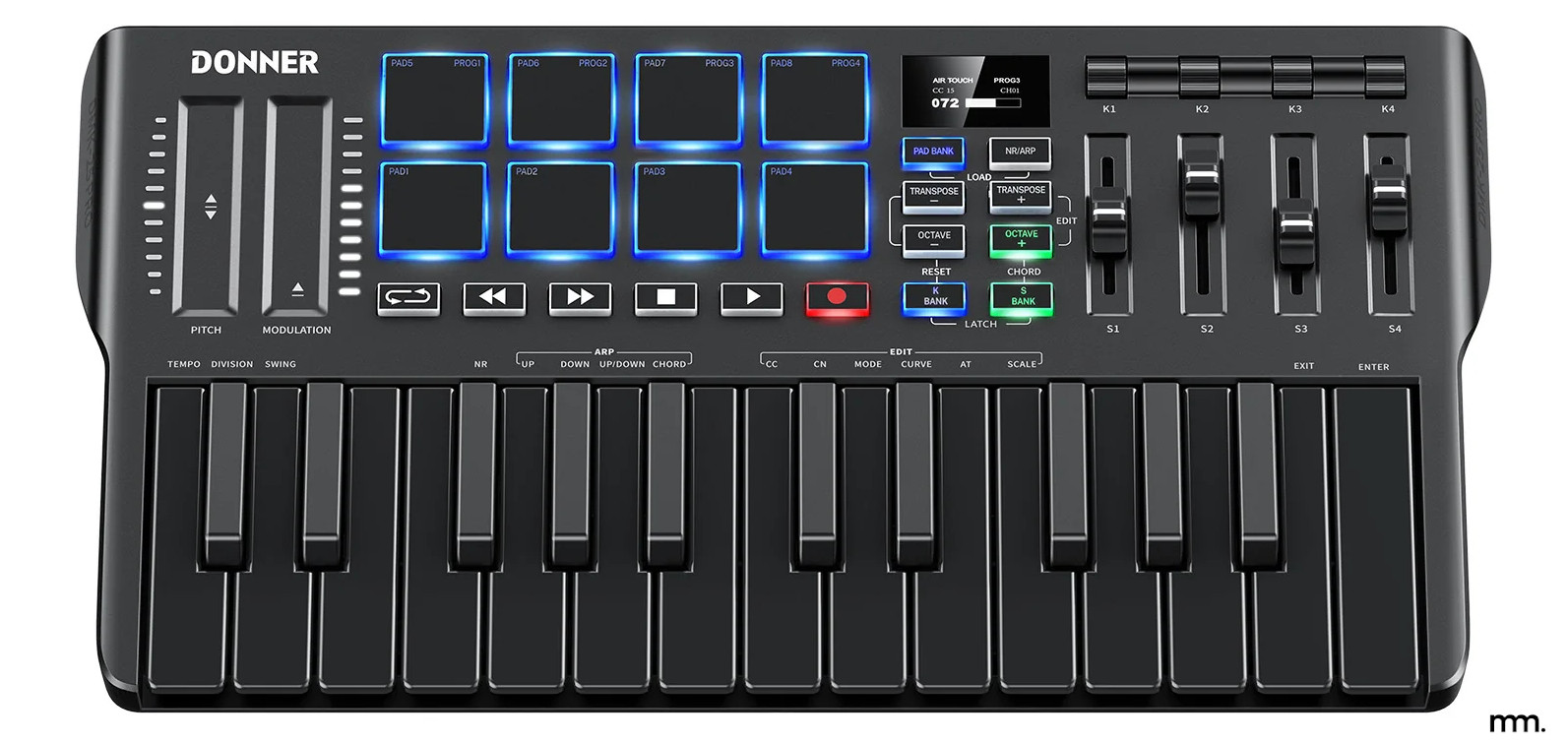
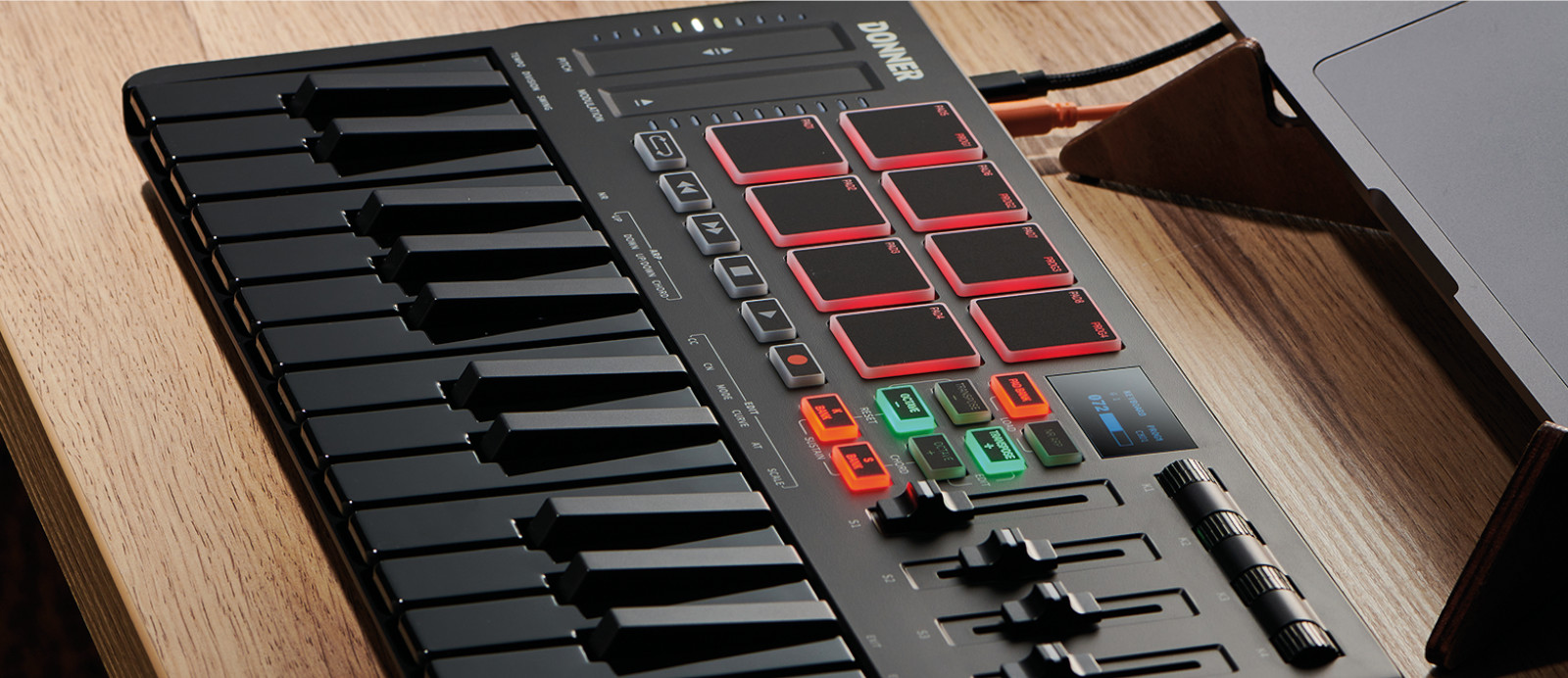
The DMK-25 Pro uses 25 velocity-sensitive mini keys alongside eight velocity-sensitive backlit pads, four assignable knobs, four assignable sliders, function controls, six transport buttons and an OLED display for visual feedback. Donner also uses touch strips for pitch bend and modulation, complete with illuminated visual feedback.
All of this fits into a controller roughly 34cm wide and weighing around 0.68kg.
That's almost ridiculous.
A serious amount of studio control has been squeezed into something you can throw into a backpack.
Scale Mode: Music Theory Without the Headache
One of the DMK-25 Pro's particularly clever features is its Dynamic Scale Mode, offering 16 scales.
This isn't about replacing musical knowledge. It's about making experimentation easier.
Select a scale and the controller can help keep melodic exploration inside a particular harmonic framework. For somebody beginning to produce electronic music, hip-hop, pop or soundtrack material, that can remove the paralysis of staring at a keyboard and wondering which of the twelve notes are currently going to ruin everything.
It can also be useful for experienced producers.
Set a scale. Stop thinking. Start improvising.
Restrictions are surprisingly good for creativity.
Chords, Arpeggios and Note Repeat
The DMK-25 Pro also includes Chord, Arpeggio and Note Repeat functions.
Each tackles a different part of the production process.
Chord mode can turn simple input into richer harmonic material. The arpeggiator converts held notes into rhythmic sequences, opening the door to pulsing synth lines and evolving patterns. Note Repeat is particularly tasty with the eight pads, allowing rapid repeated hits for hi-hats, percussion and electronic drum programming.
This is where a MIDI controller stops being a miniature piano.
It becomes a composition tool.
Control the DAW Without Living on the Trackpad
Then there are those six transport controls.
This is one of the least glamorous specifications on the DMK-25 Pro and potentially one of the most useful.
Play. Stop. Record. Move around the session.
The less frequently you have to interrupt a musical idea to reach for the mouse, the more the studio begins to feel like an instrument rather than an office workstation.
The four assignable knobs and four sliders take that further. Map them to mixer levels, virtual synth controls, effect parameters or whatever your particular workflow demands.
And because the OLED display provides feedback, you're not operating completely blind.
It's compact hardware designed to keep your hands involved.
That's the whole point.
MIDI Is Not Just for Computers
Here's where the tinkerers get their reward. MIDI can connect much more than a keyboard to a laptop.
A controller with appropriate MIDI output can talk to compatible hardware synthesizers, sound modules, drum machines and other MIDI-equipped equipment. One device can play another. A sequencer can tell several instruments when to start. Controllers can change parameters elsewhere in a rig.
And because MIDI is fundamentally a language rather than a particular sound, enormously different instruments can understand the same basic instructions.
That's why the technology has endured.
It's musical Lego.
Once you understand how the pieces communicate, you start building increasingly questionable structures.
We strongly encourage this.
From Bedroom Producer to Proper Studio
The other beautiful thing about these Donner MIDI controllers is how low the barrier to entry has become.
A laptop or compatible mobile device. A DAW. A pair of headphones. A small MIDI controller.
That's enough to begin making serious music.
Your virtual instrument collection can contain synthesizers, sampled grand pianos, orchestras, drum machines, basses and experimental instruments that would once have required a room full of extraordinarily expensive hardware.
The controller becomes your doorway into all of them.
Start with the N-25 if you want simplicity and extreme portability.
Move to the N-32 if the extra keys and onboard creative functions appeal.
Choose the STARRYPAD if beats, samples and finger drumming are the centre of your world.
Reach for the DMK-25 Pro when you want keys, pads and significantly deeper hands-on control over the production process.
There isn't really a hierarchy here.
There are workflows.
And the best controller is the one that gets between the idea and the recording as little as possible.
Why Musicmaker Loves MIDI
We've watched music-making change enormously at Musicmaker since the early 1980s.
Studios that once required enormous budgets can now exist on desks. Synthesizers that once filled rooms exist inside laptops.
A song can begin on a train, move to a bedroom studio that evening and end up on a record without ever passing through a traditional commercial studio.
MIDI has quietly been underneath that revolution for decades, and that's why affordable controllers like these Donner models matter.
They aren't exciting because they make production easier in some dismissive sense. They're exciting because they make experimentation cheaper.
You can learn synthesis. Make beats. Try orchestration. Program drums. Control hardware. Write basslines. Automate effects.
Discover that your innocent little eight-bar loop has somehow consumed the entire weekend.
All from a device small enough to disappear underneath your arm.
That's extraordinary.
The Mouse Is Excellent. Your Hands Are Better.
Computers have given musicians almost unlimited possibilities.
But music remains physical.
We tap rhythms on tables. We hum melodies. We turn things.
Hit things. Hold notes.
Move our hands instinctively when we're trying to explain how something should sound.
A great MIDI controller reconnects that physical instinct with the enormous power sitting inside modern music software.
That's the magic. Not 25 keys. Not 32 keys. Not 16 pads.
Connection.
An idea happens in your head. Your hands catch it.
MIDI carries it somewhere else.
And suddenly there is music where, a few seconds earlier, there was nothing.
Forty-odd years after electronic instruments first began speaking this common language, that's still pretty bloody miraculous.
Donner MIDI Controllers at Musicmaker
The new Donner MIDI range at Musicmaker Ireland includes the Donner N-25 25-Key MIDI Keyboard Controller, Donner N-32 32-Key MIDI Keyboard Controller, Donner STARRYPAD MIDI Pad Controller and Donner DMK-25 Pro 25-Key MIDI Controller, giving producers and musicians a wonderfully accessible route into MIDI recording, beatmaking, virtual instruments, DAW control and hardware experimentation.
Come in. Plug something into something else.
Press a button. See what happens.
That's basically how electronic music got started anyway.
From the Musicmaker Workshop
Musicmaker has been watching musicians find new ways to record, compose and experiment since the early 1980s, and few technologies have travelled that entire journey as successfully as MIDI. We love these Donner controllers because they put that enormous creative language within reach of almost anyone. From a first beat tapped into the STARRYPAD to a complete production built around the DMK-25 Pro, the important part isn't how complicated the setup looks. It's how quickly an idea becomes something you can hear.