




Your Guitar Might Not Suck. Change Your Strings.
There is a particular kind of guitarist who will spend six months researching pickups.
They will watch seventeen comparison videos, read forum threads written by men who have not experienced sunlight since 2008, learn the DC resistance of a PAF replica to three decimal places and eventually spend several hundred euro replacing the electronics in a guitar because it has become, apparently, a little lifeless.
The strings have been on it since Christmas. They are black beneath the first three frets. One of them has developed a small ecosystem.
This guitarist does not need new pickups.
This guitarist needs a cloth and an intervention.
Welcome to one of the cheapest, simplest and most criminally neglected ways to change the sound and feel of your instrument: guitar strings.
Strings are where the entire business begins. Your fingers or pick set them in motion, the vibrating string drives an acoustic guitar's top or generates the changing magnetic field detected by an electric guitar pickup, and everything downstream works with the signal created by that initial vibration. Change the material, construction, gauge, tension or condition of those strings and you change the relationship between your hands and the instrument.
And yet guitarists are magnificent creatures. We will buy another overdrive pedal because the existing seven somehow don't contain enough transparent warmth, while six pieces of exhausted wire remain stretched across the guitar like telecommunications infrastructure from the Soviet era.
So before you sell the guitar, replace the pickups or begin blaming the tonewood:
Your Strings Are Probably Disgusting
We should probably deal with this first. Strings live an unpleasant life.
Every time you play, they encounter sweat, oils, skin, dirt and moisture. On wound strings, contaminants can work their way into the tiny spaces around the wrap wire. Corrosion develops, the surface changes, and the lively high-frequency content associated with a fresh string gradually diminishes. Elixir describes a string becoming "dead" in terms of losing the intensity of frequencies it exhibited when new, while Martin similarly identifies sweat and oil accumulation as a cause of corrosion and tonal degradation.
You can often feel the decline before consciously hearing it. A fresh set has a certain elasticity and responsiveness under the fingers. Harmonics jump out. Chords have definition. Intonation can feel cleaner because the strings themselves haven't spent months being repeatedly pressed against metal frets.
Then, gradually, everything gets a little less exciting. And because the deterioration happens slowly, you adapt to it.
That's the trap.
Put a new set on after months of neglect and suddenly the guitar seems to have undergone a religious experience. There is attack again. Chords separate. The top end returns. You start playing things simply because the instrument feels good beneath your hands.
How Often Should You Change Guitar Strings?
Here is the irritating but correct answer:
It depends.
There is no universal guitar-string calendar. Someone gigging four nights a week in hot venues is putting strings through a very different life from someone playing gently for an hour on Sunday afternoon. Your body chemistry matters. Humidity matters. How aggressively you play matters. Coated versus uncoated construction matters. Wiping the strings after playing matters.
And your taste matters.
Some players adore that explosive brightness immediately after restringing. Others prefer strings once the initial zing has settled. Bassists are particularly magnificent in this regard, because somewhere on Earth right now there is almost certainly a bass player protecting a set of flatwounds older than several members of the band.
So don't obsess over an arbitrary number of weeks.
Pay attention to tone, feel, visible corrosion, tuning behaviour and intonation. If the strings feel rough, look unpleasant, refuse to stay convincing or sound dull compared with what you expect from the instrument, the guitar may already be asking you nicely.
Listen before it begins shouting.
Gauge: 9s, 10s, 11s and the Masculinity Crisis
Gauge simply describes string diameter, normally expressed in thousandths of an inch. A set described as "10s", for example, typically begins with a .010-inch high E, although the remaining gauges vary between sets and manufacturers.
Under otherwise equivalent conditions, increasing gauge increases tension. Heavier strings therefore generally feel firmer, resist bending more strongly and can tolerate a heavier picking attack before being displaced as dramatically. Lighter strings feel easier to bend and fret, which can be glorious for expressive electric playing and extremely helpful for beginners developing finger strength.
Neither is morally superior.
If 9s make you play better, use 9s. If 11s give you the resistance you want, use 11s.
If you play enormous low tunings and require something resembling suspension-bridge cable to stop the bottom string flapping around, excellent.
But don't put brutally heavy strings on your guitar because somebody on a forum told you that real tone starts at thirteen and then spend every solo fighting the instrument like you're attempting to bend reinforcing steel.
The point is control.
The best gauge is the one that gives your tuning, scale length, technique and hands the relationship you want.
And if you're making a significant gauge change, remember that your guitar may need adjustment. String tension affects neck relief, action and the behaviour of tremolo systems, while nut slots can become an issue with substantially heavier strings.
A badly considered setup is less amusing.
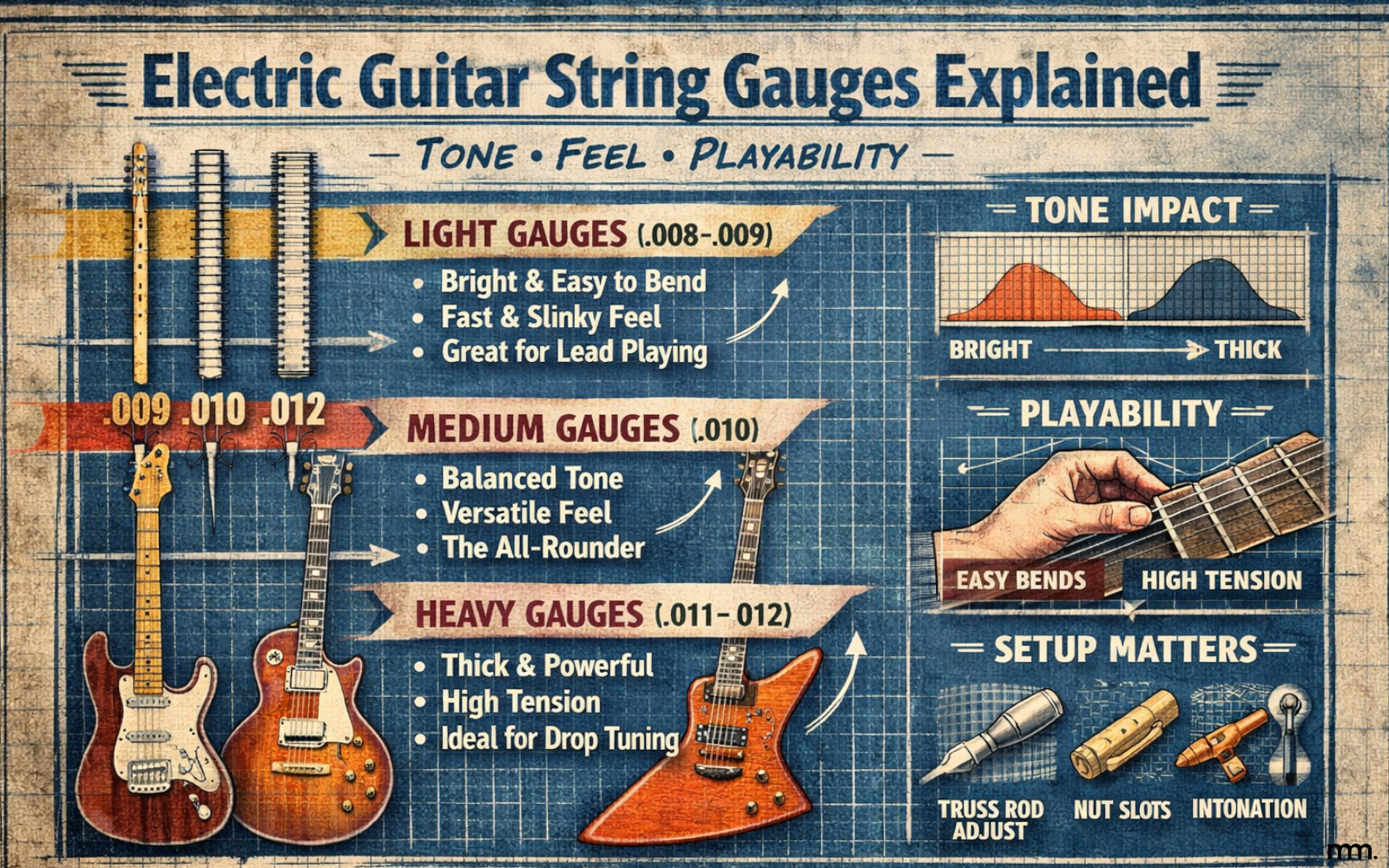
Electric Guitar Strings: Nickel, Steel and Glorious Violence
For electric guitars, nickel-plated steel has become an enormously familiar starting point because it provides a useful balance of magnetic response, brightness, feel and versatility. You'll find it across ranges from several of the manufacturers we're about to discuss.
But it isn't the only flavour.
Pure nickel can pull things towards a warmer, rounder character associated with older electric-guitar sounds. Stainless steel can be brighter and more assertive. Then core design, wrap construction, gauge and coating alter the picture further.
This is why strings are such a fantastic tone experiment.
You don't need a soldering iron. You don't need to remove a pickup. You don't need to explain another €250 transaction to your significant other.
Spend a relatively modest amount. Put on different strings.
Listen.
Acoustic Strings: Phosphor Bronze vs 80/20 Bronze
Acoustic players get an especially delicious version of this problem because the strings are mechanically driving the instrument itself.
Two of the great territories here are phosphor bronze and 80/20 bronze.
80/20 bronze guitar strings typically use a wrap alloy of approximately 80% copper and 20% zinc. They tend towards a bright, projecting character, which can be magnificent on a guitar that benefits from extra immediacy and sparkle.
Phosphor bronze uses a different bronze formulation and is commonly associated with a somewhat warmer, balanced voice while retaining plenty of clarity. D'Addario, for example, describes its current Phosphor Bronze range as warm, bright and balanced, while its 80/20 Bronze strings are positioned towards a deeper, brighter, projecting character.
Which is better? Oh no. We're not doing that.
A naturally warm instrument may come alive with the attack of 80/20. A brighter guitar might pair beautifully with phosphor bronze. Your playing style changes the result again.
Experimentation is not an inconvenience here.
Experimentation is the point.
D'Addario: The Engineers Have Entered the Building
If you enjoy the technical side of strings, D'Addario can become a dangerous website to visit.
The company's current catalogue stretches across electric, acoustic, bass, classical and numerous other fretted instruments, with everything from familiar XL sets through NYXL, XT, XS, Chromes flatwounds, ProSteels, pure nickel and Pro-Arté classical strings. D'Addario even sells extensive ranges of individual strings and supports custom configurations.
For electric players, NYXL has become one of D'Addario's major premium families, built around the company's NY Steel high-carbon core concept. But acoustic players should pay particular attention to XS, because this is where D'Addario has gone heavily into the modern coated-string problem: how do you extend life without making the string feel as though it has been laminated?
On XS Phosphor Bronze, an ultra-thin film protects the wound strings while the plain steels receive their own polymer treatment. Underneath sits a NY Steel core and phosphor-bronze wrap, with D'Addario's Fusion Twist used at the ball end. D'Addario describes XS Phosphor Bronze as its longest-lasting acoustic string and claims 131% better tuning stability than its standard acoustic strings.
The broader acoustic catalogue also gives us XS and XT versions of both phosphor bronze and 80/20, alongside uncoated alternatives and Nickel Bronze, so this is a superb brand for the player who wants to conduct actual experiments rather than simply buy the packet they recognise.
Change one variable. Play. Listen.
Become insufferably knowledgeable.
Excellent.
Elixir: For People Who Hate Changing Strings
Some guitarists enjoy restringing.
They clean the fingerboard, polish the frets, carefully wind each post and enjoy the little ritual of restoring an instrument. Other guitarists would rather file a tax return in a burning building.
Elixir Strings understands the second group.
Elixir's entire identity was built around extending useful string life through protective coatings that prevent contamination reaching the gaps between windings. The company's development process involved laboratory analysis, wear testing and large-scale player trials before its coated-string concept reached market, and today's range uses POLYWEB, NANOWEB and OPTIWEB coatings to provide different combinations of feel and tonal character.
And the differences are worth understanding.
On electric guitar, OPTIWEB is intended to get closest to the crisp tone and natural grip of an uncoated string. NANOWEB pushes towards a bright tone with a smoother feel, while POLYWEB has a warmer character and slicker sensation beneath the fingers. All three share Elixir's fundamental goal of protecting the wound string from the debris and corrosion that kill useful tone.
For acoustic players, Elixir's Phosphor Bronze NANOWEB combines that protective technology with the rich, balanced character of phosphor bronze, while its 80/20 offerings provide another tonal route.
They're particularly compelling for players whose hands destroy conventional strings rapidly, guitars that spend substantial time exposed to environmental changes, working musicians who want predictable performance, or people who simply want to spend more time playing and less time feeding the machine heads.
Also guitarists who cannot remember the last time they changed strings.
You know who you are. Actually, you probably don't.
That's the problem.
Ernie Ball: The Colour-Coded Language of Rock & Roll
You can identify certain guitar strings from across a room.
Pink packet? Super Slinky.
Bright green? Regular Slinky.
This may be one of the greatest contributions to guitarist survival ever devised, because it means somebody can walk into Musicmaker after twenty years of playing and say: "The green ones."
And somehow everybody knows what is happening.
Ernie Ball traces the Slinky story back to 1962, and the company's strings have become thoroughly embedded in electric-guitar culture during the decades since. Its modern catalogue stretches far beyond the classic sets, but those familiar gauges remain wonderfully straightforward reference points: Super Slinky 9–42, Regular Slinky 10–46, Power Slinky 11–48, heavier hybrid configurations and extended-range options.
Acoustic players have Earthwood, a line Ernie Ball introduced in 1972 during the great expansion of acoustic music through rock and popular culture.
Then there is Paradigm, where Ernie Ball takes the familiar Slinky concept and starts adding armour. Paradigm electric strings use high-strength steel, reinforcement around the ball-end twist of the plain strings, corrosion-resistant treatment and plasma-enhanced wrap wire, all with the stated aim of improving break resistance and longevity while retaining Slinky feel and tone.
Paradigm acoustic sets similarly exist in both phosphor bronze and 80/20 formulations.
So Ernie Ball gives us both ends of the beautifully irrational guitarist brain.
Want the classic packet you've bought since you were fifteen? Done.
Want technologically reinforced strings because you attack the guitar as though it owes you money?
Also done.
Check out the Ernie Ball HERE.
Martin: Acoustic Guitars Deserve Proper Vocal Cords
There is something pleasingly inevitable about Martin making strings.
The company has been making guitars since 1833 and acquired the Darco string company in 1970, bringing string manufacturing directly into its operation. Martin's argument is wonderfully simple: strings are too important to acoustic tone to treat as an afterthought.
And the current Martin range is enormous.
There are Authentic Acoustic SP sets in phosphor bronze and 80/20 bronze, Lifespan 2.0, Flexible Core, Marquis, Retro, Silk & Steel, and more specialised constructions beyond those.
For the acoustic guitarist trying to understand strings rather than merely replace them, that breadth is extremely useful.
Martin's Authentic Acoustic Lifespan 2.0 strings use an anti-corrosion treatment applied to protect the core and wrap wire while aiming to retain natural tone and feel, and they're available in both phosphor bronze and 80/20 bronze.
Then Retro takes us somewhere different again, giving players another material and tonal philosophy to explore rather than treating all acoustic strings as variations on one formula.
And that's important because an acoustic guitar is extraordinarily sensitive to the strings driving it. If you own a beautiful acoustic and have decided it sounds a little uninspiring, putting a different string formulation on it is such an inexpensive experiment that not trying it before shopping for another guitar borders on negligence.
We are still perfectly happy to sell you another guitar.
Obviously.
We simply believe in scientific procedure.
Check out Martin Strings HERE.
Savarez: The Classical Players Were Nerds Before You
Electric guitarists occasionally behave as though they invented obsessing over strings.
Classical players would like a word.
Savarez takes us into an entirely different world, because classical guitar strings introduce variables that steel-string players rarely have to consider in quite the same way: different treble materials, bass constructions and tension options can profoundly alter response beneath the right hand and resistance beneath the left.
This is where familiar Savarez families such as Alliance, Cantiga, Corum and Creation enter the conversation, with different combinations allowing classical guitarists to explore response, projection, texture and feel.
And this is why classical strings should never be reduced to: "They're nylon, aren't they?"
Mate. Walk into a room of serious classical guitarists and say that.
We'll wait outside.
Classical players can become extraordinarily particular about the behaviour of the trebles, the transition from treble to wound basses, the tension beneath the fingers and the balance across the instrument. A string choice that makes one cedar-topped classical guitar bloom beautifully might not be the combination a player prefers on another instrument.
Same principle. Different rabbit hole.
Considerably better posture.
Stringjoy: For the Player Who Has Started Doing Maths
And now we arrive at Stringjoy.
There is a point in a guitarist's development when buying strings by the traditional light/medium/heavy categories ceases to satisfy them.
They begin saying things like:
"I like tens, but the low E feels slightly loose in Drop D."
This is how it starts. Soon there are tension calculators involved.
Stringjoy is magnificently suited to this kind of player because the Nashville manufacturer has made balanced gauges and customisation a major part of its identity. Instead of accepting that the gauges somebody chose for a conventional set decades ago must necessarily be ideal for your guitar, tuning and technique, you can begin thinking about the tension relationship across the strings themselves.
And this becomes especially useful for alternate tunings, extended-range instruments and hybrid sets.
Perhaps you want familiar resistance on the top strings but a more substantial bottom end. Perhaps your tuning drops individual strings far enough that a conventional set becomes uneven. Perhaps you simply have strong opinions.
The company also has some fascinating modern coated options. Orbiters are coated nickel electric strings using an enamel-coated nickel-plated steel wrap over an uncoated core, while Foxwoods apply a related philosophy to coated phosphor-bronze acoustic strings. Stringjoy says Foxwoods can provide two to three times the longevity and peak brightness of its uncoated strings, and its current coating is PFAS-free.
This is the beautiful end-stage of string nerdery. You are no longer asking: "What strings should I buy?"
You are asking: "What tension profile do I want across a 25.5-inch scale in this tuning?"
Your family misses the person you once were.
We think you've never been happier.
Check out the Stringjoy Gear HERE.
And Now, the Grown-Ups: Thomastik-Infeld
While guitarists are fighting online about whether 9s have enough tone, the orchestral players are standing quietly in the corner wondering why it has taken us this long to mention Thomastik-Infeld.
Violin and cello strings deserve their own universe of discussion because string choice on a bowed instrument affects response, projection, articulation, stability and the way an individual instrument speaks under the bow.
And these players are listening very closely.
Thomastik-Infeld is one of the great names here. For violinists, Dominant is one of those string names that has become part of the vocabulary of the instrument, while cellists exploring the Thomastik-Infeld catalogue will encounter celebrated families such as Spirocore.
Unlike the relatively straightforward world of a standard electric-guitar set, bowed-string players frequently think about individual strings as components of a complete tonal system. A violinist may want a particular response from the E while seeking warmth elsewhere; a cellist may be balancing projection and bow response across strings with dramatically different physical roles.
For the student progressing into a better violin or cello, changing strings can therefore become an important part of discovering what the instrument is capable of.
And yes, guitarists: The violinists have also been obsessing about string tension.
They just do it quietly.
Coated vs Uncoated Strings: Fight!
This used to be a much simpler argument.
Uncoated strings offered the traditional feel and sound; coated strings traded some of that immediacy for longer useful life.
Modern string design has made that distinction considerably messier.
Elixir has multiple coating technologies specifically intended to produce different feels and tonal characteristics. D'Addario's XS uses an extremely thin film on the wound strings plus treatment for the plains. Stringjoy coats the wrap wire of Orbiters and Foxwoods while leaving the core uncoated. Martin's Lifespan 2.0 takes the route of an anti-corrosion treatment rather than simply describing the string as conventionally coated.
So coated vs uncoated guitar strings is no longer a single binary choice. The useful question is what you value.
If you adore the immediacy of traditional strings, change them frequently and don't suffer serious corrosion problems, conventional uncoated strings may make complete sense.
If you murder strings with sweat, gig constantly, dislike restringing or want more consistent useful life, modern coated or treated strings deserve a serious look.
And if you last tried coated strings fifteen years ago and hated them?
Try some current ones.
String technology did not politely freeze in time because you formed an opinion in 2011.
Roundwound vs Flatwound: Welcome to the Dark Side
Most guitarists and bassists encounter roundwound strings first. The outer wrap wire has a rounded profile, giving the string that familiar textured surface and generally contributing to a bright, harmonically rich attack. Flatwounds use flattened outer wrap wire to create a much smoother surface.
And that changes things.
The feel becomes slicker. Finger noise drops. The tonal balance becomes smoother and generally less aggressively bright, with a fundamental-heavy character that can be absolutely glorious for jazz guitar, vintage bass sounds and anyone who thinks their instrument should sound as though it knows where the good whiskey is kept.
Put flatwounds on a bass that has spent its life wearing bright rounds and you may wonder who replaced your instrument during lunch.
That's why strings are fun. They are not merely consumables.
They are temporary modifications.
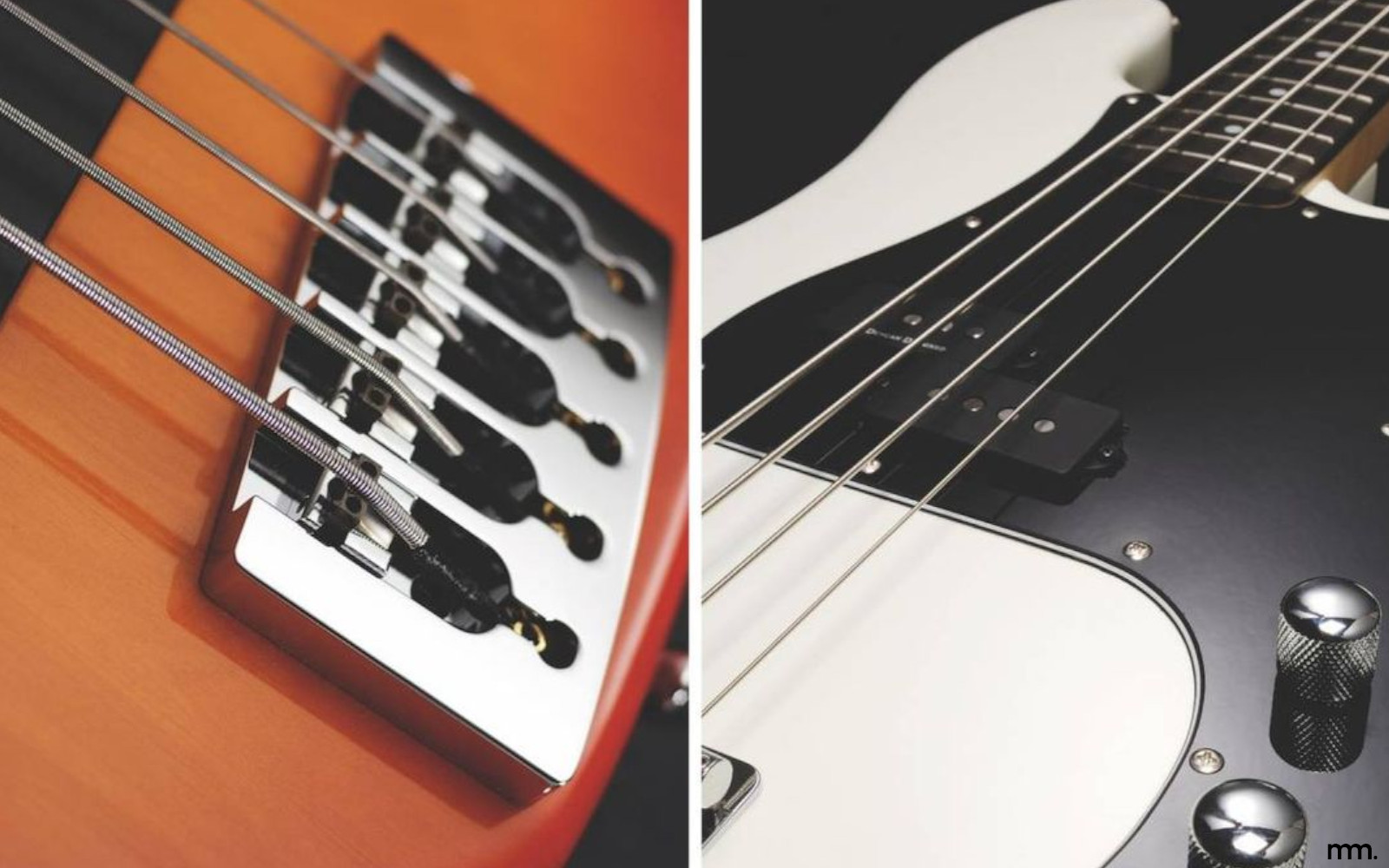
The Cheapest Tone and Feel Experiment You Can Make
This is the point we really want to hammer home at Musicmaker Dublin.
Guitarists spend enormous amounts of money chasing tone, and that's fine. We are a musical-instrument shop. We wholeheartedly endorse behaviour that results in more guitars entering the world. But strings are one of the cheapest opportunities you have to learn something meaningful about the instrument you already own.
If you have always used 10s, try 9s. If your acoustic always wears phosphor bronze, hear what happens with 80/20.
If you destroy conventional strings, try Elixir, D'Addario XS, Martin Lifespan or one of Stringjoy's coated constructions.
If you're experimenting with unusual tunings, investigate Stringjoy and start thinking about individual gauges.
If your classical needs a different response, explore Savarez.
If the violin or cello has reached the point where the strings are holding the instrument back, look at Thomastik-Infeld.
And if your guitar currently has strings old enough to remember the previous Taoiseach?
From the Musicmaker Workshop
One of the best things about the string wall at Musicmaker is that it represents hundreds of different answers to what appears, initially, to be an extremely simple question.
What six strings should I put on my guitar? Then you start playing.
The question changes.
What gauge? What material? Coated or uncoated? Phosphor bronze or 80/20? Roundwound or flatwound?
Traditional set or balanced tension? Standard tuning or dropped? Long life or maximum fresh-string attack?
D'Addario or Elixir? Ernie Ball or Stringjoy? Martin for the acoustic? Savarez for the classical? Thomastik-Infeld for the violin or cello?
There is no single correct answer because your hands, instrument, tuning, technique and ears are part of the system.
That's the joy of it. Try things.
Strings wear out anyway, which means every restring is another opportunity to conduct a small experiment. Keep track of what you like. Notice what you don't. Pay attention to how long a set lasts in your hands rather than somebody else's. Learn how different gauges affect your technique and how different materials change the personality of the instrument.
Eventually you'll find favourites.
Then, because you are a musician, you will become fiercely loyal to them for several years before inexplicably trying something completely different at 11:47 on a Tuesday night.
Perfect.
Just do us one favour.
Before you replace the pickups, sell the guitar, buy another compressor, change the bridge, blame the amplifier, question the tonewood, spend three weeks adjusting pickup height and publish a 1,700-word forum post entitled “Has My Guitar Lost Its Mojo?”...
Look down. Those strings. When did you put them on?
Exactly.