




JET Offset Guitars: Strange Shapes, Serious Value
Some guitars look as though they have sensible jobs.
You know the ones. Respectable proportions, familiar colours, everything exactly where several generations of guitar players have agreed it ought to be. They look perfectly at home playing a blues turnaround through a small valve amplifier while somebody discusses capacitors nearby.
An offset guitar has other plans.
There is something inherently rakish about the shape. The waist refuses to line up properly. The body seems to be moving even when it is hanging on the wall. Put one in Seafoam Green, black and gold or a finish called Moonburst and the message becomes fairly clear: perhaps we are not spending this evening playing Mustang Sally.
This is the wonderfully colourful territory occupied by the JET JJ-300 and JJ-350 offset electric guitars, a family of instruments that takes some much-loved alternative-guitar visual language and combines it with specifications that still feel faintly ridiculous at this end of the market.
Roasted maple necks. Roasted poplar bodies.
P-90s. Humbuckers.
Tremolos. String-through fixed bridges.
And, hiding among them, a 27-inch baritone tuned down to B and apparently dressed for an eclipse.
Welcome to the strange end of the room.
We like it here.
Why Do We Still Love Offset Guitars?
Technically, offset refers to the relationship between the two curves of the guitar's waist. Instead of sitting symmetrically opposite one another, they are displaced, creating that swept-back silhouette associated with some of the most recognisable alternative electric guitars ever made.
But the shape acquired cultural baggage remarkably quickly.
Offsets have wandered through surf music, punk, post-punk, shoegaze, indie rock, grunge and the noisier corners of experimental guitar music. Perhaps because they spent so long outside the traditional blues-and-rock establishment, they developed an identity of their own. An offset can look gloriously correct with an enormous fuzz sound, an indecent quantity of reverb or a delay pedal set several degrees beyond reasonable.
JET's JJ models understand that appeal, but they don't merely trade on the silhouette. The interesting part is how much contemporary guitar specification has been tucked underneath the retro-futurist outline.
That starts with the neck.
Across these JJ-300 and JJ-350 models, Canadian roasted maple is doing a lot of the heavy lifting. Roasting, or thermal treatment, removes moisture and alters some of the wood's physical properties, helping reduce its sensitivity to subsequent changes in humidity while producing that darker, caramelised appearance that has become highly desirable on modern electric guitars.
Once the preserve of considerably more expensive instruments, roasted maple appearing at this level is exactly the kind of detail that makes the current affordable-guitar market so interesting.
Then JET gives these instruments a Modern C neck profile, 9.5-inch fingerboard radius, 1.65-inch nut width and 22 frets. The standard JJ models use a familiar 25.5-inch scale length, giving them a reassuringly conventional playing platform underneath the unconventional body.
In other words, they look a little peculiar.
Your left hand needn't feel the same way.
JJ-300 P90: Cheap Thrills, Excellent Neck
The JET JJ-300 P90 is where the idea becomes dangerously accessible.
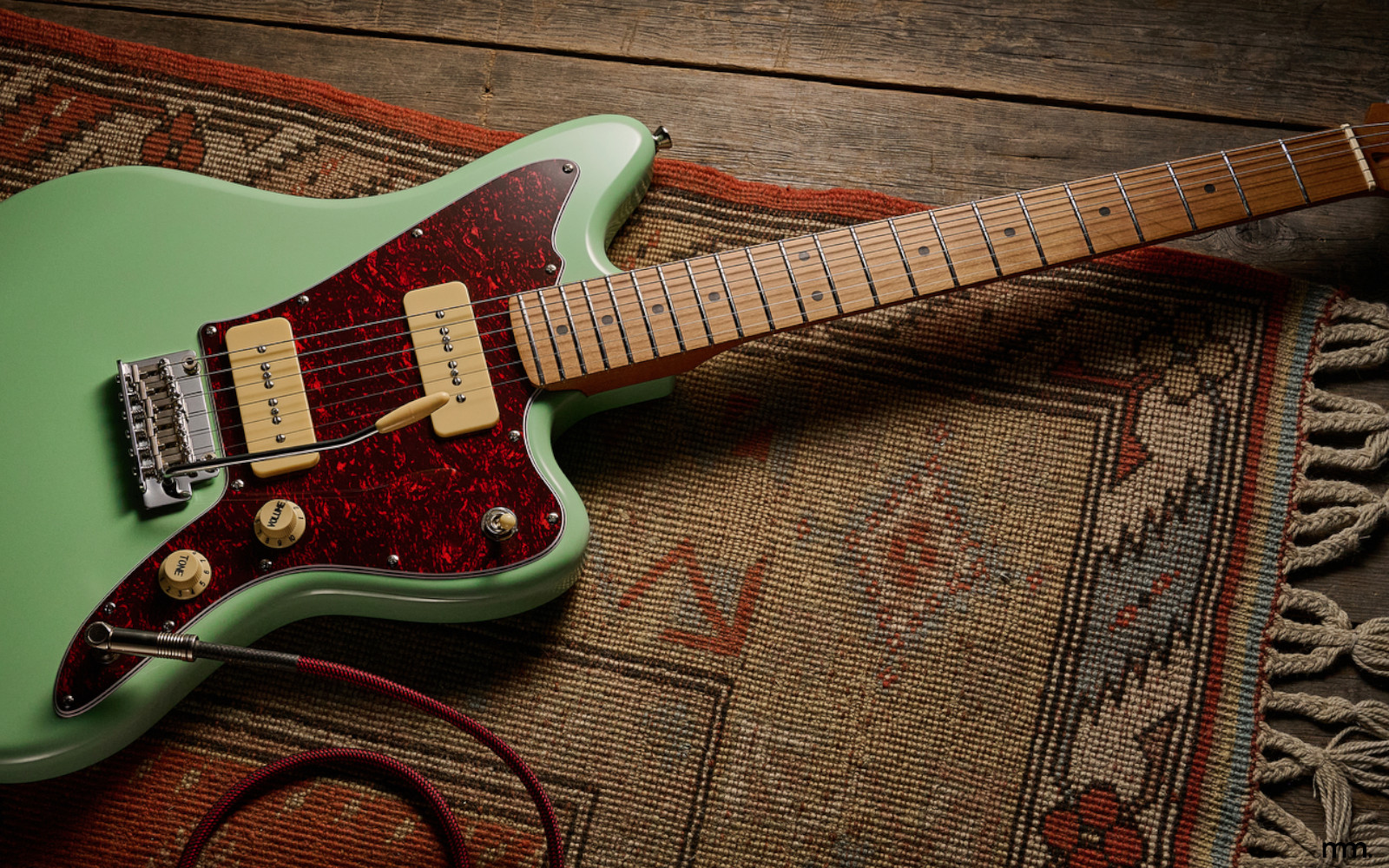
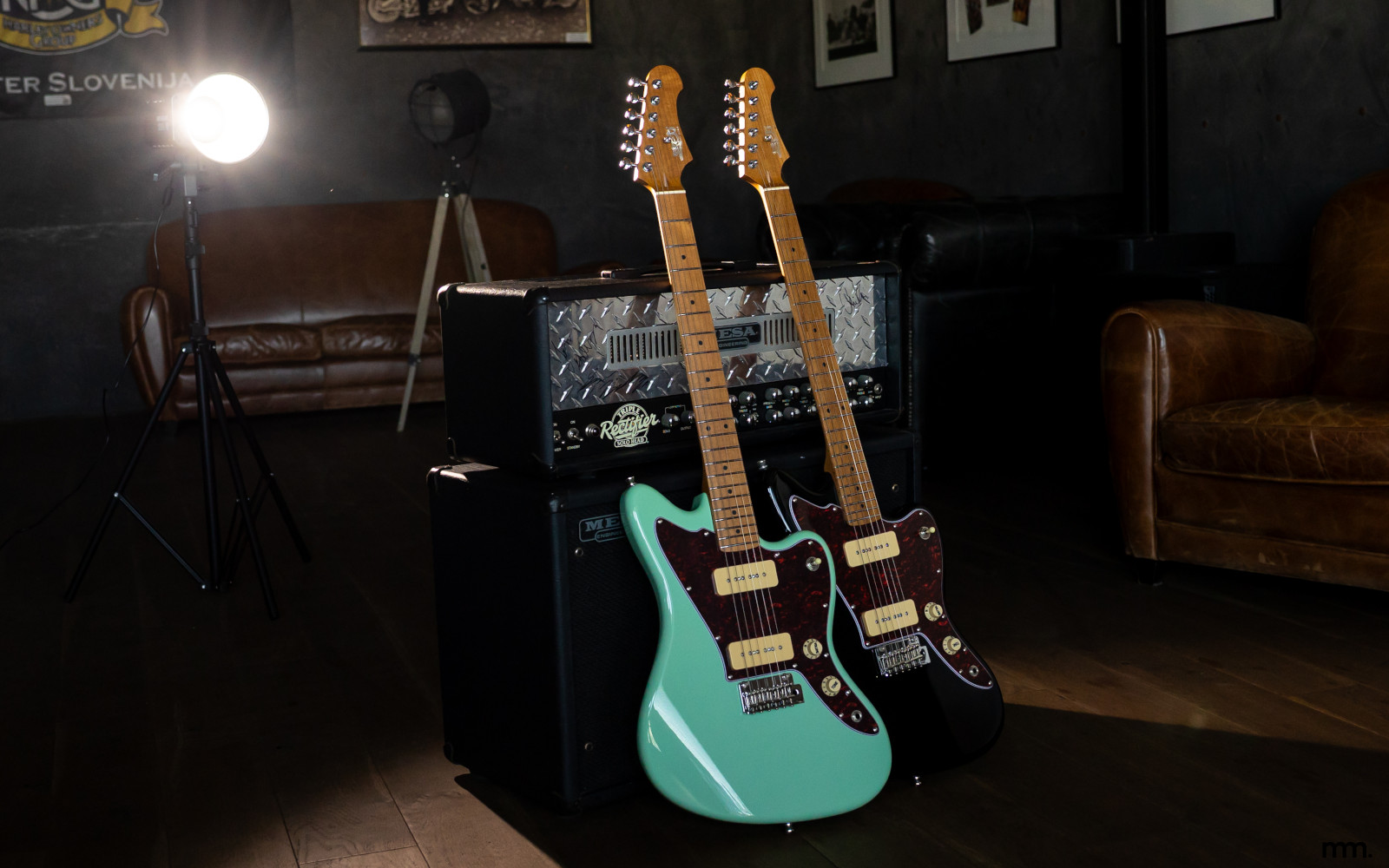
Musicmaker currently has it in White and the particularly excellent Seafoam Green, and both versions pair the offset roasted-poplar body with a Canadian roasted-maple neck and roasted-maple fingerboard. The scale is 25.5 inches, the radius is 9.5 inches, there are 22 frets, and JET fits a tremolo bridge alongside a wonderfully simple control arrangement: one volume, one tone and a three-way selector.
And then there are the P-90 pickups.
P-90s occupy one of electric guitar's most entertaining middle grounds. They are single-coil pickups, but their construction differs significantly from the narrower single coils many players associate with traditional S-style guitars. Broad coils and a different magnetic architecture contribute to a sound that can have considerably more midrange substance and attitude while retaining the attack and openness that make single coils exciting.
They can sparkle. They can bark.
They can become magnificently impolite when you introduce an overdrive pedal.
And yes, like traditional single coils, P-90s can also remind you that electromagnetic interference exists. This is part of the relationship.
In an offset guitar, though, they make enormous stylistic sense. Clean, the JJ-300 can inhabit jangly indie, surfy textures and wiry rhythm work; push the amp and the extra midrange substance gives fuzz, garage rock and alternative tones something muscular to chew on.
What makes the JJ-300 particularly appealing is that JET hasn't treated affordability as permission to make the guitar feel anonymous. Roasted maple, roasted poplar, P-90s, tremolo and proper offset styling amount to an unusually characterful specification for an affordable electric guitar.
It feels like a guitar somebody actually wanted to design. Not merely a price point somebody needed to fill.
And Seafoam Green with roasted maple?
Come on.
We are only human.
JJ-350: Things Become Slightly More Wild
Move into the JET JJ-350 family and the offset idea starts splitting into several distinct personalities.
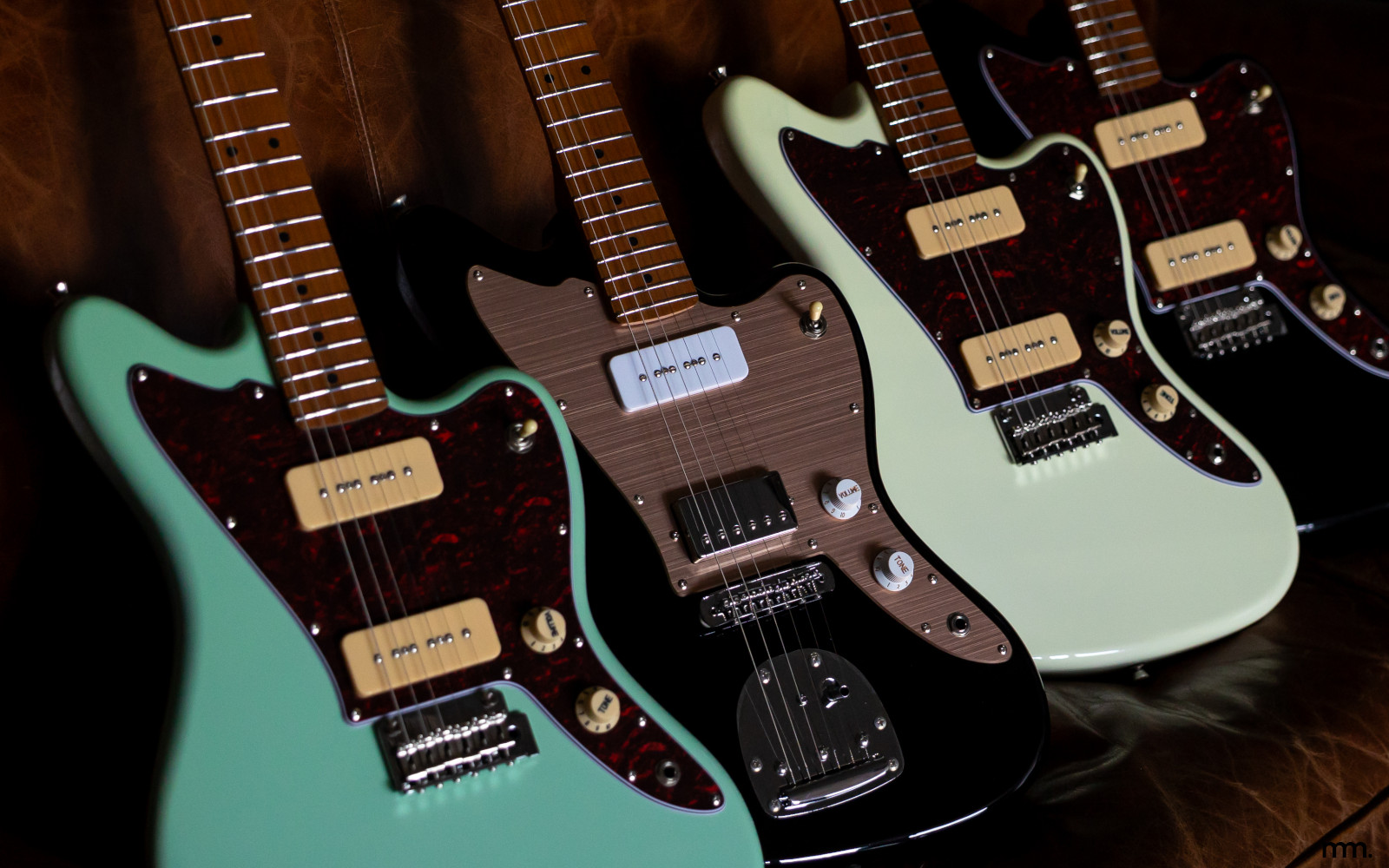
The JJ-350 BK is wonderfully severe: black body, roasted-maple neck and fingerboard, twin nickel-covered ceramic humbuckers and a fixed, string-through-body bridge. The familiar 25.5-inch scale, Modern C profile and 9.5-inch radius remain, but the playing proposition has changed substantially.
Compared with the P-90-equipped JJ-300, the HH layout points towards thicker sounds, reduced single-coil hum and the sort of output that gets along very nicely with gain. The fixed string-through bridge also gives players who have little interest in tremolo a mechanically straightforward platform with a direct feel.
Then there is the JJ-350 GR R, which takes essentially that muscular HH/fixed-bridge idea and combines it with a rosewood fingerboard and Green finish. JET currently specifies the same roasted-poplar body, Canadian roasted-maple neck, 25.5-inch scale, 9.5-inch radius and twin own-spec ceramic humbuckers.
The rosewood board subtly changes the visual language of the guitar. Against that green body and roasted neck, it looks less like an exercise in retro correctness and more like something assembled after somebody spent a productive evening looking through old record sleeves.
We approve.
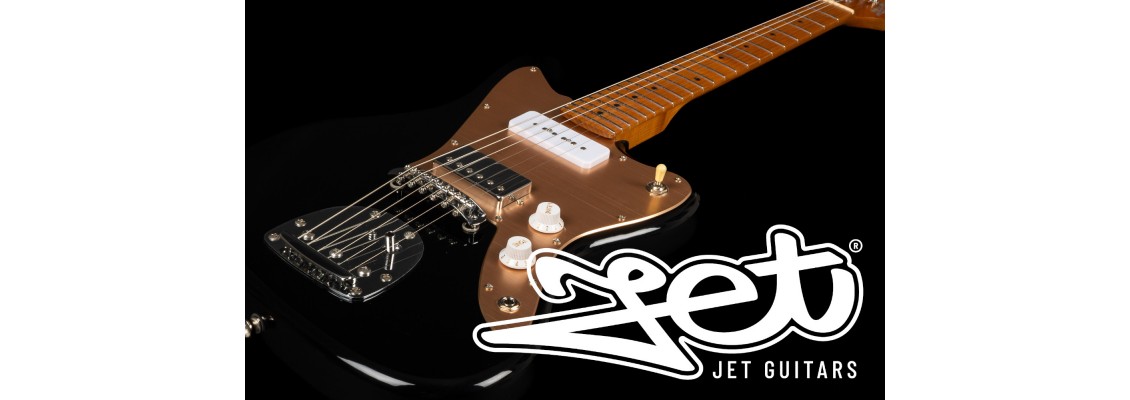
But the magnificent peacock in this particular garden is the JJ-350 BGT. Black. Gold pickguard. Roasted maple.
There is absolutely no attempt at modesty here.
More interestingly, the BGT changes the electronics again, combining an Alnico V humbucker with a P-90 and pairing them with a vintage-style tremolo. You still get the 25.5-inch scale, 22 frets, Modern C roasted-maple neck and simple one-volume, one-tone, three-way control layout, but the H+P-90 pickup combination gives this version its own tonal proposition.
That's an appealing arrangement because the two pickup types offer different textures rather than merely louder and quieter versions of the same basic voice. A humbucker brings density and noise-cancelling practicality; the P-90 brings that broader single-coil attack and midrange character.
Put those ingredients into a black offset with a gold guard and you have something that looks as though it should be leaning against an amplifier in a venue nobody can find because the entrance is behind a laundrette.
That is praise.
Roasted Maple Has Escaped the Boutique Shop
We should linger on this because it is one of the defining features of the JET range.
Not terribly long ago, a roasted maple neck was the sort of specification manufacturers mentioned in capital letters immediately before asking you for a considerable amount of money.
Thermal treatment isn't magic, and it doesn't automatically make one neck superior to every piece of untreated maple. Wood remains a naturally variable material. What roasting can do is reduce moisture content and hygroscopic behaviour, improving dimensional stability while producing that distinctive darker colour.
On a practical level, greater stability is welcome in a guitar neck because neck relief is sensitive to environmental changes. Ireland, as anyone who has moved a guitar between a heated room, a cold van and a damp Tuesday evening will understand, is not famous for maintaining laboratory conditions.
But there is another reason roasted maple has become popular. It looks bloody gorgeous.
And JET knows it.
Against White, Seafoam Green, deep Black or that peculiar lunar finish we're about to discuss, the caramel colour gives these affordable offset guitars the visual swagger of instruments from considerably further up the food chain.
This is where appointments matter.
Not because a specification sheet makes music for you, but because inexpensive guitars no longer need to feel apologetic.
And Now the Floor Drops Away
There are ordinary guitars. There are offset guitars.
And then there are offset baritone guitars, which is roughly the point where the nice indie club you've been standing in reveals that it has a staircase descending into a much darker establishment underneath.
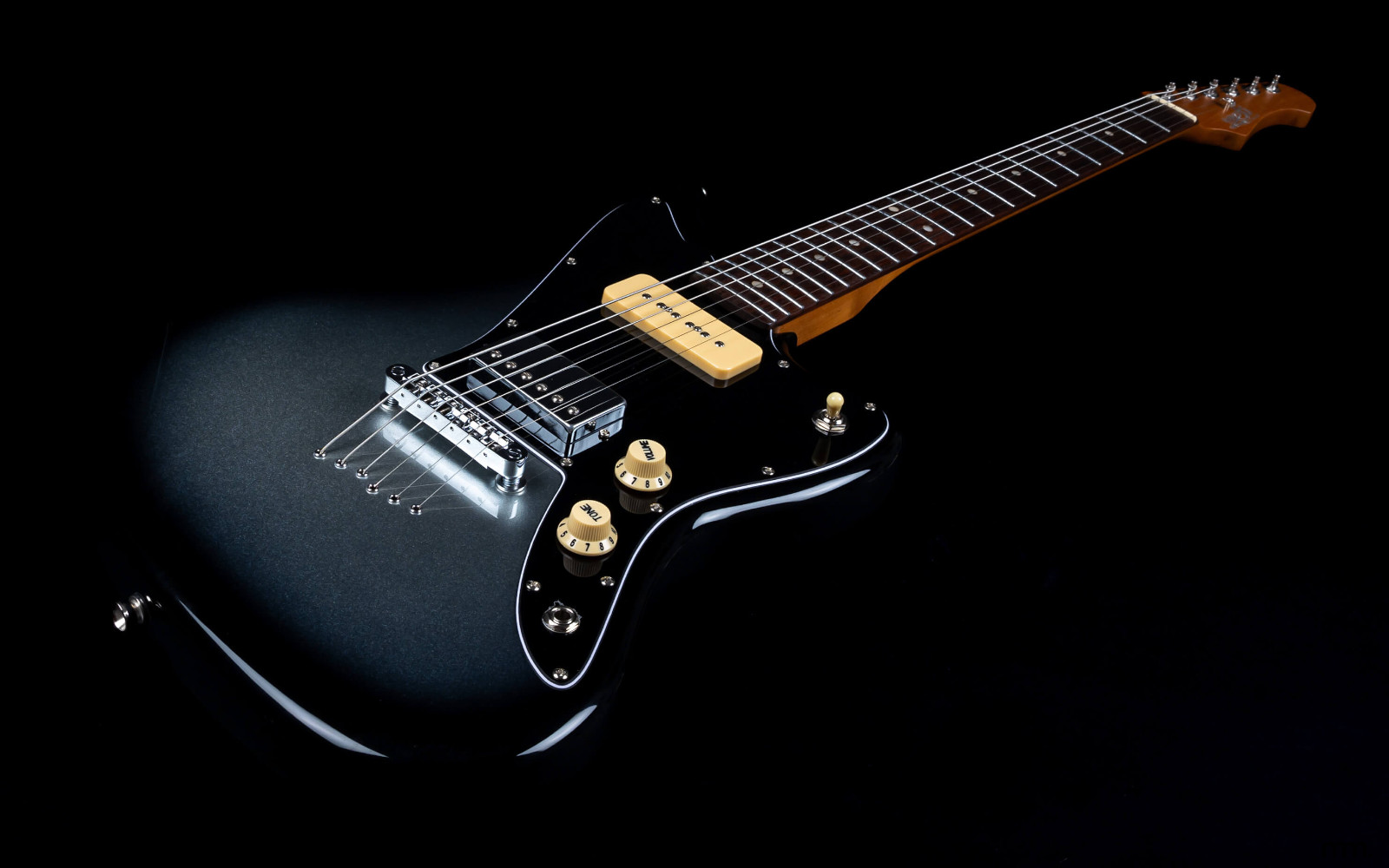
Meet the JET JJ-350 Baritone Moonburst.
It deserves its own room.
JET takes the JJ silhouette, stretches the scale from the standard model's 25.5 inches to 27 inches, uses a Canadian roasted-maple neck with a rosewood fingerboard, bolts it to a roasted-poplar body, installs twin ceramic humbuckers and anchors everything with a fixed bridge. The 9.5-inch radius and 22-fret layout remain familiar, but the longer scale changes the physics of the instrument.
Musicmaker's current example arrives tuned B to B.
And that is where things get delicious.
What Does a Baritone Guitar Actually Do?
Take a conventional electric guitar and tune it substantially lower without changing anything else and eventually the strings begin to feel loose. Attack becomes less precise, pitch can wander more dramatically when you hit hard, and the instrument may start responding less like a guitar and more like six washing lines during a storm.
A longer scale helps.
Scale length is the vibrating distance between nut and bridge, and increasing it allows a string of a given gauge to achieve the same pitch at greater tension. That is why the 27-inch scale of the JJ-350 Baritone matters. It gives those lower tunings a firmer mechanical foundation than simply taking a conventional 25.5-inch guitar and winding everything down into the basement.
The result isn't merely more metal. Although, obviously, more metal remains available.
Baritone guitars occupy a wonderful space between standard guitar and bass. The extended low register can produce enormous doom and metal riffs, but it can also create haunting clean parts, spaghetti-western twang, ambient drones, post-rock textures and layered studio parts that sit beneath a conventional guitar without simply duplicating a bass line.
Add reverb and the thing can become cinematic.
Add fuzz and property values may fluctuate.
Add both and somebody from the council may eventually visit.
The fixed bridge makes particularly good sense here because a baritone player experimenting with lower tunings generally benefits from a stable, straightforward platform. Meanwhile the twin ceramic humbuckers give the JJ-350 BM enough thickness and output to make proper use of that extended register without turning the entire exercise into low-frequency soup. JET lists nickel-covered own-spec ceramic humbuckers, one volume, one tone and a three-way selector.
And then they finished it in Moonburst.
Of course they did.
A normal sunburst would suggest that the instrument had any intention of remaining above ground.
The Affordable Guitar Has Changed
This is perhaps the most interesting thing about the JET JJ range.
Affordable guitars used to come with an implied instruction: You'll replace this later.
The contemporary market has become much less predictable.
Manufacturing has improved. Specifications that once belonged primarily to mid-priced and premium instruments have migrated downwards. Players are more informed about neck profiles, fingerboard radii, pickup types and hardware than ever before, which means manufacturers competing in the affordable electric guitar market cannot rely solely on sticking six strings onto something approximately guitar-shaped and hoping nobody asks difficult questions.
JET appears to understand the assignment.
The JJ-300 P90 gives you an accessible offset with roasted woods, proper P-90 character and tremolo.
The JJ-350 BK and GR R turn towards humbuckers, fixed string-through bridges and a more muscular personality.
The JJ-350 BGT becomes the glamorous oddball, mixing an Alnico V humbucker with a P-90 and throwing a gold pickguard into proceedings because restraint is terribly overrated.
And the JJ-350 Baritone Moonburst quietly opens a trapdoor beneath the entire range and asks if you'd like to tune down to B.
These aren't simply different colours.
They are different reasons to own an offset guitar.
P-90 or Humbucker?
If you're looking at these JET offset guitars and wondering where to begin, the pickup choice is a useful dividing line.
The P-90-equipped JJ-300 makes tremendous sense for players drawn towards indie, garage, punk, alternative rock, bluesier grit and the wonderfully unruly interaction between single-coil definition and overdrive. P-90s have enough substance to push an amplifier but enough edge to retain personality when things become dirty.
The JJ-350 HH models move towards a thicker, quieter and more gain-friendly response. Humbuckers were originally designed to combat electromagnetic hum, but their paired-coil architecture also created one of the foundational sounds of electric guitar: denser mids, substantial output and a character that takes beautifully to distortion.
Then the JJ-350 BGT refuses to choose and gives you both humbucker and P-90 flavours on the same guitar.
Quite right too.
Commitment is overrated.
Why These Guitars Are So Much Fun
Because they aren't sensible. Not completely.
The engineering is sensible. The 25.5-inch scale is sensible. The Modern C neck is sensible. The 9.5-inch radius is sensible. Roasted maple for stability is extremely sensible.
But then JET hangs all of that practicality from a gloriously asymmetric body, paints it Seafoam Green, gives another one a gold scratchplate and sends the baritone out wearing Moonburst.
That tension is what makes them interesting.
They have the specifications of instruments designed by people who understand contemporary guitar players, but the visual personality of instruments designed by somebody who has records piled across the floor. And guitar playing needs a bit of that.
We spend enough time discussing minute differences in pickup output and arguing about bridge materials on the internet. Sometimes an electric guitar should make you walk across the shop simply because you saw it from twenty feet away and thought:
What the hell is that? Then you pick it up.
And the neck feels good. And the P-90 barks. Or the humbuckers roar.
Or the baritone produces a low B that causes a nearby acoustic guitar to reconsider its immediate future.
Now we're getting somewhere.
Come Get Offset at Musicmaker
The JET JJ-300 and JJ-350 offset guitars represent one of our favourite things about the current electric-guitar world: genuinely characterful instruments no longer need to live exclusively behind frightening price tags.
You can have roasted maple. You can have P-90s. You can have humbuckers.
You can have tremolo or fixed-bridge stability.
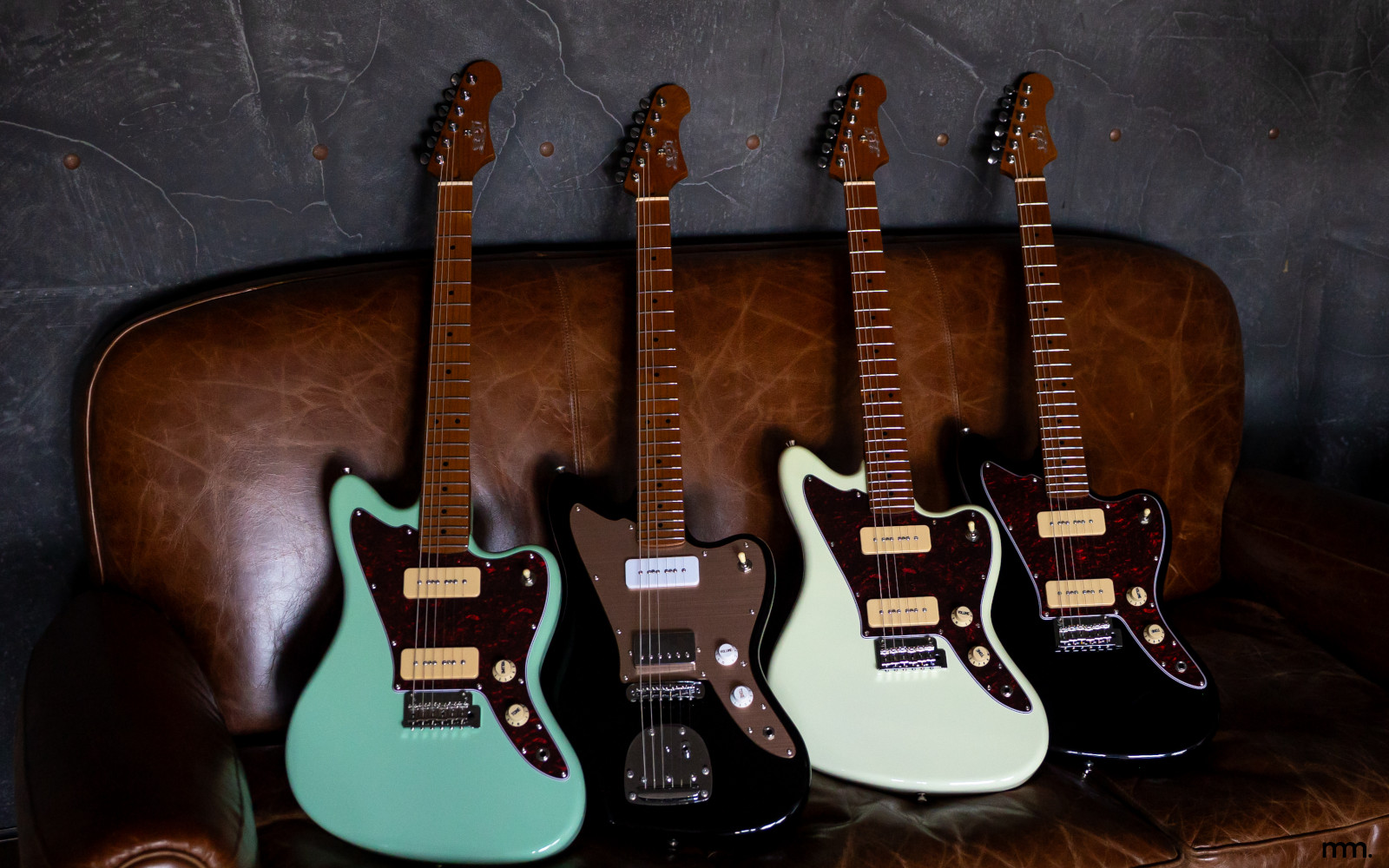
You can have White, Seafoam Green, Black, Green, gold pickguards and Moonburst.
You can even have a 27-inch baritone tuned B to B because apparently normality has been cancelled for the afternoon.
Come into Musicmaker Dublin and play them.
Offsets are difficult guitars to understand entirely from photographs because so much of their charm is physical. Sling one over your shoulder, feel where that asymmetric body settles, get your hand around the roasted-maple neck and discover which pickup arrangement makes sense through an actual amplifier.
And absolutely try the baritone. Even if you have no intention of buying a baritone.
Especially if you have no intention of buying a baritone.
That is traditionally how baritone ownership begins.
From the Musicmaker Workshop
Since the early 1980s, Musicmaker has helped Irish musicians find instruments and equipment worth falling in love with. Every guitar, drum, piano, microphone, pedal and piece of studio gear we stock is carefully chosen by people who genuinely play, perform, teach and obsess over music.
We have enormous respect for the classics. But we also have a soft spot for guitars that arrive slightly sideways.
The JET JJ-300 and JJ-350 offsets have that spirit in abundance: excellent modern appointments, accessible prices, genuinely useful pickup choices and enough visual personality to make the traditional shapes hanging beside them look faintly concerned.
And downstairs, somewhere in the dark, the baritone is still tuned to B.
Good.
Leave it there.
Browse all the Jet Offsets HERE.
Browse all our Jet Guitars HERE.