




Kyser Capos: The Little Thing You Always Need
There are pieces of musical equipment that announce themselves.
The beautiful guitar. The enormous amplifier. The pedalboard glowing on the floor like the control panel of a small spacecraft.
And then there is the capo.
Small enough to disappear into a gig bag. Affordable enough that nobody considers it a major purchase. Important enough that, when somebody asks for one five minutes before the set starts, the entire room immediately begins searching.
Check the guitar case. Check the music stand. Ask the other guitarist.
He definitely had one. He has absolutely no idea where it is.
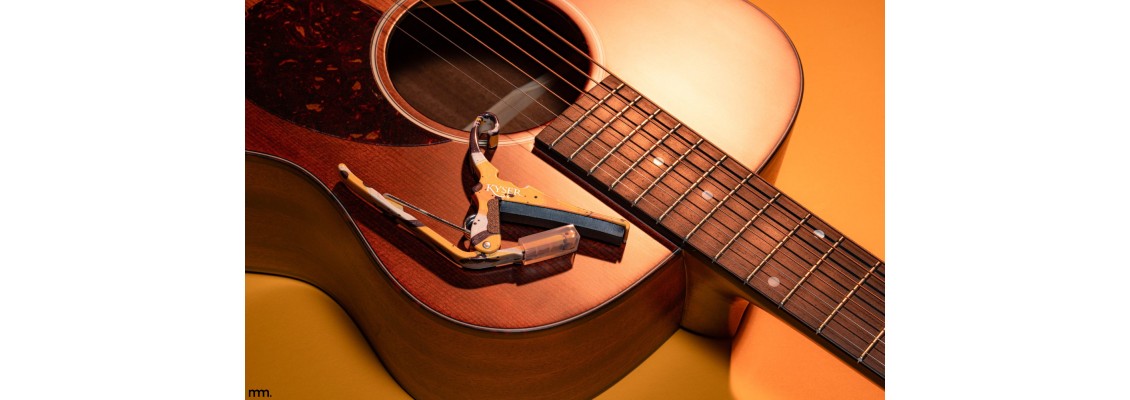
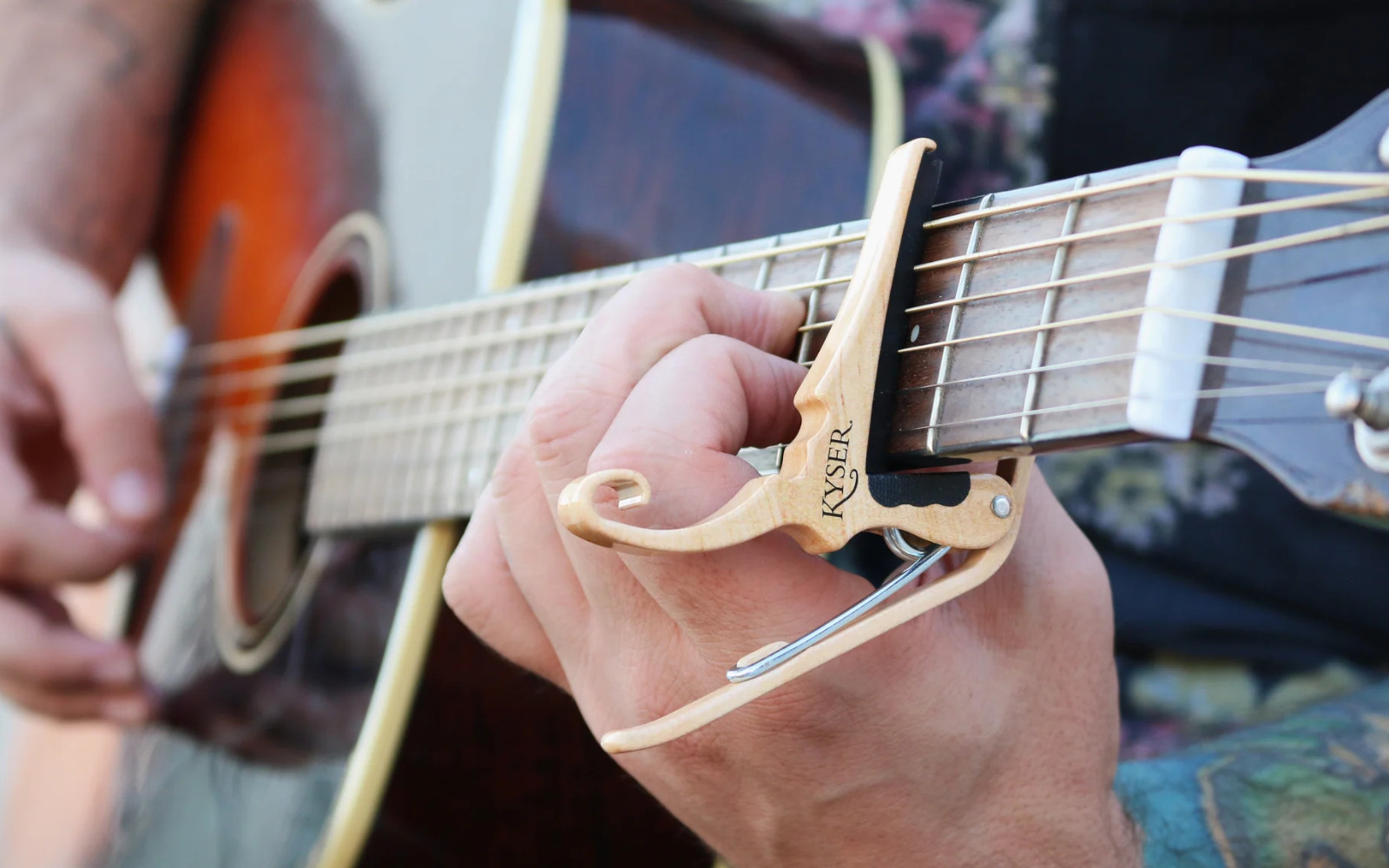
And somewhere nearby, clipped innocently to a headstock as though none of this concerns it, there is probably a Kyser Quick-Change capo.
We love these things at Musicmaker because they represent a particularly satisfying kind of musical equipment: a simple problem solved properly.
No app. No charging cable. No firmware.
Squeeze it, move it, play.
For more than four decades, that little spring-loaded movement has helped make Kyser capos some of the most recognisable guitar accessories in the world. Behind it sits a family company, an American workshop and a surprisingly lovely piece of engineering history.
From a Texas Garage to Guitar Cases Everywhere
The Kyser story begins with Milton Kyser, a Texas machinist with decades of professional experience and a love of music.
After acquiring a capo patent from a friend in 1975, Milton continued developing the concept and eventually created his own design. Following retirement, he began handcrafting capos in his garage around 1979–80, with Kyser Musical Products incorporated in Texas in 1980.
One detail tells you almost everything you need to know about the company. Well into his sixties, Milton visited clubs around Deep Ellum in Dallas, putting his capos into the hands of working musicians and asking them what they thought.
Make thing. Give thing to musician. Musician abuses thing.
Listen. Make thing better.
We can get behind that.
Today Kyser remains a family business, with Milton's great-niece Meredith Attebery as owner and president and her husband Scott serving as CEO. The capos are still manufactured in East Texas, continuing a story that began in a machinist's garage more than forty years ago.

Why the Kyser Quick-Change Works
A capo is essentially a movable nut.
Clamp it behind a fret and you shorten the vibrating length of every covered string, raising the pitch while preserving the tuning relationships between them. Each fret represents one semitone, so moving the capo one fret higher transposes everything up by one semitone; two frets gives you a whole tone, three gives you three semitones, and so on.
The clever bit is that your familiar chord shapes remain familiar.
Put a capo at the second fret and play an open G shape. Your fingers are still playing G, but the capo has raised every note by two semitones, so the chord you actually hear is A major. Play a C shape and it sounds as D. Play D and you hear E. Move the capo to the third fret and those same G, C and D shapes sound as B♭, E♭ and F.
This makes a guitar capo enormously useful for singers. If a song sits slightly too low for a vocalist, you can raise the key without relearning the progression in a collection of increasingly unpleasant barre chords.
Singer says, “Can we take that up a tone?” Capo on fret two.
Singer says, “Actually, another semitone?” Capo on three.
Singer says, “Could we hear it back in the original key?”
The Kyser Quick-Change remains professional about this.
There's More Engineering Here Than You Think
Look closely at what an acoustic guitar capo is actually being asked to do.
It needs enough pressure to fret every string cleanly, but not so much that tuning is unnecessarily disturbed. It needs to accommodate the geometry of the fingerboard, protect the guitar where it makes contact and survive thousands of openings and closings while being dropped, thrown into gig bags and generally treated like a guitar accessory.
Kyser builds its standard Quick-Change from high-grade aluminium, with protective material at the contact points and a durable powder-coated finish. The company says the capo goes through a multi-stage manufacturing process in its East Texas factory, with materials sourced from the United States and manufacturing, assembly and packaging completed there.
The process includes cutting and milling aluminium, tumbling components to smooth their edges, inspection, powder coating and final assembly. Some of the custom machinery involved was designed by Milton Kyser himself, and Kyser says the work of around 20 people contributes to making a capo.
Twenty people. For the little thing clipped to your headstock.
We rather love that.
How to Use a Guitar Capo Without Murdering Your Tuning
Now for a little capo nerdery. A capo needs pressure. It does not need all the pressure in Texas.
Pressing a string towards the fingerboard stretches it slightly, and unnecessary stretching can pull notes sharp. Positioning the capo badly can therefore create tuning problems even when absolutely nothing is wrong with the guitar.
Generally, position your capo close behind the fret, rather than halfway towards the previous one. You want clean string contact without forcing the strings through more travel than necessary.
Then play. Listen. Check the tuning.
If something sounds wrong, make sure the capo is sitting squarely and positioned correctly before accusing the guitar of betrayal. Kyser itself recommends checking capo choice and placement when troubleshooting buzz or tuning issues.
Tiny accessory.
Actual technique.
Acoustic, Electric, Classical and Beyond
One particularly good thing about the Kyser capo range is that the company doesn't pretend every fretted instrument has the same neck.
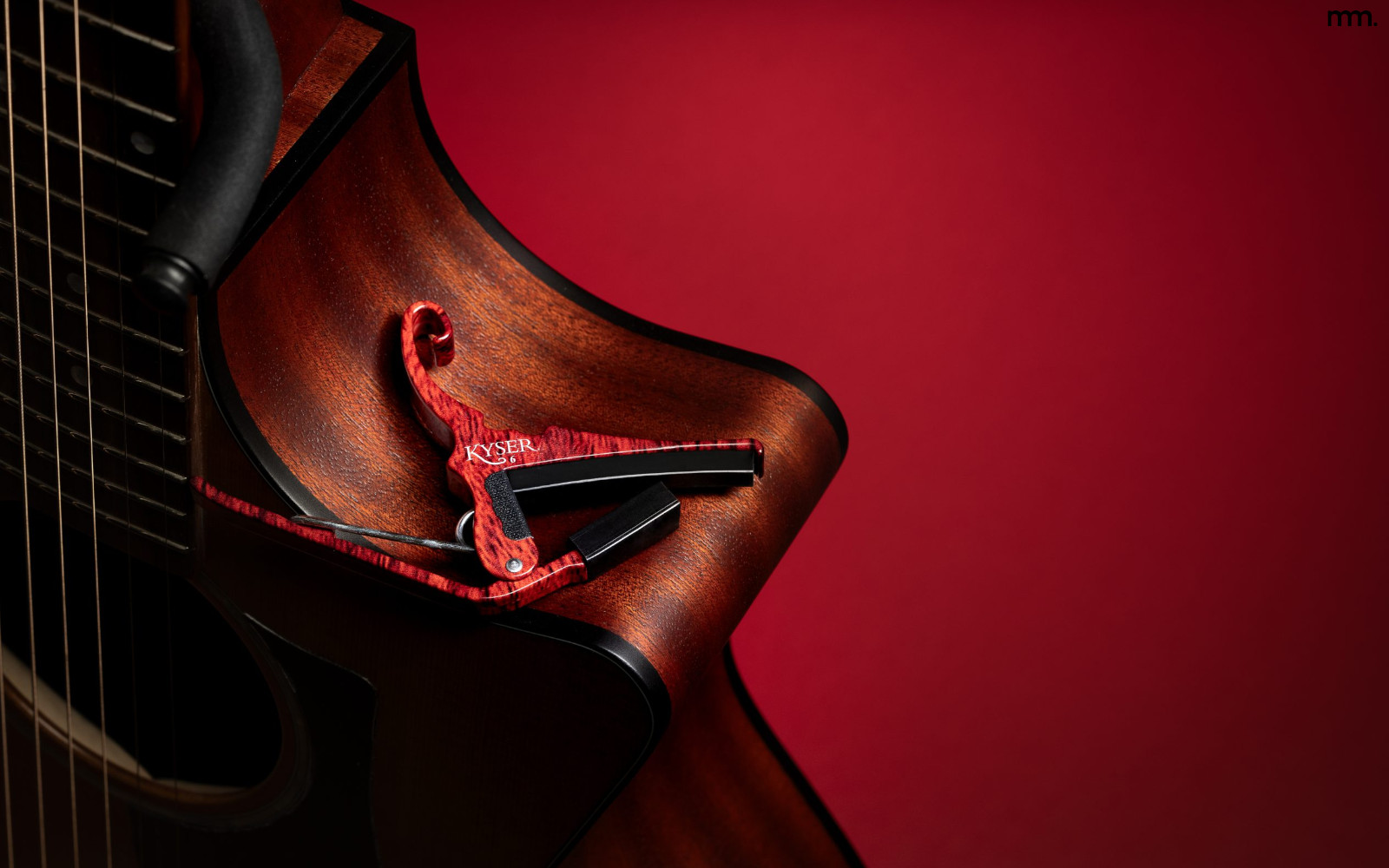
Alongside the familiar Quick-Change Acoustic Guitar Capo, Kyser makes dedicated capos for electric guitar, classical guitar, 12-string guitar, ukulele and banjo/mandolin, as well as partial and alternative-tuning designs.
Those differences matter.
A classical guitar has a different fingerboard geometry from a typical steel-string acoustic. A 12-string has twice the strings to deal with. Electric guitars bring their own combinations of fingerboard radius, string gauge and neck design.
The lesson is simple: Use the capo designed for the instrument.
Your classical guitar is not an acoustic guitar that forgot to install steel strings.
Your 12-string is not a six-string having an unusually busy afternoon.

A Capo Can Change More Than the Key
The capo is usually introduced as a transposition tool, but that description undersells it.
It can also be a songwriting tool.
Moving familiar chord shapes higher up the neck changes their register and alters the relationship between fretted notes and ringing open strings. A progression you've played a thousand times can suddenly acquire a different texture simply because the guitar is resonating in another part of its range.
Kyser even makes a Drop-D Quick-Change, a partial capo that leaves the low E string open while fretting the others, opening up alternative chord relationships without requiring a conventional full retune.
Sometimes writer's block requires deep introspection. Sometimes it requires a capo at the fifth fret.
Try the swift solution first.
Guaranteed for Life
And this is one of the details we particularly like. Kyser Quick-Change capos carry a lifetime guarantee.
Kyser states that its products are covered against failure caused by defects in materials or workmanship, including spring failure. Normal wear, neglect, accidental damage and the natural deterioration of finishes and materials aren't covered.
That's worth explaining because lifetime guarantee can otherwise become meaningless marketing language.
Kyser is standing behind the workmanship and materials of a small accessory expected to be opened, closed, moved, dropped, gigged and used repeatedly for years.
The guarantee does not, regrettably, cover leaving your capo in a pub, lending it to Dave in 2019 or putting it somewhere so exceptionally safe that it passes beyond human knowledge.
Some responsibilities remain with the musician.
The Little Thing Every Guitar Case Needs
This is why we love Kyser capos at Musicmaker Dublin.
They're not glamorous in the traditional sense. Nobody wheels a capo onto a festival stage in a flight case. There are no valves glowing inside it. Nobody has ever described their capo as having three-dimensional harmonic complexity after watching seventeen YouTube comparisons.
It just works.
For a gigging guitarist, a Quick-Change capo makes moving between song keys fast and painless. For singers accompanying themselves, it makes finding a comfortable vocal key considerably easier. For songwriters, it opens new voicings and registers. For beginners, it can make otherwise awkward songs accessible using familiar open chord shapes.
And then it clips back onto the headstock until you need it again.
Simple. Useful. Dependable.
The best little pieces of musical equipment are often like this. They don't demand attention. They remove a problem so completely that eventually you stop thinking about the tool at all.
From the Musicmaker Workshop
Since the early 1980s, Musicmaker has helped Irish musicians find instruments and equipment worth falling in love with. Sometimes that means a beautiful guitar, a thundering amplifier or a pedal capable of making deeply irresponsible noises.
Sometimes it means a tiny spring-loaded piece of aluminium, developed by a Texas machinist and refined over more than four decades, that does one important job beautifully. We love those things too. Perhaps especially those things.
So keep a Kyser capo in the guitar case. Maybe keep another at home.
And under no circumstances put either of them somewhere safe.
That's how they get you.
Long live the little gear.
Browse all our Kyser Capos HERE.