





Quiet Please! How to Practice Without Annoying Everyone
Back to School Music Practice Without the Household Revolt
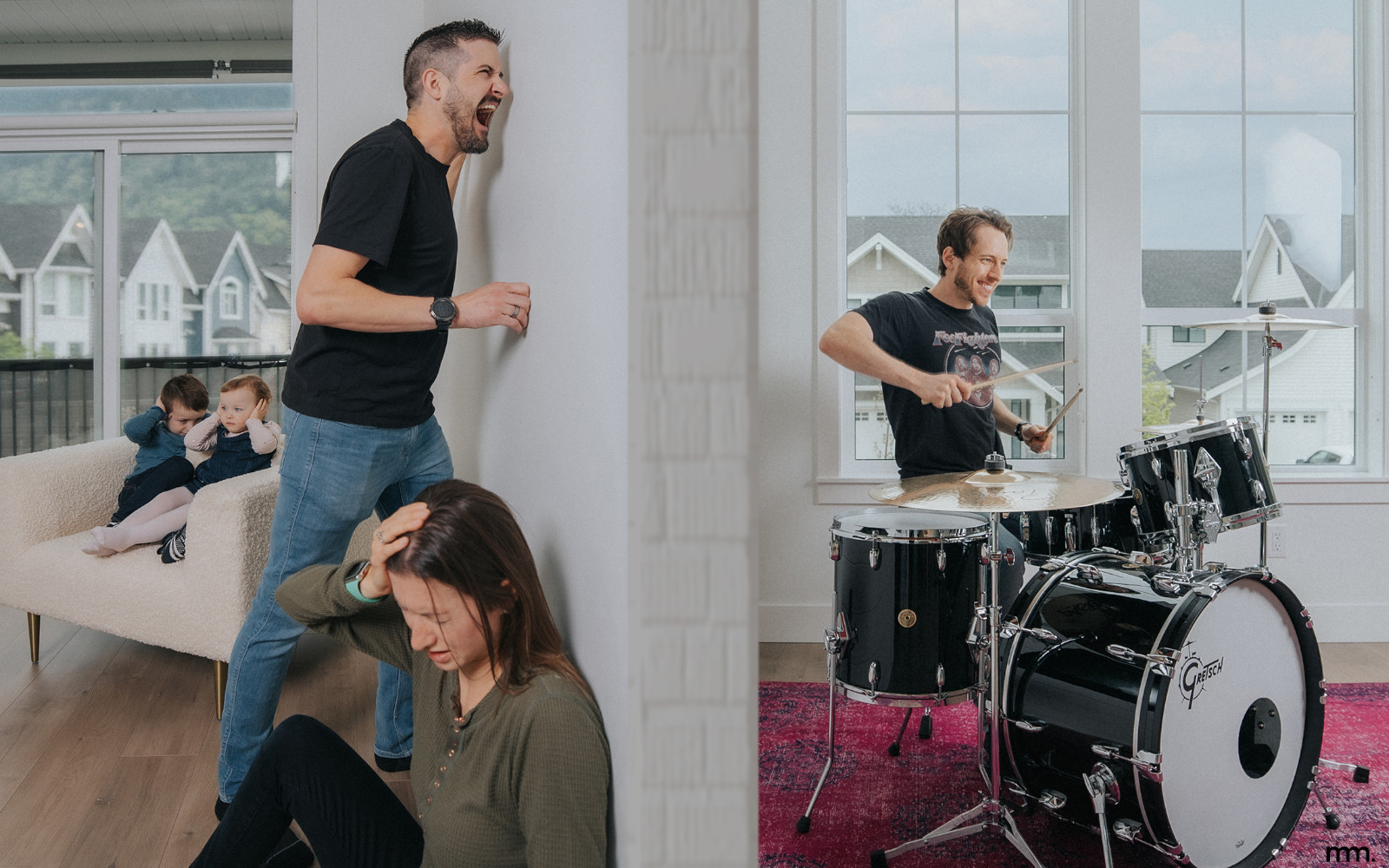
September is here. The school bags are packed, lessons are beginning again and somewhere in Ireland a twelve-year-old has just been given a drum kit.
We need to talk about volume.
Learning a musical instrument requires practice. Lots of it. The same chords, scales, rudiments and passages played repeatedly until the hands finally understand what the brain has been asking them to do. This is wonderful for the musician. For everybody else in the building, the emotional journey can be slightly more complicated.
Thankfully, modern musical instruments have given us something previous generations of musicians could only dream about: the ability to make an absolutely enormous sound that almost nobody else can hear.
A digital piano with headphones can turn late-night piano practice into a private affair. An electronic drum kit can give a drummer the sound of a huge acoustic kit without putting an actual huge acoustic kit in the spare bedroom. And Donner's remarkable HUSH Series guitars take the concept even further, effectively building private guitar practice into the instrument itself.
For students heading Back to School, beginners starting lessons and experienced musicians trying to fit practice around work, family, neighbours and the strange concept known as other people's lives, this stuff can be transformative.
Because the best practice setup isn't necessarily the loudest, biggest or most expensive.
It's the one you can actually use.
First: Practising Badly Is Important
This sounds ridiculous. It isn't.
If you're learning an instrument, you need somewhere you're allowed to sound terrible.
Every good musician has spent thousands of hours making noises they would rather you hadn't heard. Scales get mangled. Chords buzz. Drum fills collapse halfway through. The left hand forgets what the right hand is doing. Somebody attempts a difficult passage twenty-seven times and somehow plays it worse on attempt twenty-eight.
That's practice.
The problem comes when a beginner becomes self-conscious about being heard. If every mistake is being broadcast through the house, apartment or student accommodation, it becomes remarkably tempting to avoid the difficult bits and play only what already sounds good.
That's the opposite of useful practice.
Headphones change the psychology as much as the volume. Put them on, close the door and suddenly you have permission to experiment, repeat things, make mistakes and slowly turn those mistakes into music.
Quiet practice gives you somewhere private to get better.
And that's a beautiful thing.

Piano: All 88 Keys, Almost None of the Noise
A piano is perhaps the easiest demonstration of how much technology has changed home practice.
An acoustic piano is magnificent, but it has one notable design limitation when somebody decides to practise scales at 6:45 on Sunday morning:
Everybody gets piano practice.
A digital piano changes that relationship completely. You can still sit at a full 88-key keyboard, work on dynamics, scales, chords, repertoire and technique, but connect a pair of headphones and the amplified piano sound disappears from the room.
The player gets the instrument. Everyone else gets their breakfast.
Perfect.
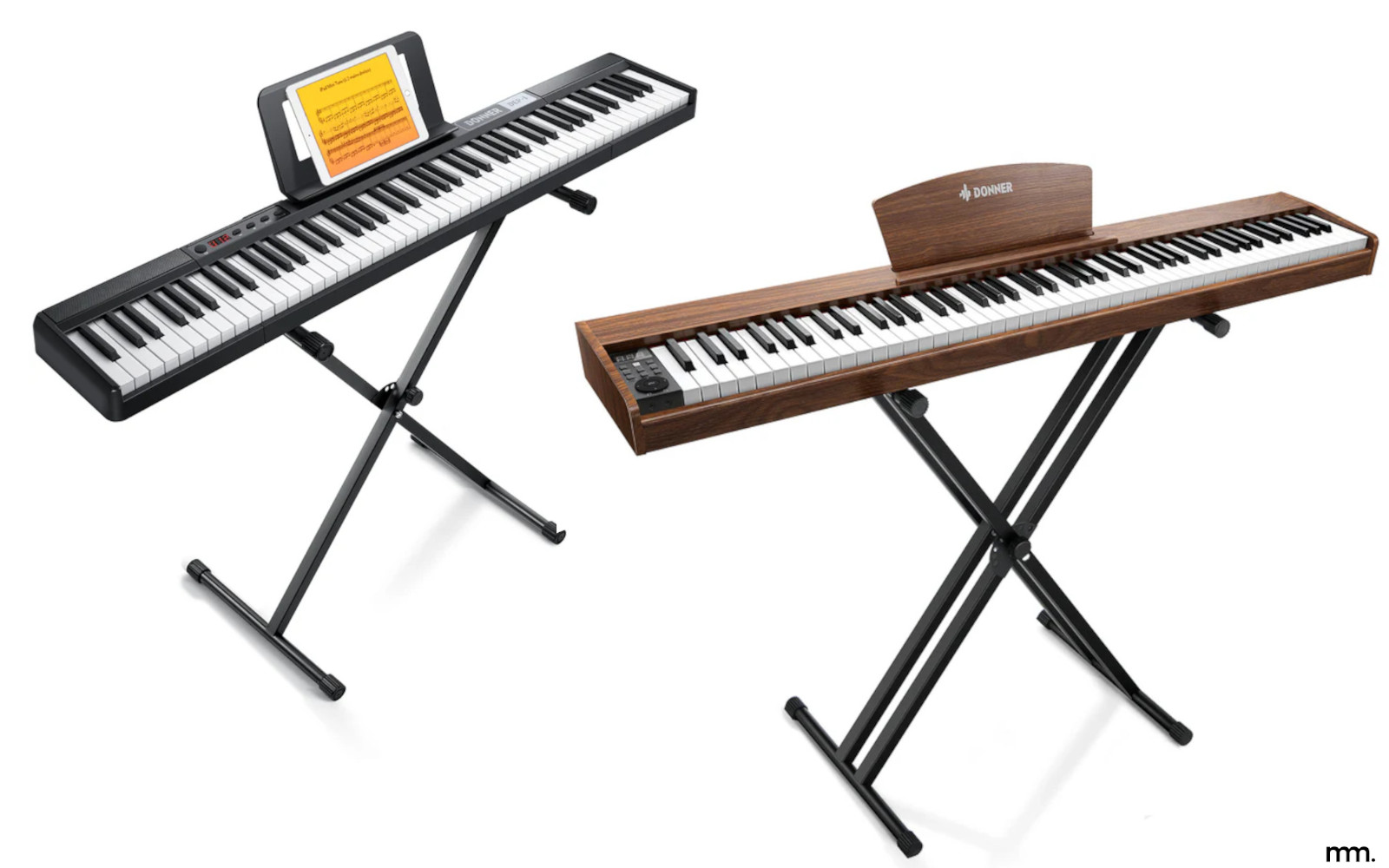
Donner DEP-1: Your Own Little Practice Room
The Donner DEP-1 makes particular sense in this context because it approaches the beginner digital piano as something that should be easy to live with.
It's the kind of instrument that suits the student who needs to practise regularly but doesn't necessarily have a dedicated music room waiting for them. Put it in the bedroom, living room or study, connect headphones when silence is required, and the piano can fit around the household rather than demanding that the household fits around the piano.
For beginners, that's a deceptively important advantage. Removing friction from practice matters. If getting started requires reorganising half the room every evening, practice becomes easier to postpone. If the piano is sitting there ready to go, the distance between “I should practise” and actually playing becomes much shorter.
And that is exactly what we want from Back to School piano gear.
Not equipment that makes promises.
Equipment that gets used.
Donner DEP-1S: Similar Idea, Different Proposition
Then there's the Donner DEP-1S, giving beginners another affordable route into an 88-key home piano setup.
The important thing here isn't to pretend every entry-level digital piano is identical. Different players care about different things: key feel, cabinet design, functions, available space and how the instrument fits into everyday life all matter.
What both the DEP-1 and DEP-1S give us in the context of quiet piano practice is the ability to work privately through headphones rather than restricting practice to socially acceptable piano hours.
And socially acceptable piano hours become remarkably narrow when the same four bars have been played for forty minutes.
Headphones are diplomacy.
Donner DDP-60: The Piano That Actually Looks Like Furniture
Now for something a bit flash.
The Donner DDP-60 is particularly lovely for the student or family who wants the practicality of a digital piano without necessarily wanting the room to look like a rehearsal studio.
Its minimalist wood-style cabinet gives it much more of a furniture presence, but underneath that restrained appearance is a surprisingly feature-rich beginner digital piano.
The DDP-60 has 88 full-size semi-weighted, touch-sensitive keys with four velocity curves, allowing developing players to begin exploring how playing force affects musical expression. Donner specifies 128-note maximum polyphony, 128 voices, 83 rhythms and 47 demo songs, with a pair of 15W speakers providing 30 watts of onboard amplification when everybody is happy to hear you.
And when they aren't? Headphones.
The DDP-60 provides headphone connectivity for private practice alongside USB-MIDI, audio output and a three-pedal piano-style unit, while its additional functions include Dual mode, keyboard split, recording, metronome and transpose facilities.
That combination makes it particularly appealing as a beginner digital piano for home practice. You have the complete 88-note range, a proper three-pedal setup and enough polyphony to accommodate sustained passages without notes being unnecessarily cut short, but you can still disappear into headphones when the house needs to become quiet.
And that minimalist cabinet deserves another mention.
Because a practice instrument that's allowed to remain permanently assembled is a practice instrument that's much more likely to be played.
Sit down. Switch on. Headphones on. Play.
That's a very good system.
Headphones: The Secret Ingredient
Of course, none of this silent-practice magic works particularly well without something to put on your ears.
Enter our old friend, the Donner M100 Studio Monitor Headphones.
A closed-back headphone is a particularly useful companion for digital instruments because the enclosed earcups help provide isolation while keeping the instrument sound close and immediate. Donner equips the M100 with 50mm drivers, 32-ohm impedance and a 20Hz–20kHz specified frequency response, making them a practical option for digital piano, electronic drum and home studio use.
And we've just written an entire article about headphones, so we won't disappear down that rabbit hole again.
Although we absolutely could.
The important point here is that a decent pair of wired headphones can serve several instruments. Today's piano headphones can become tomorrow's electronic drum headphones, audio-interface monitoring headphones or home-recording headphones.
One purchase. Lots of silence.
Beautiful.
And Then There Are Drummers
Right. Everybody else can leave the room for a minute.
Drummers.
We love you. We really do.
But you've historically presented certain logistical challenges.
An acoustic drum kit is one of the most gloriously physical ways of making music. It is also a collection of resonant wooden shells, metal cymbals and sticks specifically designed to make themselves everybody's business. This is not ideal in every home.
Electronic drums completely change the equation.
They are not literally silent — sticks hitting mesh or rubber pads still create physical noise, and kick pedals in particular can transmit vibration through floors — but compared with the acoustic output of a conventional drum kit, electronic drum practice can be dramatically easier to accommodate at home.
Then connect headphones and the drummer hears the important bit: the actual kit sounds from the module.
Everybody else mostly hears tapping.
Mostly.
We are still talking about drummers.
Donner DED-80P: Start Drumming Without Starting a War
For the beginner, the Donner DED-80P makes an enormous amount of sense.
Donner gives the DED-80P 180 built-in sounds, 15 drum kits and 30 demo songs, alongside double-layer mesh-head technology designed to provide a more natural playing response than hard practice surfaces. The package also includes the practical beginner essentials, including a throne, headphones and sticks.
The really important phrase here is electronic drum kit with headphones.
A beginner can practise basic grooves, rudiments, coordination and timing without every snare hit arriving in the kitchen at acoustic-drum volume.
And because Donner also provides integration for computer-based music production, the DED-80P can begin as a practice instrument and eventually become a controller for software drum sounds and recording workflows.
That's a lot of room to learn.
Without requiring a detached garage.
Donner DED-200 MAX: More Kit, More Room to Grow
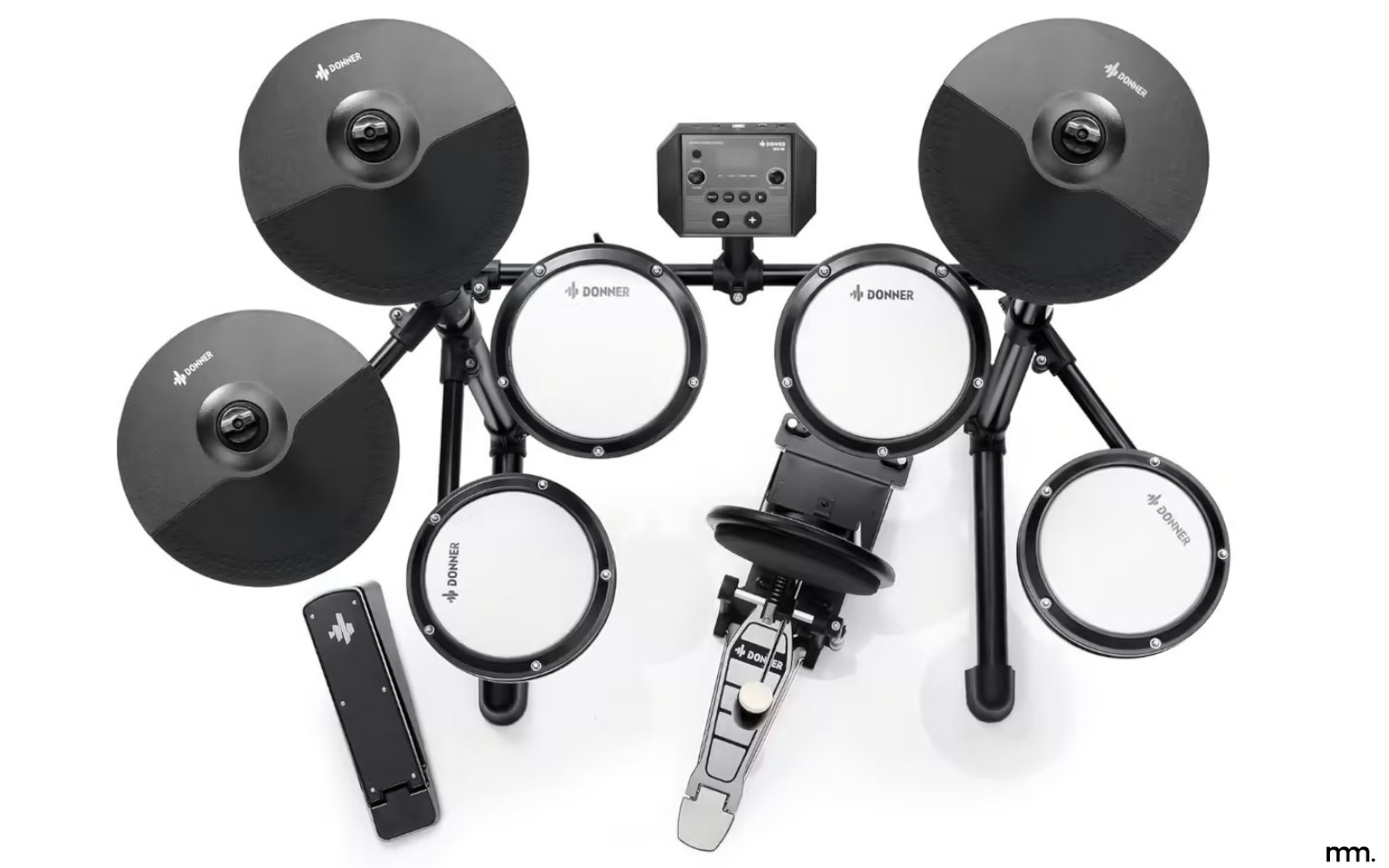
Step up to the Donner DED-200 MAX and things become considerably more substantial.
The current MAX configuration features a 10-inch dual-zone mesh snare, three 8-inch mesh toms plus an additional 10-inch floor tom, 12-inch crash and ride cymbals with choke functionality and a kick pad with proper pedal. The module provides 480 sounds, 31 customisable drum kits and 50 practice songs, while USB-MIDI connectivity allows the kit to communicate directly with a computer or DAW.
For a developing drummer, this matters because the physical layout begins giving you more room to practise movement around the kit rather than simply learning isolated sticking patterns.
The headphones still provide the privacy. But inside those headphones, the drummer can be sitting behind something enormous.
That contrast is one of the joys of electronic drums.
From the hallway: tap tap tap tap.
Inside the headphones:
GLASTONBURY.
Donner Groove Ultra: Quiet Practice Gets Very Serious
And then we arrive at the magnificent orange beast.
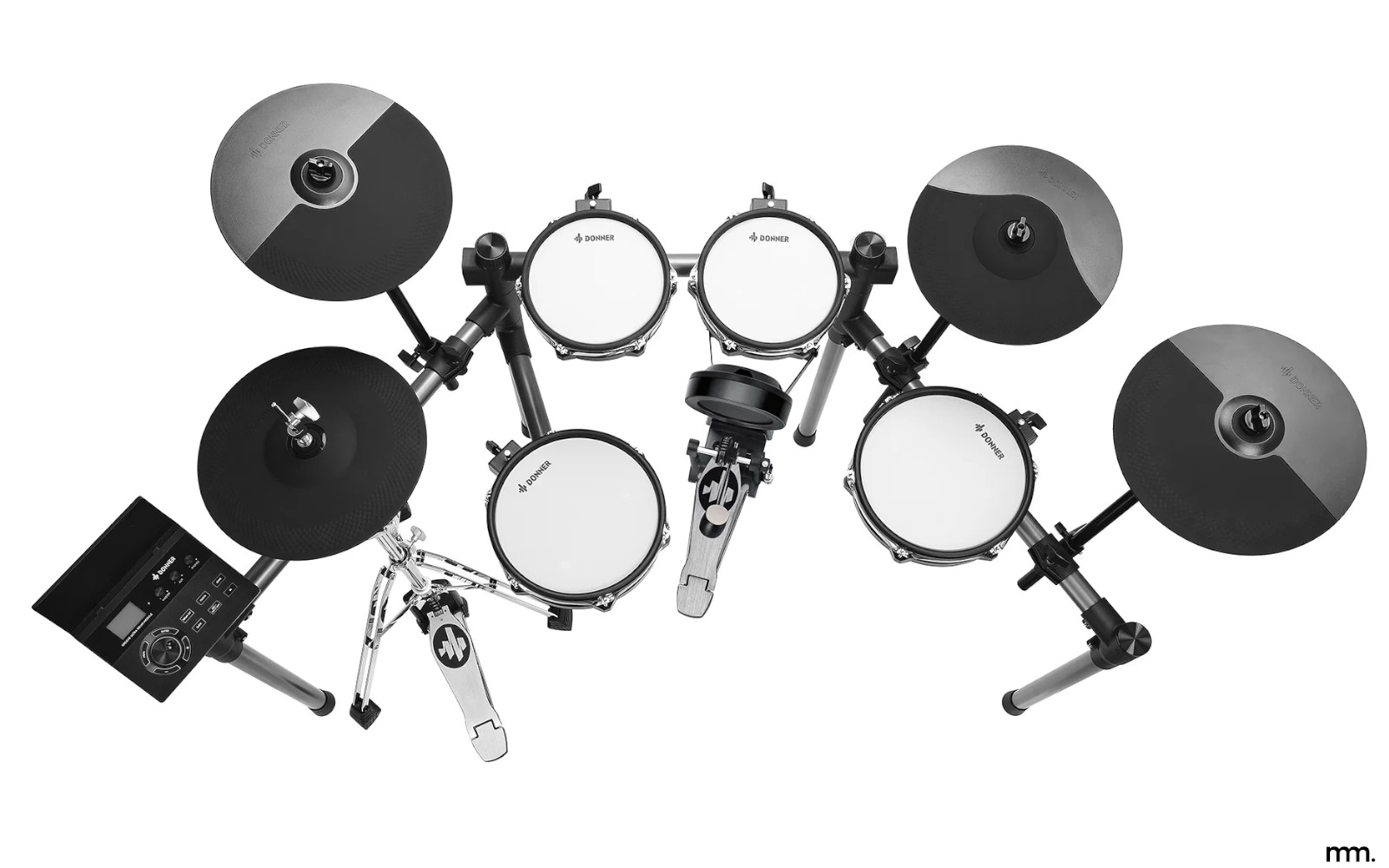
The Donner Groove Ultra Electronic Drum Set takes the home-practice concept into much more advanced territory. Donner describes a five-drum, four-cymbal setup built around a 10-inch dual-zone mesh snare, two 8-inch dual-zone rack toms, a 10-inch dual-zone mesh floor tom and 6-inch kick tower. Cymbals include a 12-inch stand-mounted hi-hat, two 12-inch dual-zone crashes with choke and a 12-inch triple-zone ride with choke.
The Groove Ultra module supplies 575+ sounds, with 50 drum kits comprising 25 factory and 25 user kits, plus 50 demo songs. USB-MIDI provides the route into DAWs and virtual drum instruments, while the whole setup sits on Donner's Swift-Rack system.
Now we're a long way from “I need something to tap on quietly after school.”
This is an electronic kit that allows a serious drummer to work on dynamics, coordination, foot technique, cymbal articulation, fills and complete performances while retaining the enormous home-practice advantage of headphone monitoring.
And the independent hi-hat stand and triple-zone ride are particularly significant for players moving towards a more conventional acoustic-kit experience. The physical relationship between limbs and playing surfaces matters enormously to drummers, and the closer an electronic setup gets to that familiar arrangement, the more naturally practice can translate back onto an acoustic kit.
Still quieter than the real thing. Still capable of making the drummer feel enormous.
Excellent.
A Small Reality Check: Electronic Drums Aren't Actually Silent
This is worth saying because we're a music shop, not magicians. Mesh-head electronic drums are quiet, not silent.
The sticks still hit something. The kick pedal still moves. Vibrations can travel through floors, particularly in apartments and upstairs bedrooms.
If downstairs neighbours are part of the equation, placement matters. A suitable mat can help with movement and some transmitted vibration, while more elaborate isolation platforms can be worthwhile in particularly sensitive situations.
But the difference compared with an acoustic drum kit is monumental.
You have moved the main sound generation away from vibrating drum shells and enormous bronze discs and put it into electronics.
That is a pretty substantial technological victory for domestic harmony.
Guitarists: Donner Has Taken "Quiet Practice" Rather Literally
And now we arrive at perhaps the most perfect instruments for this entire article.
The Donner HUSH Series.
The idea behind HUSH is wonderfully direct: strip away much of the physical bulk of a conventional guitar, retain a proper playable neck and string length, build in useful electronics and give the player direct headphone monitoring.
The result is a family of compact headless instruments designed specifically around silent guitar practice, travel and portability. Donner's current HUSH range includes acoustic-orientated and electric-orientated models, with the more advanced Pro instruments adding increasingly sophisticated onboard processing.
And for Back to School? These things are almost cheating.
Bedroom. Student accommodation. Hotel. Backstage.
Sitting in the kitchen while somebody watches television.
Plug in headphones and practise.
No amp required. No room-filling acoustic body.
No domestic summit meeting beforehand.
Donner HUSH-I
Silent Practice, Minus the Fuss
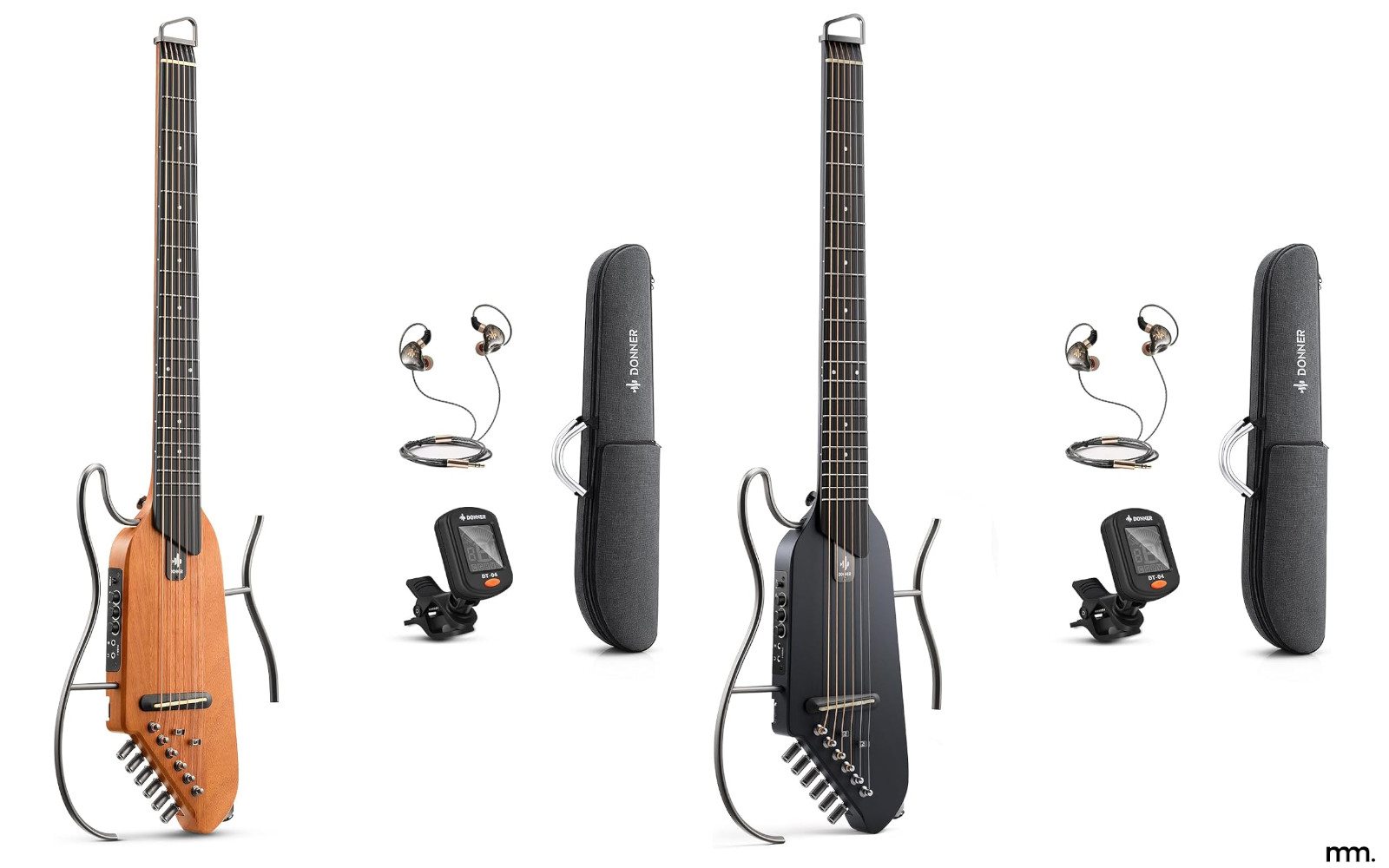
If quiet practice is the whole point, the Donner HUSH-I Headless Hush Guitar might be the most perfectly on-theme instrument in the entire article.
Available at Musicmaker in Black and Mahogany, the HUSH-I is a beautifully clever travel-friendly acoustic-electric built around one simple idea: give the player a proper full-scale guitar experience without the bulk, acoustic volume or setup requirements of a traditional instrument.
Its solid mahogany neck-through construction gives the guitar a warm, resonant character with impressive sustain, while the ultra-lightweight headless design and removable ergonomic body wings make it exceptionally easy to store, carry and travel with. Fully assembled, it gives the player familiar physical reference points against the body; packed down, it becomes a remarkably compact instrument that disappears neatly into its supplied gig bag.
That makes the HUSH-I a brilliant fit for quiet guitar practice at home, student accommodation, hotel rooms, backstage warm-ups and travel. There is no large acoustic body projecting sound into the room, so most of the useful guitar tone can be sent directly where it belongs when discretion is required: into your headphones.
The onboard piezo pickup system provides a clear acoustic-style signal through headphones, an amplifier or a recording setup, while dedicated volume, bass and treble controls let the player shape the sound directly from the guitar. Donner also includes an anti-phase switch, a practical addition for reducing feedback when the instrument moves from private practice into amplified live use. That last point is important because the HUSH-I isn't merely a silent practice novelty. Plug the ¼-inch output into an amp, PA, audio interface or other suitable system and it becomes a genuinely useful acoustic-electric instrument for rehearsal, performance and songwriting too.
Playability has clearly received the same attention as portability. The HUSH-I uses an asymmetrical neck profile, rounded fret ends and a 24.75-inch scale length across 20 frets, helping the instrument remain comfortable through long sessions. The HPL fingerboard adds durability, while the removable frame gives the hands and forearm somewhere natural to settle without restoring all the bulk Donner worked so hard to remove.
Then there are the tiny details that tell you somebody has actually thought about travelling with the thing. A magnetic hex-key holder, hidden tuning-key storage and thoughtfully arranged hardware mean the tools you need are designed to stay with the guitar rather than disappearing into whichever drawer consumes every guitar accessory you have ever owned.
For Back to School guitar practice, the HUSH-I is almost absurdly well suited. Pick it up after homework, plug in headphones and practise without an amplifier, without a large acoustic body filling the house and without turning somebody else's evening into your scale routine.
The Black HUSH-I gives the whole concept a sleek, modern edge, while the Mahogany finish leans into the natural warmth of the instrument's construction. Same clever platform. Same quiet-practice philosophy. Two very different looks.
And both make the same argument beautifully:
You don't need a lot of space to make progress.
Donner HUSH-X: Electric Guitar, Minus the Amp Problem
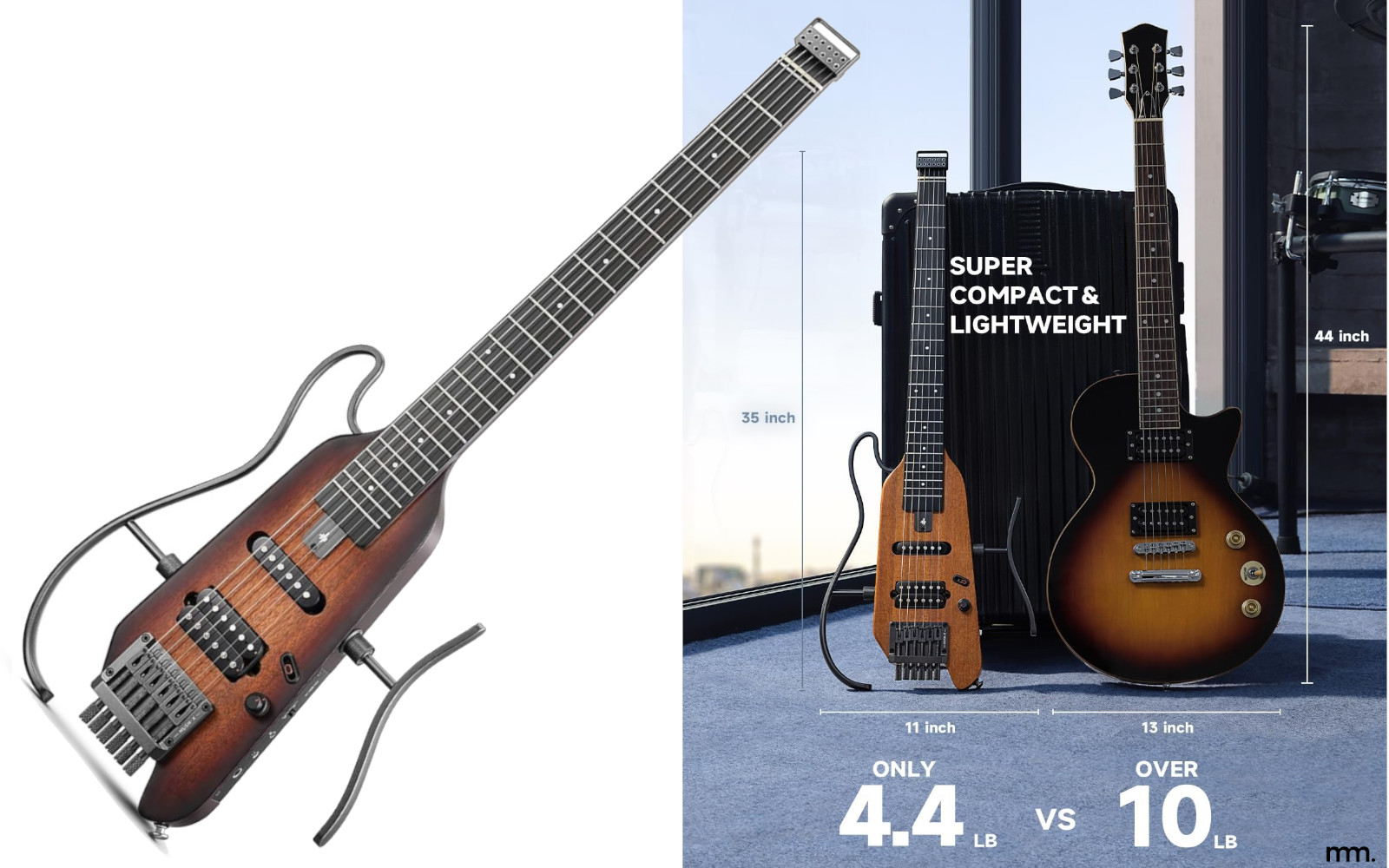
The HUSH-X moves the same philosophy firmly into electric-guitar territory.
Its headless design uses a 25.5-inch scale, 22 medium frets, 14-inch fingerboard radius and bone nut, with a Donner Alnico V humbucker and single-coil pickup combination controlled through three-way switching. The guitar also provides active/passive circuit switching and Donner's headless bridge/tuning system.
The physical design is the clever bit.
Without a conventional headstock or full-sized solid body, the HUSH-X is remarkably compact, while its removable frame provides the physical reference points a guitarist expects against the body.
For quiet electric-guitar practice, that creates a delicious proposition.
You can have a full-scale electric playing experience without needing to turn on the practice amp across the room.
For a student returning from school, somebody practising after work or a guitarist attempting to squeeze forty minutes of playing into the tiny gap between everything else, convenience matters.
Pick it up. Headphones in. Play.
No ceremony required.
The Beauty of a Practice Setup That Is Always Ready
And this is really what connects the Donner DDP-60, Donner electronic drum kits and Donner HUSH guitars.
Convenience.
We often talk about practice as though motivation is the only variable. You simply need discipline.
Sure.
But human beings are spectacularly good at not doing things when those things are inconvenient. If practising guitar requires finding the amp, locating the cable, moving something, connecting a pedalboard and negotiating volume, sometimes you don't bother. If piano practice can only happen when nobody else needs quiet, you miss days.
If the drum kit can only be played during a tiny window when the neighbours are out, progress becomes hostage to somebody else's Tesco schedule.
Good home practice equipment removes those excuses.
The DDP-60 waits in the room. The electronic kit waits with headphones hanging beside it. The HUSH guitar comes out of the bag.
You play.
Parents: Quiet Practice Is Good for You Too
Here's the shamelessly practical Back to School bit.
If somebody in your house is beginning music lessons this September, you want them to practise.
You have paid for the lessons. You may have paid for the instrument. You have probably driven somewhere.
You are now emotionally invested in the production of a recognisable tune.
So make practice easy.
A digital piano with headphones allows scales to happen without taking over the living room. An electronic drum kit allows rudiments and grooves to be practised at home without installing an acoustic snare drum three metres from your television. A HUSH guitar gives the guitarist somewhere to work through chords, scales and riffs privately.
This isn't about making music smaller. It's about making more music possible.
And there is another benefit.
The student gets privacy. They can be bad. They can make mistakes. They can play the intro again. And again.
And again.
And again.
Nobody rolls their eyes.
Nobody shouts through the wall.
Nobody asks, "Have you not got that bit yet?"
Because that bit is precisely what they're practising.
Twenty Minutes Nobody Else Needs to Hear
There is a strange assumption that serious practice must involve enormous amounts of time.
It doesn't. For a beginner, twenty focused minutes can be incredibly valuable.
Put the headphones on. Tune the guitar or choose the piano sound. Warm up. Spend five minutes on technique. Spend ten minutes attacking the thing you currently cannot do. Finish by playing something you actually enjoy.
Tomorrow, do it again.
The beauty of quiet practice is that those twenty minutes become easier to find.
Before school. After school. After dinner. Later at night. During somebody else's television programme.
When the baby is asleep — although perhaps not the electronic kick pedal directly above the baby's room. We're enthusiastic, not insane.
The point is that modern quiet practice gear for musicians creates opportunities.
And repeated opportunities eventually become progress.
Quiet Doesn't Mean Small
This may be the most important distinction.
Quiet practice isn't about reducing the musical experience. Quite the opposite.
Inside a pair of headphones, the Donner Groove Ultra can become a huge multi-piece drum kit with hundreds of available sounds.
The DDP-60 can deliver a full 88-key piano experience while its speakers remain effectively removed from the equation.
And a HUSH-X Pro can give a guitarist simulated guitars, amps, cabinets and effects while the person in the next room hears little more than the physical strings.
That's the magic. The physical volume gets smaller.
The musical world inside the headphones doesn't.
Back to School Means Back to Practice
New term. New lessons. New (maybe) instrument. New routine.
And perhaps this is the year when practice stops being the thing that has to be squeezed awkwardly around everybody else's life.
At Musicmaker, we're surrounded by equipment designed to make music bigger, louder and more spectacular. We love all of it. Give us enormous amplifiers, acoustic drums, PA systems and enough volume to rearrange the furniture.
But sometimes the smartest piece of musical technology is the one that lets a musician disappear into their own world for half an hour.
The Donner DEP-1 and DEP-1S give new pianists accessible routes into private digital-piano practice. The wonderfully stylish Donner DDP-60 adds a full 88-key semi-weighted keyboard, three-pedal setup and furniture-style design to the equation. Donner's DED-80P, DED-200 MAX and Groove Ultra electronic drum kits take drummers from first beats into increasingly serious electronic setups, all while making headphone practice a central part of the experience. And the Donner HUSH Series may be the purest expression of the idea, putting quiet, portable guitar practice directly into the instrument.
Different players. Different instruments. Same beautiful little idea.
Practise more. Disturb less. Get better.
Browse all the instruments HERE.
Free Shipping Across Ireland
Musicmaker offers free shipping across Ireland on qualifying orders, making it easier to build a quiet home practice setup with the Donner DEP-1, DEP-1S and DDP-60 digital pianos, Donner electronic drum kits, the Donner HUSH-I Headless Hush Guitar, and a solid pair of headphones for private practice.
From first scales and rudiments to late-night songwriting and silent guitar sessions, the right setup can make practising easier to fit into everyday life — and getting it home shouldn't be the difficult part.
From the Musicmaker Workshop
We've been helping people learn instruments at Musicmaker since the early 1980s, and one thing hasn't changed in all that time: getting better requires repetition. What has changed is how easily that repetition can fit into ordinary life. Digital pianos, mesh-head electronic drums, direct headphone monitoring and instruments like the Donner HUSH Series mean a musician no longer needs an empty house, a rehearsal room or remarkably tolerant neighbours simply to get an hour's work done.
For students heading Back to School, that can make a bigger difference than another clever practice trick. Give somebody an instrument they can play when they actually have time to play it, give them somewhere they can make mistakes without feeling watched, and practice begins to become part of everyday life rather than an event that has to be organised.
Every musician needs somewhere they're allowed to sound bad.
Give them that space. Then give them time.
The good stuff comes afterwards.