





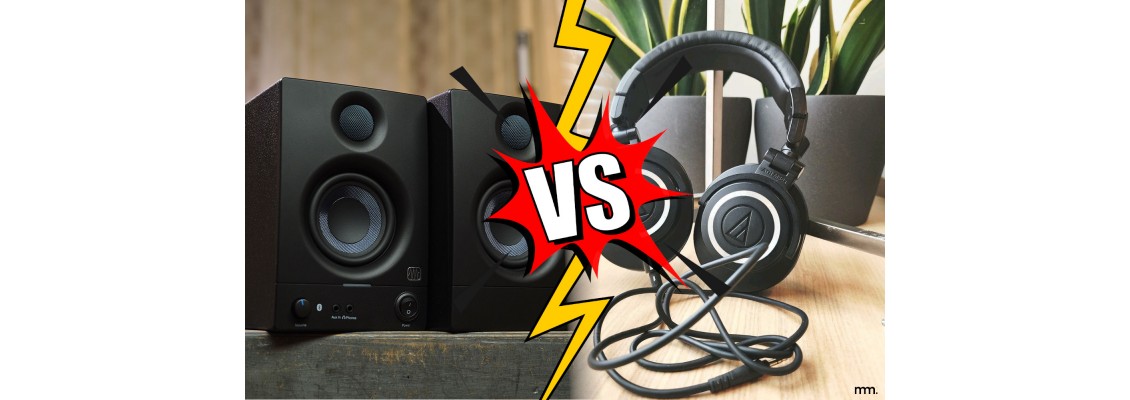
Studio Monitors vs Headphones: Eris 3.5BT vs ATH-M50x
Five Rounds. Two Monitoring Philosophies. One Very Long Evening.
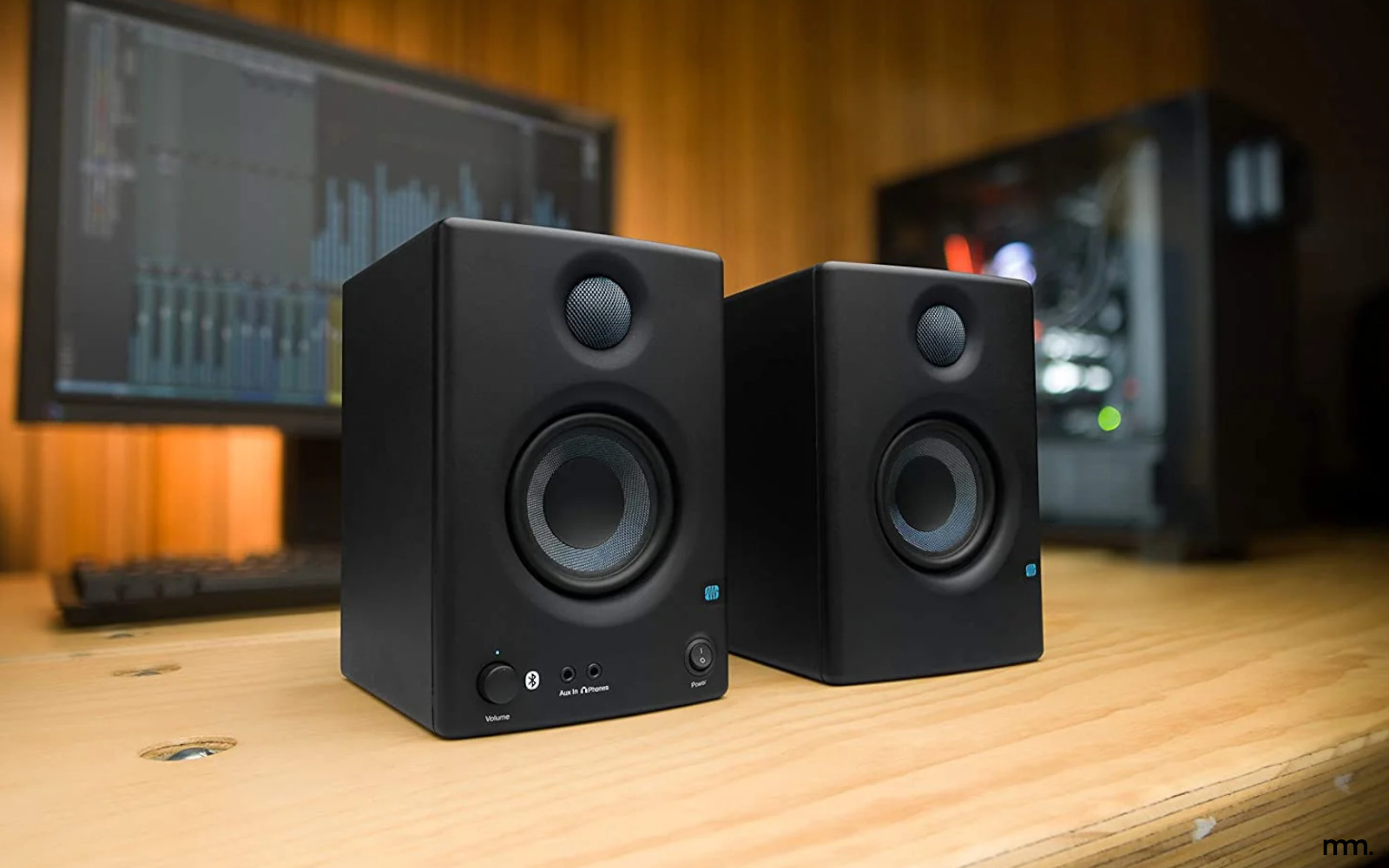
In one corner, the more than capable PreSonus Eris 3.5BT Bluetooth Studio Monitors.
There comes a point in every home studio when making sound is no longer the problem.
The interface is connected. MIDI is behaving itself. The vocal has been recorded enough times that nobody can remember which take contained the actual performance and which one contained the mysterious chair squeak. The session has grown from a simple song into a sprawling forty-track organism with auxiliary buses, parallel compression and at least one plug-in whose purpose you can no longer explain.
The music exists.
Now comes the hard (er) part.
Can you actually hear what you have made?
Monitoring is where confidence is dragged into the street and beaten under a flickering lamp. Every decision you make is based on what your listening system tells you. You reduce the bass because the bass sounds excessive. You brighten a vocal because it feels dull. You widen the guitars because the middle seems crowded, and by the time you have finished, the mix resembles a once-proud building after controlled demolition.
You heard something. You trusted it.
Then you changed the music.
Tonight, two very different witnesses have been summoned to testify.
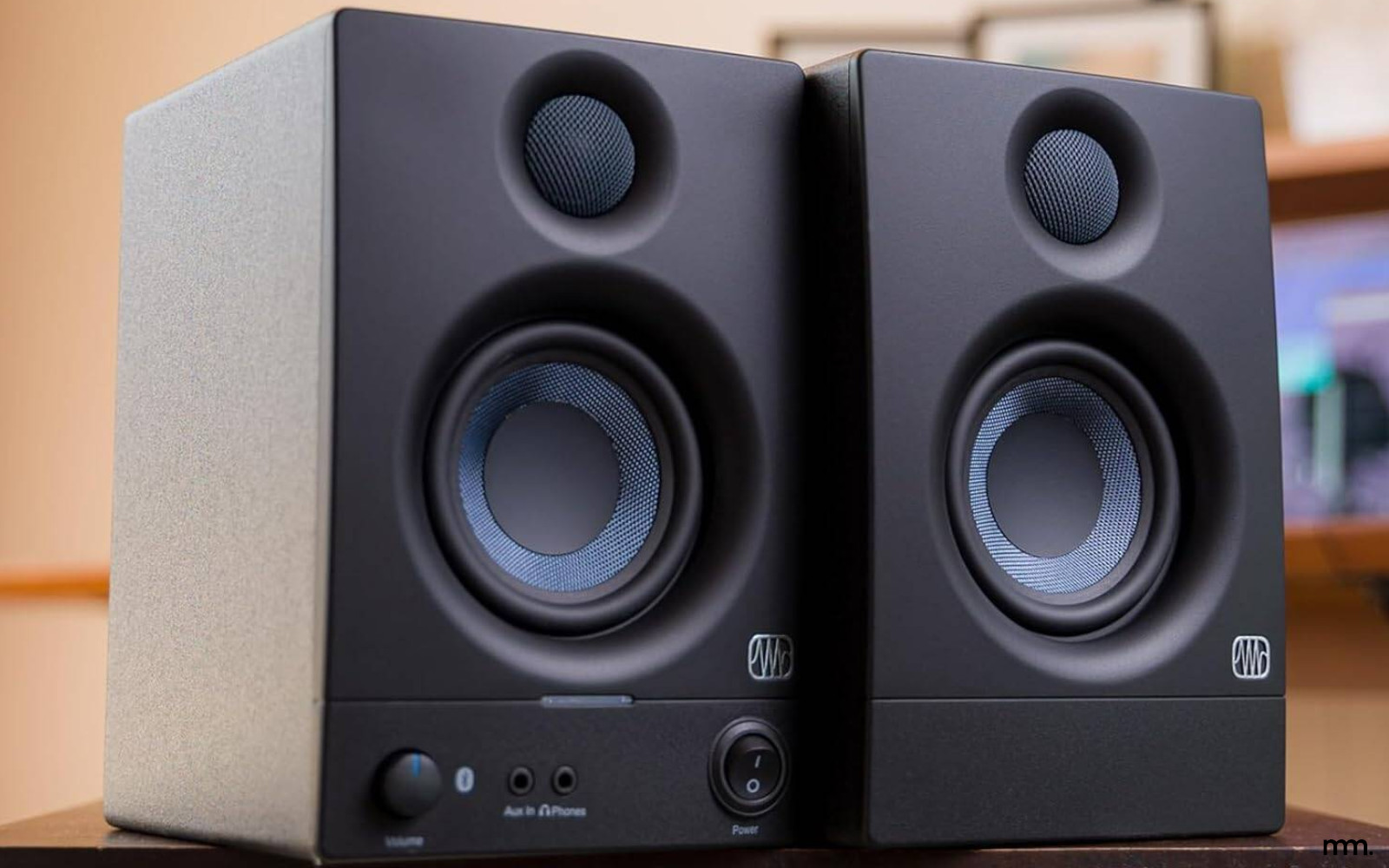
In one corner stand the PreSonus Eris 3.5BT Bluetooth Studio Monitors, a compact pair of active nearfields using 3.5-inch woven-composite low-frequency drivers, 1-inch silk-dome tweeters and 50 watts of Class AB amplification, with a quoted 80Hz–20kHz frequency response, Bluetooth 5.0 and acoustic-tuning controls designed to help them survive the realities of a home studio.
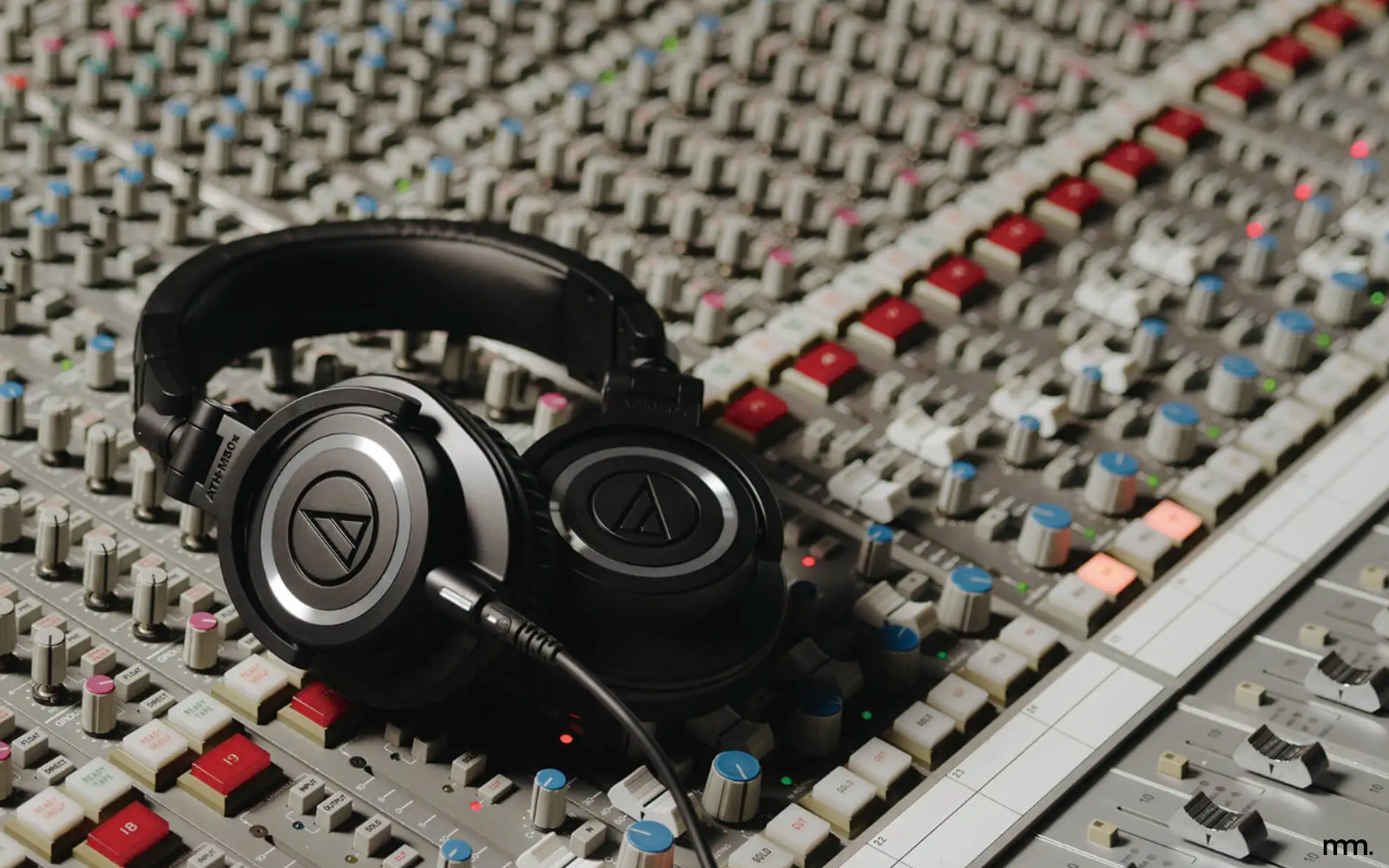
In the opposite corner sit the Audio-Technica ATH-M50x Professional Monitor Headphones, already looking disturbingly calm. Their closed-back earcups contain 45mm dynamic drivers with neodymium magnets and CCAW voice coils, with a quoted 15Hz–28kHz response, 38-ohm impedance and 99dB sensitivity. They fold, they swivel, they isolate, and they have spent years turning up in studios precisely because they are exceptionally difficult to kill.
Speakers against headphones. Room against isolation. Air against intimacy.
Five rounds. Ring the bell.

Portable, powerful, comfortable. The Audio Technica ATH-M50x Professional Monitor Headphones aren't worried.
ROUND ONE: SPACE
The Eris attacks first, and it attacks with physics.
Put two loudspeakers in front of you and something happens that headphones cannot reproduce in quite the same way. Sound leaves the cabinets, moves through air and reaches both ears. The left speaker is heard predominantly by the left ear, but not exclusively. The right speaker does the inverse. The two channels interact in the physical world and, when the monitors are positioned properly, a phantom image forms between them.
The vocal appears in the centre despite there being no speaker there. A guitar can hover just left of it. Reverberation seems to extend behind the direct sound. Push a percussion part towards one side and it occupies a position rather than simply becoming louder in one ear.
This is the theatre of stereo.
The PreSonus Eris 3.5BT builds that stage from reassuringly modest hardware. Each cabinet combines a 3.5-inch woven-composite low-frequency driver with a 1-inch ultra-low-mass silk-dome tweeter, while the pair shares 50 watts of Class AB power — 25 watts per side — and reaches a quoted peak output of 98dB SPL at one metre.
These are not giant main monitors intended to dominate a purpose-built control room. They are desktop nearfields for people working at realistic distances in bedrooms, small studios and creative spaces that still occasionally contain beds.
That modest scale is part of the appeal.
When the speakers are correctly placed, the mix gets to leave your head. You can sit back, listen across the front of you and judge the relationship between elements in a way that feels naturally connected to how loudspeaker playback behaves almost everywhere else.
The ATH-M50x retaliates with extraordinary intimacy. It brings detail brutally close and can make a wide stereo mix feel enormous, but that very closeness changes the perspective. Conventional headphones deliver left primarily to left and right primarily to right, so the acoustic crossfeed you experience from loudspeakers is greatly reduced. Width can become intoxicating. Hard-panned sounds can feel more dramatic. Tiny stereo effects suddenly strut around like emperors.
That can be wonderful.
It can also tempt you into building a stereo landscape that only truly exists while two drivers are clamped to your skull.
For judging space, pan relationships and the physical stereo image, the monitors draw first blood.
ROUND ONE WINNER: PRESONUS ERIS 3.5BT
The Eris leaves the round carrying the stereo field like a trophy.
The M50x retreats to its corner.
It is not worried.
ROUND TWO: THE ROOM TURNS TRAITOR
And here comes the problem with loudspeakers.
The room.
The room is not an innocent bystander. It is a heavily armed third party with no respect for the rules.
Walls reflect sound. Corners accumulate low-frequency energy. Desks throw reflections towards the listening position. The distance between each monitor and the nearest boundary matters. Furniture matters. Glass matters. Plaster matters. The chair matters. Move your head thirty centimetres and the low end can change enough to make you question decisions you were absolutely certain about five seconds earlier.
The mix has not changed. Your room has falsified the evidence. This is the Eris's great vulnerability.
PreSonus knows it too, which is why the Eris 3.5BT includes high- and low-frequency Acoustic Tuning controls, each allowing ±6dB of adjustment, centred at 10kHz and 100Hz respectively. They are useful broad controls for adapting the monitors to a real-world setup, but no knob can magically transform an untreated box room into a professionally designed control room.
Then the ATH-M50x walks out of its corner and commits murder. It does not care about your walls. It does not care that the left monitor would have been too close to the wardrobe. It does not care that your desk is glass, that the ceiling is low or that the only acoustic treatment in the room consists of a duvet and optimism.
The headphone drivers are attached directly to the listening system.
You.
The M50x therefore removes a huge part of room acoustics from the equation. It does not solve every monitoring problem — nothing does — but for someone working in student accommodation, a rented room, a bedroom or a space where serious acoustic treatment simply isn't possible, this is liberation.
The detail becomes immediate too. The faint guitar amp buzz behind the chorus suddenly reveals itself. An edit clicks. The reverb tail carries something ugly. There is a breath before the vocal that seemed perfectly harmless through speakers and now sounds like someone breaking into the session.
This is where isolation stops being merely convenient and becomes diagnostic violence.
The Eris fights bravely. But the room has betrayed it.
ROUND TWO WINNER: AUDIO-TECHNICA ATH-M50x
The M50x does not knock the monitors down.
It simply turns the room off.
Much colder.

ROUND THREE: LOW END — DESCENT INTO THE PIT
Bass is where home studios go to suffer.
The Eris enters the round with a perfectly respectable but very important limitation: PreSonus quotes its low-frequency extension at 80Hz.
That is absolutely useful for compact nearfield monitoring. There is plenty of information there for guitars, vocals, acoustic material, songwriting, editing and a huge amount of music production. But physics remains physics, and a 3.5-inch woofer in a compact cabinet is not going to recreate the physical experience of a massive full-range monitor system.
Music does not politely end at 80Hz.
The fundamental of the low E on a conventional bass guitar sits much further down. Electronic kick drums and synthesised bass can carry substantial information beneath that region, and modern production can become extremely sub-heavy very quickly.
If you turn the bass up until tiny desktop monitors reproduce the visceral low-frequency impact of a club PA, you have ceased monitoring and begun a hostage situation.
The ATH-M50x enters with a quoted frequency response extending down to 15Hz, and because a headphone driver does not need to energise the entire room, it can reveal low-frequency information that a compact nearfield may only partially communicate.
But this round is nastier than looking at two numbers. Headphone bass and speaker bass are different experiences.
Through monitors, low frequencies interact with the room and can be felt physically as well as heard. Through headphones, the driver is much closer to the ear and does not create the same whole-body sensation or room interaction. The M50x may tell you something exists at the bottom of the mix that the Eris barely hints at, but the Eris can tell you how the audible bass interacts with actual physical playback in front of you.
So now the witnesses disagree. Excellent.
That disagreement is exactly where learning begins.
If the bass sounds beautifully controlled on the M50x but disappears through the Eris, investigate it. If it seems modest on the monitors but becomes a swamp in the headphones, investigate that too. Do not search for one system that makes the other unnecessary. Learn which aspects each one exaggerates, which it conceals and where its weaknesses become predictable.
For this round, though, we need blood.
For revealing deep low-frequency information at roughly this price and physical scale, the headphones land the heavier blow.
ROUND THREE WINNER: AUDIO-TECHNICA ATH-M50x
The M50x climbs out of the pit carrying the bass guitar.
The Eris watches from above.
It has another plan.
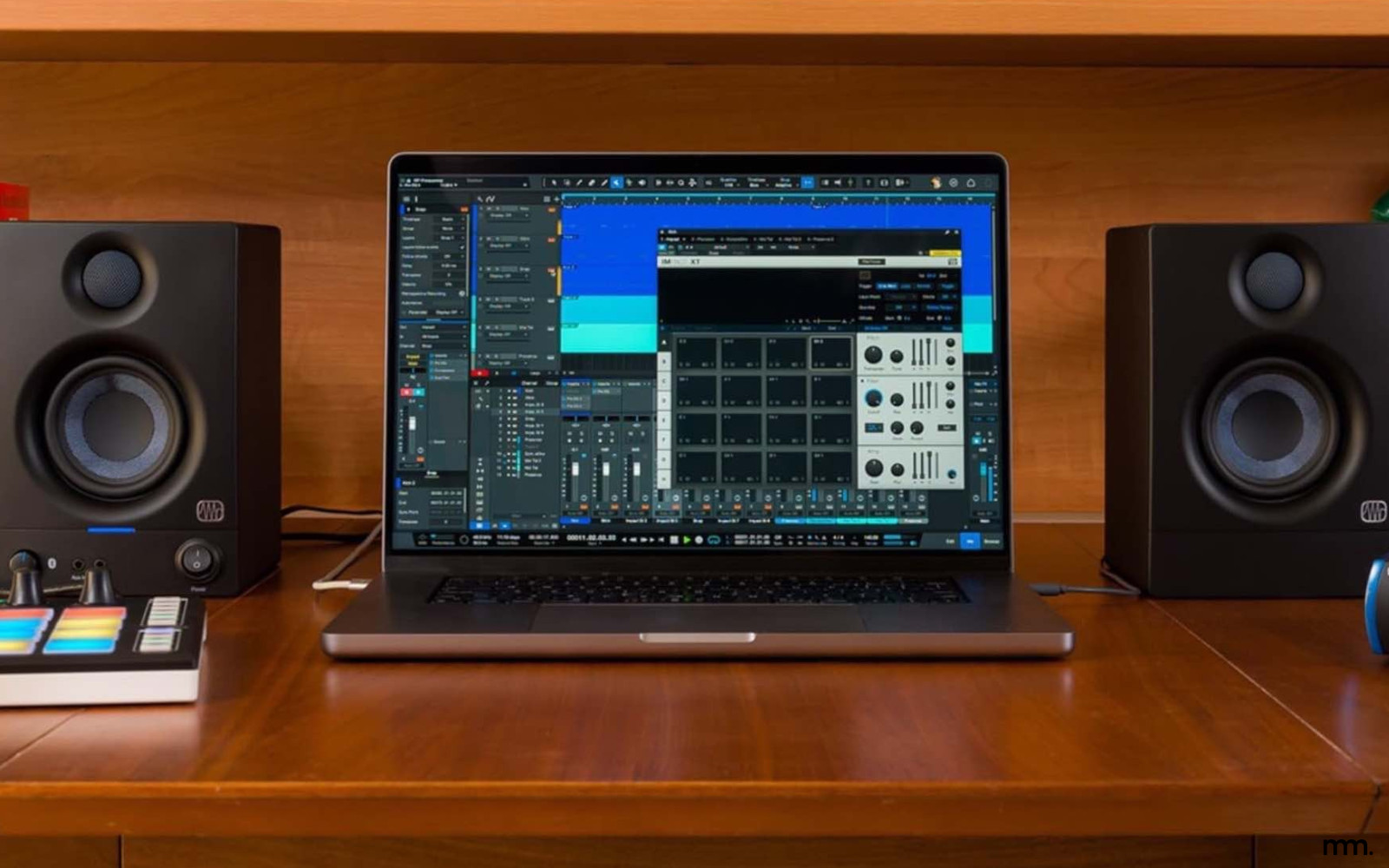
ROUND FOUR: THE MIXING TABLE BECOMES AN ALTAR
The music has been recorded. Now the decisions begin.
And this is where the monitors come back angry.
Mixing is not merely finding faults. It is judging relationships. How loud is the vocal compared with the band? Does the chorus feel larger than the verse? Is the bass supporting the kick or strangling it? Does the reverb create depth or merely make everything sound as though it was recorded in a cathedral toilet?
A loudspeaker system gives you something immensely powerful during this process: distance.
You can turn the Eris 3.5BT down and listen from the chair. You can stand up. You can move back from the desk. You can hear how the track behaves when all the microscopic detail stops demanding attention and the musical hierarchy is forced into the open.
That matters because a mix can be spectacular at close range while being structurally rotten underneath.
Turn the speakers down until conversation would be possible over them. Does the vocal still own the song? Does the chorus still rise? Can you understand what the rhythm section is doing? Do the important parts survive without volume supplying the excitement?
If not, the mix has begun to confess.
This is one of the reasons monitors remain so valuable even in an era of extraordinary headphones. The Eris gives you a conventional stereo presentation in physical space, letting the left and right channels interact acoustically and allowing you to judge the overall picture rather than only its smallest details.
The M50x retaliates viciously with precision. It is excellent for hearing edit points, tiny timing issues, clicks, vocal artefacts, subtle distortion and effect tails. But that microscopic power can become a trap if you spend the entire mix working inches from every imperfection.
You begin polishing individual leaves while the forest burns behind you. For forensic work, the headphones are horrifyingly effective. For judging the whole mix as music, the Eris gets the nod.
ROUND FOUR WINNER: PRESONUS ERIS 3.5BT
The monitors rise from the canvas.
They do not look healthy.
They do look furious.
Two rounds each.
Of course.
ROUND FIVE: TRANSLATION — THE REAL CHAMPIONSHIP
Everything before this was training.
Now the track leaves your studio. And the world begins trying to destroy it.
It goes into a car whose owner has discovered the bass control and mistaken it for a moral obligation. It goes through cheap earbuds and expensive earbuds, Bluetooth speakers, televisions, phones and laptops whose manufacturers have apparently decided that firing tiny speakers directly into a desk is an acceptable way to reproduce music.
Then it reaches someone's ancient kitchen radio, a device held together by grease, habit and an electrical plug that nobody has inspected since 1997. If the song is lucky, one day it may also find itself roaring through a serious PA at a volume you never heard during the mix.
Welcome to translation.
A mix does not need to sound identical on every system because that is impossible. What has to survive is the hierarchy of the music.
The vocal needs to remain the vocal. The bass should support the track without vanishing on small systems or becoming a geological event on large ones. The snare should retain impact without transforming into industrial machinery. The chorus should still feel larger than the verse after all the seductive stereo information you admired in the studio has been brutally stripped away.
This is where our entire fight changes. Neither the Eris nor the M50x is an oracle. They are witnesses.
And witnesses are valuable precisely because they do not always agree.
The Eris tells you what happens when the mix becomes physical and inhabits a room. It reveals the conventional stereo image, overall balance and how the musical elements interact when sound moves through air.
The M50x drags you into the recording and interrogates it. It reveals low-frequency material, detail, noise, edits and tiny spatial information that may have hidden behind the room.
The trick is not choosing which witness to believe. The trick is learning each one so thoroughly that you know how it lies.
Play records you know intimately through the Eris until you understand what finished music normally sounds like on those speakers in your room. Listen to the same records through the ATH-M50x until you understand its bass character, stereo width and vocal perspective.
Build references. Not theoretical ones. Records you know so deeply that the first bar already tells you whether something has changed. Then play your mix.
If your bass behaves wildly differently from professional records through the M50x, pay attention. If the vocal collapses into the backing track on the Eris while every reference vocal remains steady, pay attention. If the chorus only feels exciting in one monitoring environment, that is evidence too.
This is where familiarity becomes more powerful than the fantasy of perfect monitoring.
So who wins translation? The system that allows you to hear from more than one perspective.
But the round still demands an individual victor, and the Eris earns it by putting the mix into the same fundamental medium through which vast amounts of real-world listening still happens: loudspeakers moving air in a space. The M50x remains an essential cross-check, but speakers are merciless when it comes to revealing whether the song can stand outside the extraordinary intimacy of headphones.
ROUND FIVE WINNER: PRESONUS ERIS 3.5BT
The bell rings.
PreSonus takes three rounds. Audio-Technica takes two.
So PreSonus wins the fight. Right?
Wrong.
THERE IS NO CHAMPION
The crowd boos. Good.
Let them.
Because a three-two score does not mean the PreSonus Eris 3.5BT is a better monitoring solution than the Audio-Technica ATH-M50x.
It means it won three particular fights. Change the battlefield and the score changes instantly.
Start recording through microphones and the M50x will tear the Eris apart because closed-back headphones let the performer hear the cue mix without blasting it back into the microphone. Audio-Technica's earcups swivel through 90 degrees, the 38-ohm impedance makes them practical with a broad range of suitable studio hardware, and three detachable cables are included — a 1.2–3m coiled cable, a 3m straight cable and a shorter 1.2m straight cable.
Start producing at midnight in an apartment and the ATH-M50x wins before the fight begins. Move between studios and the foldable 285g headphones can travel with you while the Eris remains on the desk.
But put the job back into a reasonably controlled room and ask which tool allows you to step away, judge a conventional stereo image and hear music physically occupying space, and the Eris comes roaring back.
It also happens to be spectacularly practical. Alongside Bluetooth 5.0, the 3.5BT provides balanced ¼-inch TRS inputs, unbalanced RCA, a stereo 3.5mm input and a front-mounted headphone output. Plugging headphones into that socket mutes the monitors, which means PreSonus has thoughtfully equipped the speaker system with a way to surrender immediately when somebody opens a microphone.
Brutal. But useful. That is the entire story.
The Eris is not the M50x. The M50x is not the Eris.
Thank God.
The Real Enemy: You at Two in the Morning
There is one participant in this fight we have avoided naming.
The producer. You.
Monitoring equipment can only report what it is capable of reproducing. Your ears and brain then have to interpret the evidence, and after enough hours of listening, they become extraordinarily unreliable. Fatigue is the silent assassin in the control room.
Listen too loudly for too long and perception changes. The top end begins to feel dull, so you add more. The bass stops exciting you, so you add more. You become accustomed to the vocal level and start moving it around despite having absolutely no remaining perspective on where it should sit.
At two o'clock, the mix is magnificent. At nine the next morning, the snare sounds like somebody firing a cutlery drawer down a staircase.
This is not necessarily because your monitors failed. It is not because your headphones failed.
Your ears were dead.
They simply neglected to send you the paperwork.
That is why stepping away matters. Reference tracks matter. Fresh ears matter. Low-level listening matters.
And it is another reason two monitoring systems can be so useful.
Sometimes moving from the Eris to the M50x exposes the problem. Sometimes taking the headphones off and returning to speakers does it.
Sometimes neither helps. Then the correct studio technique is astonishingly advanced:
Go to bed.
Which Should You Buy First?
Now we stop throwing furniture around and answer the useful question.
If you are working in an untreated bedroom, student accommodation, shared house or anywhere volume is a serious constraint, the Audio-Technica ATH-M50x is probably the more universally practical first purchase. It eliminates much of the room from the monitoring equation, works beautifully for recording with microphones, travels easily and gives you access to deep low-frequency and forensic detail without requiring a dedicated acoustic space.
If you already own decent headphones and want your first genuine nearfield listening experience, the PreSonus Eris 3.5BT makes enormous sense. Its 3.5-inch woven-composite drivers, silk-dome tweeters, 50 watts of Class AB amplification and acoustic-tuning controls create a serious compact monitoring system, while Bluetooth and its generous input selection allow it to become the everyday audio system for a desk as well as the monitoring pair for a DAW.
And if you are going to get serious about mixing? Eventually, having both perspectives is extraordinarily valuable.
Not because gear addiction has won. Although the defence has requested additional time to review the evidence. Because different monitoring systems fail differently.
And their disagreements teach you things.
From the Musicmaker Workshop
We have watched home recording become astonishingly accessible at Musicmaker Dublin, but monitoring remains one of those wonderfully stubborn parts of production where no amount of new technology has removed the need to listen carefully.
There is no magic box that reveals the final mix. There is no pair of headphones that abolishes uncertainty. There is no studio monitor that makes the room irrelevant.
What you can build is familiarity.
Listen to excellent records through the PreSonus Eris 3.5BT until you understand what finished music sounds like there. Learn the way those compact nearfields present bass, vocals, width and ambience in your room. Do exactly the same through the Audio-Technica ATH-M50x, learning its detail, low-frequency perspective and the peculiar intimacy of music delivered directly around the ears.
Then make them fight.
Mix on the Eris. Check on the M50x. Go back to the Eris. Reference another track.
Take a break. Listen tomorrow.
And when the monitors and headphones finally stop contradicting each other and begin pointing towards the same ugly problem in your mix, understand what has just happened.
The enemies have formed an alliance. And now they're coming for you.
Fix the mix.
Free Shipping Across Ireland
If the battle is moving into your own studio, Musicmaker offers free shipping across Ireland on qualifying orders, so both the PreSonus Eris 3.5BT Bluetooth Studio Monitors and the Audio-Technica ATH-M50x Professional Monitor Headphones can make the journey from our Dublin shop to your setup.
Choose the monitors. Choose the headphones.
Eventually choose both. The war does not care.
Because sooner or later the track will leave your room, crawl battered and bleeding through phones, cars, earbuds, laptops, Bluetooth speakers and that unspeakable kitchen radio, and everything you did in the studio will finally be judged in public.
May your vocal remain audible. May your bass remain controlled. May your snare show mercy
And may the mix survive.
Get your ATH-50Xx Headphones HERE.