




The Taylor Sound: Four Acoustic Guitars Worth Playing
There are guitar companies whose instruments need an introduction, and then there is Taylor Guitars.
For decades, Taylor has occupied a fascinating position in the acoustic world. The company respects the fundamental traditions of acoustic guitar making, but it has never seemed particularly interested in treating tradition as a set of rules that cannot be disturbed. Player comfort, neck design, bracing, sustainable use of timber, pickup technology and manufacturing have all been areas in which Taylor has been perfectly happy to rethink the accepted way of doing things.
That philosophy has produced something even more important: a recognisable identity.
Pick up a good Taylor acoustic and there is usually an immediacy to it. The neck feels familiar remarkably quickly. The notes arrive cleanly, with definition around the attack and enough separation that individual strings retain their place inside a chord. There is brightness without the instrument necessarily becoming brittle, and a sense of precision that makes Taylors particularly satisfying for players who care about articulation.
And yet there isn't really one Taylor sound.
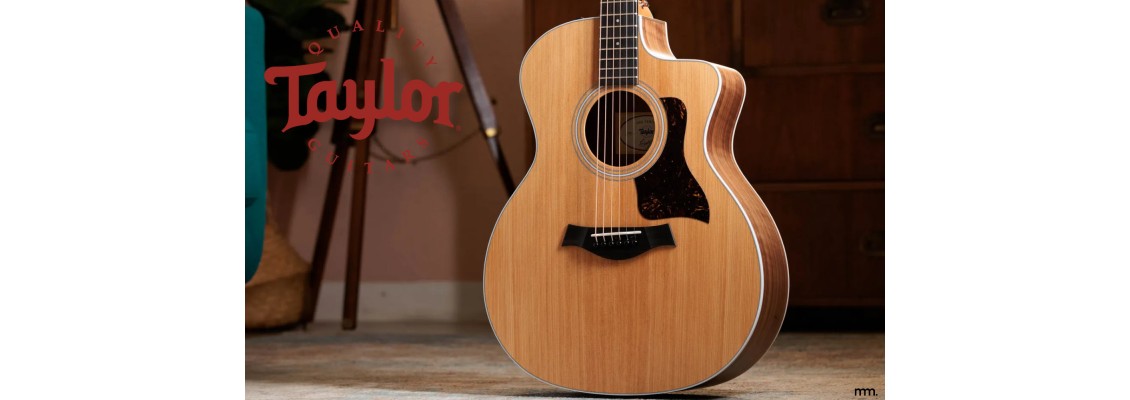
That becomes wonderfully obvious when four very different Taylor guitars arrive together at Musicmaker: the compact Taylor BT2 Baby Taylor, the almost-full-size Big Baby Taylor BBT, the beautifully approachable Taylor Academy 12e, and the enormously versatile Taylor 214ce Grand Auditorium.
They share a family resemblance, but each one exists for a different reason.
And every one of them makes a remarkably good argument for coming home with you.
Taylor BT2 Baby Taylor
Small Guitar, Proper Taylor
The Taylor BT2 Baby Taylor has been around long enough that it is easy to underestimate how clever the idea remains.
This is a three-quarter-size Dreadnought, built around a compact 22-3/4-inch scale length that makes the entire playing experience feel immediately more manageable. Taylor itself describes the Baby as one of the original true travel guitars, but its usefulness stretches considerably further than airports and hotel rooms.
For younger guitarists and players with smaller hands, the reduced dimensions can remove a surprising amount of physical intimidation. For experienced musicians, the same characteristics make the BT2 a beautifully convenient songwriting guitar, sofa guitar, alternate-tuning machine or travelling companion.
But the important bit is the mahogany top.
Spruce is often the default choice for a steel-string acoustic soundboard, with its combination of clarity, headroom and projection. A hardwood mahogany top gives the BT2 a different personality. Taylor describes it in terms of strong fundamentals, clarity and focus, and that goes some way towards explaining the attraction: there is a woody directness to the voice, with less emphasis on a huge halo of overtones and more attention placed on the note itself.
On a small guitar, that works beautifully.
The layered Sapele back and sides provide a durable structure around the solid top, while Taylor's arched-back Baby construction helps this little body produce a surprisingly confident acoustic voice. It isn't trying to impersonate a full-size Dreadnought. Instead, it takes the things that are genuinely useful about a smaller instrument — comfort, immediacy and portability — and gives them enough tonal character that you actually want to keep playing it.
And that distinction matters. A travel guitar that feels like a compromise spends its life in a bag.
A good Baby Taylor ends up beside the sofa because somebody keeps reaching for it.
The Beauty of a Guitar That's Always There
There is an argument for small guitars that has almost nothing to do with tonewood.
They get played.
The BT2 doesn't require ceremony. You don't need to clear a space, retrieve a precious hard case or prepare yourself for Serious Acoustic Guitar Time. It is compact enough to become part of everyday life, and that can make it extraordinarily useful for songwriting.
Pick it up while you're waiting for something. Find a chord. Follow it somewhere.
Twenty minutes later, you've got the beginning of a song.
There is also something particularly pleasing about a mahogany-topped guitar in that environment. The BT2's fundamental-focused character suits dry chord work, bluesier fingerstyle playing, altered tunings and intimate songwriting without trying to create an enormous acoustic spectacle around every note.
The Taylor BT2 Baby Taylor Mahogany is small because small is useful.
Not because small has to mean lesser.
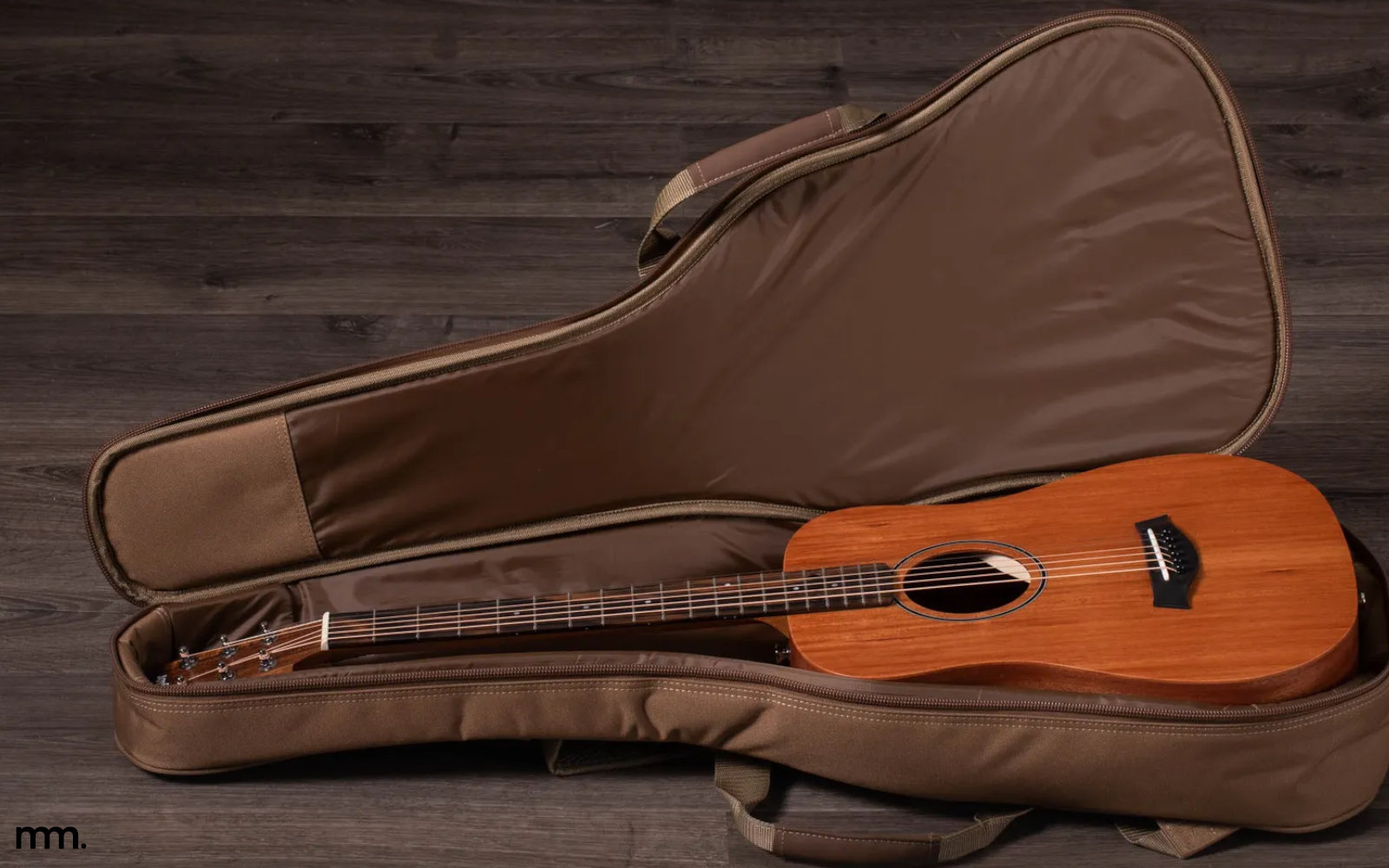
Check out the Taylor BT2 with gig bag at Musicmaker today!
Big Baby Taylor BBT
When the Baby Grows Up
And then somebody inevitably says:
I love the Baby Taylor idea. Could I have… more guitar?
Yes.
Meet the Big Baby Taylor BBT.
The Big Baby occupies a fascinating middle ground. It retains the stripped-back, practical spirit of the Baby family, but stretches the concept into a much more substantial acoustic instrument with a 25-1/2-inch scale length and a scaled-down Dreadnought body that feels considerably closer to a conventional full-size guitar.
This makes the BBT something of a secret weapon.
It is still slimmer and more manageable than a traditional large Dreadnought, but there is enough body beneath the right arm to produce greater low-frequency authority, projection and acoustic spread than its smaller sibling.
And the current version gets particularly interesting at the soundboard.
Taylor now uses a solid torrefied spruce top, paired with layered walnut back and sides. Torrefaction involves carefully heating the spruce in a controlled environment, altering its physical properties and giving Taylor a way to introduce some of the warmth and depth we tend to associate with more seasoned material while retaining the clarity and projection that makes spruce such a useful acoustic-guitar top wood.
The result is a guitar that feels wonderfully straightforward.
There's no cutaway. No onboard electronics on this BBT. No attempt to dress the instrument up as something more elaborate than it needs to be.
Just a solid spruce top, walnut-backed body, full 25-1/2-inch scale, light D'Addario XS strings and the familiar ease of a Taylor neck.
That simplicity is enormously appealing.
The Big Baby Might Be the Goldilocks Taylor
For some players, the Big Baby Taylor lands in a remarkably useful place.
A full Dreadnought can be physically imposing, particularly for younger musicians, smaller players or anybody who simply doesn't enjoy wrapping themselves around a deep acoustic body. A three-quarter-size travel guitar can go too far in the other direction for someone who wants the response and string tension of a conventional scale.
The BBT sits between those worlds.
You get a proper 25-1/2-inch scale length and enough acoustic body to strum with authority, but the guitar retains the slightly pared-back character that makes the Baby family so inviting.
For students moving towards their first serious acoustic, it makes enormous sense. For experienced guitarists who want something uncomplicated beside the desk or in the writing room, it makes enormous sense. For the player who says “I don't need a pickup; I just want a really good acoustic guitar”, it makes enormous sense.
And sometimes that's what good guitar design looks like. Not another feature.
The correct amount of guitar.
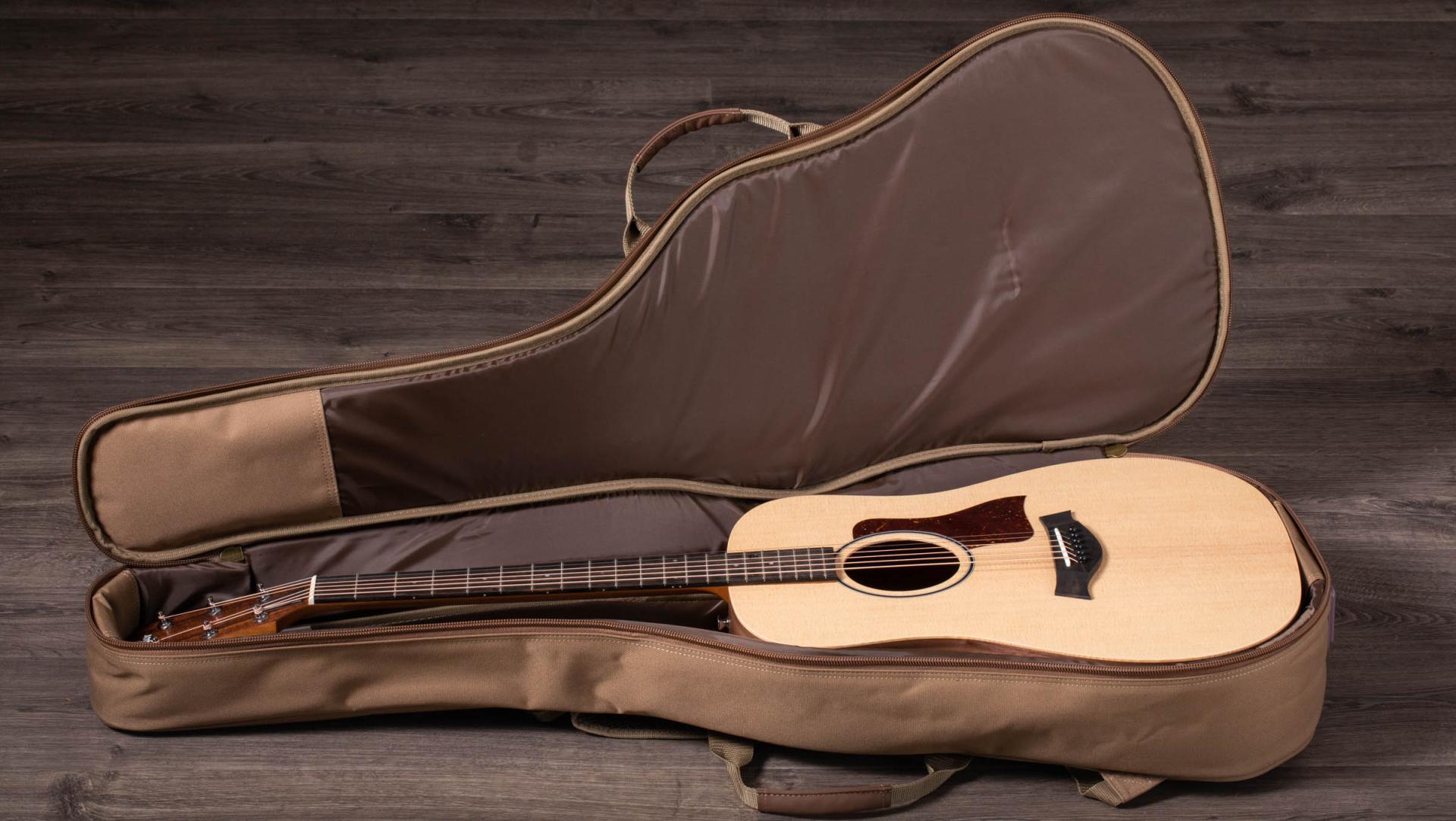
The entirely wonderful Big Baby Taylor acoustic guitar, available at Musicmaker now.
Taylor Academy 12e
Comfort Is Not Cheating
The Taylor Academy 12e represents another side of Taylor's philosophy, and perhaps one of the company's most important ideas.
Learning guitar is difficult enough. Why make the guitar itself part of the problem?
Taylor created the Academy Series around reducing unnecessary physical obstacles for developing players, and the current Academy 12e is a particularly elegant expression of that thinking. It uses the compact Grand Concert body shape, a slightly shorter 24-7/8-inch scale length, a narrower 1-11/16-inch nut, light-gauge strings and a built-in armrest that softens the point where the lower bout meets the player's picking arm.
None of those things makes the guitar play itself.
You still have to practise. Sorry.
But they can make the instrument feel considerably less combative while you're doing it. And this is one of the things Taylor understands particularly well: playability isn't a luxury feature.
If a neck feels inviting, the strings don't require unnecessary effort and the body sits comfortably against you, you tend to play longer. If you play longer, you tend to improve. If you improve, you tend to become more emotionally attached to playing the guitar.
The Academy 12e Is Not Just a Beginner Guitar
And this is where the Academy Series becomes much more interesting than the phrase entry-level Taylor suggests.
The current Academy 12e combines a solid torrefied spruce top with layered walnut back and sides, using X-bracing beneath the soundboard. Taylor's Grand Concert body gives it a naturally focused, articulate personality, with a more intimate physical feel and touch-sensitive response than a larger-bodied acoustic.
That makes the Academy 12e extremely friendly to fingerstyle playing.
Individual notes emerge cleanly. Chords retain definition. The smaller body doesn't throw unnecessary low-end weight around the room, and the torrefied spruce brings enough projection and harmonic maturity that the guitar never feels timid.
So yes, give one to a beginner. It is an exceptionally thoughtful first serious guitar.
But hand the same instrument to an experienced songwriter, fingerpicker or electric guitarist looking for a comfortable acoustic and the Academy 12e doesn't suddenly become irrelevant.
Quite the opposite.
Good ergonomics remain good ergonomics after you've learned your scales.
Plug It In
The “e” in Academy 12e matters too.
Taylor equips the guitar with its ES-B electronics, giving the player onboard amplification alongside a built-in digital chromatic tuner.
That dramatically extends the life of the instrument.
A player can begin with lessons and bedroom practice, move into rehearsals, play a first open mic, join a band, begin performing and continue using the same guitar rather than immediately discovering that their acoustic has no convenient way of getting into a PA.
That is exactly what we want from a good first guitar. Not something you buy because you don't know if you'll stick with it.
Something good enough that you have a reason to stick with it.
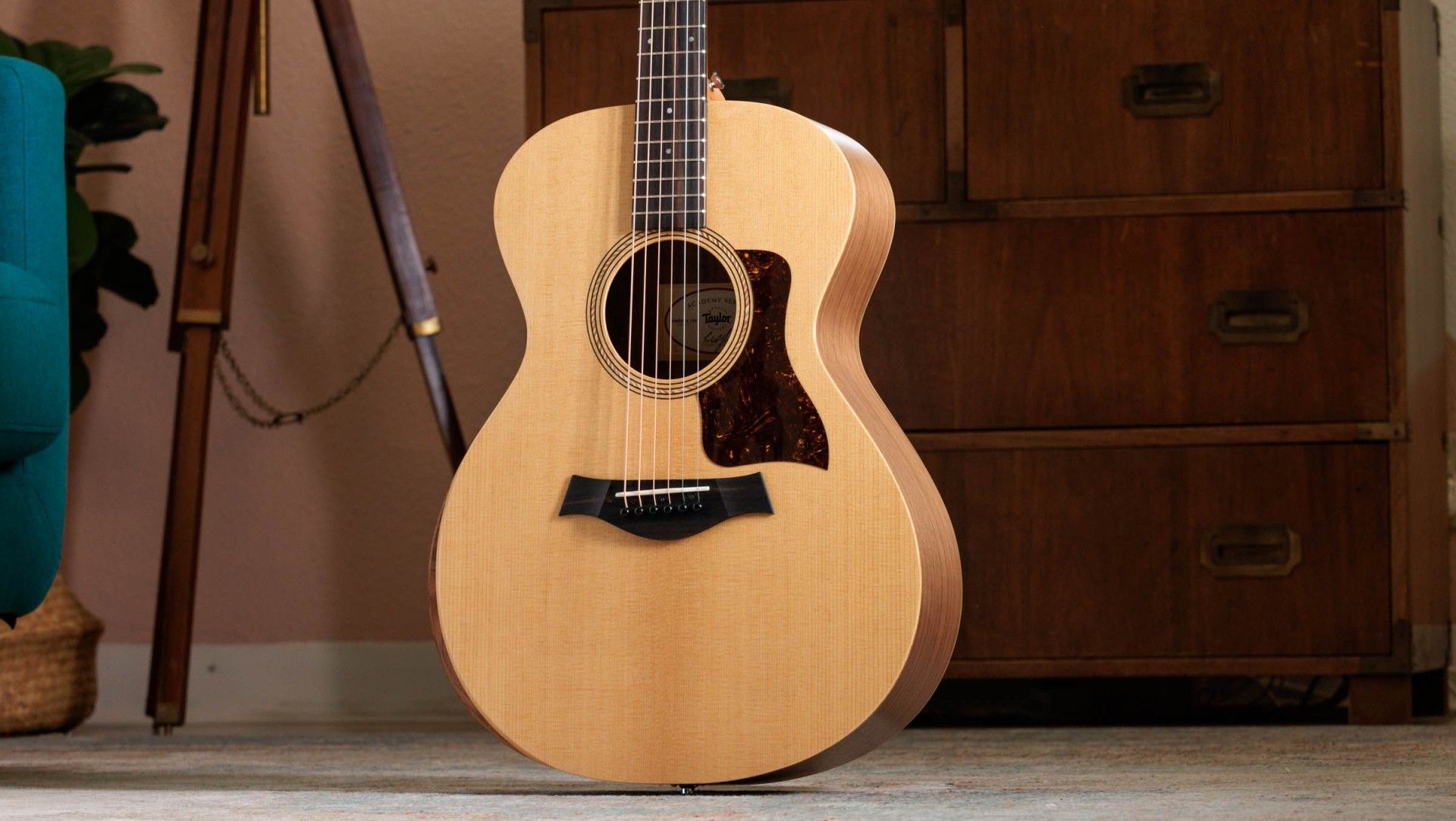
Taylor 214ce
And Here Comes the Grand Auditorium
Then we arrive at the Taylor 214ce, and the conversation changes again.
If there is a body shape that explains modern Taylor particularly well, it is the Grand Auditorium.
Taylor's medium-sized flagship shape sits in that enormously useful territory between intimate fingerstyle instrument and powerful strumming guitar. The waist keeps the body comfortable against the player, but there is enough internal air volume to produce genuine projection and low-frequency presence. Taylor describes the shape as clear, balanced and suitable for both fingerstyle and strumming, which is precisely why the Grand Auditorium has become such a recognisable part of the company's identity.
The 214ce takes that platform and makes it into a genuine working musician's acoustic-electric.
The current model pairs a solid torrefied spruce top with layered walnut back and sides, and Taylor now uses C-Class bracing inside the body to enhance volume, sustain and low-end response.
This is where the guitar begins to feel bigger than the specification sheet. Strum it and there is width. Fingerpick it and there is separation. Play with a flatpick and the attack remains clean enough for individual lines to emerge.
Back off with the right hand and the guitar follows you down rather than disappearing.
That adaptability is the 214ce's great strength.
One Guitar, A Lot of Jobs
Some acoustic guitars have a very obvious speciality.
That can be wonderful.
The Taylor 214ce is compelling for almost the opposite reason. It is extremely difficult to find something it doesn't want to do.
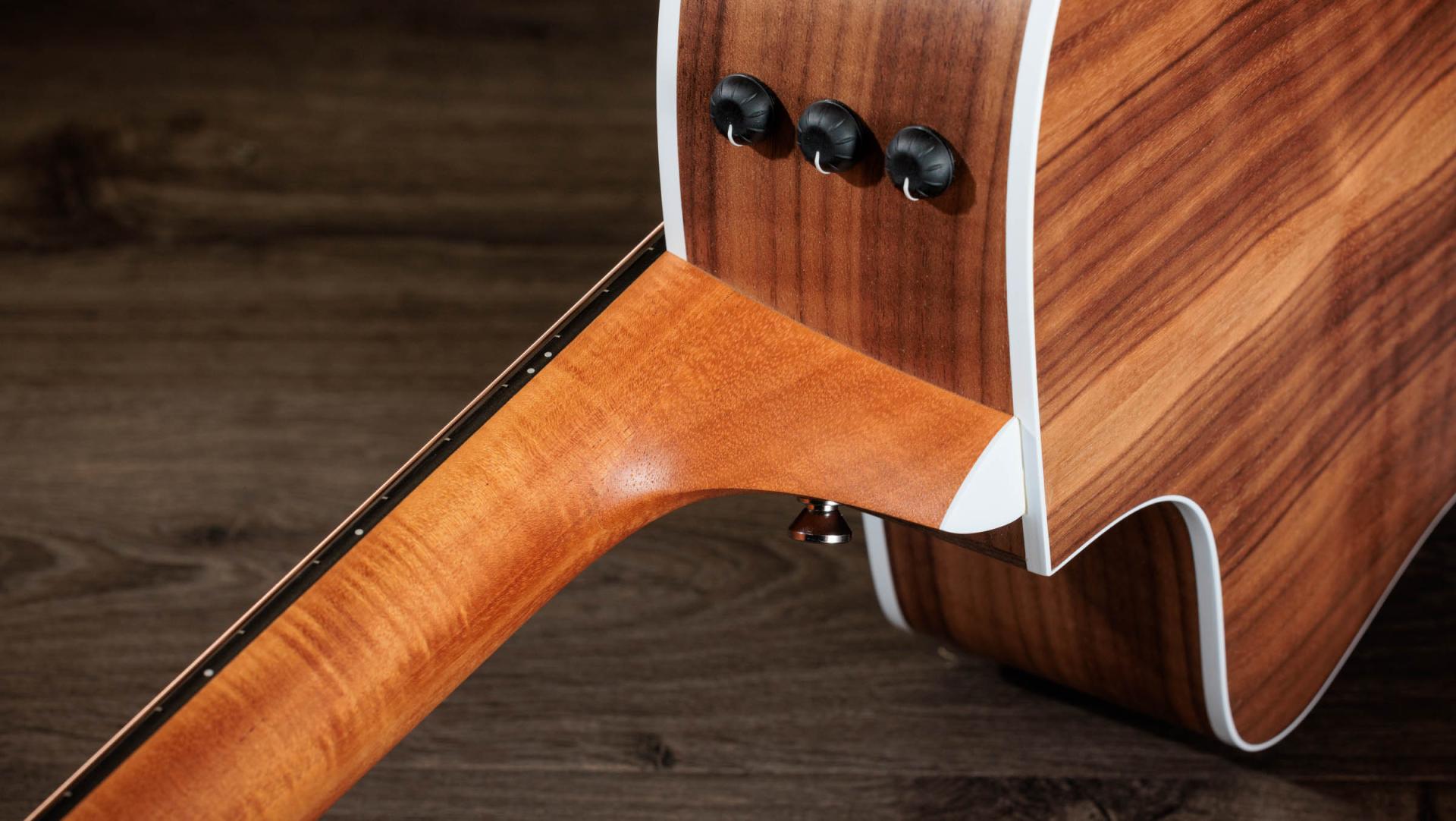
The Grand Auditorium proportions give a singer-songwriter enough body to support a vocal without turning every chord into a wall of bass. Fingerstyle players get the string-to-string definition Taylor is known for. Strummers get projection and headroom. The Venetian cutaway gives clean access further up the neck, making melodic work and contemporary acoustic playing substantially more comfortable.
And because we're dealing with a full 25-1/2-inch scale, there is a familiar sense of tension and authority beneath the hands.
This is the sort of guitar that can spend Monday evening on the sofa, Wednesday at rehearsal, Friday plugged into a PA and Sunday in front of a studio microphone.
It doesn't need to know what genre you're playing next.
That's your problem.
Taylor ES2: Built for the Stage
And when the 214ce leaves the acoustic room, Taylor's Expression System 2 electronics are waiting.
The ES2 is built around Taylor's behind-the-saddle pickup approach, designed to capture more of the dynamic behaviour of the saddle rather than relying on a conventional undersaddle arrangement. On the 214ce, it gives the guitar a straightforward route from natural acoustic instrument to stage-ready acoustic-electric.
That matters because amplified acoustic tone isn't an optional extra for a lot of modern players.
If you're gigging with a band, playing solo through a PA, working with a singer or simply turning up to an open mic where the sound engineer has approximately eleven seconds available for you, being able to plug in and get a dependable signal is invaluable.
The 214ce is designed for that reality.
It is an acoustic guitar first.
But it knows perfectly well there is a stage outside.
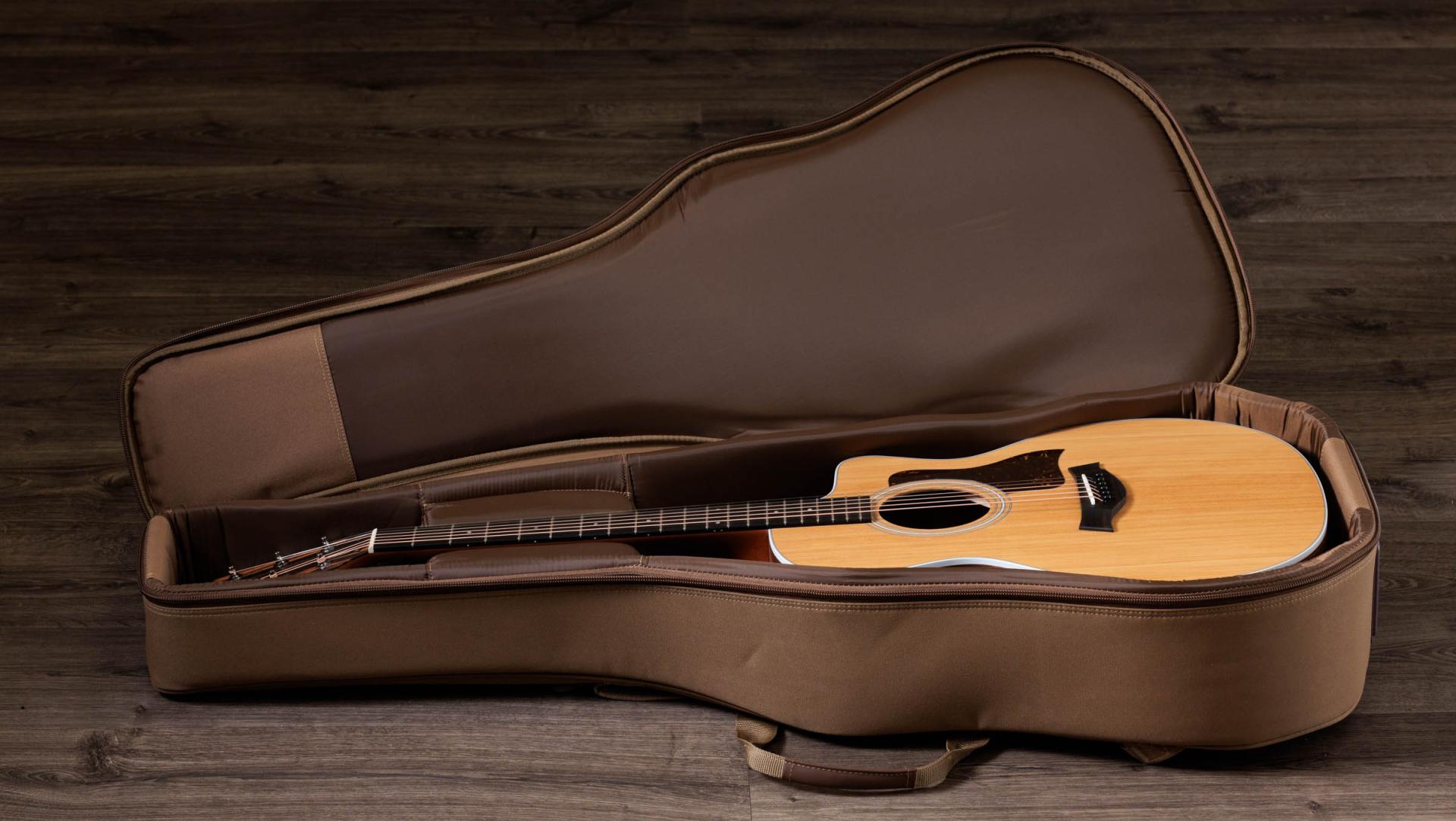
Four Taylors, Four Different Reasons
Put these guitars beside one another and the progression is fascinating because it isn't simply good, better, best.
The Taylor BT2 Baby Taylor Mahogany is the beautiful little troublemaker. Compact, warm, direct and ridiculously easy to keep within arm's reach, it works for beginners, travellers, songwriters and experienced players who have discovered that owning a large guitar doesn't mean you always want to pick it up.
The Big Baby Taylor BBT expands that philosophy into something much closer to a full-size acoustic experience. Its torrefied spruce top, layered walnut construction and full 25-1/2-inch scale give it greater reach and authority while retaining the stripped-back practicality that makes the Baby family so appealing.
The Taylor Academy 12e is perhaps the cleverest of the four. It takes seriously the idea that a guitar should encourage the player rather than test their tolerance, combining Grand Concert proportions, a shorter scale, narrower nut and armrest with a solid torrefied spruce top, layered walnut body and ES-B electronics.
And the Taylor 214ce Grand Auditorium is the all-rounder that has grown into its boots. Bigger voice, versatile body, Venetian cutaway, C-Class bracing and ES2 electronics make it the obvious choice here for the player looking for an acoustic-electric capable of moving confidently between home, studio and stage.
They aren't four versions of the same guitar.
They're four different invitations.
Which Taylor Acoustic Guitar Should You Buy?
There is a wonderfully scientific method for solving this problem.
Come in and play them. Seriously.
Specifications can narrow the field, but an acoustic guitar is one of the most physical purchases a musician makes. Body depth, neck feel, scale length, response beneath the picking hand and the simple emotional reaction to hearing the instrument in the room all matter.
If portability and compact dimensions are central to the appeal, start with the BT2 Baby Taylor.
If you want the stripped-back Baby Taylor philosophy with considerably more of a full-size acoustic feel, pick up the Big Baby Taylor BBT.
If comfort is paramount and you want an exceptionally approachable acoustic-electric with enough quality to remain useful long after the beginner stage has passed, the Academy 12e deserves serious attention. And if you're looking for a versatile Taylor acoustic-electric guitar for gigging, songwriting, recording and everyday playing, put the 214ce Grand Auditorium in your hands.
Then stop reading specifications for a minute.
Play some chords. Play whatever song your hands automatically play when nobody is watching.
Listen to what comes back.
That's the bit no website can tell you.
Taylor Guitars at Musicmaker Dublin
We've been putting guitars into musicians' hands at Musicmaker Dublin since the early 1980s, and Taylor remains one of those names that needs remarkably little explanation once somebody actually plays one.
The four guitars currently sitting in front of us show why.
There is no requirement that a Taylor acoustic guitar should be enormous, expensive or elaborately decorated before the company's design philosophy begins to make sense. You can feel it in the compact simplicity of the Baby Taylor, in the almost-full-size usefulness of the Big Baby, in the deliberately player-friendly Academy 12e and in the wonderfully adaptable Grand Auditorium body of the 214ce.
Different prices. Different bodies. Different purposes.
But the same underlying idea persists: make the guitar comfortable enough to disappear beneath the player, responsive enough to reward good technique and musical enough that you keep coming back to it.
That's a very difficult philosophy to argue with.
Especially when there are four of them sitting in the shop.
Taylor Guitars Delivered Free Across Ireland
Found your Taylor but can't make it into Dublin? No bother. Musicmaker offers free shipping across Ireland on qualifying orders, so your new Taylor BT2 Baby Taylor, Big Baby Taylor BBT, Academy 12e or Taylor 214ce can make its way from our guitar room to your door without adding another cost to the adventure. We will always encourage players to come into Musicmaker, sit down and spend some proper time with a great acoustic guitar — because nothing replaces hearing and feeling an instrument for yourself — but if you already know which Taylor is calling your name, we'll help get it to you.
Great guitars should be played, not left sitting in a shopping basket.
Browse all our current Taylor guitars HERE.
From the Musicmaker Workshop
There are acoustic guitars you admire from across the room, and there are acoustic guitars that make much more sense once they're actually in your lap. Taylor has always been exceptionally good at the second kind.
What we love about this particular group is the progression without the hierarchy. The BT2 doesn't apologise for being small. The Big Baby Taylor doesn't need elaborate appointments to justify itself. The Academy 12e treats comfort as something serious players deserve rather than something beginners should eventually grow out of, and the 214ce takes the balance, clarity and playability people associate with Taylor and turns them into an immensely useful working instrument.
That's why we'd rather you came in and played them than spent another three hours comparing specifications.
A guitar can look perfect on paper. The right one tends to make its argument through your hands.
And when a Taylor does that? Well.
You probably came into town for something else.
Good luck with that.
Browse all our Acoustic Guitars HERE.