




Back to School: Your First Guitar Starts Here
Everything You Actually Need to Start Playing Guitar

September does something strange to us. Fresh notebooks appear. Bags are packed. Timetables return to refrigerators. Everybody suddenly owns far too many pens, and all those vague promises made during the summer begin turning into actual plans.
This year I'm going to start, things. For some people, that means school. More school, other school.
For others, it means guitar. And obviously we prefer the second one.
Because somewhere right now, somebody is about to learn their first chord. Somebody is going to discover that fingertips can apparently hurt in places they didn't know existed. Somebody is going to spend fifteen furious minutes trying to make an F chord sound like anything other than a small wardrobe falling downstairs.
Then, eventually, they're going to play a song.
An actual song. And everything changes.
At Musicmaker, we've been watching that happen since the early 1980s. Generations of Irish guitarists have walked through the doors knowing absolutely nothing, picked up their first instrument and begun exactly where every guitarist begins:
At the beginning.
So for Back to School, here's our guide to buying your first guitar — what you genuinely need, what you absolutely don't, and why excellent beginner guitars from Stagg, Alvarez and JET Guitars mean starting properly no longer requires a terrifying budget.
Class begins now.
No homework.
Well...Maybe twenty minutes a day.
The practice bit is vital.
First Question: Acoustic or Electric Guitar?
This is where the internet traditionally becomes very serious.
People will tell you acoustic guitar develops stronger fingers. They'll tell you electric guitar is easier to fret. They'll argue about scale length, string tension, technique, musical styles and which route creates a more rounded musician.
We have a considerably simpler answer. Which one makes you want to play?
That's your first guitar.
If you've spent the summer listening to singer-songwriters and imagining yourself with an acoustic, buy an acoustic.
If you want distortion, riffs, indie, punk, metal, blues, funk or the opportunity to stand in front of a mirror pretending you're headlining the Olympia, buy an electric.
Do not buy the guitar somebody tells you that you're supposed to learn on.
The best beginner guitar is the one sitting across the room that makes you think: I'll just play for five minutes. Forty-five minutes later, you're still there.
That's the whole game.

The Acoustic Route: Stagg & Alvarez
If your idea of learning guitar begins with six strings, a wooden body and absolutely no requirement for an amplifier, we've got two particularly good ways into the acoustic world at Musicmaker.
And they start at very different places.
For the absolute beginner on a tight budget, Stagg makes an enormous amount of sense. For somebody ready to spend a little more on a first acoustic — or who already suspects this guitar business is going to become serious — the Alvarez Artist Series takes a substantial step upwards into solid-top construction.
Neither approach is wrong.
The important thing is getting a guitar into your hands.
Stagg Guitars: Start Here. Seriously.
There can be a slightly unhelpful attitude in guitar culture that your first instrument needs to represent some enormous financial commitment.
It doesn't. You haven't played a chord yet. What you need is a playable guitar, in an appropriate size, that lets you start learning without annihilating the Back to School budget.
That's where Stagg acoustic guitars are particularly useful.
Stagg's range gives beginners access to traditional full-size acoustics alongside smaller instruments, different body styles and acoustic-electric options. That makes them particularly interesting for younger students because we can match the guitar more sensibly to the person rather than simply handing everybody the same enormous acoustic.
And don't underestimate how important that is.
A full-size dreadnought can feel glorious in the hands of an adult, but for a smaller child it can feel like attempting to play a wardrobe. If the body is uncomfortable, the neck feels miles long and every chord requires advanced yoga, practising becomes a chore remarkably quickly.
The first guitar should remove barriers, not create them.
For older students and adults, an affordable full-size Stagg gives us another wonderfully straightforward proposition: a proper guitar for learning chords, strumming, rhythm and those first increasingly recognisable songs.
You don't need an heirloom. You need Tuesday's practice guitar.
Then Wednesday's. Then Thursday's.
That's how it starts.
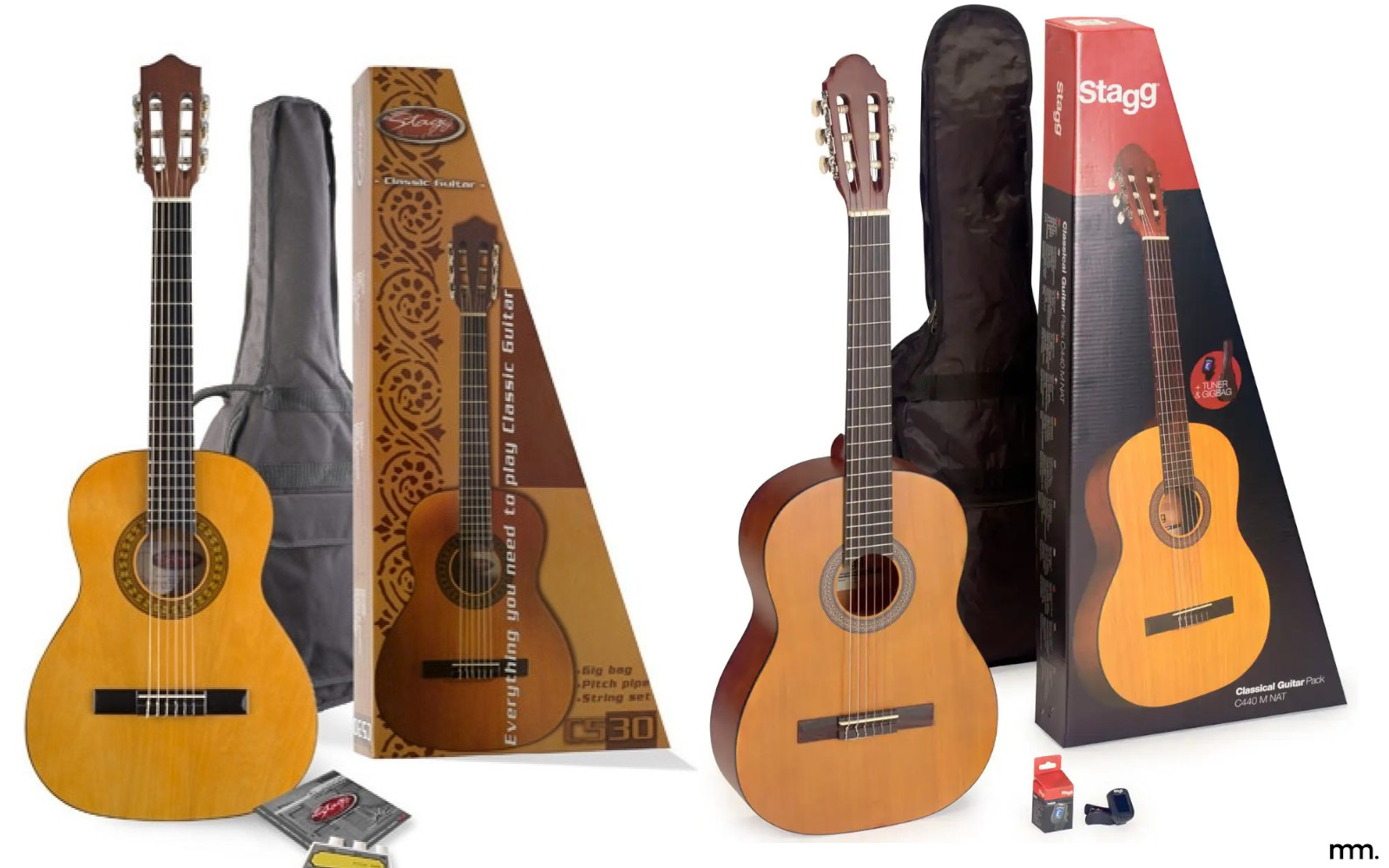
Affordable, convenient and decent. Check out Stagg Acoustic Guitars at Musicmaker today.
Alvarez Artist Series: Your First Serious Acoustic
Now suppose the budget can stretch a little further.
This is where Alvarez Artist Series acoustic guitars become extremely interesting.
And the important difference isn't simply a nicer finish or a more expensive name on the headstock.
We're entering the world of solid-top acoustic guitars.
The Artist Series is where Alvarez takes many of the construction ideas that have earned the company such a strong reputation among acoustic players and makes them remarkably accessible. Depending on the model, you'll find solid soundboards including Sitka spruce, mahogany and cedar, alongside Alvarez's carefully considered bracing, bi-level bridge design and quality hardware.
For a beginner, that means you're buying into an instrument with considerably more tonal potential than the words first guitar might suggest.
And that's rather lovely.
Because there is no rule saying a beginner guitar must be something you intend to replace.
Why a Solid Top Matters
The top is the great vibrating engine of an acoustic guitar.
The strings themselves move very little air. Their energy travels through the bridge into the soundboard, and that large wooden surface does the serious acoustic work.
A well-designed solid-top acoustic guitar can offer wonderful dynamic range, harmonic detail and responsiveness. Play gently and the instrument gives something back. Increase the attack and there's somewhere for the sound to go. For somebody learning, that responsiveness can be incredibly rewarding.
As your right hand improves, you begin hearing the difference. As your chord changes become cleaner, you hear that too. As you move from timid first strums towards actually attacking the strings with confidence, the guitar comes with you.
That's the nerdy reason.
The simpler reason is: A good guitar makes practising nicer.
And nice things tend to get used.
Browse the Artist Series HERE.
A Guitar You Don't Have to Outgrow
That's one of the great attractions of the Alvarez Artist Series as a first acoustic guitar.
You're not necessarily buying a temporary instrument. You can learn on it.
Write on it. Record it. Gig it. Keep it.
Your ability changes, but the guitar doesn't suddenly become useless because you've improved.
For the committed beginner, teenager already completely obsessed with music, returning guitarist or adult who has finally decided this is the year, that's a compelling proposition.
You don't have to buy a beginner guitar simply because you're a beginner.
You can just buy a good guitar.
So Which Beginner Acoustic Guitar Should You Buy?
This is where coming into an actual guitar shop becomes useful.
Don't simply decide that more expensive automatically means more appropriate.
For a younger student, a smaller Stagg acoustic guitar that fits comfortably may be a vastly better learning instrument than a beautiful full-size guitar they physically struggle to hold.
For somebody testing the waters, an affordable Stagg can remove the biggest obstacle of all: The cost of getting started.
For the committed beginner with a little more budget, an Alvarez Artist Series solid-top acoustic gives you an instrument with the construction, response and tonal potential to travel much further down the road.
Sit down. Try the body size. Wrap your hand around the neck. Play whatever you know.
If you know nothing yet, even better.
That's literally why we're here.
The Electric Route: JET Guitars
Now we plug in. And things become wonderfully less responsible.
JET Guitars is one of those brands that can make experienced players pick up an affordable guitar, inspect it, look at the price again and mutter: Hang on.
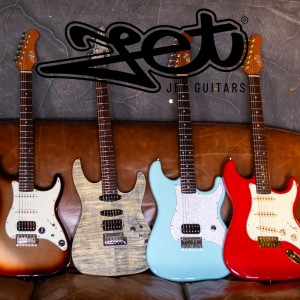
The current JET 300 Series is particularly tasty for new players because we're seeing specifications that historically weren't normal territory for affordable beginner electric guitars.
Take the JET JS-300. We're talking a roasted maple neck, comfortable Modern C profile, 25.5-inch scale, 22 frets and the classic three-single-coil pickup configuration with five-way switching.
Roasted maple on an affordable first electric guitar.
Things have changed, mate.
JET JS-300: Your First Electric Can Be Properly Cool
This matters more than it sounds. A beginner guitar shouldn't look like punishment for not being good yet.
You should love the bloody thing. You should walk past it and want to pick it up.
And the JS-300 understands the assignment.
The familiar S-style layout is enormously versatile. Three single-coil pickups and a five-way selector switch give a new guitarist several distinct tonal colours before they've even considered effects.
The bridge pickup brings bite and definition. Move towards the neck and things become rounder and smoother. Those in-between positions introduce the wonderfully glassy, hollow textures associated with decades of funk, blues, pop and indie guitar.
One guitar. Loads to discover.
And that's exactly what we want from a first electric guitar.
Options.
Your musical taste at thirteen may bear absolutely no resemblance to your musical taste at sixteen.
Frankly, your musical taste at lunchtime may bear little resemblance to what happens after dinner.
Your first guitar should leave doors open.
JET JT-300: Keep It Simple
Then there's the JET JT-300. Same broad philosophy. Different beast.
The classic T-style design gives us a wonderfully straightforward two-pickup layout with a fixed bridge and the familiar directness that has made this type of electric guitar a favourite across rock, indie, blues, country and pop.
Two pickups. Volume. Tone. Selector.
Make music.
A fixed bridge also means there's less mechanically happening at the business end of the strings, which some beginners may appreciate.
Tune it. Plug it in. Learn the riff.
We can discuss boutique capacitors in twenty years.
Your First Electric Guitar Is Should Be Cool
This might sound frivolous. It isn't.
A guitar spends a surprising amount of time sitting in your bedroom while you're learning.
You are going to look at it. If you think it's gorgeous, you'll pick it up. If you pick it up, you'll play it. If you play it, you'll improve.
So yes, colour matters. Shape matters. The ridiculous fantasy of standing on a stage with it matters.
Wanting the instrument matters.
Your first electric guitar does not have to look like the guitar equivalent of school trousers.
Check out all our Jet Guitars HERE.
Right. You've Chosen the Guitar. What Else Do You Actually Need?
This is where first-time buyers frequently encounter The Accessories Avalanche.
Suddenly there are capos, pedals, humidifiers, slides, stands, straps, polish, string winders, twelve varieties of plectrum and something called fret wrap.
Relax. You don't need the entire guitar shop.
Not yet. For an acoustic guitar, the essential setup is gloriously simple:
Guitar. Tuner. Picks. Strap. Gig bag.
Add a capo fairly early because an enormous number of songs use one, and having a spare set of strings somewhere in the house is extremely sensible.
For electric guitar, we add one rather important item.
Your First Guitar Amp
An electric guitar without an amplifier still makes a noise.
Technically. But you want an amp.
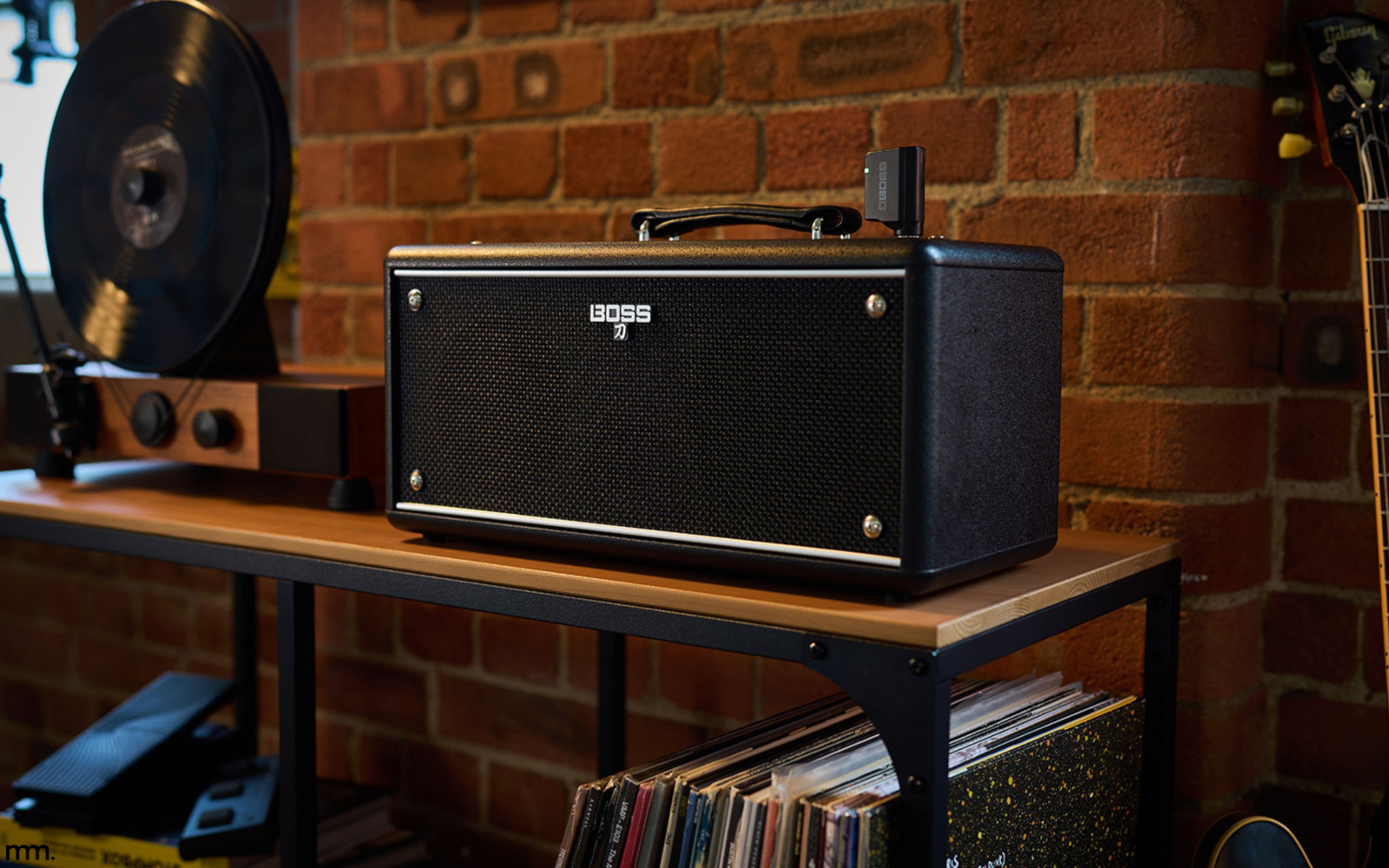
The good news is that beginner guitar amps have become ridiculously capable. You do not need a gigantic valve stack to learn in a bedroom, and unless your family lives in an aircraft hangar, they may actively discourage this approach.
A compact practice amp gives you enough volume to enjoy the guitar properly, while many modern designs add headphone outputs, auxiliary or Bluetooth playback, different amp voicings and onboard effects.
That means you can plug in, find a sound you like and play along with music without immediately beginning the guitarist's other great hobby:
Buying seventeen pedals. That comes later.
We have a whole wall ready for you.
Check out some sweet amps HERE.
You Need a Cable
Electric guitar beginners! Come closer. We need to save you from something.
The guitar does not come out of the box wirelessly communicating with the amplifier through the sheer power of rock.
You need an instrument cable. One end goes into the guitar. The other goes into the amp.
This may seem painfully obvious until somebody buys a guitar and amplifier separately and nobody buys the bloody cable.
We have seen things. Get a decent one.
A guitar cable will be stepped on, twisted, rolled up, stuffed into bags and plugged and unplugged thousands of times.
It doesn't have to be extravagant.
It does have to work.
Buy a Tuner. Seriously.
"But there's a tuning app on my phone."
Yes. And those can be extremely useful.
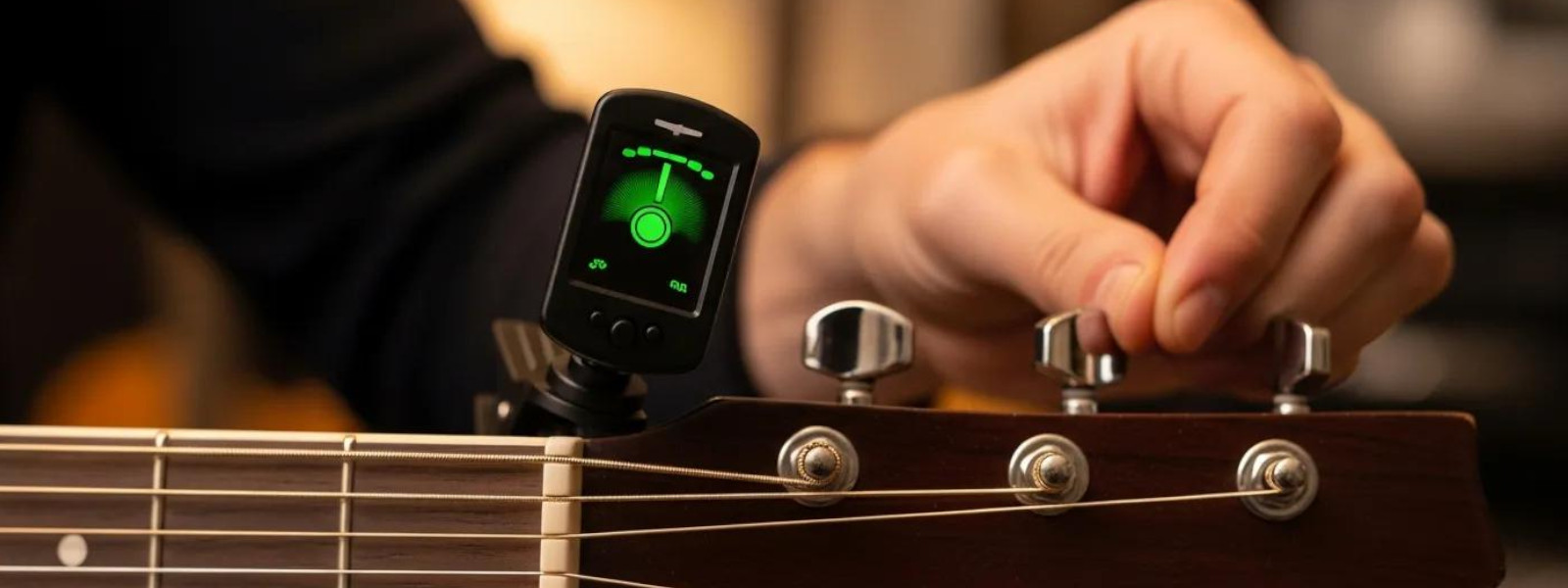
Still buy a tuner. A simple clip-on guitar tuner is inexpensive, tiny and one of the most useful pieces of equipment a guitarist owns.
Clip it to the headstock. Pluck a string. Tune the guitar.
Because here's the slightly cruel truth: You can play the chord correctly and it will still sound awful if the guitar isn't in tune.
A beginner may understandably assume they're doing something wrong.
Sometimes they're not. Sometimes the B string has simply gone rogue.
Tune before you practise, before you play.
Every time.
That's one of the first good guitar habits.
Picks: Tiny Pieces of Plastic, Enormous Arguments
Buy several. Seriously.
Plectrums are cheap, mysteriously migratory and incredibly personal.
Thinner picks can feel forgiving for early strumming because they flex across the strings. Medium picks offer a useful compromise between rhythm and individual-note playing. Thicker picks provide more resistance and precision, which many players prefer as their technique develops.
There isn't a correct answer. Try them.
Also, if you purchase three picks, you will own zero picks by next Thursday.
If you purchase twelve picks, you may still have two by Christmas.
This is established guitar science.
What About a Strap?
For electric guitar? Absolutely. For acoustic? Also absolutely.
A guitar strap isn't merely decorative. Playing while standing changes the position of the instrument relative to your body, so getting comfortable on your feet is worth doing early if your future plans involve rehearsals, gigs or magnificently unnecessary bedroom rock-star poses.
And since we're talking Back to School, we have a particularly nice option close to home: the Musicmaker Sustainable Strap - Black.
It's a wonderfully straightforward addition to a first guitar setup and one we particularly like because it carries the Musicmaker name while putting sustainability into something every guitarist can actually use.vBlack also has the enormous technical advantage of looking good on basically everything.
Sunburst? Black strap.
Surf green? Black strap.
Natural acoustic? Black strap.
Bright pink JET? Mate.
Set it to a comfortable height and practise standing occasionally.
Do not immediately lower the guitar to your knees because you saw somebody cool doing it.
They had practised.
Spare Strings: The Emergency Pencil Case of Guitar
Strings break.
Usually at an inconvenient moment.
Having a spare set means a broken string becomes a maintenance job rather than the end of guitar for the weekend.
Acoustic and electric guitars generally use different string types and gauges, so ask us which set suits your instrument.
And don't panic about changing them.
The first restring feels like bomb disposal.
By the tenth, you're doing it while discussing dinner.
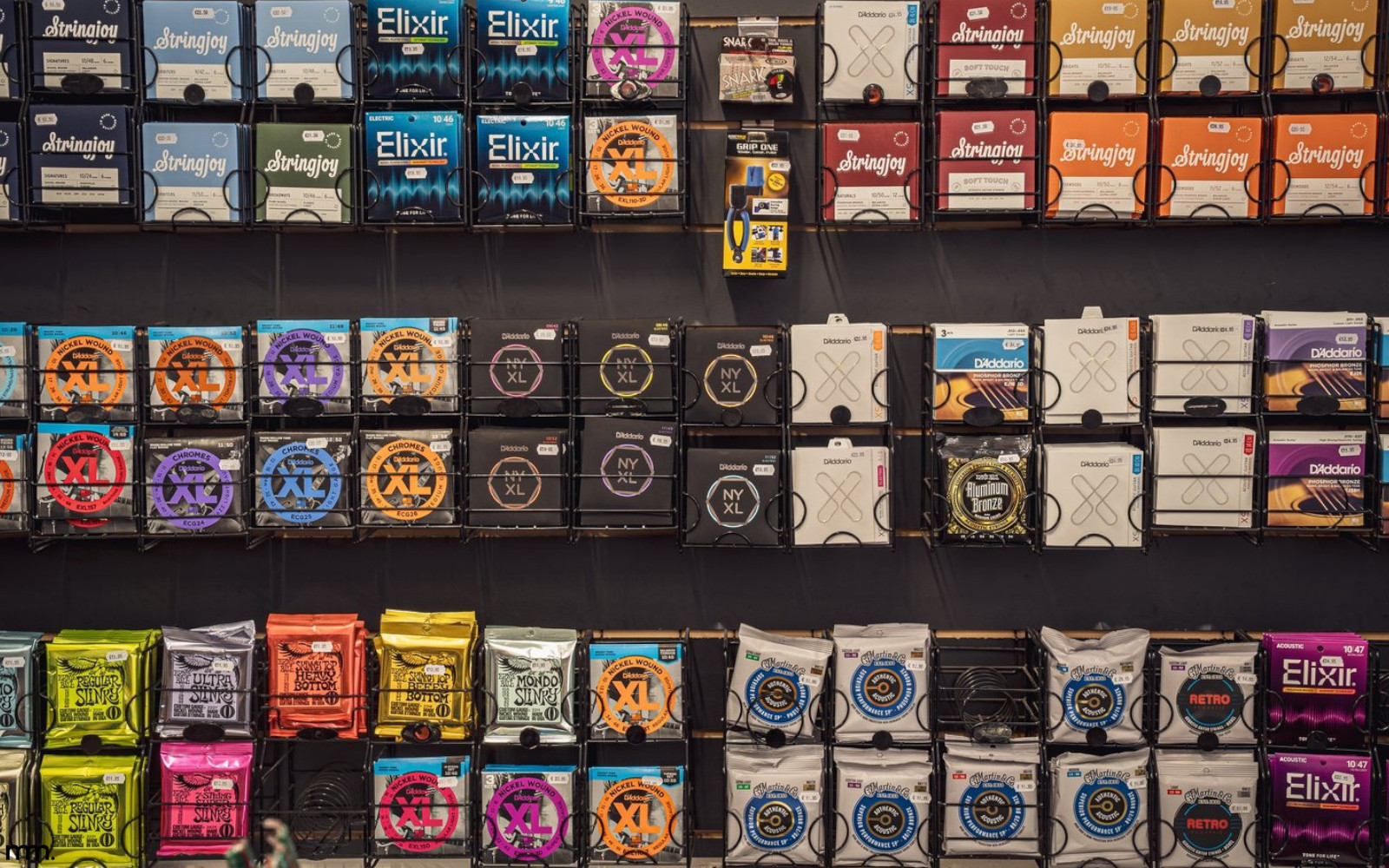
We stock a million different kinds so pop in to Musicmaker all call us for advice!
A Gig Bag Matters More Than You Think
This is especially relevant for Back to School guitar students. Lessons mean transport.
Transport means doors, buses, cars, rain, school corridors and the occasional sibling whose spatial awareness remains under development.
Use a bag. A guitar sitting safely at home needs less protection. A student's guitar has a social life.
A decent gig bag protects the instrument, makes it considerably easier to carry and usually provides somewhere to stash the tuner, spare strings, picks, music and the capo you will otherwise spend twenty minutes searching for before every lesson.
Future you will appreciate this.
Do You Need a Capo?
Eventually yes.
A guitar capo clamps across the strings at a chosen fret, effectively allowing you to change the guitar's key while retaining familiar chord shapes.
For beginners, this can be enormously useful because an extraordinary number of popular songs use capos.
It also means you can move a song into a more comfortable vocal range without immediately learning an entirely new universe of chord shapes.
Is it essential on day one? No.
Will you probably own several eventually because the first one has disappeared into the same dimension as all your picks?
Absolutely.
Check out our range of Capos HERE.
Parents: You Don't Need to Buy the Most Expensive Guitar
This matters. If your son or daughter is starting guitar lessons this September, please don't feel that spending more automatically makes you a more supportive parent.
It doesn't. A beginner needs a guitar that is appropriately sized, comfortable, structurally sound, capable of staying in tune and properly set up.
That's where buying from an actual music shop becomes valuable.
We can help determine if a full-size acoustic makes sense or whether a smaller Stagg guitar would be more comfortable. We can show you what spending a little more on an Alvarez Artist Series solid-top acoustic guitar actually gives you. On the electric side, we can put a JET guitar into the student's hands and see what actually feels right.
And we can explain amplifiers, cables, strings, tuners and all the other bits without assuming you already know what any of them are.
Because you're not really buying a guitar. You're buying someone's first guitar.
Those are different things.
Adults: Back to School Includes You
This might be our favourite bit. September does not belong exclusively to children.
There is no upper age limit on being a beginner.
Maybe you wanted to learn guitar at fifteen and never did. Maybe there's been an old acoustic in the house for twenty years and you've finally decided to find out what all the strings are for.
Maybe your children are heading back to school and, for the first time in months, there is going to be an hour when nobody needs anything from you.
Mate. Buy the guitar.
Learn three chords. Murder a song you love.
Learn the fourth chord. Murder it slightly less.
There is enormous pleasure in being terrible at something new.
Nobody is grading you.
You don't have to join a band. You don't have to post it online. You don't even have to become a guitarist.
You can simply play guitar.
That counts.
Your Back-to-School Guitar Checklist
For acoustic guitar, start with a comfortable guitar, tuner, picks and gig bag. Add spare strings and a capo and you're beautifully equipped for lessons and home practice. A strap is worth adding if you're going to practise standing or perform.
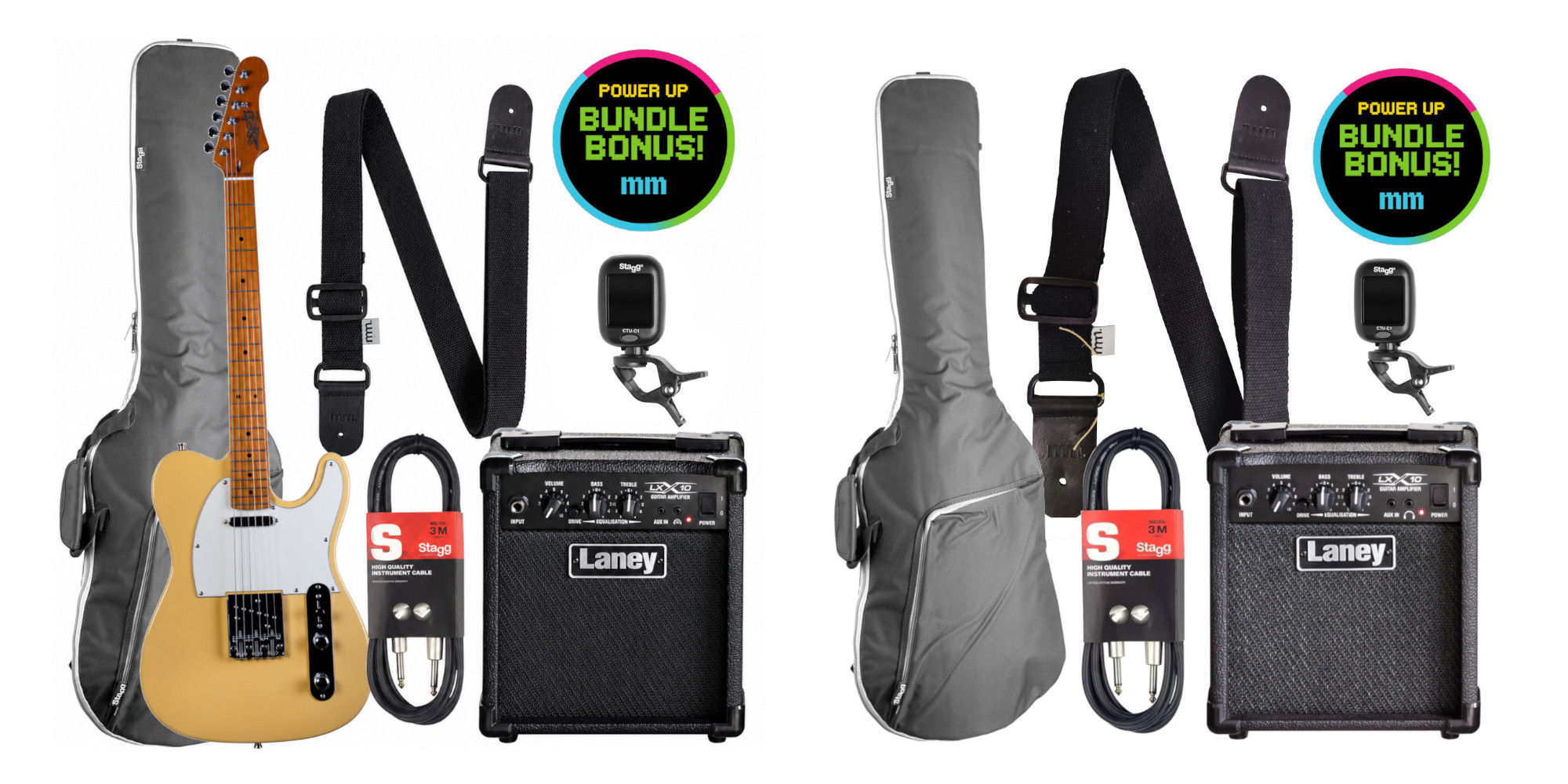
For electric guitar, you'll need the guitar, practice amp, instrument cable, tuner, strap and picks, with a gig bag and spare strings taking care of transport and inevitable little emergencies.
That's the real beginner guitar setup.
Not fifty products. Not a professional touring rig.
Just enough equipment that when it's time to practise, nothing gets in the way.
Check out out mm Bundle Deals for handy all-in-one packs!!
Three Routes Into Your First Guitar
This is why we love having Stagg, Alvarez and JET Guitars together at Musicmaker.
Stagg guitars make the first step genuinely accessible. Affordable instruments and different size options mean the financial barrier between “I'd love to learn guitar” and “I own a guitar” can be remarkably small.
The Alvarez Artist Series represents a different proposition: responsive solid-top acoustic guitars with genuinely serious attention paid to construction, bracing and tone. These aren't guitars you buy because you're a beginner.
They're good guitars that a beginner can absolutely start on.
And JET electric guitars bring another kind of excitement entirely. Cool finishes, beautifully approachable designs and surprisingly serious specifications make them wonderful first electrics for somebody who wants to plug in and start discovering what electric guitar can actually do.
Three routes. Different budgets. Different sounds.
One excellent place to begin.
Your First Guitar Should Make You Excited
That's the specification we can't put in a table.
Excitement.
Your first guitar might get scratched. Good.
It might eventually acquire stickers. We'll survive.
Its first set of strings will become disgusting. Change them.
You might learn three chords and suddenly discover those three chords are enough to play an alarming number of songs.
Now we're getting somewhere.
Because twenty years from now, you probably won't remember what the tuner cost.
You won't remember which thickness of pick came in the bag.
You almost certainly won't remember the specifications you spent three nights researching before buying the thing.
You'll remember the guitar.
Your first one.
The guitar on which your fingers first hurt. The guitar that taught you your first chord. The guitar you played your first song on. The guitar you carried to lessons.
The guitar you couldn't stop looking at when you were supposed to be doing homework.
And the September when you finally started.
Browse all our Beginner Instruments HERE.
From the Musicmaker Workshop
We've been helping people choose their first guitars at Musicmaker since the early 1980s, and it's still one of our favourite things to do. Nobody walks through the door already knowing everything. That's why we're here. Bring the student. Bring the parent who hasn't a clue what a pickup is. Bring the adult who has wanted to learn for thirty years and has finally decided that this September is the one. We'll help find a guitar that fits the player, the music and the budget — from brilliantly accessible Stagg acoustics and solid-top Alvarez Artist Series guitars to seriously cool JET electrics — and we'll make sure you've actually got what you need to start.
Because a first guitar isn't supposed to prove how serious you are.
It's supposed to make you want to come back tomorrow.