




Speed, Power & Precision: Gibraltar Double Pedals
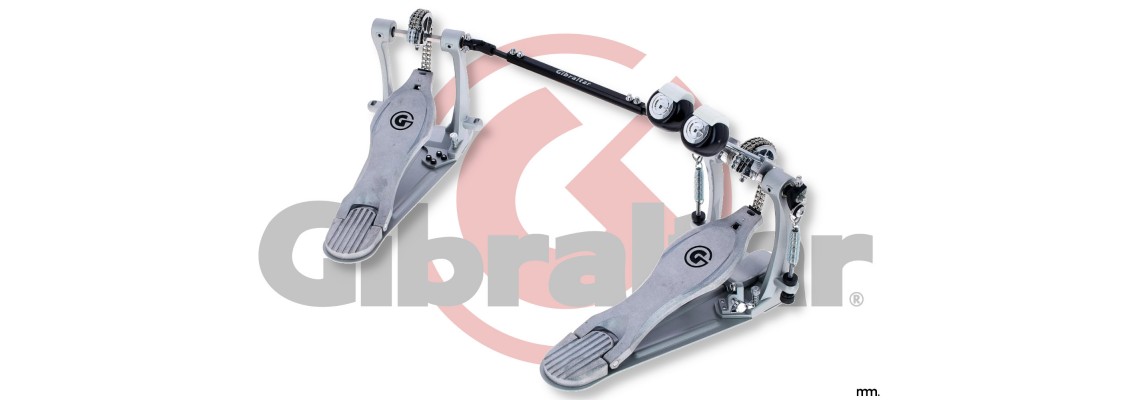
The mighty GTC6-DB Tour Class Double, ain't she beautiful.....?
There is something slightly unreasonable about the double bass drum pedal.
Which is definitely part of its charm.
A single bass drum pedal already gives a drummer access to an enormous rhythmic vocabulary, and generations of players have demonstrated fairly conclusively that one foot is perfectly capable of causing trouble. Then somebody looked at the situation, considered the available limbs and decided the obvious solution was to connect another pedal to the same bass drum and bring the left foot into the conspiracy.
Drumming has been considerably less peaceful ever since.
The double pedal has become deeply associated with metal, and understandably so. The ability to produce rapid, sustained alternating strokes changed the vocabulary of heavy drumming, giving players access to those rolling low-frequency barrages that can make a breakdown feel less like a section of music and more like structural engineering being tested to failure.
But reducing the double bass drum pedal to a machine for metal drummers misses most of the fun.
Fusion players use double pedals to create intricate foot ostinatos, linear phrases and accents that would be awkward or impossible with a conventional single-pedal setup. Progressive drummers can weave the feet into odd-grouping patterns beneath independent hand parts. Rock players use them for short bursts and fills rather than sustained machine-gun patterns. Even a drummer with no interest whatsoever in playing at ludicrous tempos can use a double pedal to expand the vocabulary available around the kit.
The interesting part is that once both feet become involved, the pedal stops feeling like a simple lever beneath your shoe.
It becomes a machine.
And machines have geometry, resistance, inertia, bearings, cams, springs, drive systems and adjustment points. Change any of those things and you change the conversation between your foot and the beater.
That brings us rather neatly to three Gibraltar double pedals currently stalking the drum department at Musicmaker: the Gibraltar 4711ST-DB 4000 Series Strap Drive, Gibraltar GRC5-DB Road Class Single Chain Drive and Gibraltar GTC6-DB Tour Class Double Chain Drive.
Three double pedals. Three approaches to transferring motion.
And one very obvious objective.
Make the bass drum obey.
The Bass Drum Pedal Is an Instrument
This is worth establishing before we start comparing hardware.
A good pedal does not create foot technique for you. That would be lovely.
Unfortunately, Gibraltar has yet to discover the bearing that automatically practises your doubles while you are watching television.
What a good pedal can do is remove unnecessary resistance between the movement you intend and the stroke that reaches the drumhead. It can give you a stable platform, predictable rebound and enough adjustment to establish a relationship between footboard, spring and beater that complements the way you actually play.
That relationship becomes especially important with a double pedal because the two sides of the system are mechanically different.
Your primary pedal drives one beater directly. The secondary pedal has to transmit your left-foot movement through a connecting linkage before that movement reaches the second beater. Any play, unwanted resistance or inconsistency in that system becomes something your feet have to negotiate.
Experienced double-pedal players become remarkably sensitive to this stuff.
A fraction more resistance here. A beater sitting slightly differently there. A spring tension that felt wonderful at moderate tempo but becomes exhausting during sustained sixteenths. A footboard angle that encourages one technique while fighting another.
The goal is not necessarily to make everything as light as possible.
The goal is to make the response predictable enough that your feet can stop thinking about the mechanism.
Because speed is not simply the ability to move quickly.
Useful speed is repeatable motion under control.
And that is where the nerdiness begins.
Strap, Single Chain or Double Chain?
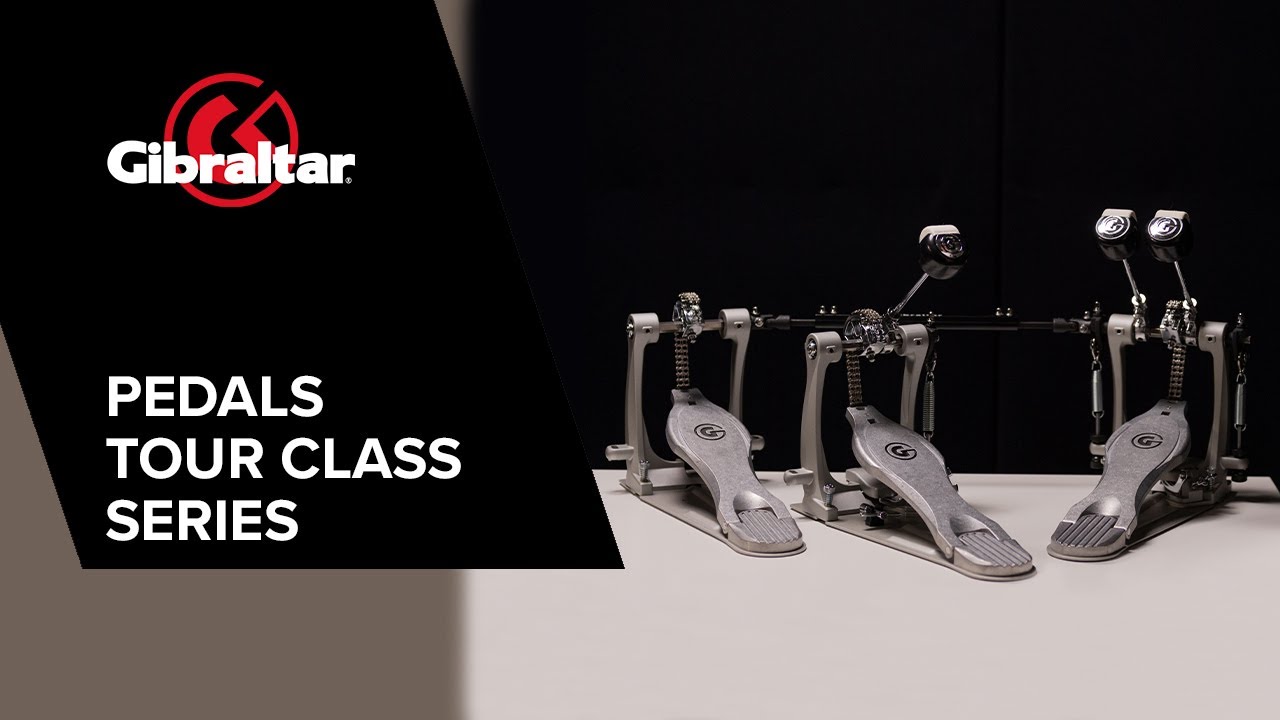
If you want to understand these three Gibraltar double bass drum pedals, start with the drive.
The drive system connects the footboard to the cam or beater assembly, converting downward foot movement into the rotational movement that throws the beater towards the drumhead.
The three pedals here give us a lovely little mechanical progression.
The GRC5-DB uses dual single-chain cam drives — one for each side of the double-pedal system.
The GTC6-DB uses dual-chain cam drives.
All three ultimately accomplish the same task, but the sensation underfoot can be different enough to influence which system feels most natural to a particular drummer. Gibraltar itself characterises the 4000 Series strap design as fast and fluid, the Road Class as balancing speed with control, and the Tour Class dual-chain design around powerful, smooth and consistent response.
There is no universally superior drive system hiding at the end of this article.
There are feet. And feet are weird.
Technique, footwear, spring tension, foot position, beater height, throne height and the amount of force a player naturally puts into the stroke can all change what feels good. Which means this is one of those wonderful pieces of drum hardware where specification gets you only so far.
Eventually you have to sit down and put your foot on the thing.
Gibraltar 4711ST-DB: The Strap-Drive Speed Machine
There is an elegance to a strap-drive bass drum pedal.
The mechanical relationship feels wonderfully direct without being brutally rigid, and Gibraltar has leaned into that character with the 4711ST-DB 4000 Series Strap Drive Double Pedal.
Both sides use strap drives designed to produce what Gibraltar describes as a natural, connected response, while the G-style footboards and heel plates create a smooth playing surface particularly conducive to sliding foot techniques. Beneath all of that sits an all-cast metal frame intended to keep the pedal strong without turning it into a portable anchor. The connector bar and spring tension are adjustable, and Gibraltar includes dual-surface beaters so the contact point against the bass drum head can also be changed.
This is where the word speed needs a little interrogation.
A fast pedal does not move your foot for you. What players generally mean when they describe a pedal as feeling fast is that the mechanism returns efficiently, responds predictably and does not seem to swallow useful energy during repeated strokes.
That matters when you start working with techniques such as heel-up alternating singles, heel-toe motions, slides and quick doubles. At higher tempos, tiny inefficiencies become surprisingly obvious because the foot is no longer making one enormous isolated movement. The technique becomes an exercise in controlling rebound and using smaller, more economical motions.
The 4711ST-DB's smooth footboard is particularly interesting here. A drummer using slide-based techniques needs the foot to travel across the board without constantly negotiating aggressive surface geometry, and Gibraltar specifically calls out that smooth playing area as part of the design.
But don't mistake fluidity for fragility.
There is still a cast-metal frame underneath you, and there are still two beaters about to strike a bass drum with considerable intent.
The strap simply gives the machine its particular personality.
For the drummer beginning to explore fast double bass drumming, the appeal is obvious. The mechanism encourages fluid movement, offers useful adjustment without burying the player beneath engineering options, and gives both feet access to the same fundamental strap-driven feel.
It is clean.
It is quick.
And it looks entirely too innocent for what you are about to do with it.
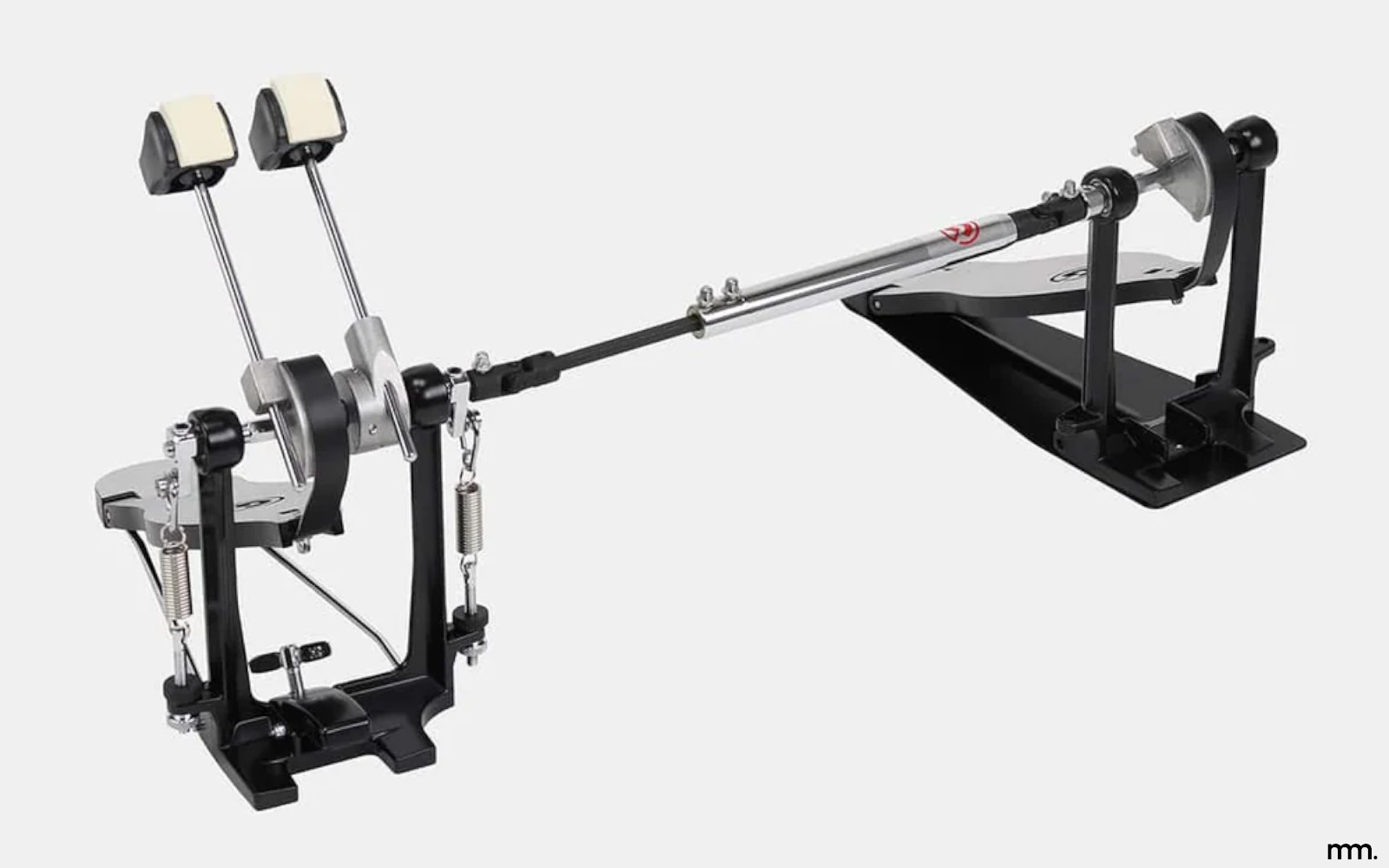
This pedal screams Fusion. The Gibraltar 4711ST-DB Velocity Strap Drive Double.
Gibraltar GRC5-DB Road Class: Chain Reaction
Then we introduce metal into the transmission.
The Gibraltar GRC5-DB Road Class Double Pedal uses dual single-chain cam drives, bringing a slightly different mechanical character to the equation. Gibraltar describes the design as delivering balanced motion with speed and control, built around curved frames inspired by the company's higher-end G-Class architecture.
The Road Class also introduces some lovely practical details.
There are patented spring rocker arms with felt silencers, designed to keep unwanted spring noise under control. Each beater gets an independent single-point adjustment, and the side-mount hoop clamp is positioned to make installation and removal less of an exercise in reaching blindly beneath the footboard while quietly inventing new swear words.
That felt silencer might sound like a tiny detail until you put a microphone near the kit.
Bass drum pedals contain moving mechanical components. Springs move. Linkages move. Bearings rotate. The drummer may be focused entirely on the enormous acoustic event happening when the beater hits the head, but microphones can be remarkably enthusiastic collectors of noises you did not realise existed.
Reducing unnecessary mechanical chatter is therefore not merely cosmetic.
In the studio, quiet hardware is good hardware.
The single-chain drive also puts the Road Class in a very familiar place for drummers who have spent years playing traditional chain pedals. There is a physicality to chain drive that generations of players understand instinctively, and the Road Class doesn't attempt to reinvent that relationship. Instead, it refines it into a double-pedal system built around controlled response, practical adjustment and a stable curved frame.
For rock, fusion and metal players who want speed but still enjoy a little mechanical presence beneath the foot, that can be a very appealing balance.
Because sometimes you don't want the pedal to disappear completely.
Sometimes you want to feel the machine working with you.
Gibraltar GTC6-DB Tour Class: Bring the Machinery
And then the chains multiply.
The Gibraltar GTC6-DB Tour Class Double Chain Drive Double Pedal moves to a dual-chain cam drive, and the emphasis shifts towards strength, stability and consistency while retaining the fluidity required for technical playing. Gibraltar describes it around speed, balance and control, with the dual-chain mechanism providing reliable, powerful motion beneath both feet.
The Tour Class retains the useful single-point beater adjustments, spring rocker arms with built-in silencers and side-mount hoop clamp, but the double-chain transmission is the mechanical heart of the thing.
Why double chain?
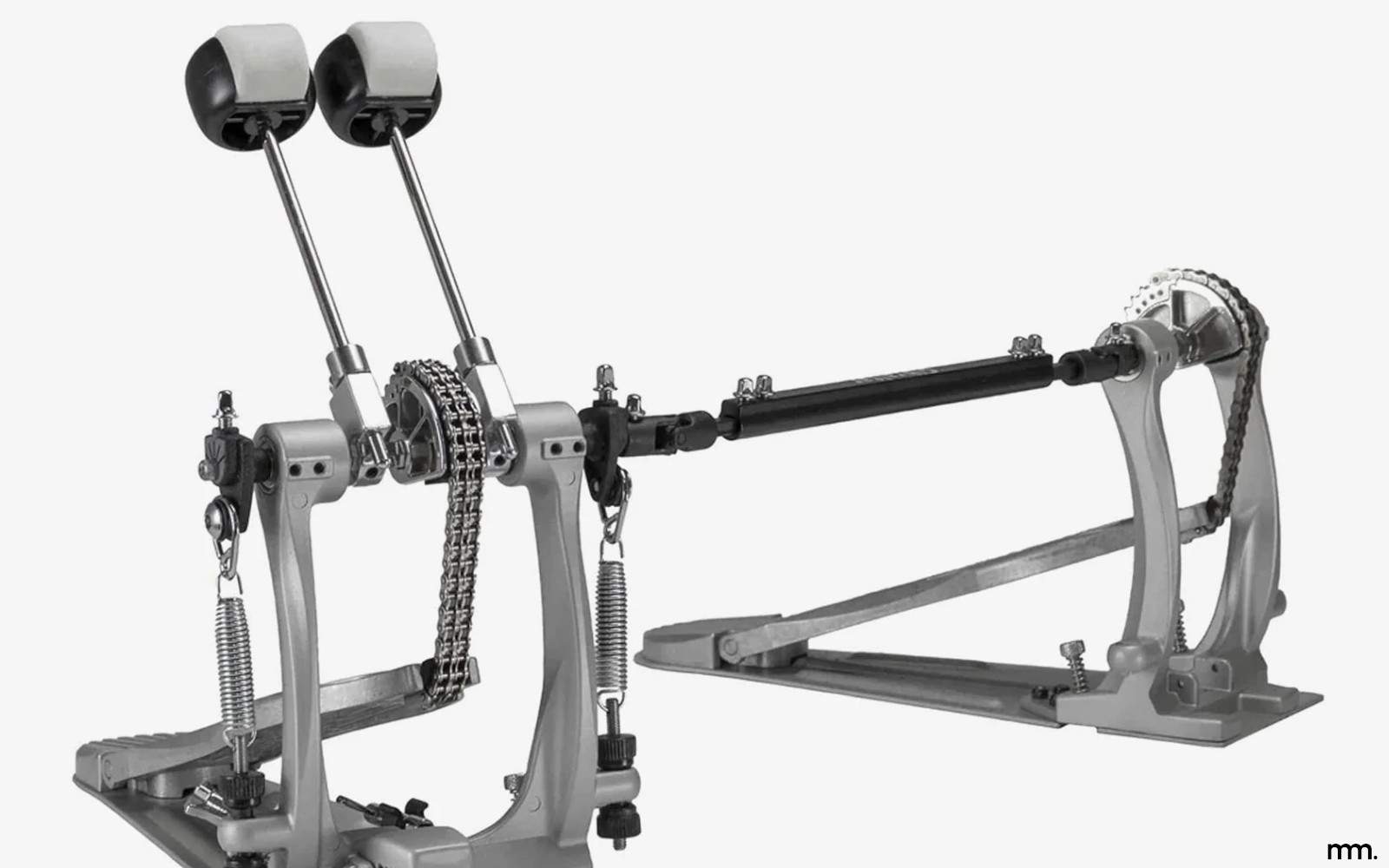
A second chain can increase lateral stability in the drive and create a reassuringly solid connection between footboard and cam. For players who hit hard, play aggressively or simply prefer a pedal that feels substantial beneath them, that additional stability can be enormously attractive.
And this is where power becomes an interesting word.
Power at the bass drum does not come simply from owning a heavier-looking pedal. The eventual impact depends on the velocity and effective mass of the beater, how the pedal's geometry translates your foot movement, spring behaviour, beater distance and — most importantly — what your leg and ankle are actually doing.
But hardware can influence how confidently you access that power.
A pedal that feels stable beneath an aggressive player invites commitment. You stop subconsciously protecting the mechanism. You lean into the stroke. You begin trusting that the machine will return consistently enough for the next note to arrive exactly where your foot expects it.
For metal players, that confidence becomes essential once the tempo rises and the kick pattern extends beyond a flashy two-second burst.
Anybody can produce several heroic double-kick notes while making the facial expression of a Viking discovering electricity.
The difficult part is playing them evenly for an entire phrase.
Then an entire section. Then an entire song. Then an entire set.
The Tour Class feels designed with that sort of consistency in mind.
Not merely speed.
Sustained authority.
Speed Is Not the Point
This might seem like an odd thing to say halfway through an article about double pedals.
But it matters.
Speed is spectacular. There is something physically thrilling about hearing a drummer execute a perfectly even stream of bass drum notes at a tempo that makes the rest of us suspect there may be additional limbs hidden somewhere beneath the floor tom.
But raw speed without control becomes mush very quickly. The truly impressive double-pedal players have dynamic control.
They can make sixteenth notes speak evenly. They can accent within the pattern. They can move between single and double strokes without the groove suddenly changing volume. They can place a short double-bass phrase inside a funk or fusion groove without it sounding as though a death-metal drummer has fallen through the ceiling.
That last skill is particularly delightful.
Because some of the most musical double-pedal playing barely announces itself as double-pedal playing at all.
A fusion drummer might use the second pedal to complete a linear phrase between hands and feet. A progressive player might create a repeating foot ostinato while phrasing freely above it. A rock drummer might use a rapid three- or four-note burst to add violence to a fill without turning the entire song into an endurance event.
The pedal expands the vocabulary.
You decide how loudly to speak it.
The Slave Pedal Problem
Now we enter the laboratory.
One of the central challenges in any double-pedal design is making the secondary side behave as closely as possible to the primary pedal.
Your right foot on a conventional right-handed setup sits above the main mechanism. Your left foot operates a separate footboard connected to that mechanism by a driveshaft. That connecting assembly introduces additional mechanical elements into the system, and additional mechanical elements introduce opportunities for friction, play and rotational inertia.
This is why serious players spend time adjusting their double pedals rather than simply bolting them onto the bass drum and immediately attempting 220 BPM.
Spring tension matters. Beater position matters. The connector matters. The physical placement of the secondary pedal matters.
And, crucially, your left foot probably matters even more.
Many players initially assume the slave pedal feels weaker because the hardware is sabotaging them, when the darker truth is that their non-dominant foot has spent several years enjoying a considerably easier life on the hi-hat.
Now it has been conscripted. There will be complaints.
This is where practice becomes beautifully unglamorous. Slow alternating singles. Consistent subdivisions. Working the weaker foot independently. Practising with a metronome at tempos where you can actually hear whether the notes are even instead of immediately racing towards the point where everything becomes a low-frequency blur.
Your double pedal can be engineered beautifully.
It cannot negotiate with your nervous system on your behalf.
Spring Tension: Stop Cranking Everything to Maximum
Drummers love adjustment. Drummers also occasionally respond to adjustment by turning everything as far as it will go.
Spring tension is a classic victim.
More tension produces a stronger return force, which can help the footboard and beater recover quickly after a stroke. That sounds perfect for fast playing, so the obvious conclusion is to wind the springs up until the pedal could operate a medieval siege weapon.
Unfortunately, your foot has to work against that tension on every stroke. Too little tension can feel sluggish. Too much can make the pedal unnecessarily exhausting and interfere with the natural rebound you are trying to control.
The correct setting is not the one that looks most serious. It is the one that complements your technique.
This is why the adjustable spring tension on the 4711ST-DB, alongside the spring-rocker systems used on the GRC5-DB and GTC6-DB, matters far more than it appears on a specification list.
Spend time with it. Make small changes. Play actual grooves after each adjustment instead of merely firing off your fastest doubles.
Your feet will tell you considerably more than the knob position will.
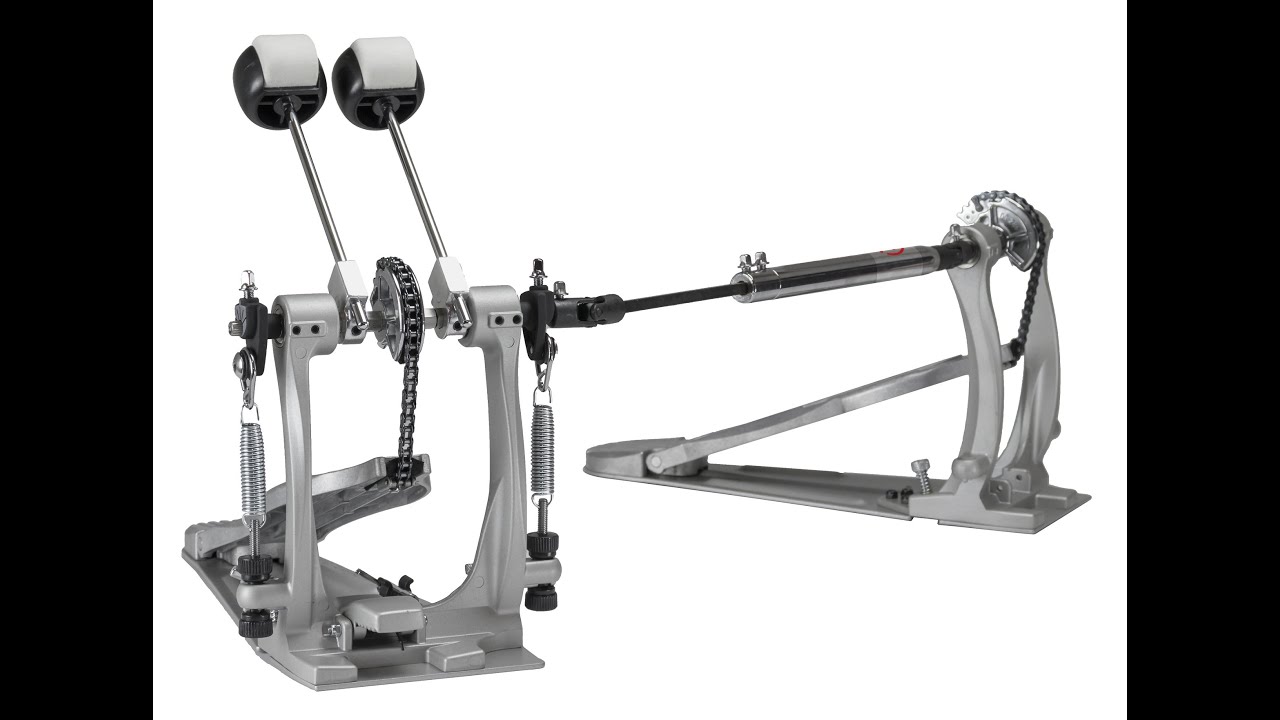
The Road Class Double Pedal - check it out in Musicmaker today.
The Beater Is Part of the Sound
Here is another lovely piece of double-pedal nerdery.
We talk about bass drum pedals as though their only job is to move quickly, but the beater is literally the component striking the instrument.
It therefore participates in the sound.
The 4711ST-DB includes dual-surface beaters, allowing the player to change the nature of that contact point.
A softer contact surface can emphasise a rounder attack, while a harder surface can produce a more pronounced transient. That difference becomes particularly relevant in fast double-bass playing because the engineer, audience and drummer need to distinguish individual strokes.
This is one reason heavily amplified metal kick sounds often contain considerable upper-frequency attack.
The low end provides physical weight. The attack tells the ear when the note happened.
Without enough definition, an astonishingly fast foot pattern can collapse into an expensive rumble.
Which is tragic. You did all that practising.
We would quite like to hear it.
Fusion Cats, This One Is Yours Too
Metal owns a spectacular amount of double-pedal culture, but fusion drummers should not leave the room.
The double pedal is an independence device.
Once the left foot is freed from exclusively operating the hi-hat, the kit's architecture changes. The feet can become a two-note rhythmic voice beneath the hands, allowing patterns to move across snare, toms, cymbals and bass drum with fewer physical compromises.
This can be used with tremendous subtlety.
Think in terms of orchestration rather than speed. A right-left bass drum figure can answer a hand phrase. A double under a snare accent can add weight without sounding overtly metallic. Alternating feet can extend a linear pattern across the kit. Odd subdivisions can be distributed between four limbs rather than forcing the hands to carry the entire rhythmic argument.
Suddenly the double pedal is not a weapon. It is another door into coordination.
Of course, you can then open that door and immediately play blast beats through it.
We are not here to judge.
Metalheads, You Already Know Why You're Here
There is still no point pretending.
Some of you saw Gibraltar double bass drum pedals in the title and began hearing sixteenth notes immediately.
Welcome.
For metal drumming, the double pedal has become one of the defining pieces of hardware because the genre continually asks the bass drum to perform rhythmic work that would once have been distributed very differently around the kit.
But the pursuit of extreme speed has produced a useful lesson for every drummer: Efficiency beats brute force.
At moderate tempos you can get away with large leg movements and enormous strokes. As the tempo increases, excess movement becomes the enemy. The technique migrates towards smaller motions, better rebound management and greater involvement of the ankle. Players develop heel-toe techniques, slides, swivels and other approaches because there is a physical ceiling to simply stomping faster.
This is where pedal feel becomes intensely personal.
One drummer may adore the fluid response of the 4711ST-DB strap drive.
Another may prefer the familiar balance of the GRC5-DB single-chain system.
Another wants the solidity and consistency of the GTC6-DB double-chain drive.
None of those choices will practise for you.
But the right one can make your technique feel like it is travelling through the mechanism rather than fighting against it.
And that is worth chasing.
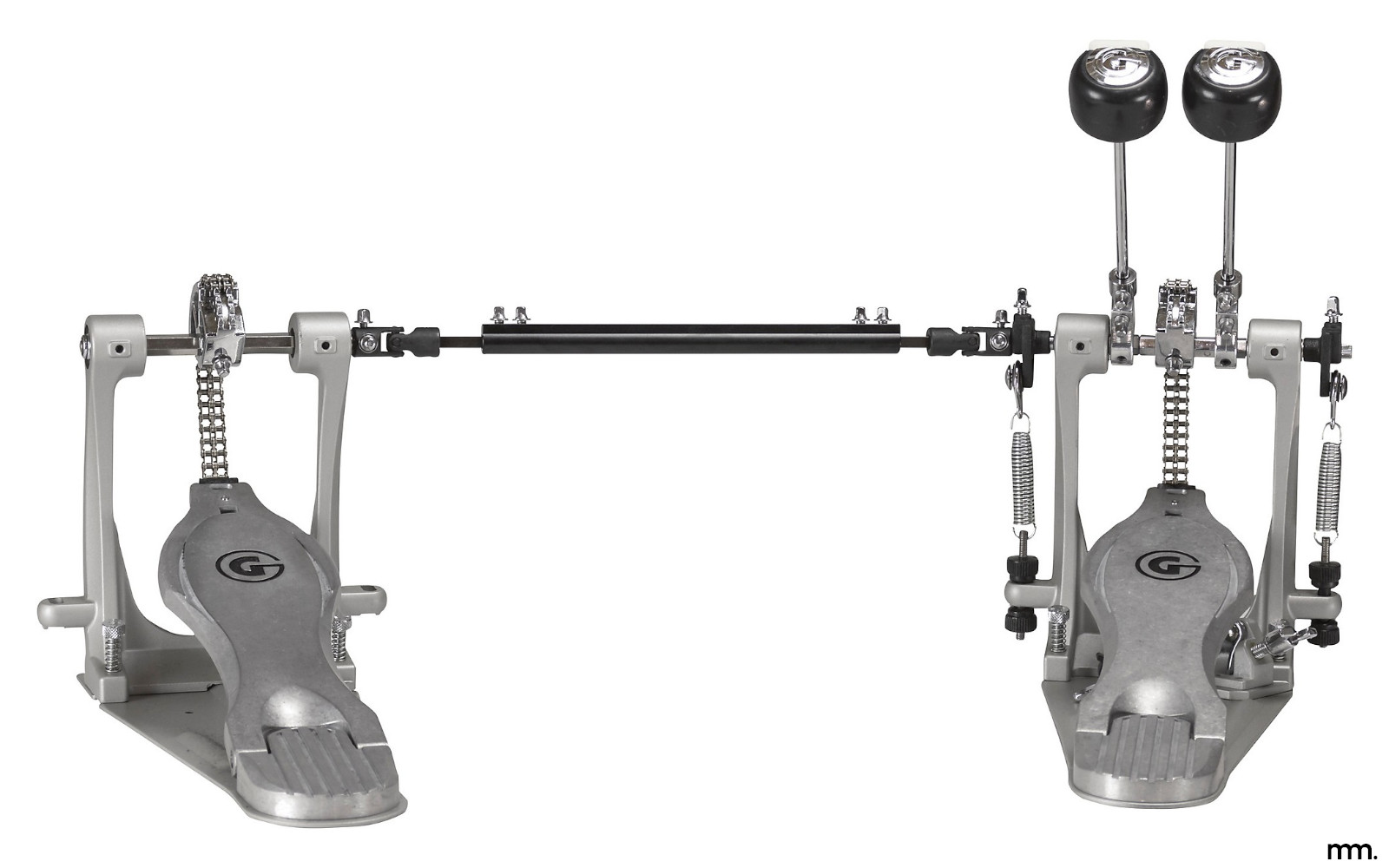
You know you can trust this beast, the Gibraltar Tour Class Double Pedal.
Three Machines, Three Personalities
The Gibraltar 4711ST-DB 4000 Series Strap Drive Double Pedal is the fluid one. Dual strap drives, smooth G-style footboards, adjustable connector and tension, cast-metal construction and dual-surface beaters give it a straightforward mechanical character built around quick, connected movement.
The Gibraltar GRC5-DB Road Class sits in that beautifully useful middle territory, combining dual single-chain cam drives with curved G-Class-inspired frames, independently adjustable beaters, spring rocker arms with felt silencers and a practical side-mount hoop clamp.
The Gibraltar GTC6-DB Tour Class brings the extra physical assurance of dual-chain cam drives, while retaining single-point beater adjustment, silenced spring rocker arms and quick hoop attachment. It is the one that most obviously speaks the language of strength and stability while still being designed for fluid technical work.
Don't think of them as beginner, intermediate and serious.
Technique does not obey price categories that neatly.
Think instead about feel.
Fluid strap response. Familiar single-chain movement. Solid double-chain authority.
Three ways of translating muscle into motion.
Three machines waiting for feet.
Precision Before Glory
Here is the part nobody wants printed on the side of the box. Your double bass drumming will sound better if you practise slowly.
Awful, isn't it?
You bought a device containing two pedals, two beaters, springs, cams, a driveshaft and enough metal to suggest that something extremely dramatic is about to occur, and now somebody is telling you to set the metronome somewhere deeply unheroic.
Do it anyway.
Play alternating eighth notes until both feet produce the same volume Then sixteenths. Reverse the lead foot.
Listen for flams between the feet. Listen for the left foot fading.
Feel for tension entering your legs.
Build tempo only when the notes remain relaxed and even. This is where speed actually comes from.
Not from desperation. Not from spring tension wound to the moon.
Not from staring intensely at videos titled INSANE DOUBLE KICK SPEED HACK!!!
Control first. Efficiency next. Speed follows.
And then, one afternoon, something rather wonderful happens.
The feet stop feeling like two separate operators struggling with complicated machinery. The pedals stop occupying your attention. The kick pattern simply appears underneath the hands because the movement has finally become part of your vocabulary.
That is the real goal.
Not to play a double pedal.
To play drums.
Come Put Your Feet on Them
You can read about bass drum pedals all afternoon.
You can compare strap drive with chain drive, single chain with double chain, study cams, investigate spring geometry and watch a frighteningly relaxed Scandinavian man play sixteenth notes at a tempo normally associated with dental equipment.
Eventually, though, you need a drum stool. Pedals are tactile.
The Gibraltar 4711ST-DB, GRC5-DB and GTC6-DB make that particularly obvious because each takes a recognisably different mechanical route towards the same destination. So come into Musicmaker Dublin and try them.
Adjust the spring tension. Move the secondary pedal into a comfortable position.
Feel the return. Play slowly. Play quickly.
Try doubles. Try a groove.
Try the ridiculous thing you have been practising when nobody else is home.
Because the best double bass drum pedal is not the one with the most aggressive name, the largest number of chains or the specification sheet most capable of frightening your parents.
It is the one that makes the distance between thought and impact feel shortest.
Check out our Kick Pedals HERE.
From the Musicmaker Drum Department
Since the early 1980s, Musicmaker has helped Irish drummers find instruments and hardware worth falling in love with. We stock the things that make noise and the beautifully engineered things that allow you to make that noise exactly when you intended.
The bass drum pedal belongs firmly in the second category.
The Gibraltar 4711ST-DB Velocity/4000 Series Strap Drive, GRC5-DB Road Class Single Chain Drive and GTC6-DB Tour Class Double Chain Drive offer three distinct routes into double-pedal playing, from fluid strap-driven response through familiar single-chain control to the solid authority of a double-chain system.
Metal. Fusion. Prog. Rock.
Or simply a drummer wondering what happens when the left foot is given considerably more responsibility.
Come try them.
Your neighbours were getting too comfortable anyway.