Avalon D580 Vietnamese Ebony: A Rare Irish Masterpiece
Handcrafted in Northern Ireland. Dressed in extraordinary Vietnamese Mun ebony. Built with the kind of patience that modern manufacturing rarely allows.
There are certain acoustic guitars that make you stop talking.
Not because somebody has announced a spectacular specification, or because the price tag has attracted an audience. Sometimes it's simply the sight of an extraordinary piece of timber, shaped into something familiar yet utterly individual, that makes you want to put down your coffee and take a closer look.
The Avalon D580 Vietnamese Ebony/Spruce is one of those guitars.
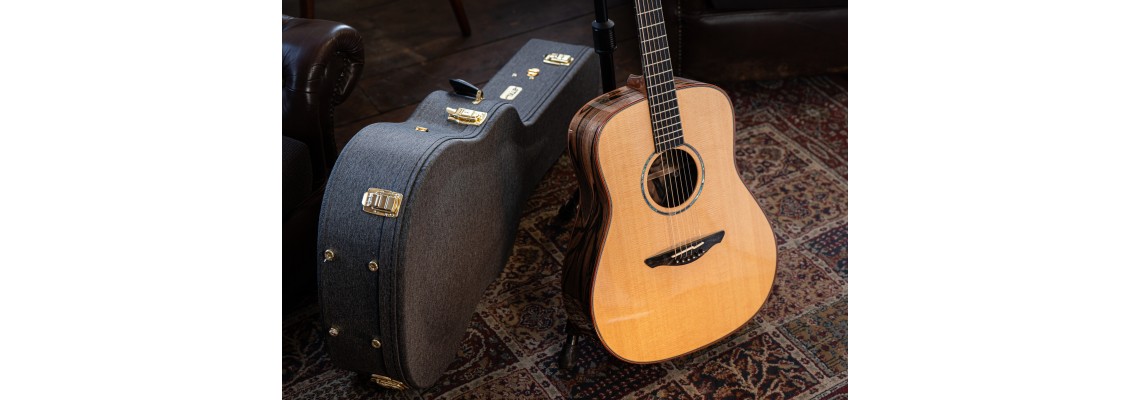
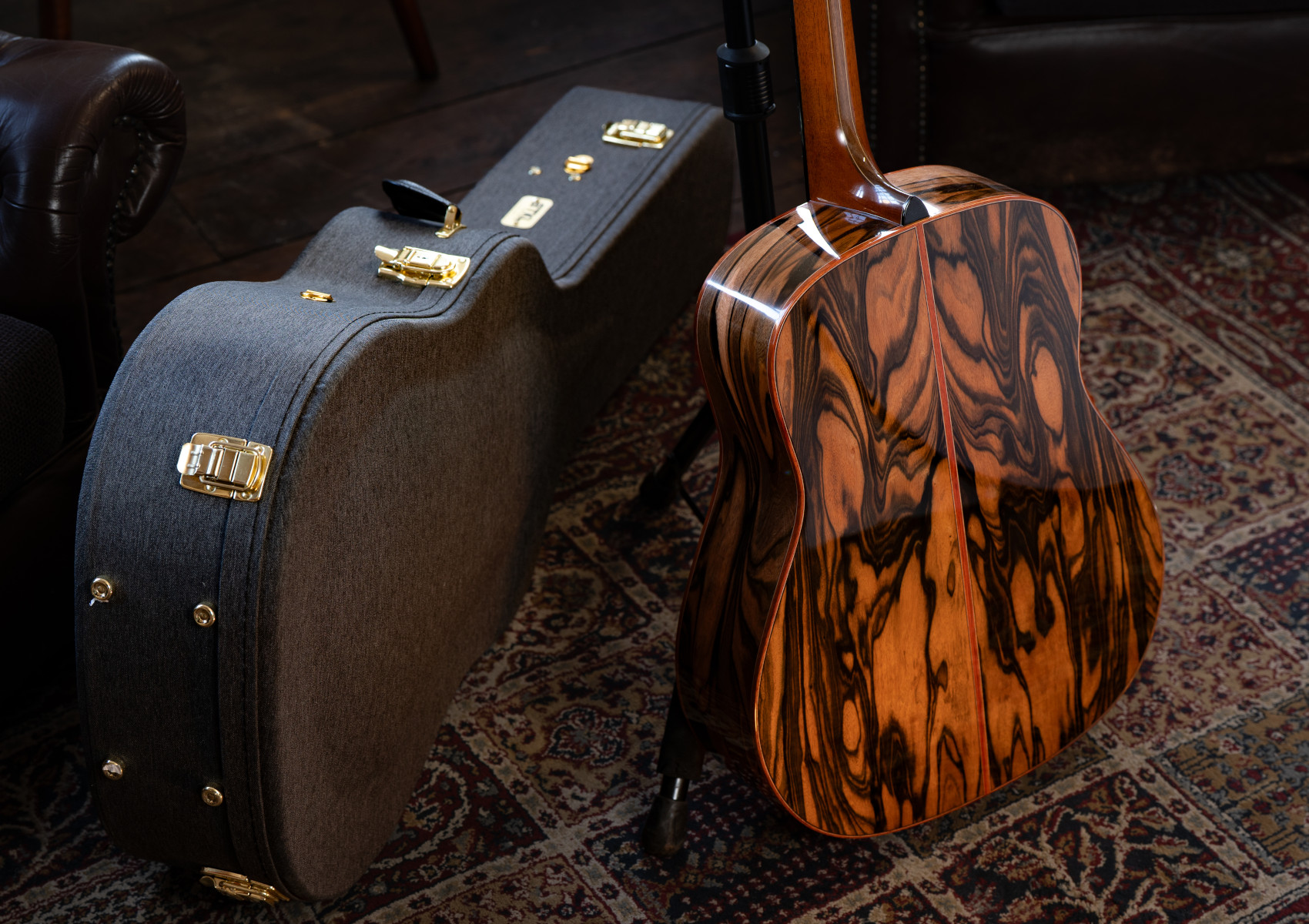
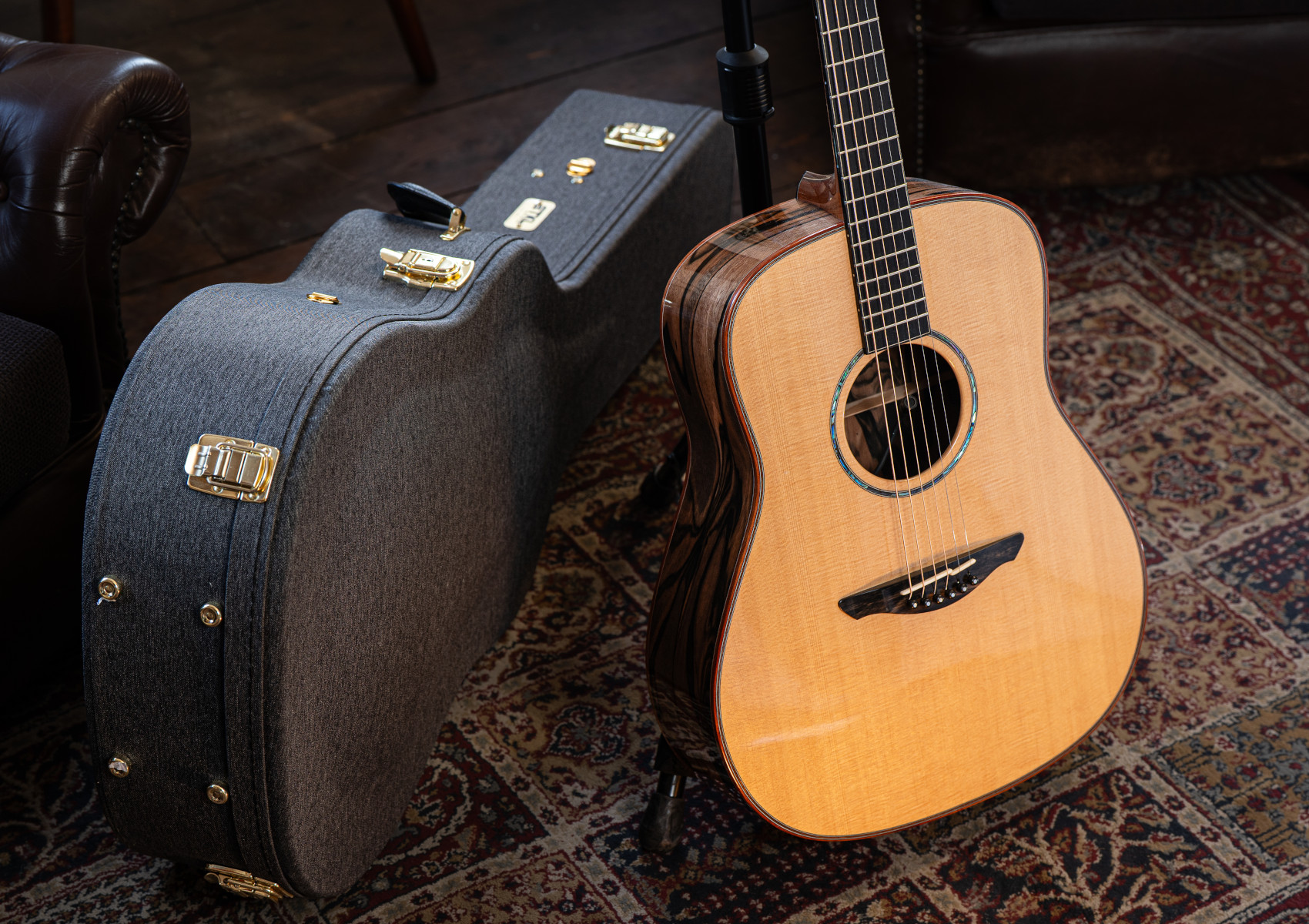
Built by hand in Northern Ireland, this magnificent dreadnought brings together a solid Sitka spruce soundboard, solid Vietnamese Mun ebony back and sides, and the painstaking craftsmanship that has made Avalon such a fascinating name in boutique acoustic guitar building.
And then there's the back of the guitar.
Good Lord, the back of the guitar.
Vietnamese Mun Ebony: Nature Has Been Showing Off
Most guitarists know ebony as the dark, dense timber traditionally used for fingerboards and bridges. Beautiful, hard-wearing and wonderfully smooth beneath the fingers, it's one of the great materials of instrument making.
But Vietnamese Mun ebony is an altogether different proposition when used for the back and sides of an acoustic guitar.
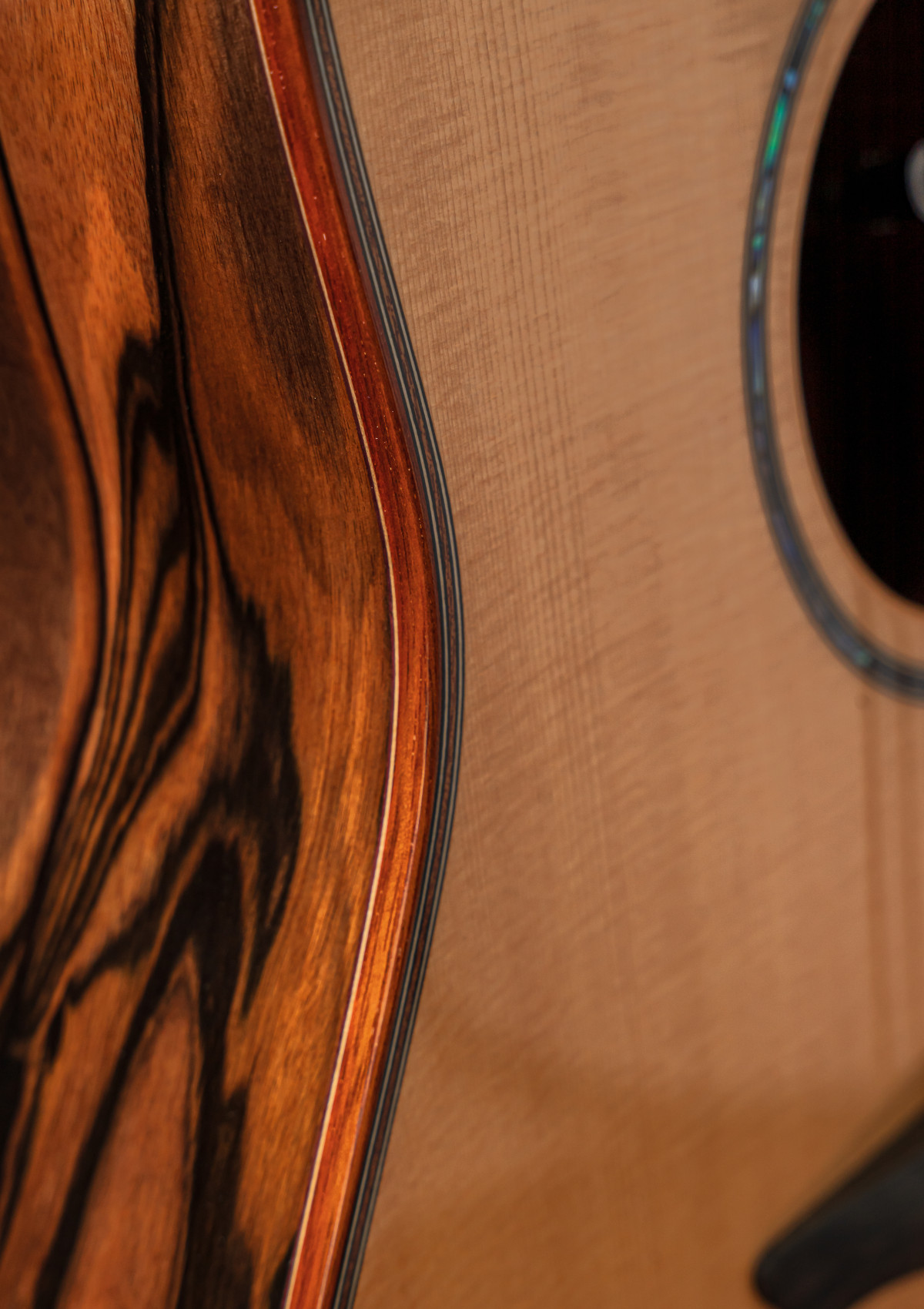
Instead of the relatively uniform black appearance associated with conventional ebony fingerboards, Mun ebony can display dramatic ribbons of dark brown, charcoal black and warmer, almost reddish figuring. The grain shifts and swirls across the surface, producing patterns that no designer could convincingly repeat.
On the D580, that natural figuring becomes a central part of the instrument's character. The dark timber contrasts beautifully with the lighter spruce top, while the ebony binding and carefully chosen appointments allow the wood to remain the star of the show.
There's nothing timid about it. And nothing needs to be added to make it interesting.
Mun ebony is also an exceptionally dense, slow-growing hardwood. Working with it demands sharp tools, careful preparation and a serious understanding of how the material behaves. Its hardness and density make it challenging to shape, and its rarity makes thoughtful material selection especially important.
That matters because the back and sides of a fine acoustic guitar aren't simply decorative surfaces. They help define the instrument's structural behaviour, the way energy moves through the body and the character of the sound that reaches the listener.
The wood is extraordinary to look at. But its real purpose begins when somebody plays the first chord.
Handcrafted in Northern Ireland: The Avalon Philosophy
There's something deeply satisfying about the fact that a guitar built from such an unusual Southeast Asian timber should emerge from a workshop in Northern Ireland.
Avalon's approach to guitar making is rooted in traditional lutherie. The company describes a process in which individual instruments are built by hand, with each soundboard voiced and its bracing shaped through the judgement of experienced craftspeople.
That's important.
Two pieces of spruce from the same species can behave quite differently. One may be comparatively stiff; another may flex more readily. Grain orientation, density, thickness and the particular piece of timber all influence the way a soundboard vibrates.
A skilled luthier responds to those differences.
By carefully shaping the internal bracing and refining the top, the builder works towards a balance of strength, responsiveness and musical character. Remove too little material and a guitar may feel constrained. Remove too much and its structure can be compromised.
Somewhere between those extremes is the point where the soundboard begins to behave as intended.
There is no magic involved. Just experience, patience and the ability to recognise what a particular piece of wood is telling you.
The D580 is a wonderful example of why that approach still matters.
Sitka Spruce and Mun Ebony: Power Meets Precision
A dreadnought is a bold choice for an instrument of this character.
The body shape has long been associated with powerful acoustic projection, strong bass response and the ability to hold its own beneath enthusiastic strumming. It became a favourite of flatpickers, folk players and singer-songwriters for very good reasons.
But the D580's combination of solid Sitka spruce and solid Vietnamese Mun ebony offers an intriguing variation on that familiar formula.
Sitka spruce is prized for its excellent strength-to-weight characteristics and broad dynamic potential. It can respond to a light touch while retaining the headroom needed for more aggressive playing. That's one reason it has remained such a dependable choice for premium steel-string acoustics.
The Mun ebony back and sides introduce a different set of physical properties. Dense hardwoods can contribute to a reflective, focused character, although no tonewood alone determines the sound of a finished guitar. Body geometry, bracing, top thickness, construction and the individual instrument all play their part.
What makes the D580's design so compelling is the intention behind that combination: the projection and dynamic range of a spruce-topped dreadnought, paired with the clarity and note definition associated with a dense hardwood body.
Think about a big open G chord.
You want the low strings to carry weight, but you don't want them swallowing the middle of the chord. You want the higher notes to ring clearly, with enough separation to hear the individual voices.
Now imagine moving into a fingerpicked passage, where the thumb is keeping a steady bass pattern beneath a melody on the treble strings. That's where articulation becomes every bit as important as volume.
The D580 is designed to explore that territory: dreadnought authority with a strong emphasis on detail.
Of course, the final judgement belongs to the ears and hands of the person playing it. No photograph, timber chart or technical description can substitute for that moment.
The Details: Quiet Luxury, Serious Craftsmanship
For all the visual drama of the Mun ebony, Avalon has been remarkably restrained with the surrounding details.
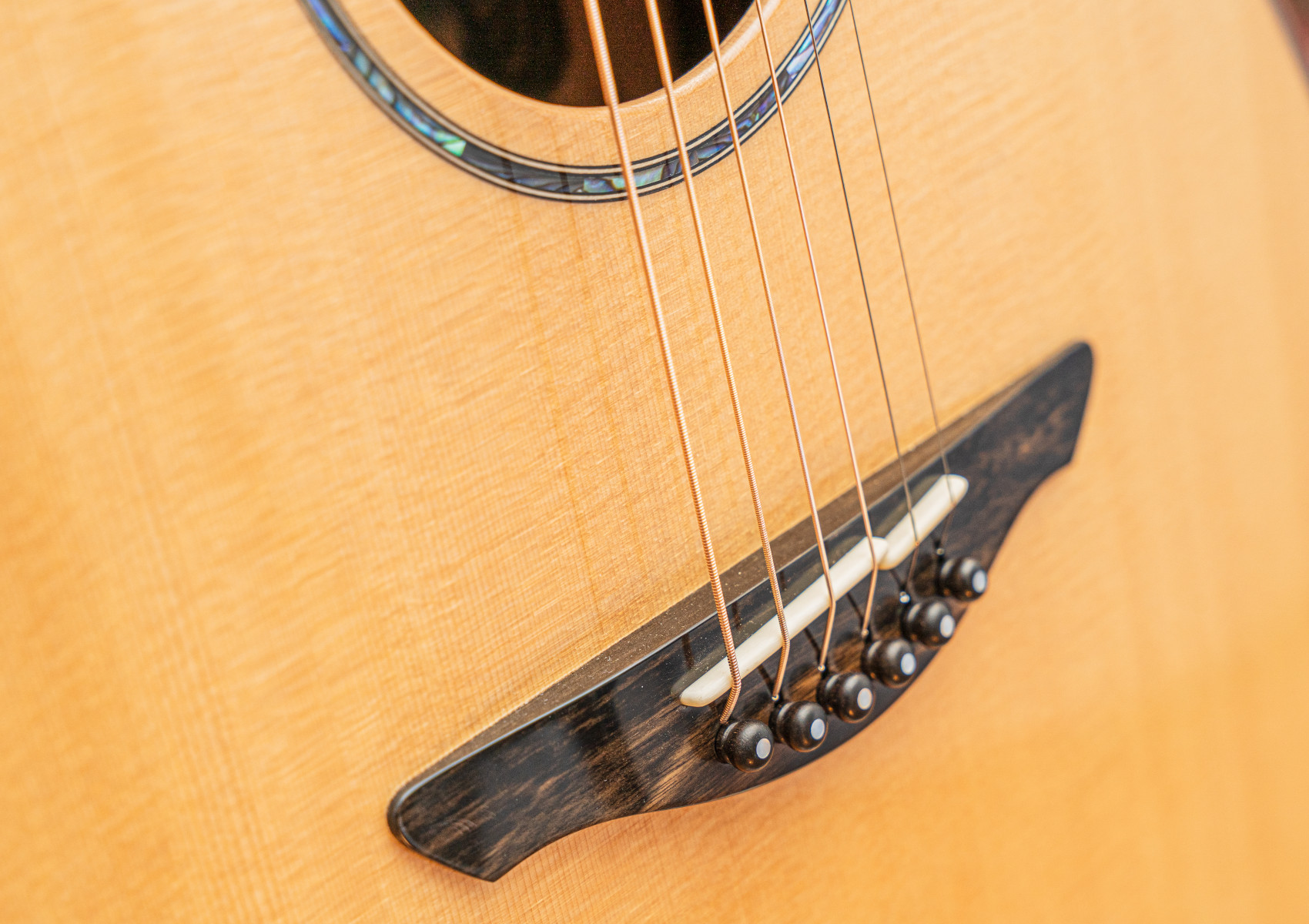
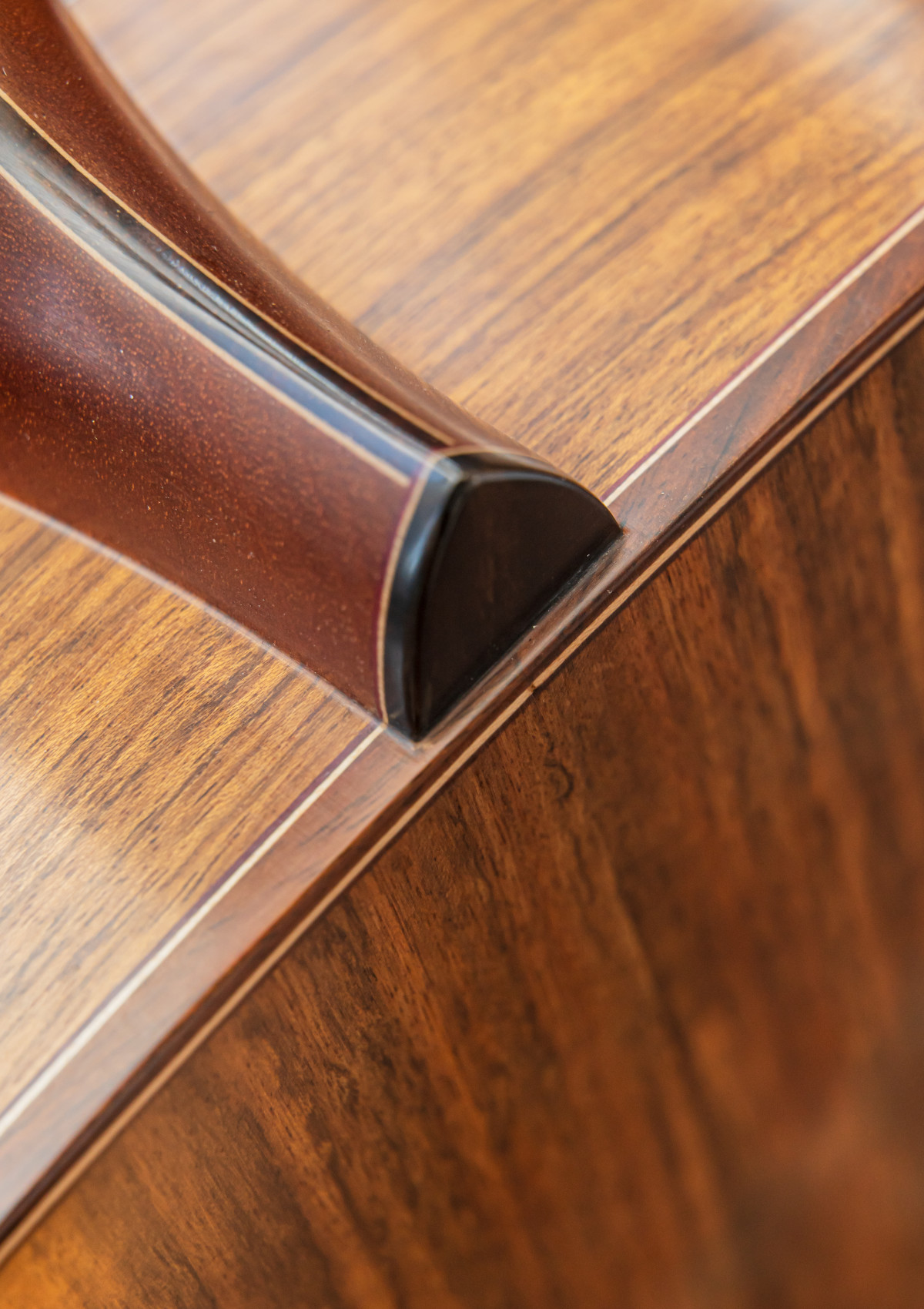
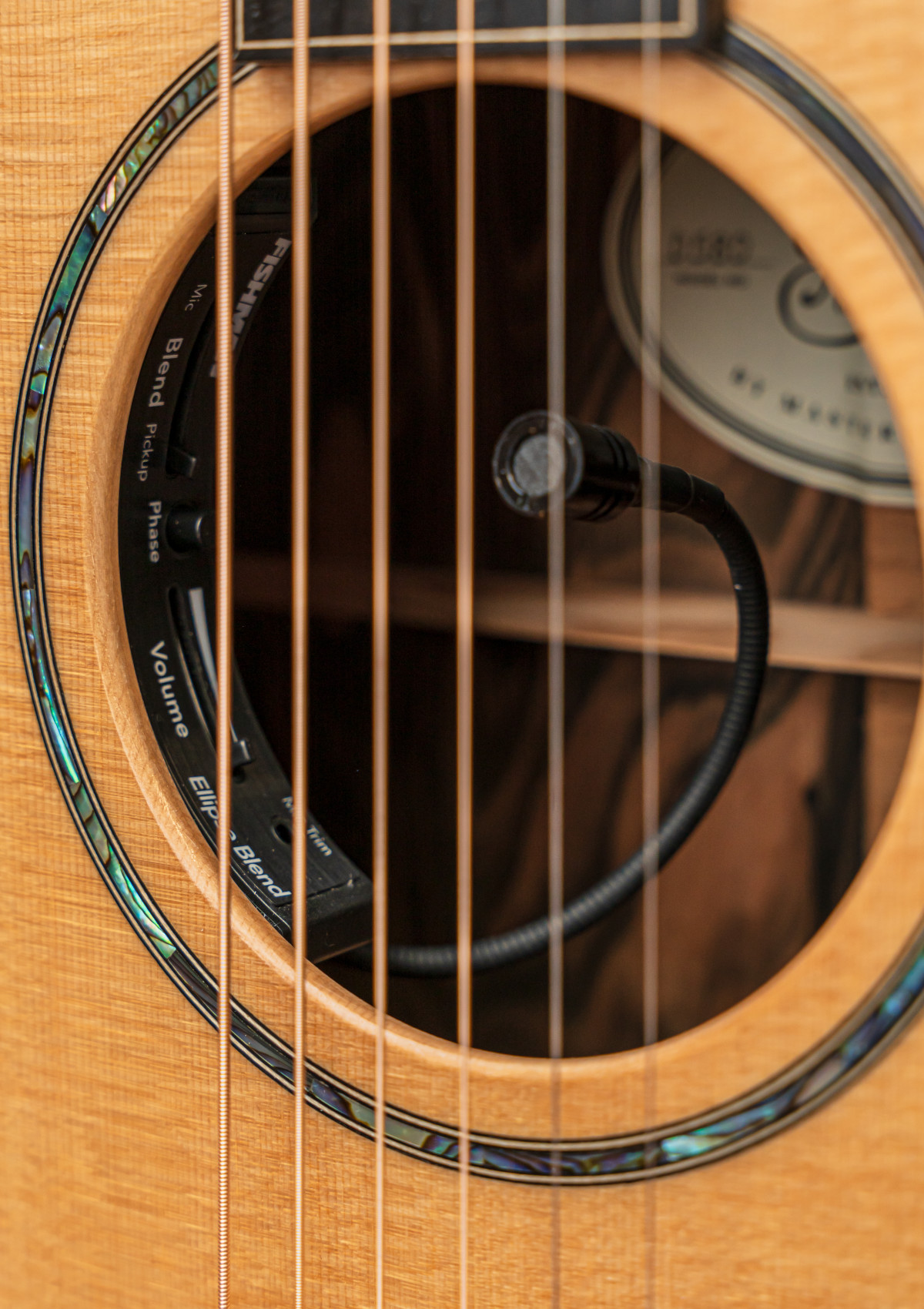
The D580 features an ebony fingerboard, bridge, headplate and body binding, creating a consistent visual theme without distracting from the natural timber. A solid Paua abalone rosette provides a flash of iridescent colour around the soundhole, while the mother-of-pearl Avalon logo adds a beautifully understated finishing touch.
The neck is made from Brazilian mahogany, selected for this particular build, while a natural bone nut and saddle provide hard, precisely shaped contact points for the strings.
Those little components deserve attention. The quality of the nut slots affects tuning behaviour and playability, while the fit and shape of the saddle influence string height and how effectively vibration is transferred to the bridge.
They aren't glamorous details.
They are, however, exactly the sort of details that separate an instrument that looks impressive from one that feels properly considered.
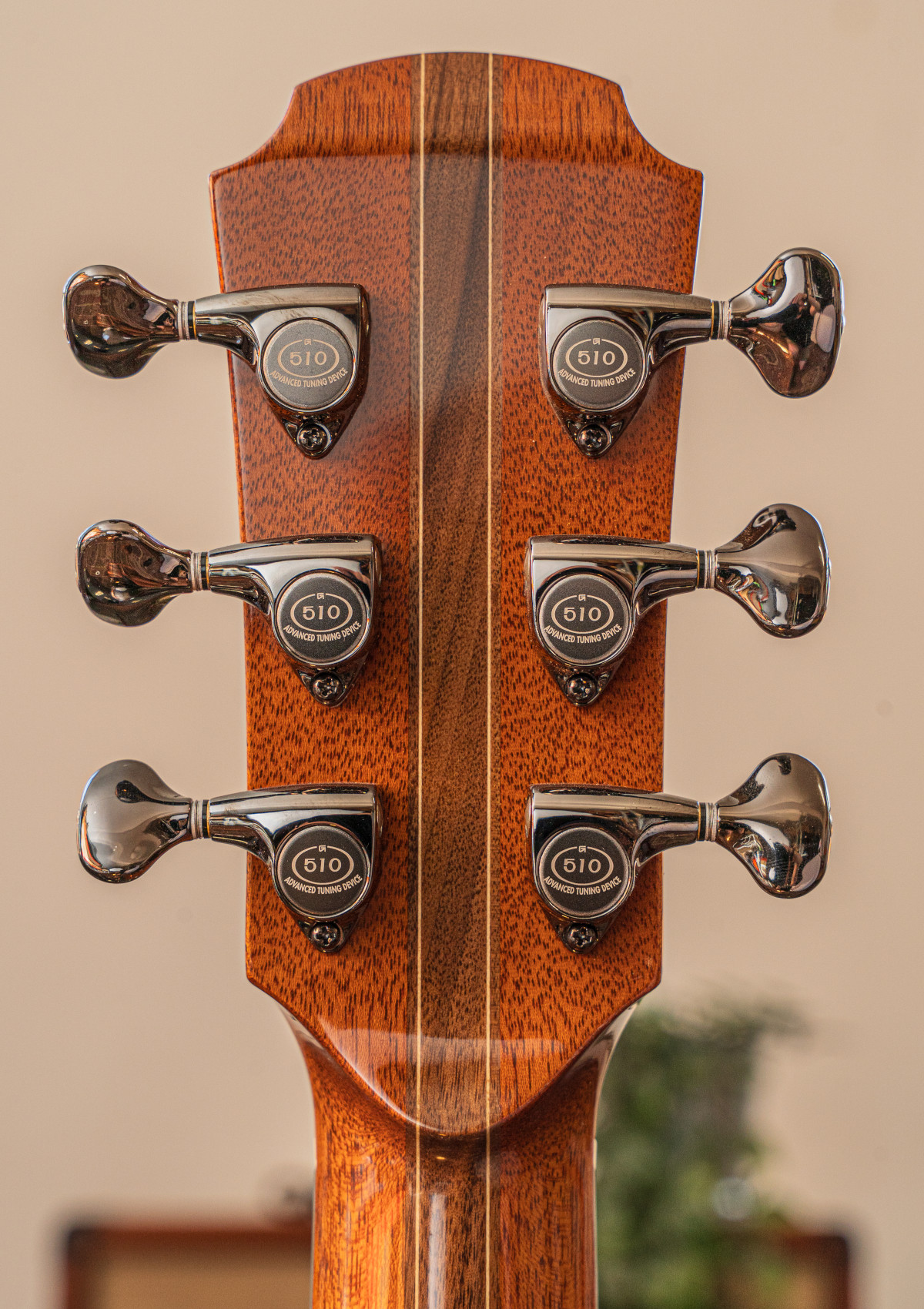
The D580 is fitted with Gotoh SG381 machine heads, dependable precision tuners with the sort of smooth operation that becomes increasingly appreciated over years of use. It also comes strung with D'Addario XS .012–.053 strings, giving the guitar a coated phosphor-bronze string set designed for durability and consistent performance.
And because a guitar of this calibre deserves serious protection, Avalon includes a deluxe TKL hard case.
Quite right too.
Fishman Ellipse Blend: Bringing the D580 to the Stage
A fine acoustic guitar can sound magnificent in a quiet room and become a completely different challenge when somebody puts a microphone, a monitor wedge and an enthusiastic drummer into the equation. Thankfully, the D580 comes equipped with the Fishman Ellipse Blend system.
This combines an undersaddle pickup with an internal microphone, allowing the player to blend the direct, feedback-resistant qualities of the pickup with some of the natural air and body detail captured by the microphone.
It's a clever arrangement.
The undersaddle element provides a dependable foundation, especially when stage volume starts climbing. Bringing in the microphone can add a more open, dimensional quality to the amplified sound, particularly in controlled performance environments.
As with any microphone-equipped acoustic system, the balance needs to suit the room. A little internal microphone can be beautiful in a quiet setting; too much on a loud stage can invite feedback.
The advantage is having that choice.
For a guitarist who wants to take a carefully crafted acoustic into live performance without abandoning its natural character, the Ellipse Blend is a thoughtful inclusion.
An Instrument to Play, Not Simply Admire
Here's the thing about exceptional acoustic guitars.
It's easy to become distracted by the spectacular timber, the intricate craftsmanship and the pleasure of knowing that something has been made slowly and carefully.
The D580 certainly offers plenty to admire. But its real value has to live in the playing.
In the response of the soundboard when a note is picked gently. In the balance between bass and treble. In the way a chord develops after the initial attack. In the feel of the neck after an hour of playing, when the novelty of the appearance has faded and the relationship between musician and instrument begins to take over.
That's the standard a handcrafted guitar should be judged against.
Not simply how remarkable it looks on a stand, but how much it encourages you to keep playing. And there is something especially appealing about a dreadnought that combines such a traditional musical purpose with such an unconventional choice of timber. The shape is familiar. The construction philosophy is rooted in generations of acoustic guitar making. Yet the Mun ebony gives the D580 an identity that feels entirely its own.
It is an unusual meeting of tradition and individuality.
And that is precisely why it deserves attention.
From the Musicmaker Workshop: A Very Special Irish Acoustic
At Musicmaker, we've spent decades watching guitars come and go through the doors of our Exchequer Street shop.
Some are wonderfully practical instruments, built to be played hard, carried everywhere and loved without ceremony. Others arrive with details that make even seasoned guitar enthusiasts stop and investigate.
The Avalon D580 Vietnamese Ebony/Spruce belongs firmly among the latter.
Its appeal begins with the extraordinary appearance of the Mun ebony, but it doesn't end there. The hand-voiced spruce top, Northern Irish craftsmanship, carefully selected hardware and Fishman electronics reveal a guitar designed with the serious musician in mind.
There's also something worth celebrating in the simple fact that work of this quality is being produced here on the island of Ireland.
In an age of extraordinary manufacturing efficiency, Avalon continues to place real value on the individual judgement of the luthier: the experienced eye, the practised hand and the willingness to spend time on details that may never appear in a specification sheet.
That is craftsmanship worth supporting.
And the D580 is a striking reminder that the most interesting acoustic guitars often emerge when a builder respects tradition without being afraid to explore unusual materials.
Vietnamese ebony. Sitka spruce. Northern Irish hands.
A remarkable combination.
And a guitar we'd very much like you to experience for yourself.
Musicmaker — 29 Exchequer Street, Dublin 2.
Independent minds. Serious gear. Glorious noise.