Donner MIDI Controllers: Big Ideas, Small Keyboards
Four clever little machines. A universe of sounds. And absolutely no need to build a recording studio in your spare bedroom.
You buy your first MIDI keyboard. You take it out of the box. Plug it into your computer. Press a key.
And…
Nothing.
No grand piano. No synthesizer. No enormous cinematic BRAAAAAAM.
Not a sausage.
Congratulations. You've just discovered one of the most important technologies in modern music.
Because a MIDI controller isn't supposed to be a piano in the traditional sense. It's something rather more interesting: a device that tells other musical equipment what to do. One little keyboard can play a sampled concert grand in the morning, a vintage synthesizer after lunch, an entire string orchestra that evening and an absolutely disgusting 808 bass at approximately 1:37am.
Same keys. Completely different musical universe.
And right now, we've got four excellent ways to get involved at Musicmaker Dublin.
The Donner N-25, Donner N-32, Donner STARRYPAD and Donner DMK-25 Pro have arrived to make music production, beatmaking and songwriting considerably more accessible.
They're compact, affordable and full of genuinely useful creative features.
Producers, songwriters, electronic musicians, curious guitarists and inveterate knob-twiddlers…
This one's for you.
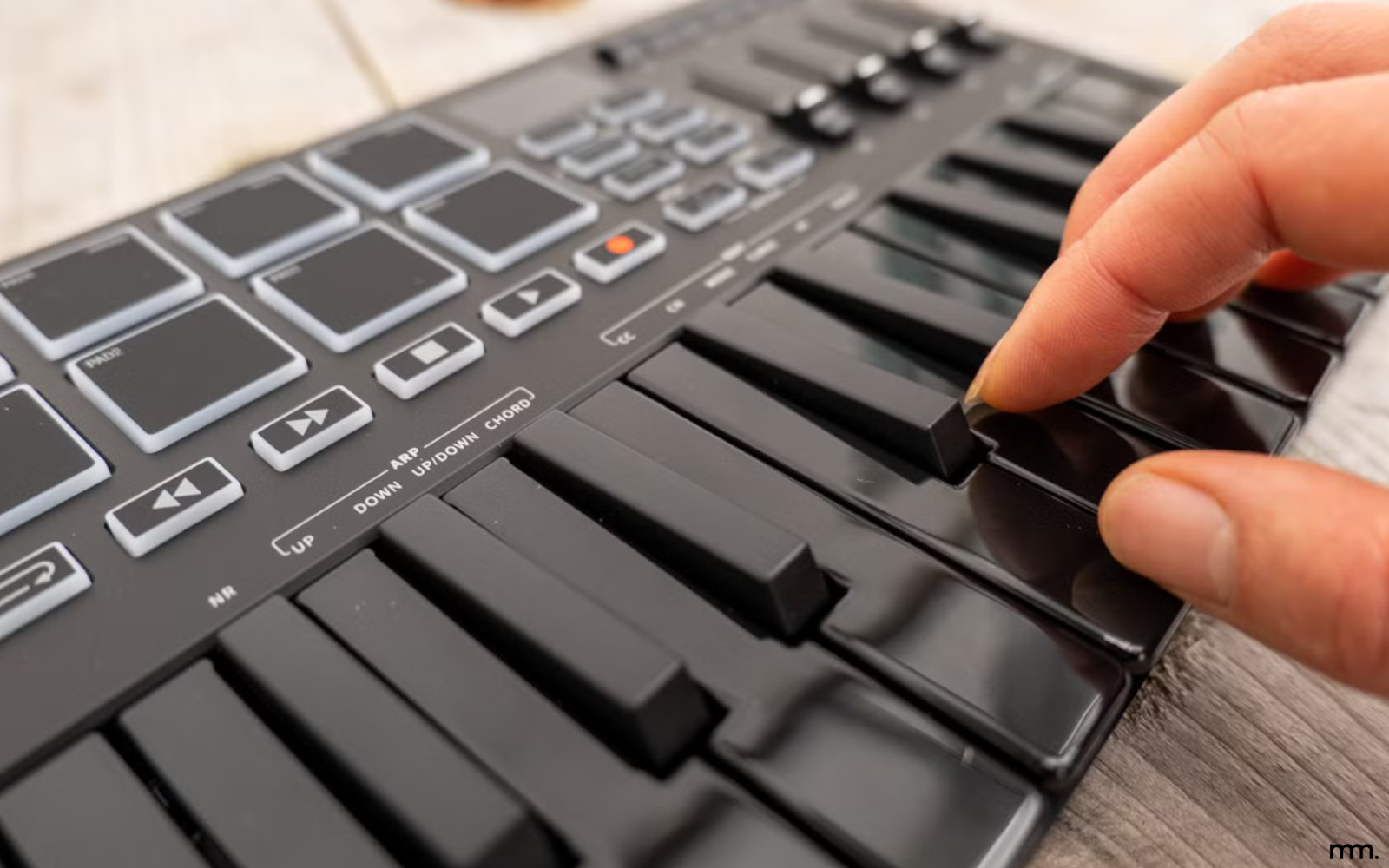
What Is MIDI, and Why Should You Care?
MIDI stands for Musical Instrument Digital Interface.
The original standard emerged in the early 1980s, allowing electronic instruments from different manufacturers to communicate using a common language. More than four decades later, that language remains fundamental to music production.
Here's the clever bit.
MIDI doesn't normally carry the sound of an instrument. It carries instructions about a performance. Which note was played? When did it start? When did it stop? How hard was it struck? Was the sustain pedal pressed? Did somebody move a modulation control? Your computer, synthesizer or virtual instrument receives those instructions and turns them into sound. And that separation is extraordinarily powerful.
Imagine recording a piano melody into Ableton Live, Logic Pro, Cubase, FL Studio, GarageBand or another digital audio workstation. With an audio recording, you've captured the sound of that performance. With MIDI, you've captured the musical instructions.
That means you can change the instrument afterwards. Turn the piano into a synthesizer. Move a wrong note. Adjust the rhythm. Change the tempo. Transpose the entire passage. Or discover that your delicate ballad sounds unexpectedly magnificent played by a gigantic electronic bass.
These things happen. The important point is that MIDI lets you experiment without constantly starting again.
And once that idea clicks, an enormous world opens up.
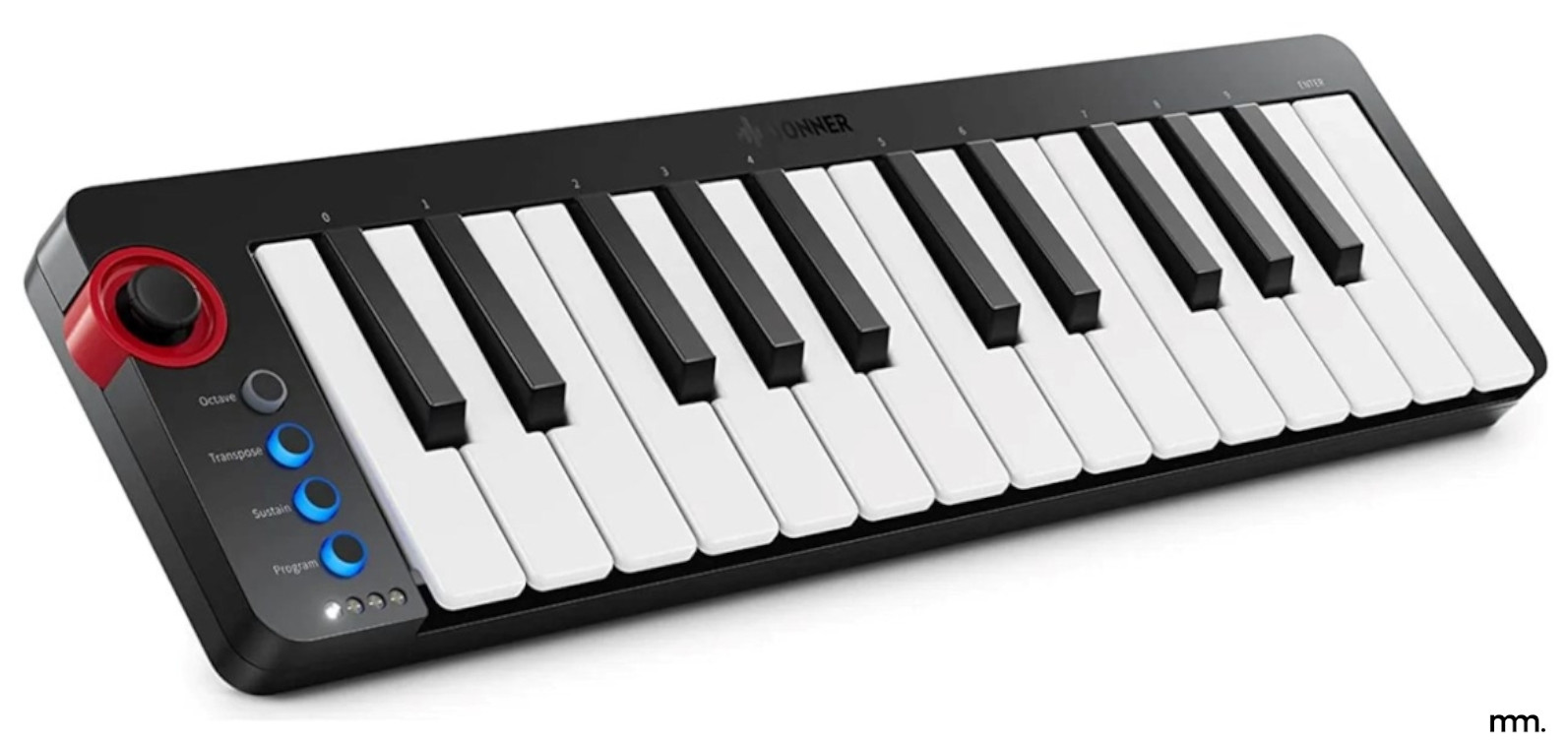
Donner N-25: Your First Twenty-Five Keys of Trouble
Let's begin with the beautifully straightforward Donner N-25 25-Key MIDI Keyboard Controller. €79.
That's a remarkably approachable price for a little machine capable of controlling a world of virtual instruments.
The N-25 has 25 velocity-sensitive mini keys, which means it can detect not only the notes you're playing but also the force of your keystrokes. That matters more than you might think. Play a virtual piano gently and you can produce a softer performance. Strike the keys harder and the instrument can respond with greater intensity. Depending on the software, velocity can also influence sample selection, filter behaviour or other expressive parameters.
Suddenly, those little keys become much more than simple on-and-off switches.
The N-25 connects over USB-C, making it easy to use with a compatible computer and music-production software. Its compact design takes up very little desk space, while octave controls let you reach notes far beyond the physical keyboard's two-octave range. There are four programmable user banks, sustain and pitch controls, and a built-in arpeggiator for turning held notes into rhythmic patterns.
That last feature is particularly addictive.
Play a chord, engage the arpeggiator and suddenly you've got the beginnings of a synth sequence.
Add a drum beat. Find a bass sound. Realise it's now half past midnight.
The N-25 is ideal for somebody beginning their music-production journey, a guitarist looking to add keyboards to home recordings, or a producer who wants a small controller that can live permanently beside a laptop.
It's simple without being boring. And that's a lovely place to start.
Explore the Donner N-25 at Musicmaker — €79
Donner N-32: Seven Extra Keys, Plenty More Mischief
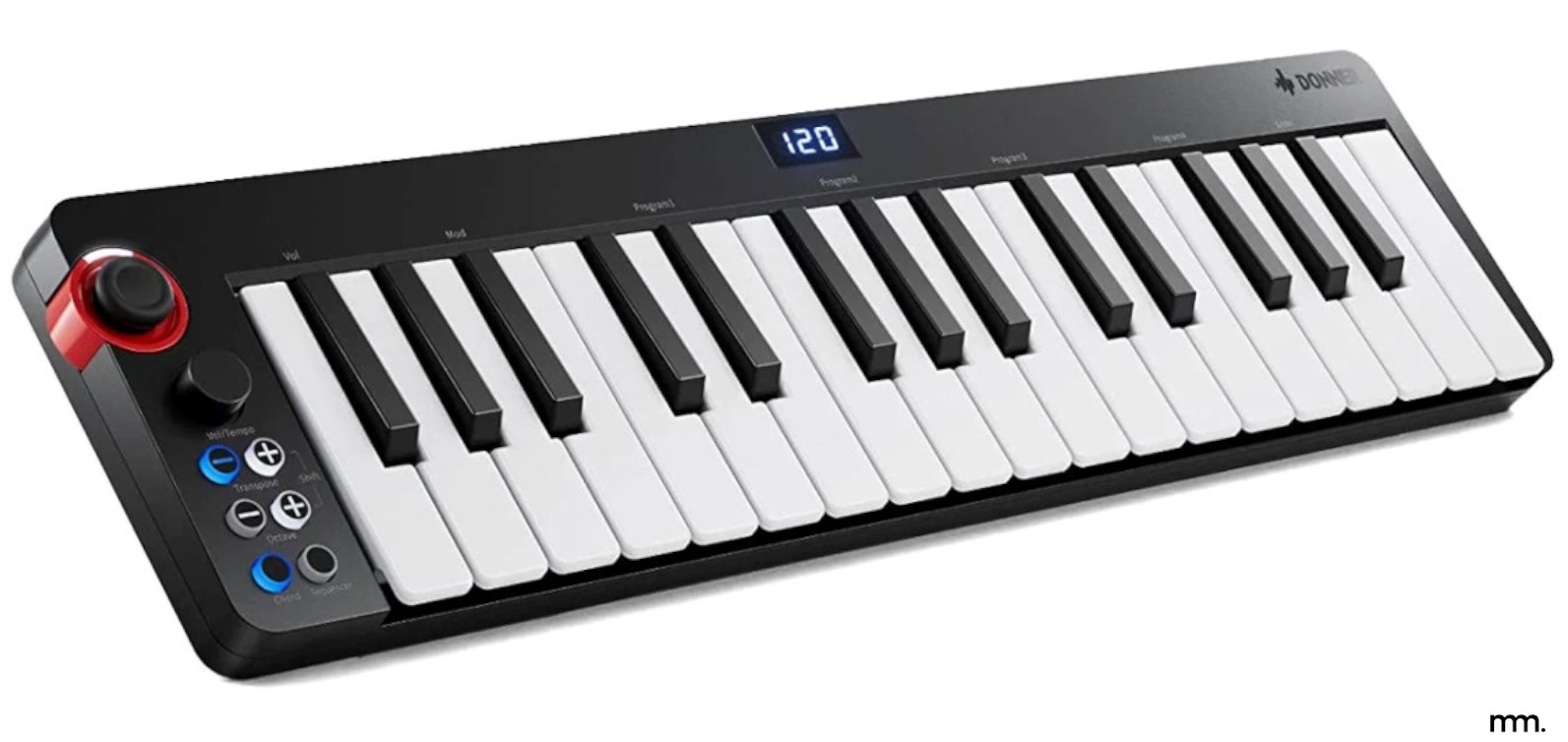
Next up is the Donner N-32 32-Key MIDI Keyboard Controller - €89.
Seven more keys for another ten euro. But there's more happening here than a slightly longer keyboard. The N-32 combines 32 velocity-sensitive mini keys with a useful selection of onboard creative functions, including a chord mode, arpeggiator and sequencer.
And this is where things get particularly interesting for songwriters.
An arpeggiator takes the notes you're holding and plays them as a repeating pattern. A chord function can make harmonic experimentation more immediate. Sequencing tools help you build musical phrases rather than performing every note in one uninterrupted take. These aren't substitutes for learning music. They're ways of exploring ideas. Perhaps you've got a bassline but can't quite hear the chords that belong above it. Perhaps you've found a synth sound and want to build a rhythmic pattern around it. Perhaps you're simply curious about what happens when you hold three notes and start changing the arpeggiator.
The N-32 encourages that sort of curiosity.
There are four programmable user banks, octave controls, sustain functionality and pitch-bend and modulation wheels for adding expression to compatible instruments. It also connects over USB-C and is designed to work with major computer-based production environments. Despite its additional keys, the N-32 remains compact enough for a small studio desk or mobile setup. For producers who want a little more playing room than a conventional 25-key controller, it makes excellent sense.
And at €89, it's a remarkably easy instrument to recommend.
Explore the Donner N-32 at Musicmaker — €89
Donner STARRYPAD: Get Your Fingers Off the Mouse
Of course, not every musical idea begins with a melody.
Sometimes it begins with somebody tapping a rhythm on the kitchen table. Sometimes it begins with a kick drum. And sometimes it begins with a snare sound so magnificent that you spend forty-five minutes building an entire track around it.
Enter the Donner STARRYPAD MIDI Pad Controller - €99.
Instead of piano keys, the STARRYPAD gives you 16 velocity-sensitive silicone performance pads, designed for triggering drum samples, percussion, loops, sound effects and whatever other sonic mischief your software can accommodate. The pads are backlit, with customisable RGB lighting, making it easy to identify different assignments and build a layout that suits your workflow. Three selectable pad banks expand the available assignments to 48 pad positions.
That's a lot of rhythmic potential beneath your fingertips. But the STARRYPAD isn't simply a collection of buttons. It includes two assignable faders, two rotary controls, programmable buttons, tap tempo and a Note Repeat function.
That last one is especially handy for beatmakers.
Instead of manually playing every rapid hi-hat note, Note Repeat can generate repeated triggers according to the chosen rhythmic division. Combined with velocity-sensitive pads, it opens up a world of rhythmic variations and performance techniques. And there's something enormously satisfying about finger drumming. A mouse can place notes precisely on a screen. But pads let you physically perform a rhythm, introducing the little variations in timing and dynamics that give beats personality. Hip-hop, electronic music, pop production, experimental sound design, live sample triggering — the STARRYPAD has plenty of places to make itself useful.
USB-C connectivity keeps the setup straightforward, and Donner includes access to Cubase LE and Melodics learning resources to help new users get started.
For anyone who thinks in beats before melodies, this is a cracking piece of kit.
Explore the Donner STARRYPAD at Musicmaker — €99
Donner DMK-25 Pro: A Proper Little Production Command Centre
And now we arrive at the big personality in the smallest possible package.
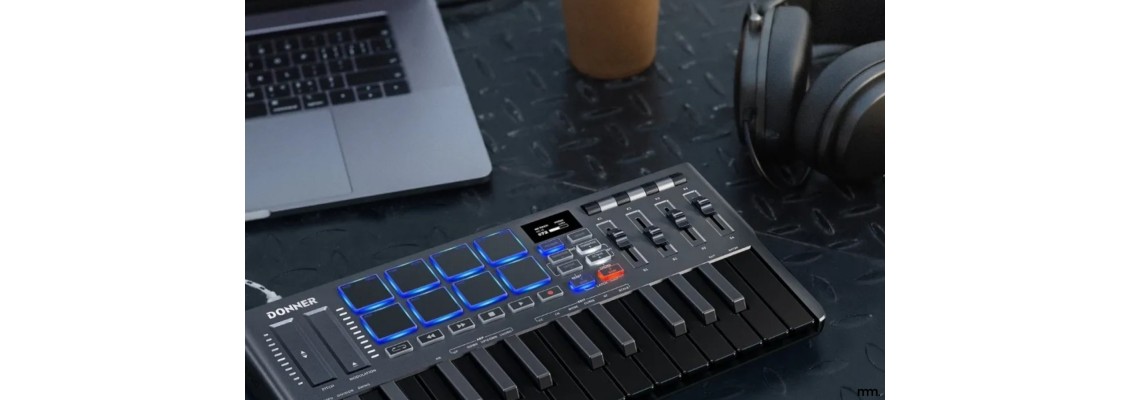
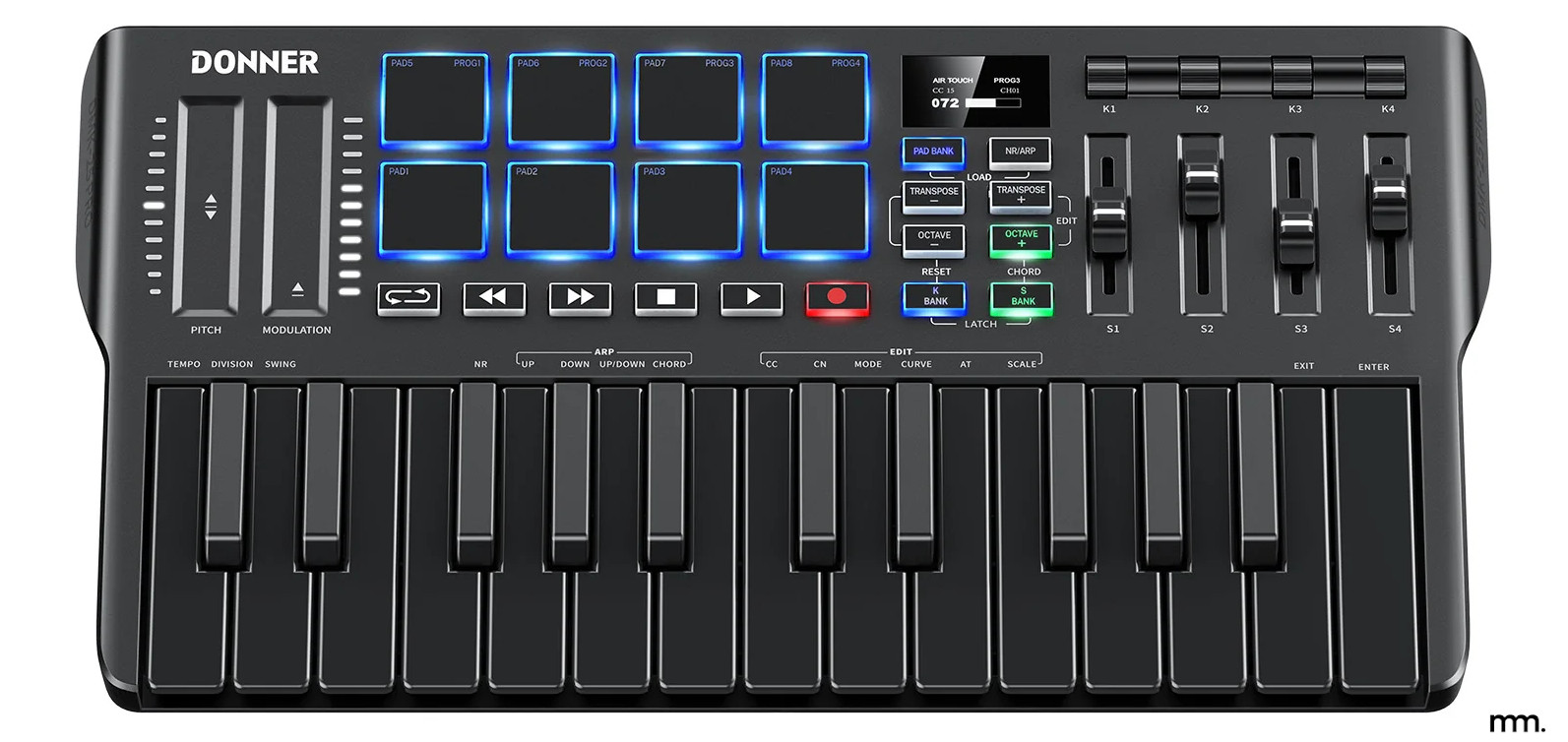
The Donner DMK-25 Pro MIDI Controller - €149.
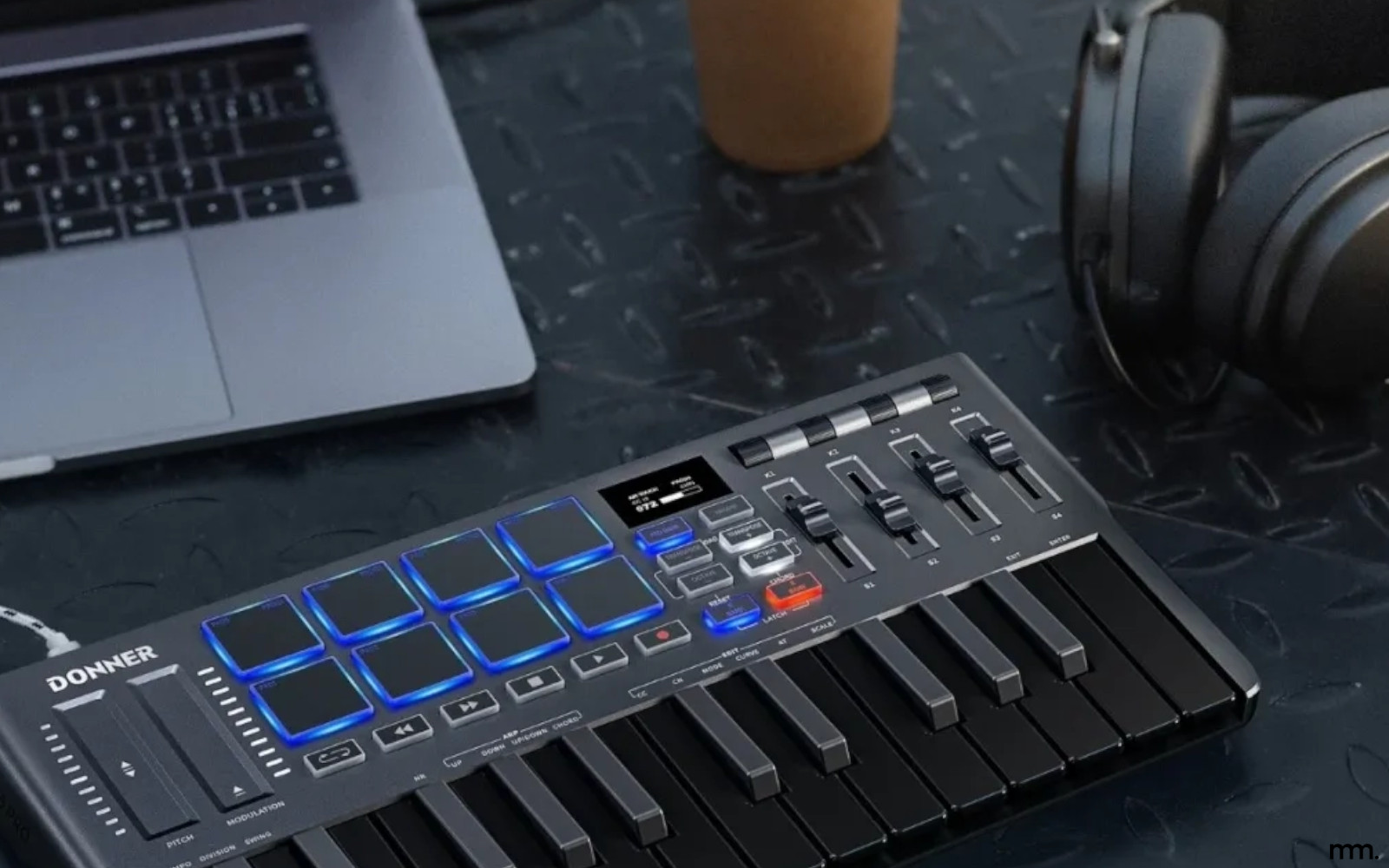
This is where a compact keyboard begins behaving like a serious production workstation. You get 25 velocity-sensitive mini keys, eight velocity-sensitive pads, assignable knobs and sliders, transport controls and an OLED display that provides useful visual feedback. The pads are ready for drum programming and sample triggering. The knobs and sliders can be assigned to compatible software parameters. The transport controls help manage recording and playback without constantly reaching for the mouse. That means you can play a synth line, adjust its filter, change a software instrument parameter and control parts of your recording session from one compact device.
It's a more hands-on way to work.
And for many producers, that physical interaction makes a remarkable difference. A synthesizer filter feels different when you turn a control while playing, rather than drawing an automation curve afterwards. A drum pattern feels different when you tap it out. A chord progression feels different when your fingers discover it.
The DMK-25 Pro also features Dynamic Scale Mode, offering 16 selectable scales to help keep melodic exploration within a chosen collection of notes. That's particularly useful when experimenting with unfamiliar musical modes or trying to develop a melodic idea quickly. Add the built-in chord and arpeggiator functions, and the controller becomes a surprisingly capable creative companion. Touch-sensitive pitch and modulation strips provide additional expressive control, while USB-C connectivity keeps the whole setup portable.
Donner also offers access to Steinberg software, including Cubase LE, through its supported software programme. Check the current registration and eligibility details when activating the bundle.
The DMK-25 Pro is the obvious choice here for somebody who wants a more comprehensive connection between their hands and their DAW. Not because more buttons automatically make better music.
But because having the right controls within reach can make the creative process feel wonderfully immediate.
Explore the Donner DMK-25 Pro at Musicmaker — €149
Do You Need to Know How to Play Piano?
Absolutely not.
And this is worth saying loudly. A MIDI keyboard is not reserved for people who can perform Chopin at concert tempo.
It's an interface for musical ideas. A bassline might require one finger. A drum part might involve tapping out a few notes. A synthesizer pad might begin with three keys held together while you experiment with a filter. You can build complex arrangements one layer at a time, using virtual instruments to create sounds that would once have required a room full of expensive equipment.
And because MIDI notes remain editable, you're free to experiment, make mistakes and discover something unexpected. In fact, some of the most interesting electronic music has come from people approaching instruments in entirely unconventional ways. You don't need permission to begin.
You need curiosity, some software and something that lets your hands communicate with it.
That's where these little Donner controllers come in.
Which Donner MIDI Controller Should You Buy?
Here's the lovely thing about this range. There isn't one correct answer.
If you want a straightforward first MIDI keyboard for music production, the N-25 is an excellent starting point.
If you prefer a little more keyboard space and enjoy experimenting with chords, arpeggios and sequences, the N-32 is a wonderfully affordable upgrade.
If drums, samples and rhythmic performance are the centre of your musical world, the STARRYPAD is the natural choice.
And if you want keys, pads, assignable controls and deeper hands-on interaction with your DAW, the DMK-25 Pro is the most comprehensive option of the four.
One practical note: these are MIDI controllers, not conventional standalone keyboards with built-in speakers and a library of onboard sounds. You'll need compatible software or another sound-generating device to hear what you're playing.
That's not a limitation so much as the whole idea. The controller provides the performance. Your chosen instrument provides the sound.
And the possibilities are rather enormous.
From the Musicmaker Workshop: The Mighty MIDI Lives On
At Musicmaker, we've watched music production change beyond recognition since the early 1980s.
Studios that once demanded enormous budgets can now exist on a desk. Instruments that once filled entire rooms now live inside a laptop. A song can begin on a train, develop in a bedroom and become a finished recording without ever passing through a traditional commercial studio. MIDI has been quietly supporting that revolution for decades. And that's why we love seeing genuinely accessible controllers like these arrive in the shop.
They lower the cost of experimentation.
They make it easier to learn synthesis, program drums, write melodies, arrange music and discover entirely new approaches to songwriting. Most importantly, they encourage you to make something. So if you're looking for Donner MIDI controllers in Ireland, come and see us at Musicmaker, 29 Exchequer Street, Dublin 2.
We'll happily talk keyboards, pads, recording software, beatmaking and the mysterious business of getting a controller to make a noise.
Or explore the complete range online:
Shop Donner MIDI Controllers & Keyboards at Musicmaker Ireland
The mouse is excellent.
Your hands are better.
Musicmaker — Independent minds. Serious gear. Glorious noise.