Boss Pedals Have Taken Over Musicmaker
Fifty-Three Reasons to Step on Something
Something has happened in Musicmaker.
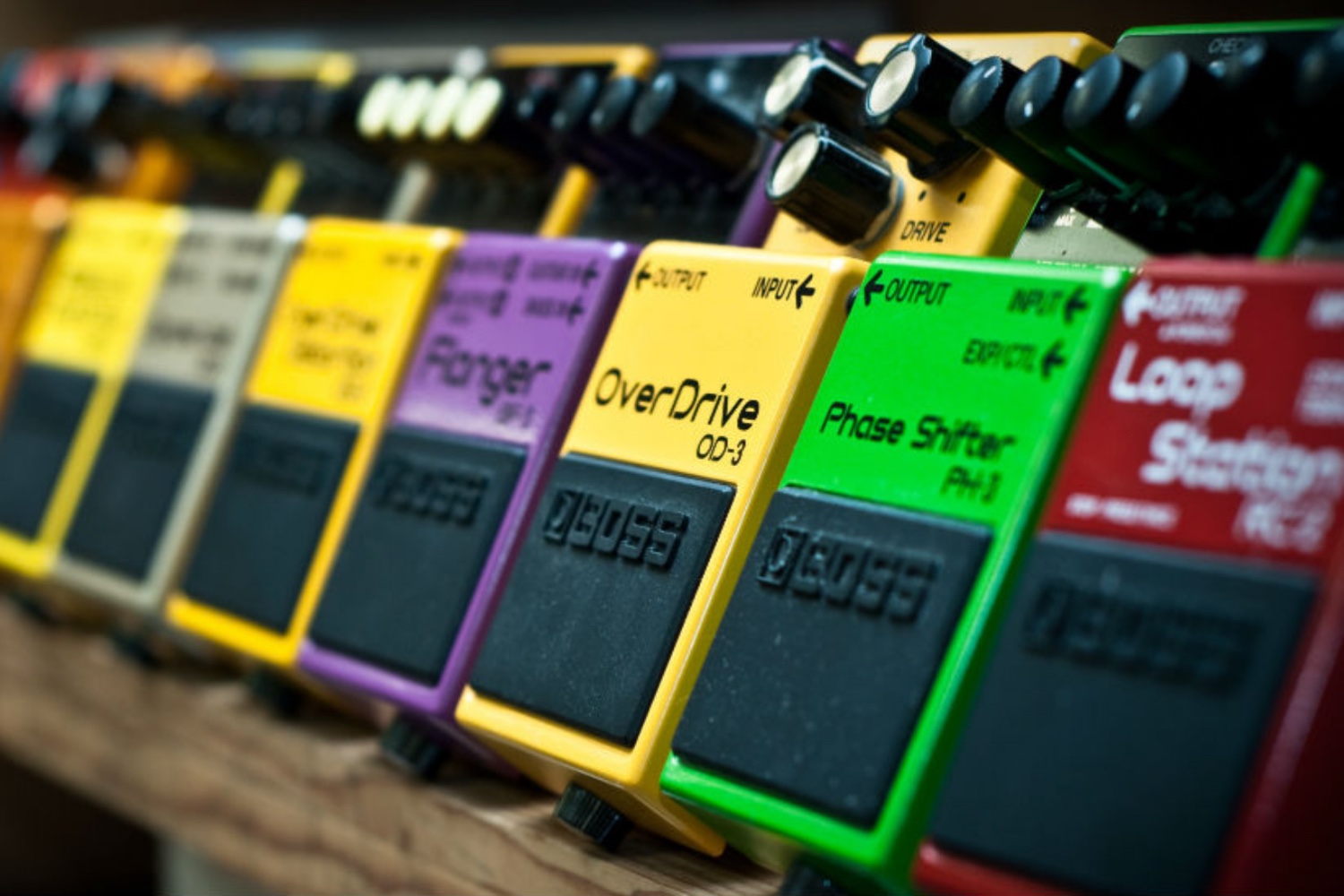
At first it looked innocent enough. A few boxes arrived. Then more boxes arrived. Orange appeared. Blue followed. Yellow. Green. Silver. Black. Several shades that appear to have been chosen specifically so a guitarist can identify an effect from the opposite side of a dark stage while being shouted at by a drummer.
And then we counted them.
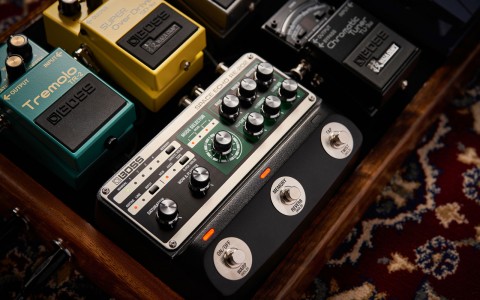
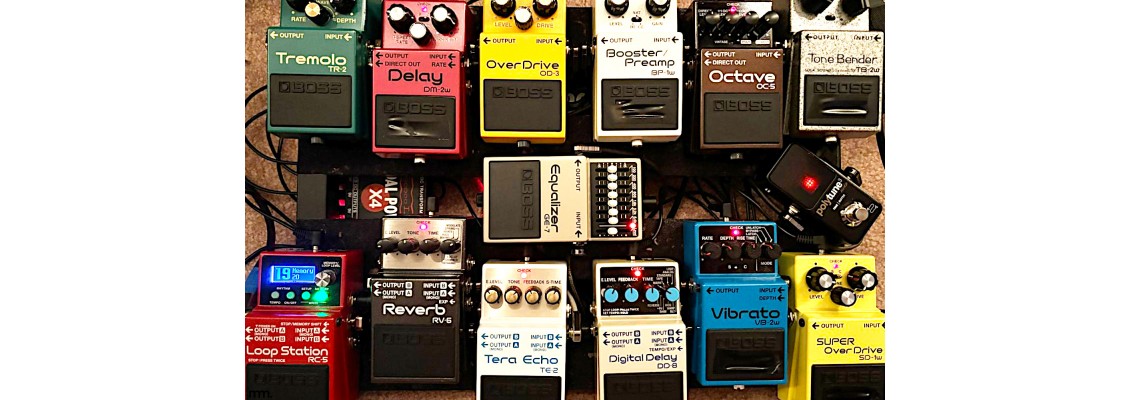
There are currently 53 Boss products showing in the Musicmaker effects department.
This is no longer a delivery. Boss has occupied the building.
Frankly, we're delighted.
Because few companies have influenced the history of guitar effects as profoundly as Boss, and fewer still have managed the particularly difficult trick of becoming both completely ordinary and utterly iconic at the same time.
You know the shape. You know the footswitch.
You know the coloured metal box with four black rubber corners and BOSS stamped across the front.
There is a reasonable chance you've owned one. There is an even better chance you've stepped on one. And somewhere on Earth right now, a DS-1 that has been kicked, dropped, beered upon, thrown into three vans and held together cosmetically by stickers is preparing for another gig without complaint.
Boss pedals are simply part of the furniture of electric guitar.
Except somebody has just delivered most of the furniture to 29 Exchequer Street.
So gather round, guitar nerds.
We need to talk about pedals.
Before the Pedalboard Became a Pedalboard
Go back far enough and guitar effects become gloriously inconvenient.
Reverb might live inside an amplifier. Echo could involve actual magnetic tape travelling around a mechanical transport. Distortion was something you extracted from amplifiers through volume, abuse and occasionally decisions that would make an electrical engineer leave the room.
Effects existed, of course, but the neat modern idea of assembling a row of compact boxes at your feet was still evolving.
Then Boss arrived and helped standardise the whole affair.
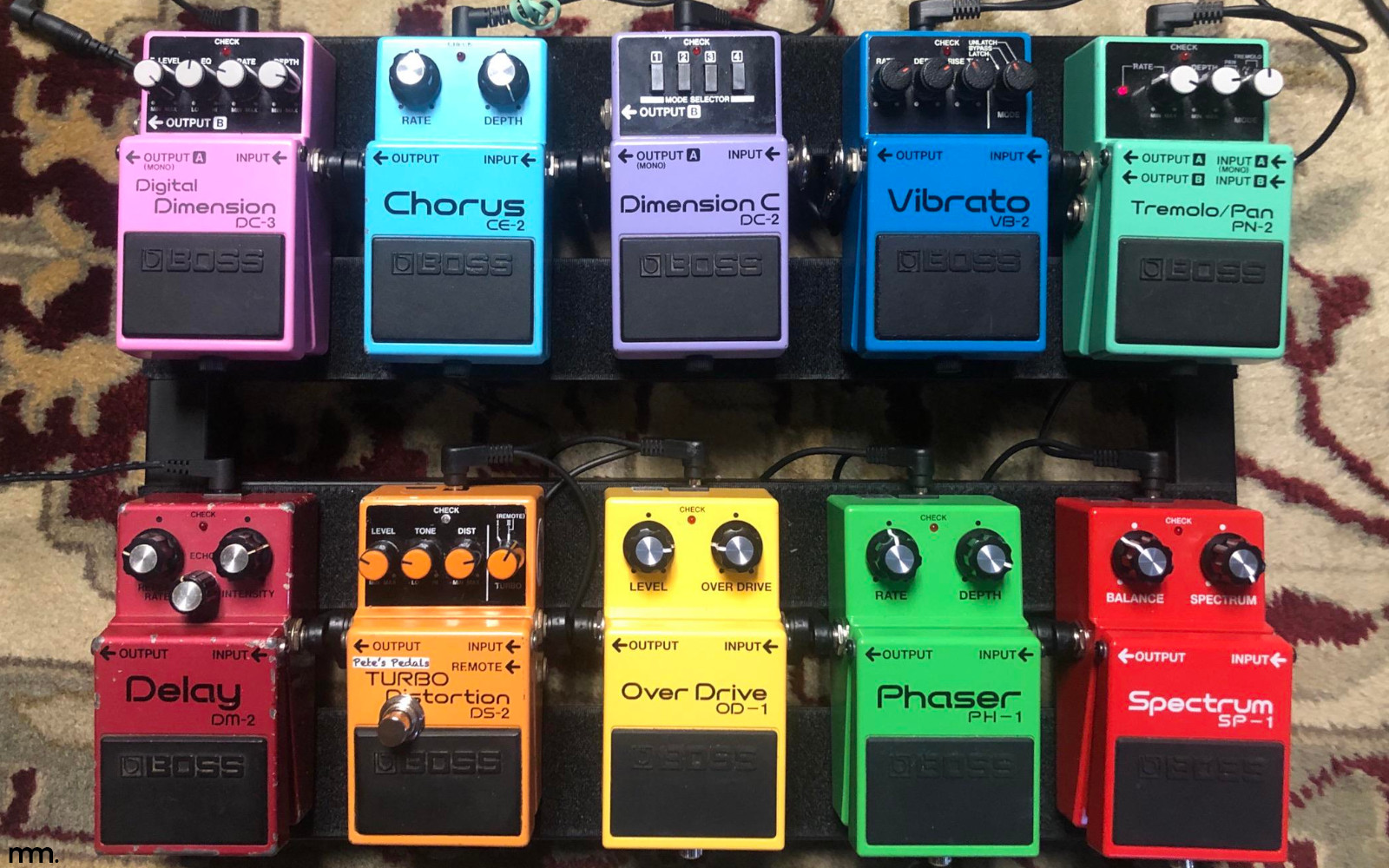
The first three Boss compact pedals appeared in 1977: the OD-1 OverDrive, PH-1 Phaser and SP-1 Spectrum. The DS-1 Distortion followed in 1978. Boss says more than 15 million compact pedals had already been sold by the time the format celebrated its 40th anniversary, and the DS-1 went on to become the company's best-selling compact pedal.
Think about what that means.
Nearly half a century of musicians have looked down and seen essentially the same physical language.
Input on one side. Output on the other. Knobs where you can reach them. Big hinged footswitch. LED. Battery hiding beneath the treadle. Metal enclosure capable of surviving circumstances that would render many household appliances emotionally unavailable.
But the more interesting Boss legacy is not merely mechanical.
It is sonic.
Boss helped make effects understandable.
Orange meant distortion. Yellow became associated with overdrive. Blue became chorus territory. White housed tuners and delays. You could walk into a music shop, point at the coloured box and begin learning what an effect actually did.
And once you understood one pedal, another made sense.
That is an extraordinarily powerful piece of industrial design.
The Department of Filth
Let us begin where guitarists traditionally begin.
Make it dirty.
Overdrive and distortion sound superficially similar because both alter the waveform and generate additional harmonics, but they can behave very differently beneath your fingers.
Overdrive generally takes its inspiration from an amplifier being pushed into clipping. At lower gain settings it can retain more of the relationship between pick attack and output, so playing softly may remain relatively clean while harder playing produces more grit.
Distortion tends to impose a stronger clipping character, compressing and reshaping the signal more aggressively.
And then there is fuzz.
Fuzz has seen the rulebook and rejected its authority.
Boss has spent decades exploring the enormous territory between subtle push and somebody has apparently driven a Transit van through the amplifier.
The DS-1 Distortion remains the obvious orange monument. Introduced in 1978, its hard-edged attack, sustain and cutting character helped establish a distortion sound that has appeared across rock, punk, alternative music and metal ever since. Boss still produces it, Musicmaker still sells it, and generations of players continue finding uses for three knobs labelled Tone, Level and Distortion.
There is something wonderful about that longevity.
The world has invented smartphones, streaming, artificial intelligence and refrigerators that can apparently send emails.
The DS-1 still has three knobs.
Correct.
Elsewhere in the dirt department, things get more sophisticated. The BD-2W Blues Driver Waza Craft takes one of Boss's most loved touch-responsive drive circuits into Waza territory, while the JB-2 Angry Driver is one of the more unusual collaborations in Boss history: Boss and JHS Pedals combined the BD-2 Blues Driver concept with the JHS Angry Charlie, providing independent drive characters that can also be combined in series or parallel.
That last part is proper pedal-nerd territory.
Put two gain stages in series and the first begins influencing how the second clips. Change the order and you change the result. Run them in parallel and instead of one distorted signal feeding another, the two characters can coexist alongside each other.
This is why guitarists own several overdrives despite assuring loved ones that they already own an overdrive.
They are not the same, Susan.
Please respect the research.
Waza Craft: Boss Gets Extremely Serious About Boss
Then we arrive at the little Japanese symbol that causes pedal enthusiasts to lean towards the glass cabinet.
Waza Craft.
“Waza” is closely associated with art and technique, and the Waza Craft range gives Boss the opportunity to revisit important designs with premium analogue circuitry, carefully selected components and expanded voicing.
This is not simply vintage cosplay. It is Boss looking backwards with modern engineering tools.
The CE-2W Chorus, for example, is a beautiful little history lesson disguised as a blue pedal. It provides the classic CE-2 sound alongside modes derived from the CE-1 Chorus Ensemble, connecting a modern compact pedal directly back to Boss and Roland's earliest chorus heritage.
And that heritage matters.
Before the compact pedals even arrived, the Boss CE-1 Chorus Ensemble appeared in 1976, bringing the chorus effect derived from Roland's Jazz Chorus technology into a standalone effects unit. The CE-2 followed in 1979 and helped establish the compact chorus pedal as one of the defining modulation sounds of the following decades.
Then there is the DM-2W Delay, which revisits Boss's early analogue delay lineage while extending the useful delay range beyond the vintage design.
And the BP-1W Booster/Preamp, another current Musicmaker arrival, goes even deeper into Boss/Roland history by drawing on the character of classic preamp circuits rather than merely offering “make louder” in a box.
This is where collecting Boss pedals starts becoming dangerous.
At first you want a chorus.
Three hours later you are explaining Japanese analogue pedal history to somebody who only asked what time dinner was.
Welcome, nerd.
We kept you a chair.
Chorus, Rotary and the Beautiful Art of Making Pitch Wobble
Modulation is where guitar tone stops behaving itself.
Chorus, flanger, phaser, vibrato and rotary effects all create movement, but they achieve it differently.
Chorus generally creates the impression of multiple performances by mixing the dry signal with a subtly delayed signal whose timing or pitch is modulated. Your ear interprets those tiny differences as width and movement.
Flanging uses very short modulated delays, producing the characteristic sweeping comb-filter effect.
Phasing instead manipulates phase relationships through filters, creating moving peaks and notches in the frequency response.
Rotary effects chase another phenomenon entirely: the complex pitch and amplitude modulation created by rotating speaker systems.
Same broad family.
Completely different flavours of seasickness.
The CE-2W gives the Boss shipment its direct connection to chorus royalty, while the RT-2 Rotary Ensemble brings rotary-speaker movement into the modern compact format. The SL-2 Slicer then wanders into the room carrying scissors and begins rhythmically chopping the signal into patterns.
And this is where modulation becomes more than decoration.
A slow chorus can widen a clean guitar. A rotary effect can make sustained chords breathe and swirl. A rhythmic slicer can transform one held chord into an entire pattern.
The effect begins influencing what you play.
That is one of the great secrets of pedals.
Sometimes we imagine effects as something added after a guitar part has been written.
In reality, a great effect can write half the part for you.
Play a chord. Step on something strange.
Suddenly the chord has an opinion.
Delay: Repeat After Me
Now we enter dangerous territory.
Delay.
There are people who own one delay pedal. We have heard rumours.
For everybody else, Musicmaker's current Boss selection is bordering on irresponsible.
The DD-3T represents the beautifully direct digital-delay school. The DD-8 expands the compact format into a far broader delay toolkit. The DD-200 pushes into programmable, performance-oriented territory with considerably deeper control.
Then Boss starts opening doors into its own past.
The DM-2W revisits analogue delay.
The RE-2 and RE-202 Space Echo revisit one of Roland's most important effects machines.
And sitting near the top of the current Musicmaker pile is the magnificent DM-101 Delay Machine.
At this point we are no longer simply repeating notes.
We are designing time.
Analogue Delay and Why Imperfection Sounds So Good
Traditional analogue delay commonly uses bucket-brigade devices, or BBDs, to pass an analogue signal through a chain of stages.
The important musical consequence is that the repeats are not perfect copies.
High frequencies soften. Repeats become darker. The signal acquires character as it circulates.
And this supposed imperfection is exactly what players love.
A pristine digital repeat can reproduce a note with extraordinary accuracy. An analogue repeat can feel as though the note is slowly disappearing into the walls.
Neither is objectively better.
They occupy different emotional spaces.
The DM-101 takes that analogue principle and becomes gloriously excessive with it, combining real analogue BBD delay circuitry with sophisticated digital control. That means the actual delayed signal can retain analogue behaviour while modern processing handles complex routing, modulation, stereo operation and control.
This is the kind of engineering that makes pedal nerds stare into middle distance.
Analogue where analogue matters. Digital where digital helps.
Lovely stuff.
Space Echo: When Delay Became an Instrument
Then there is the RE-202 Space Echo.
Oh boy.
The original Roland RE-201 Space Echo, introduced in 1974, used magnetic tape travelling past multiple record and playback heads to generate echoes. But tape echo is never merely “the same note again later”.
Tape stretches. Motors fluctuate.
Magnetic media saturates. Mechanical systems introduce wow and flutter.
Repeats change as they decay.
The machine develops behaviour.
That unpredictability became part of the sound.
The modern RE-202 recreates the behaviour of the RE-201 digitally, modelling elements including tape response, motor variation, preamp colour and spring reverb, while expanding the original idea with stereo operation, additional echo-head combinations, memories, MIDI and performance controls. Boss even analysed vintage RE-201 units during development, including an untouched example from the company archive.
The smaller RE-2 brings the essential Space Echo concept into the familiar compact Boss enclosure.
So the Musicmaker delay shelf currently spans an extraordinary amount of effects history.
Simple digital echo. Modern programmable delay.
Analogue bucket-brigade delay. Tape-echo recreation.
Several decades of humans asking one important question: what if that note happened again?
Reverb: Put Your Guitar Somewhere That Doesn't Exist
Delay repeats a sound. Reverb constructs the space around it.
At least, that is the useful oversimplification.
Real reverberation is an extraordinarily dense network of reflections. Sound leaves a source, strikes surfaces and returns at different times and amplitudes until the individual reflections become too numerous for the ear to perceive as separate echoes.
A reverb pedal allows us to fake that acoustic behaviour.
Which is excellent, because fitting a cathedral onto a pedalboard has historically been difficult.
The Boss RV-6 is the compact workhorse here, covering the practical reverb territory required by enormous numbers of guitarists without demanding a control room and a degree in acoustics.
Then the RV-200 goes considerably deeper, adding a broader palette and the sort of programmable control that makes sense when reverb stops being a finishing touch and starts becoming part of the composition. Both are currently sitting in the Musicmaker Boss range.
Spring. Plate. Hall. Room.
Shimmering, modulated, enormous ambient spaces.
At conservative settings, reverb can simply stop a close-miked or dry guitar feeling unnaturally naked.
Turn it up and something else happens.
The room disappears. You are now playing guitar inside weather.
Shoegaze people, we see you.
Pitch: Your Guitar Has Acquired Additional Guitars
Pitch effects are wonderfully strange because they interfere with one of the most fundamental pieces of information in music:
What note did you actually play?
The PS-6 Harmonist can create harmony and pitch-shifting effects around the played note, while Boss's octave lineage is represented elsewhere in the range by pedals such as the OC-5, which combines vintage-style mono octave behaviour with modern polyphonic tracking and an octave-up voice.
And then there is the XS-100 Poly Shifter, currently sitting near the pointy end of Musicmaker's Boss selection.
Modern polyphonic pitch shifting matters because tracking multiple notes cleanly is vastly more difficult than tracking a single monophonic line. The processor needs to analyse complex harmonic information quickly enough that the result still feels connected to your fingers.
Get that right and pitch ceases to be merely an effect. It becomes an arrangement tool.
Alternate tunings without physically retuning. Pitch movement under expression control.
Huge octave textures. Harmonised lines.
Sounds that would require several instruments if we were behaving sensibly.
Fortunately, we are buying guitar pedals, so sensible has already left the premises.
Compression and Noise: The Nerd Department
Now we reach the effects nobody notices until they are doing their job badly.
Compression controls dynamic range. Noise suppression controls unwanted noise.
Neither necessarily produces the immediate “OH SWEET JESUS WHAT IS THAT?” response of a Space Echo twisting itself into orbit.
Both can transform a working rig.
The BC-1X Bass Compressor applies sophisticated compression specifically with bass in mind, where preserving attack and low-frequency authority while controlling dynamics can be particularly important. Compression is frequently misunderstood as simply “making quiet bits louder and loud bits quieter”.
That is part of the story.
But the useful part for musicians is how the envelope changes. Control the transient and the note can feel smoother. Increase sustain and held notes remain present for longer.
Use compression intelligently on bass and the instrument can sit more consistently against kick drum and guitars without every note having identical musical emphasis.
Then comes the NS-1X Noise Suppressor.
High-gain guitar rigs amplify everything. Including things you did not invite.
Pickup noise. Electrical interference. Hiss. The consequences of stacking enough gain pedals to communicate with neighbouring counties.
Noise suppression attempts to distinguish the wanted musical signal from the unwanted floor beneath it, reducing noise while preserving the natural attack and decay of the instrument.
Not glamorous.
Very useful.
Like brakes. Or socks.
The IR-2 and the Disappearing Guitar Amplifier
Now things get extremely modern. The Boss IR-2 Amp & Cabinet represents a profound shift in what a pedalboard can actually be.
For decades the traditional chain was conceptually simple:
Guitar → pedals → amplifier → speaker cabinet → microphone → PA or recording system.
Amp and cabinet simulation changes that.
A pedal can now provide the amplifier voicing and recreate the frequency and time-domain behaviour associated with a miked speaker cabinet through impulse-response technology, allowing a guitarist to send a convincing finished signal directly towards a PA, interface or monitoring system.
Musicmaker currently has the IR-2 in the Boss line-up.
This is not necessarily about declaring amplifiers obsolete. We love amplifiers. Large speakers moving air remain one of life's finer experiences.
It is about options.
A direct rig can be compact. Repeatable. Quiet on stage. Convenient for recording. Useful for headphone practice. Easier to transport.
Your entire guitar rig can increasingly live at your feet.
The amplifier has not disappeared.
It has become software wearing a metal shoe.
Loop Stations: Congratulations, You Are Now the Band
Boss and looping have become almost inseparable.
A looper records a section of your playing and immediately repeats it, allowing additional performances to be layered on top.
Simple idea. Enormous consequences.
The current Musicmaker Boss collection includes the RC-1 Loop Station and the larger RC-500, giving us everything from compact looping to substantially deeper multi-track performance control.
The RC-5 alone manages to squeeze up to 13 hours of stereo recording, 99 phrase memories, rhythm functions and expanded external/MIDI control into the familiar compact-pedal footprint.
But specs aren't why loopers are addictive. Loopers force you to listen differently.
Record four bars badly and four bars badly will return forever. Your timing becomes visible. Your harmony becomes testable. Your arrangement has nowhere to hide.
They are practice tools, writing tools and performance instruments all at once.
Lay down a chord progression. Add percussion against the guitar body.
Add a bass line. Add a melody.
Add seventeen unnecessary harmonies.
Realise the first loop was slightly late.
Experience despair.
Multi-Effects: Boss Builds the Entire Pedalboard
And then Boss asks a sensible question.
Why stop at one effect?
Musicmaker's current Boss selection stretches right up through GX-series processors, the ME-90B for bass and the flagship GT-1000 guitar effects processor.
This is the other side of the modern Boss identity.
The company that became famous for individual coloured stompboxes also builds systems capable of putting entire signal chains under one set of feet.
Amp modelling. Cabinet simulation.
Overdrive. Distortion. Compression. Pitch.
Modulation. Delay. Reverb.
Routing. Presets. Expression control.
Direct outputs.
The old argument that multi-effects are merely beginner shortcuts has been dead for years.
Modern processors are rigs.
The attraction is not simply owning “lots of effects”.
It is being able to build complete sounds and recall them.
One switch can potentially change amp behaviour, gain structure, modulation, delay timing and reverb simultaneously.
For a gigging player moving between tightly arranged songs, that is enormously powerful.
And for bassists, the ME-90B and GX-1B recognise an equally important truth: bass effects need to respect low-frequency foundation rather than simply applying guitar processing and hoping everybody survives.
The Weird Shelf
Every good pedal company needs a weird shelf.
Boss has an excellent weird shelf.
The SL-2 Slicer rhythmically carves audio into patterns.
The PS-6 creates harmonies.
The XS-100 moves pitch.
The AC-3 Acoustic Simulator attempts to coax acoustic-style characteristics from an electric signal.
There is even a VE-22 Vocal Performer sitting among the current haul, because apparently guitarists cannot be trusted to have all the effects. Singers have discovered knobs too.
This is the part of effects culture we adore. Not every pedal needs to solve a problem.
Some should create one.
A strange effect can make you play something you would never have played through a clean amplifier.
That alone can justify its existence.
Confusion is occasionally an excellent compositional technique.
The Boss Wall Is Alive at Musicmaker
So yes.
Roughly a metric ton of them, in the technical language used by our receiving department.
There are classic distortions and sophisticated drives. Waza Craft reimaginings. Chorus and rotary modulation. Digital delay, analogue delay and Space Echo madness. Reverbs. Pitch shifters. Compression. Noise suppression. Loop Stations. Amp and cabinet simulation. Multi-effects for guitar and bass. Practical boxes. Ridiculous boxes. Boxes that solve problems and boxes that may cause you to write an entirely different song.
And that is exactly how a great effects department should feel.
Not like a catalogue. Like possibility.
Come into Musicmaker on Exchequer Street.
Bring your guitar if you like. Tell us what you are trying to make happen.
Or tell us you have absolutely no idea and would simply like to step on some colourful things until something glorious occurs.
We understand this approach completely.
Free Shipping Across Ireland
Can't make it into Dublin?
No bother.
Musicmaker offers free shipping across Ireland on qualifying orders, so the current Boss invasion can travel.
From compact Boss distortion, overdrive, chorus, delay and reverb pedals to Waza Craft effects, Loop Stations, amp simulators and full multi-effects processors, you can explore the Boss range online and have your chosen box of sonic irresponsibility sent your way.
Please use your new powers responsibly.
Or don't.
We sell fuzz pedals.
Our moral authority here is limited.
From the Musicmaker Workshop
Since the early 1980s, Musicmaker has helped Irish musicians find instruments and equipment worth falling in love with. Every guitar, drum, piano, microphone, pedal and piece of studio gear we stock is carefully chosen by people who genuinely play, perform, teach and obsess over music.
And Boss has been part of that world for practically our entire existence.
We've watched these little pedals appear on beginner rigs, professional touring boards, studio floors and stages all over Ireland. Some have been technological landmarks. Others have simply spent decades doing one useful thing exceptionally well.
That's the beauty of them. A pedal doesn't need to revolutionise your life.
It needs to make you want to play.
And right now, Musicmaker has enough Boss pedals in the building to keep a guitarist experimentally occupied until approximately the heat death of the universe
So come in. Plug in. Pick a colour.
Step on something.
Things are about to get weird.