Plug In and Misbehave: New Epiphone SGs & Les Pauls
Three classic electric guitar designs, five gorgeous finishes and a rather unreasonable amount of rock 'n' roll temptation. Fresh Epiphone guitars have landed at Musicmaker Dublin, and there's plenty here for the serious guitar nerd.
The amplifier is already humming. There's a cable stretched across the floor, a drummer somewhere in the building attempting to remember the intro, and somebody has just turned the gain up a little further than strictly necessary. You hit an open A chord. The speakers respond with that wonderful, slightly ragged crunch, the sort that makes you instinctively reach for the volume knob on the guitar rather than the amplifier. Roll it back and the sound cleans up. Lean into the next chord and it starts growling again. Suddenly you're thinking about Free, Thin Lizzy, AC/DC, early Fleetwood Mac and every gloriously overdriven guitar record that ever made you want to learn an instrument.
This is the sort of afternoon that reminds us why we love electric guitars.
And it's particularly appropriate right now, because a fresh collection of Epiphone guitars has just arrived at Musicmaker Dublin.
We're talking about three distinct models, presented across five finishes: the Epiphone SG Tribute Plus, the Epiphone Les Paul Tribute Plus and the Epiphone Les Paul Standard 50s Goldtop. All three draw inspiration from the extraordinary history of Gibson's most recognisable electric guitar designs. All three offer different approaches to the familiar combination of humbuckers, shorter scale lengths and traditional rock guitar ergonomics.
But they're not interchangeable.
The SG is light on its feet, comfortable and wonderfully direct. The Les Paul Tribute Plus offers classic single-cut styling with an inviting price tag and a modern playing feel. The Standard 50s Goldtop is a more traditional proposition, complete with the substantial neck profile and vintage-inspired appointments that make guitarists speak in increasingly excitable tones.
And the prices? From €369 to €749.
Let's get properly stuck in.
Epiphone SG Tribute Plus: Three Bursts, One Rock Classic
There's a very good reason the SG has remained a favourite among rock guitarists for more than sixty years. It doesn't ask for much. A comfortable body, two humbuckers, a straightforward set of controls and a neck that gives you access to the notes you actually want to play. Plug it into a responsive amplifier and you're in business.
The SG's story begins in 1961, when Gibson introduced a dramatically redesigned version of the Les Paul. The carved maple top and familiar single cutaway were replaced by a thinner mahogany body with two sharply pointed horns. The result was lighter, more compact and much easier to navigate high up the fingerboard. Eventually, the design became known as the SG, short for Solid Guitar. And it found a particularly enthusiastic audience among musicians who had absolutely no intention of playing quietly.
Think Angus Young, Tony Iommi, Derek Trucks, Pete Townshend and countless others. Very different approaches to music, but a shared appreciation for the SG's combination of comfort, access and character.
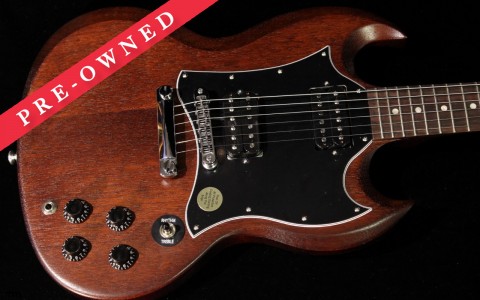
The new Epiphone SG Tribute Plus in Vintage Sunburst captures plenty of that appeal, with a few interesting touches of its own.
A Proper SG Feel, With a Rather Handsome Makeover
At €369, the SG Tribute Plus is an extremely appealing route into this classic double-cutaway design.
Its mahogany body features the familiar bevelled contours that help an SG sit comfortably against the player. The slim profile makes it particularly enjoyable for guitarists who find some single-cutaway instruments a little substantial. But there's a significant construction detail worth noting.
Unlike the traditional Gibson SG's glued-in neck, this Tribute Plus uses a bolt-on mahogany neck with a tapered heel. That doesn't make it a lesser guitar by definition. It makes it a different construction approach, one that helps Epiphone deliver the SG experience at a very accessible price. The tapered heel is a thoughtful touch, providing a smoother transition into the upper register. And the 1960s SlimTaper Rounded C neck profile should appeal to players who prefer a relatively slim, comfortable grip rather than a large vintage-style handful.
The laurel fingerboard is bound and decorated with pearloid trapezoid inlays, giving the guitar a more dressed-up appearance than some entry-level SG designs. There's also a flame maple veneer across the top.
Now, let's indulge in a little guitar-nerd precision.
A decorative flame maple veneer is not the same thing as the thick carved maple cap found on a traditional Les Paul. Its primary contribution here is visual. It gives the SG Tribute Plus a beautifully figured appearance beneath those burst finishes, without fundamentally changing the slim, bevelled SG design.
And those finishes are absolutely delicious.
Vintage Sunburst, Cherry Burst or Ebony Burst?
We have three versions of the SG Tribute Plus in stock, each priced at €369.
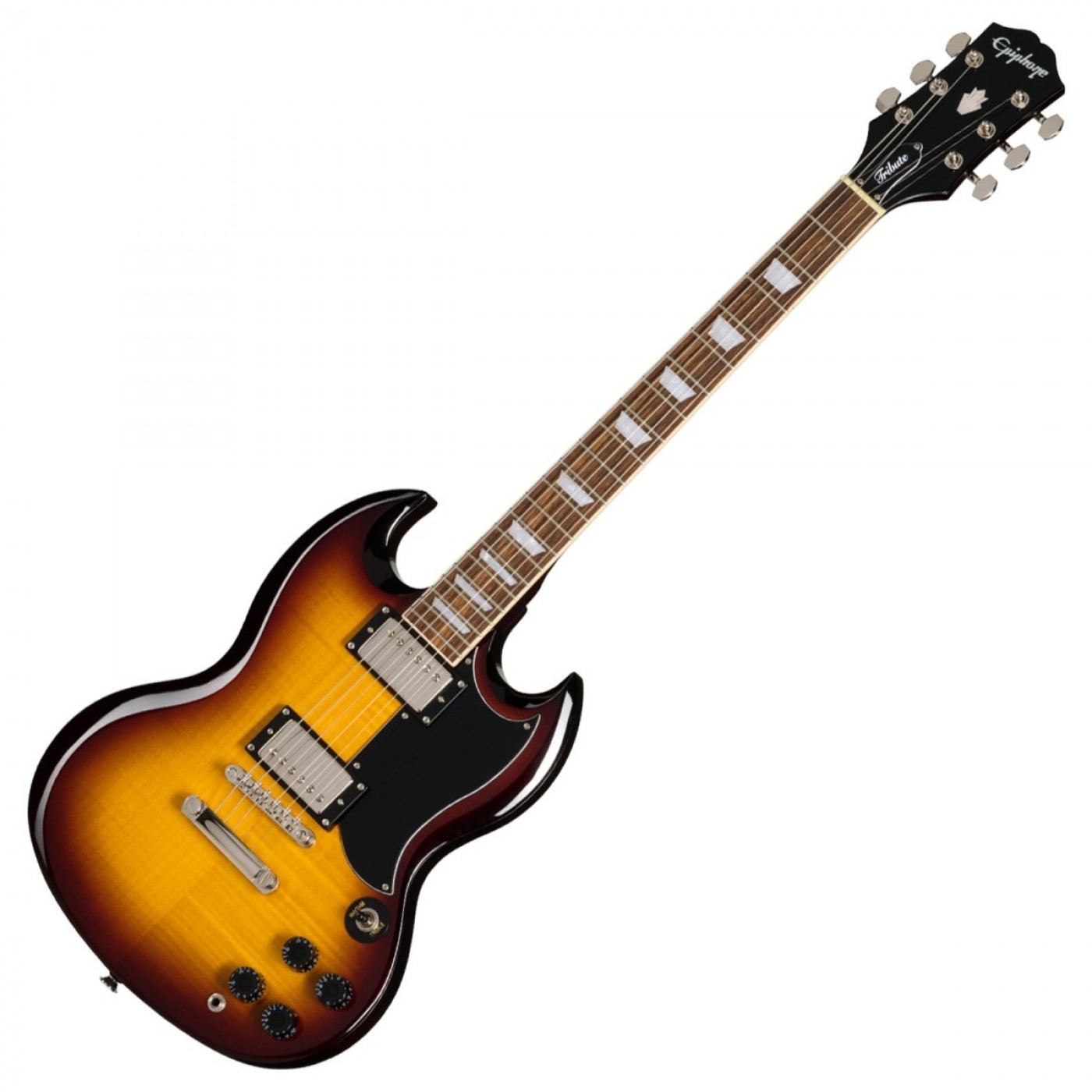
Epiphone SG Tribute Plus — Vintage Sunburst is the traditionalist's choice. Golden amber shades move towards darker edges, giving the guitar an almost unexpected elegance. It's an SG that looks ready for a blues-rock session in a small club, followed by a very loud encore.
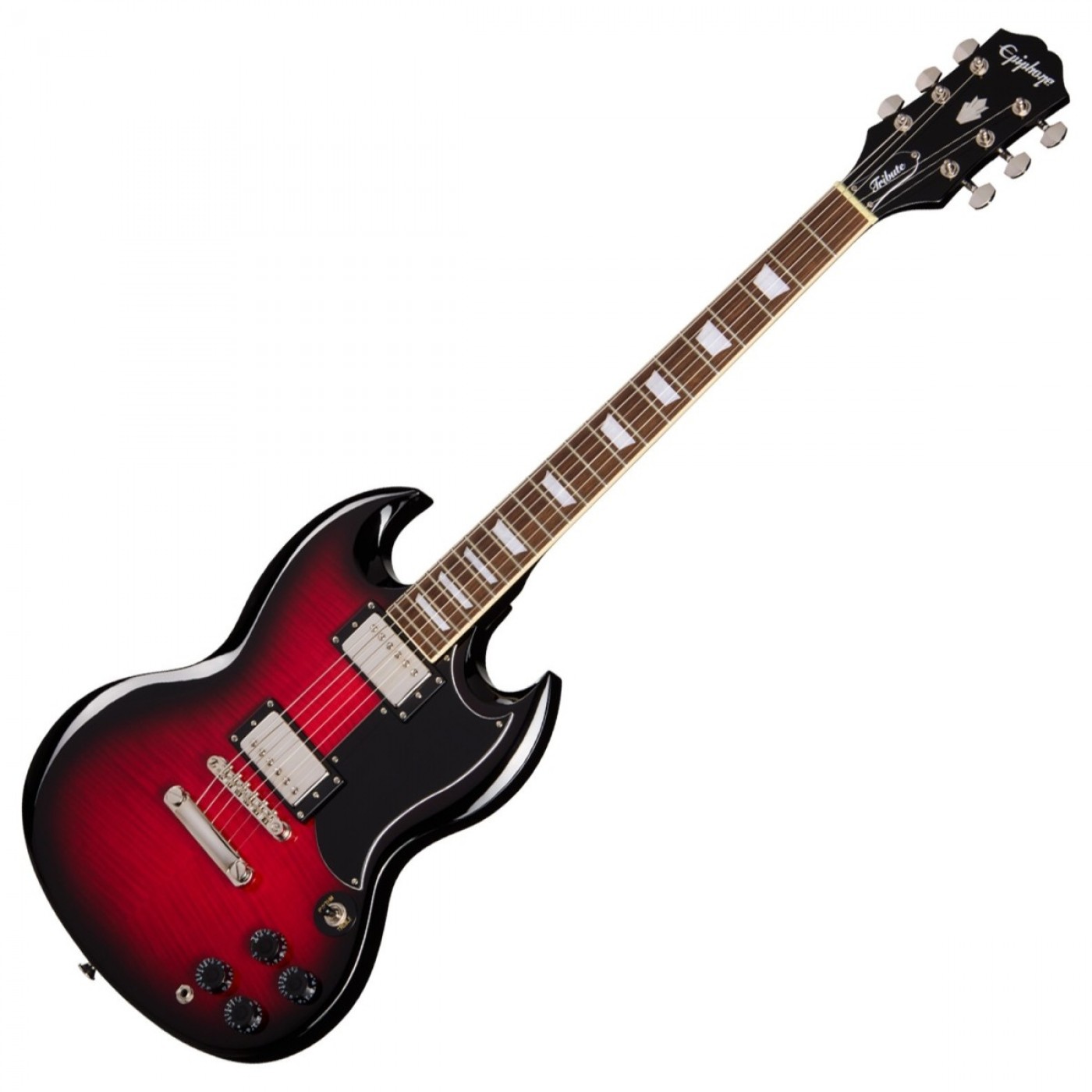
Epiphone SG Tribute Plus — Cherry Burst is a little more flamboyant. Rich red tones bring a sense of energy to the familiar double-cutaway silhouette. It's particularly attractive against the nickel hardware and dark fingerboard.
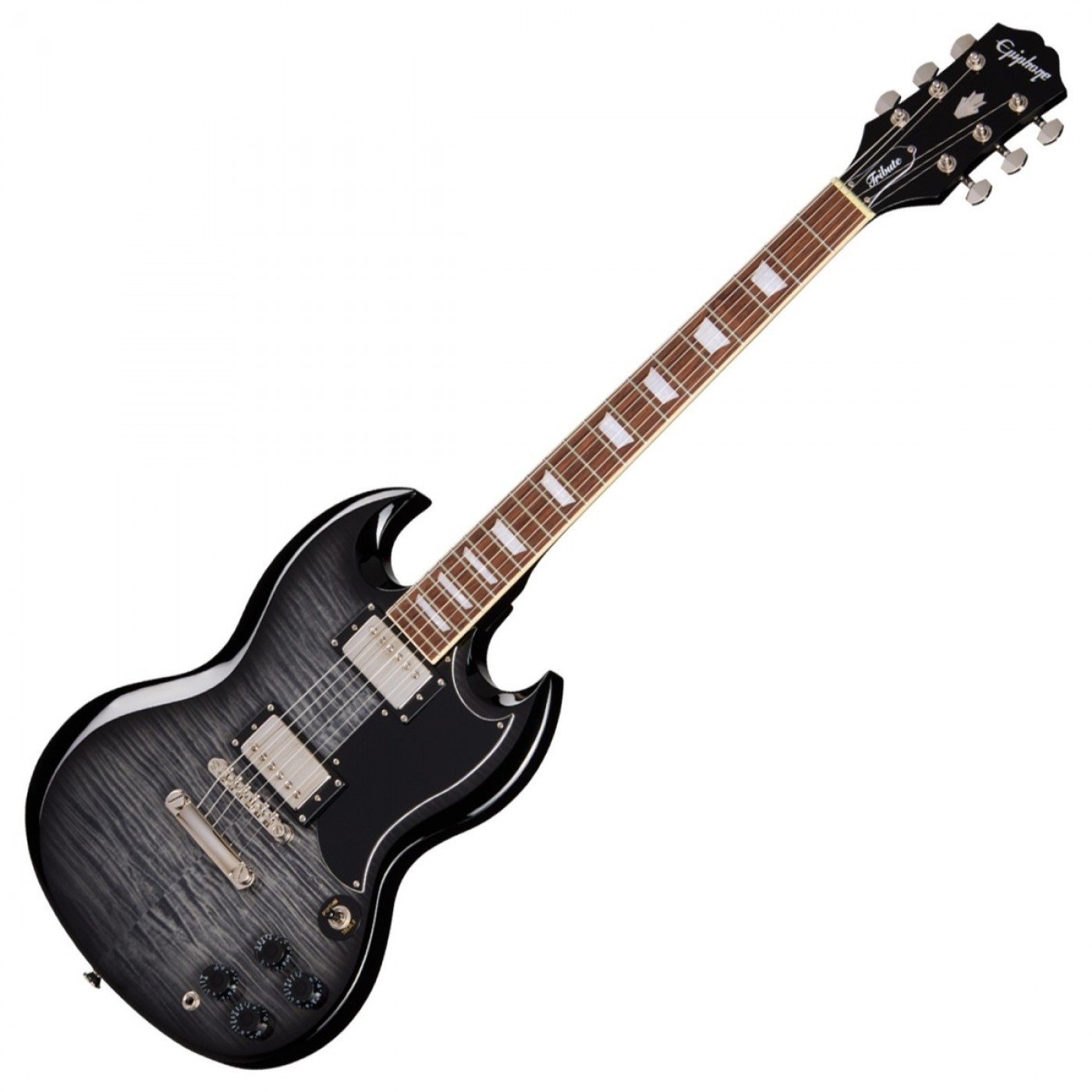
Epiphone SG Tribute Plus — Ebony Burst takes the darker route. Moody, dramatic and rather sophisticated, it looks like the sort of guitar that might have a secret collection of Black Sabbath records hidden somewhere in its case.
Three colours. The same basic instrument. Three opportunities to spend far too long deciding which one looks best.
We're not judging.
We've been doing exactly the same thing.
Louder: Epiphone 650R and 700T Humbuckers
The SG Tribute Plus is equipped with an Epiphone 650R humbucker in the neck position and a 700T humbucker at the bridge. This is an interesting pairing because the pickups are intended to offer contrasting voices.
The neck pickup is positioned where the strings move through a relatively wide arc, giving it a naturally fuller and rounder response. That makes it a useful starting point for blues leads, warmer clean sounds and sustained melodic playing. The bridge pickup hears the string closer to its anchored end, where the vibration has a different harmonic balance. It typically produces a tighter, more cutting sound, particularly useful when you want a riff to remain intelligible through distortion. The 700T's ceramic-magnet design is associated with a more assertive, higher-output approach to rock guitar tone.
And that's always fun.
Through a crunchy amplifier, the bridge position should provide the sort of immediate attack that suits classic hard-rock rhythm playing. Switch to the neck and back off the gain for something smoother and more rounded. The familiar two-volume, two-tone control layout gives you further room to experiment.
One particularly enjoyable trick is to use the middle pickup-selector position and adjust the two pickup volumes independently. It's a simple way to explore different balances between the bridge's attack and the neck's warmth without changing amplifier settings. That's the beauty of traditional electric guitar electronics.
They reward curiosity.
And at €369, the SG Tribute Plus is a particularly tempting way to investigate that relationship.
Epiphone Les Paul Tribute Plus: Vintage Sunburst for €399
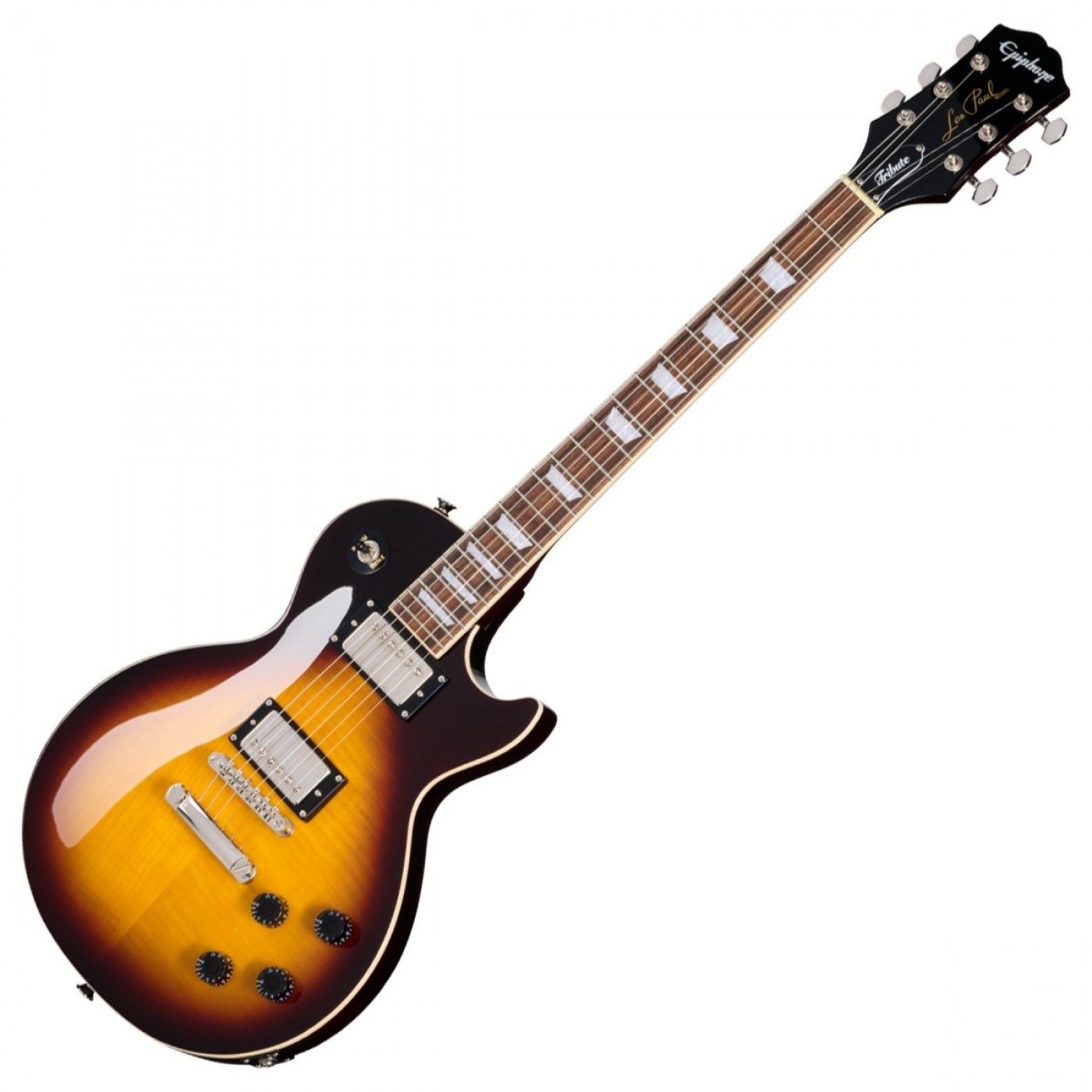
Now we move from the pointed horns of the SG to the unmistakable silhouette of the Les Paul. And here things become rather interesting. The Epiphone Les Paul Tribute Plus in Vintage Sunburst is currently priced at €399.
That's just €30 more than the SG Tribute Plus.
For players drawn to the classic single-cutaway look, that difference is unlikely to cause too many sleepless nights. But the two guitars have distinct personalities. The SG feels lean, direct and particularly accommodating when you're playing high on the neck. A Les Paul places more visual and physical emphasis on its carved top, substantial body and traditional single-cutaway design.
The Les Paul has also accumulated a rather impressive musical CV.
Peter Green. Gary Moore. Jimmy Page. Paul Kossoff. Billy Gibbons. Slash. The list is enormous, and the range of sounds these musicians produced is even more impressive.
What unites many of those recordings isn't simply distortion. It's the way a Les Paul responds to the player's hands and the amplifier. A good rock guitar doesn't need to be permanently saturated with gain. Some of the most compelling sounds happen at the point where clean tone begins to break up. Play gently and the notes remain open and articulate. Dig in and the amplifier starts to compress and growl.
That's where the fun lives.
A Classic Single-Cut Design With Modern Appeal
The Les Paul Tribute Plus has the familiar Vintage Sunburst appearance, complete with a carved top, decorative AAA flame maple veneer, cream appointments and traditional trapezoid fingerboard inlays. It's the sort of guitar that makes you start imagining an old Marshall combo before you've even picked it up.
Its bolt-on mahogany neck has a 60s SlimTaper Rounded C profile, making it attractive to players who enjoy the Les Paul design but prefer something less substantial in the fretting hand than a full 1950s-style neck.
Which is important. Guitar necks can be intensely personal.
Some players love a deep, rounded profile because it gives the hand something substantial to grip. Others prefer a slimmer carve that allows the thumb and fingers to move more freely around the neck. Neither is objectively better. The correct choice is the one that feels natural when you're playing.
For guitarists moving from modern instruments towards a more traditional single-cutaway design, the Tribute Plus is a particularly interesting candidate.
The Guitar Nerd Bit: Why Les Pauls Love a Good Amplifier
A traditional Les Paul uses a 24.75-inch scale length, shorter than the 25.5-inch scale found on many Fender-style guitars. That measurement is the vibrating length of the string between the nut and bridge. With the same string gauge and tuning, the shorter scale requires less string tension. This can make bends feel a little easier and give the strings a subtly different response beneath the fingers. It's one reason so many blues and rock players enjoy the expressive quality of a Les Paul.
The guitar's humbuckers are another important part of the equation.
A humbucker uses two coils arranged to reduce the electrical interference that can affect a conventional single-coil pickup. The design also offers a different tonal response, often with a stronger midrange character and a smooth, substantial sound. Combine that with a responsive amplifier and the possibilities become wonderfully broad. A neck humbucker through a lightly driven amp can produce a rounded, vocal quality for blues phrases. A bridge humbucker through a British-style overdrive can deliver the tight, aggressive attack needed for classic rock riffs.
And when you use the guitar's volume controls rather than simply stomping on another pedal, you begin to discover how much variation is available from a relatively simple instrument.
The Tribute Plus is a lovely invitation to explore all of that.
Especially at €399.
Epiphone Les Paul Standard 50s Goldtop: The Main Event
Right.
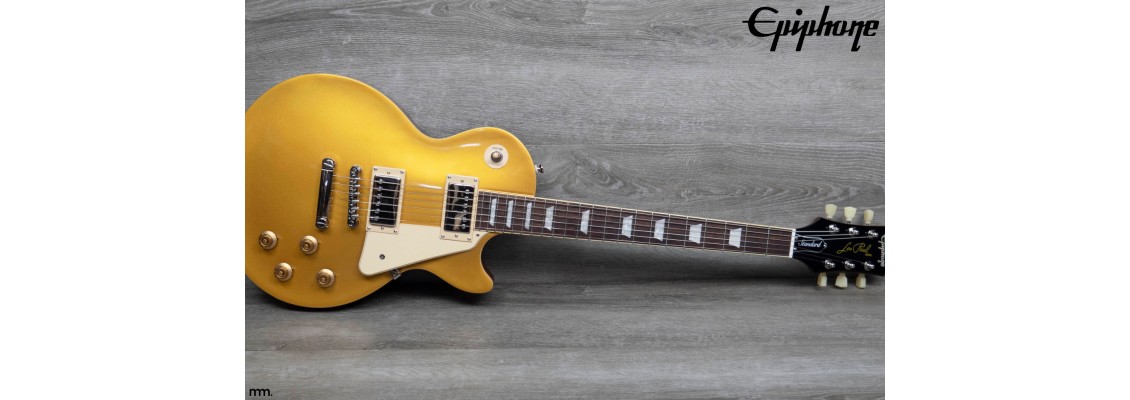
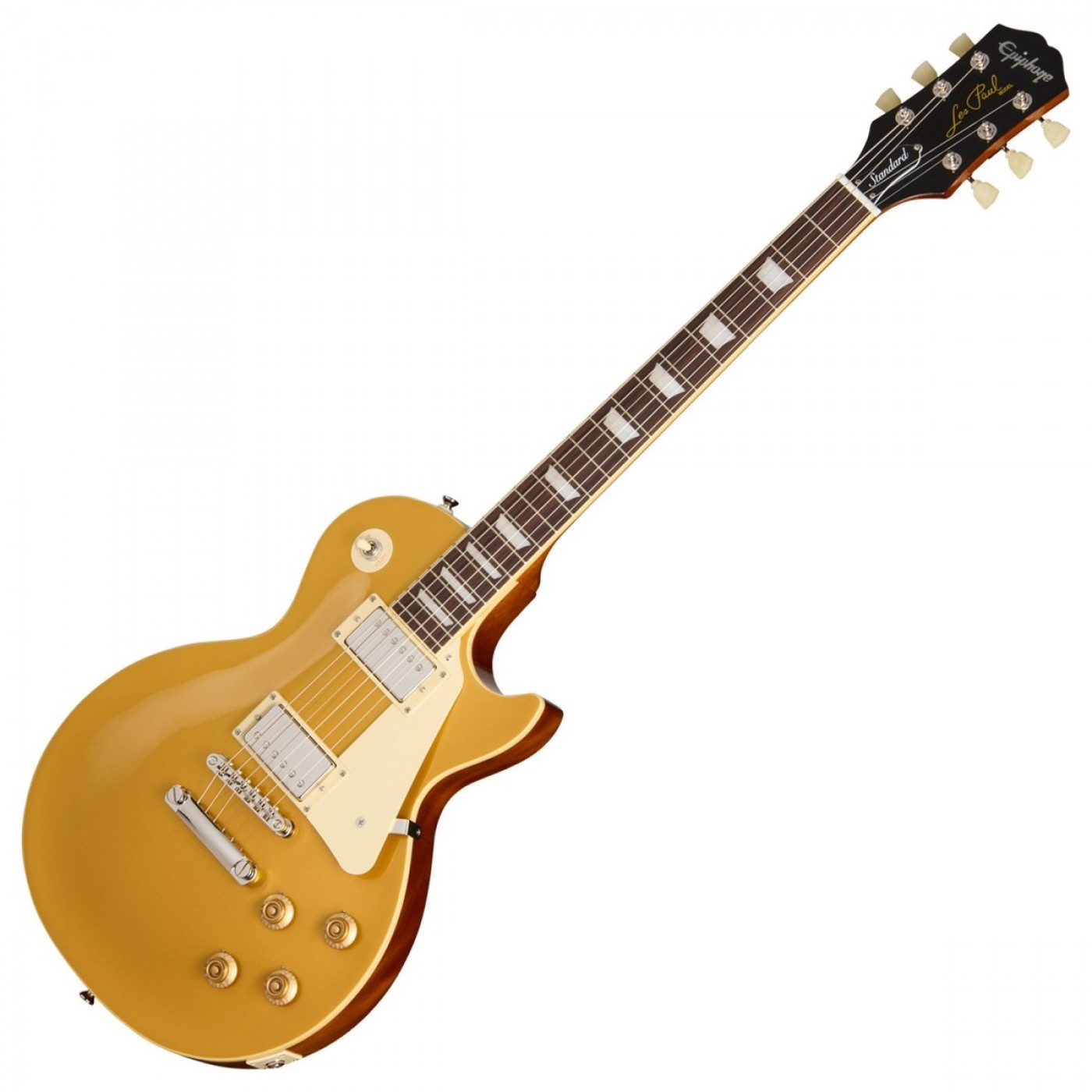
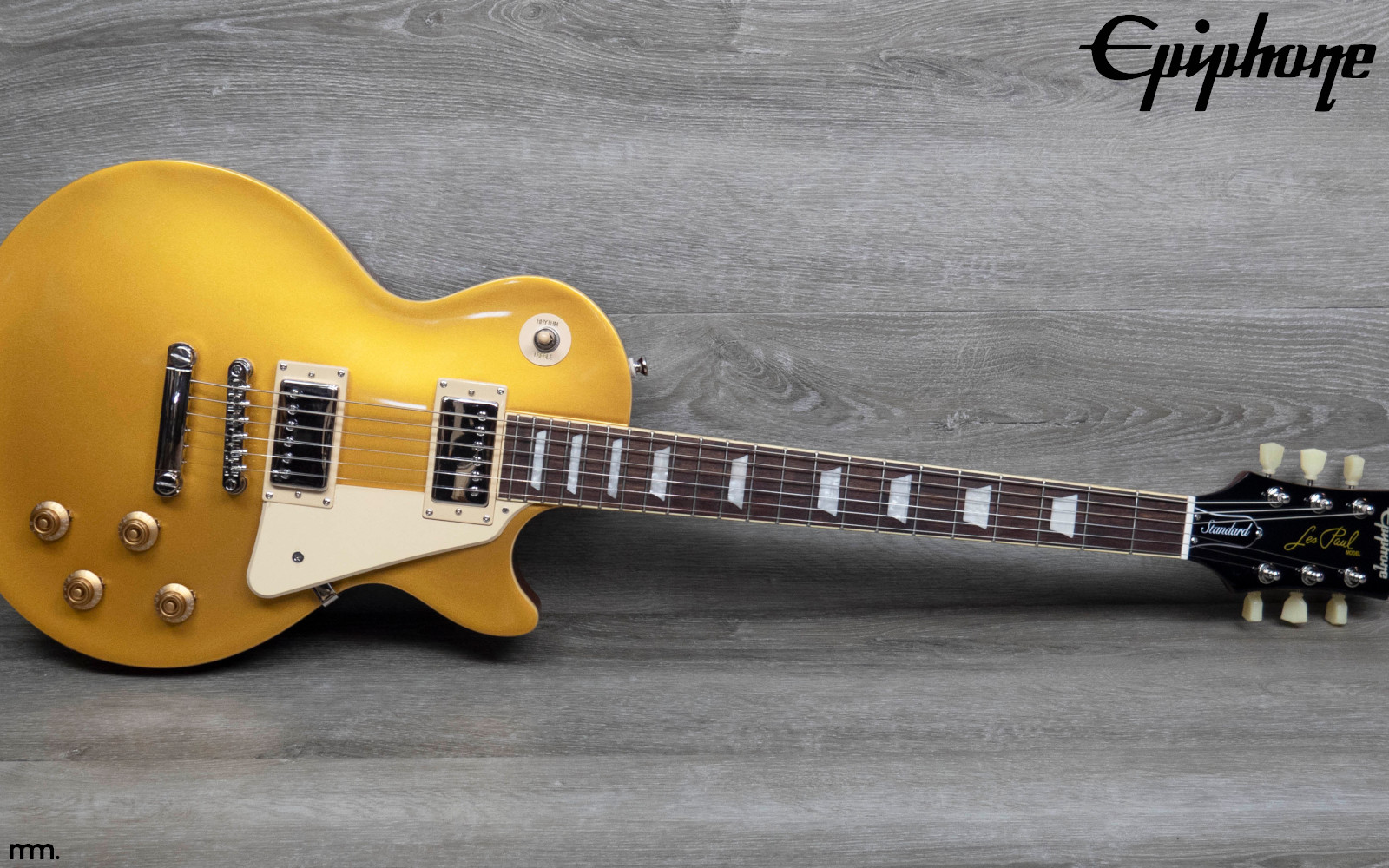
Now we need to talk about the Goldtop. Because there's something about a gold-finished Les Paul that continues to make guitarists behave in a deeply unreasonable manner. The Epiphone Les Paul Standard 50s Goldtop has just arrived at Musicmaker, priced at €749. And it's a particularly beautiful interpretation of one of the most important designs in electric guitar history.
The original Gibson Les Paul appeared in 1952 wearing a gold finish.
That colour was central to the instrument's early identity. Gibson wanted its new solid-body guitar to look prestigious, sophisticated and unmistakably different from the competition. The result was extraordinary. Even today, a Goldtop has an elegance that feels entirely its own.
And although the original 1952 guitars used P-90 pickups, the design evolved rapidly throughout the decade. By 1957, Gibson had introduced humbuckers to the Les Paul, creating the foundation for some of the most celebrated electric guitar sounds ever recorded.
The Epiphone Standard 50s Goldtop draws on that later, humbucker-equipped tradition.
The 50s Neck: A Proper Handful of Rock 'n' Roll
One of the defining features of this guitar is its 1959 Rounded Medium C neck profile. This is where the Goldtop begins to distinguish itself from the slimmer-feeling Tribute Plus. The Standard 50s offers a more substantial mahogany neck, designed to evoke the playing feel of vintage instruments.
For some guitarists, that extra depth is exactly what makes a Les Paul feel right. A fuller neck can encourage a relaxed grip and provide a reassuring physical connection to the instrument. It can feel especially satisfying when playing open chords, slow blues phrases and expressive bends.
Of course, hand size and technique matter. A larger neck isn't automatically more comfortable, and a slim neck isn't necessarily faster. The relationship between neck depth, shoulder shape, fingerboard radius and the player's hand is more complicated than a simple thick-versus-thin argument. But that's part of the pleasure of trying guitars in person. You can read specifications all day.
Then you pick up a Goldtop and discover that your hand has already made the decision.
Mahogany, Maple and the Traditional Les Paul Recipe
The Standard 50s uses a mahogany body with a maple cap and a glued-in mahogany neck. It's a familiar construction, but one that deserves a little closer examination. The maple cap provides a rigid, carved top surface, while the mahogany body forms the main structure of the instrument. The set neck creates a continuous glued joint between neck and body. These choices influence the guitar's physical feel, mass, balance and mechanical behaviour.
It's tempting to assign very specific sounds to individual timbers, but electric guitar tone is the result of several interacting factors. Pickups, strings, setup, hardware, amplifier and playing technique all contribute significantly. What we can say is that this construction has become inseparable from the traditional Les Paul playing experience.
And the Goldtop embraces it wholeheartedly.
The familiar Tune-O-Matic bridge and stopbar tailpiece provide individual saddle adjustment for intonation and a straightforward fixed-bridge arrangement. The rosewood fingerboard carries traditional trapezoid inlays, while cream binding and vintage-inspired hardware complete the aesthetic.
There's nothing here that feels like an attempt to reinvent the Les Paul.
That's rather the point.
ProBucker Pickups: The PAF-Inspired Approach
The Epiphone Les Paul Standard 50s Goldtop is fitted with a ProBucker-1 in the neck position and a ProBucker-2 at the bridge. These are vintage-inspired Alnico II humbuckers, designed to evoke the general character associated with classic late-1950s pickup designs. The ProBucker-1 offers the warmer, rounded response you'd expect from the neck position, while the ProBucker-2 provides a little more bite and authority at the bridge.
And the combination is extremely appealing for classic rock.
Imagine a medium-gain amplifier, perhaps with a little natural compression as the power section begins working harder. Select the bridge pickup, roll the guitar's tone control back slightly and play a big open chord. You want the individual notes to retain enough definition that the harmony remains clear, even as the amplifier begins adding saturation.
Now switch to the neck pickup. The sound becomes smoother and fuller, making it an attractive choice for sustained melodic lines and expressive blues phrasing.
Then there's the middle position, where both pickups contribute.
With independent volume controls, you can fine-tune their balance and find sounds that sit somewhere between the warmth of the neck and the sharper attack of the bridge. It's a wonderfully musical arrangement. No elaborate switching system required.
Just a pair of humbuckers, a responsive amplifier and a player who understands the value of turning a knob.
Why the Goldtop Still Matters
There's an obvious historical attraction to the Goldtop.
It connects the modern player to the earliest years of the Les Paul, when Gibson was still refining the instrument that would eventually become a rock music institution.
But nostalgia alone doesn't explain its enduring popularity.
A Goldtop is a beautiful, practical electric guitar.
Its familiar controls are intuitive. Its humbuckers cover an enormous amount of musical ground. Its shorter scale makes expressive bending particularly enjoyable. And its substantial neck can provide exactly the playing feel some guitarists have been searching for.
At €749, the Epiphone Standard 50s Goldtop offers an appealing combination of traditional design, vintage-inspired electronics and serious stage-ready character.
And yes, it looks absolutely sensational.
We've been staring at it.
Quite a lot, actually.
SG or Les Paul? Which One Should You Choose?
This is the question that has probably occupied more rehearsal-room conversations than any sensible person would care to count.
And the answer is delightfully personal.
The SG Tribute Plus is the natural starting point for somebody who values a slim body, easy access to the upper frets and an energetic, direct playing feel. It's particularly attractive for players who spend a lot of time standing up, enjoy lead guitar work high on the neck or simply love the unmistakable SG silhouette.
The Les Paul Tribute Plus offers a different proposition. Its single-cutaway design and slimmer 1960s-style neck will appeal to players who want classic Les Paul looks without necessarily committing to a chunkier vintage profile.
At €399, it's a particularly tempting choice.
The Standard 50s Goldtop is the traditionalist of the group. Its fuller neck, maple-capped mahogany construction and vintage-inspired ProBucker pickups make it the obvious candidate for somebody who wants to explore the feel and character of a late-1950s-style Les Paul.
But there is no universal winner.
A guitarist who adores the Goldtop's substantial neck might find the SG too slim. Another player may fall in love with the SG's upper-fret access and never look back. And plenty of musicians eventually discover that they need both.
We understand.
We really do.
A Little Les Paul History for the Guitar Nerds
If these new arrivals have awakened your appetite for Gibson and Epiphone history, we've got a rather tasty companion piece waiting in the Musicmaker Journal.
Our feature, The History of the Gibson Les Paul, follows the instrument from Les Paul's early experiments and the original 1952 Goldtop through the arrival of humbuckers, the legendary late-1950s Bursts and the extraordinary British blues revival.
It's a fascinating story.
The original single-cutaway Les Paul was effectively discontinued in 1961, only to return in 1968 after guitarists began rediscovering its enormous musical potential.
The SG, meanwhile, developed an identity of its own and became one of the most recognisable electric guitars ever made.
Two designs with a shared history.
Two very different playing experiences.
And both still inspiring musicians more than six decades later.
You can also browse our wider Epiphone guitar collection and explore the electric guitars available at Musicmaker.
There's plenty more trouble to be found.
Finding Your Classic Rock Sound
One final thought before you come down to the shop and start playing everything in sight.
The guitar is only part of the sound. Those classic rock recordings we love were created through combinations of instruments, amplifiers, speakers, recording techniques and extraordinarily expressive musicians.
The amp matters enormously.
A clean amplifier with plenty of headroom will reveal the character of each pickup differently from an amp that's already beginning to distort. A British-voiced overdrive can emphasise midrange bite and produce the familiar crunch associated with countless rock recordings. A warmer, more rounded amplifier can flatter the neck pickup and encourage those long, singing blues phrases.
And pedals can take things further still.
A simple overdrive pedal placed in front of a clean or slightly breaking-up amplifier can add sustain, compression and harmonic colour without necessarily drowning out the guitar's natural dynamics. For a new Epiphone, that's a lovely place to start.
Explore our guitar amplifiers and effects pedals if you're putting together a classic rock setup.
But don't feel obliged to build an enormous pedalboard immediately.
Start with the guitar. Learn how the pickups interact. Experiment with the volume and tone controls. Find the point where the amplifier responds to your picking dynamics. And give yourself permission to spend an entire evening playing the same riff.
We've all been there.
Five Fresh Epiphone Finishes, Ready at Musicmaker Dublin
So there we have it.
Three guitar models. Five finishes. A very healthy amount of rock 'n' roll heritage.
The SG Tribute Plus brings its unmistakable double-cutaway design, comfortable neck and punchy humbuckers to the party in Vintage Sunburst, Cherry Burst and Ebony Burst, all at €369.
The Les Paul Tribute Plus in Vintage Sunburst offers classic single-cutaway appeal for €399.
And the Les Paul Standard 50s Goldtop delivers that wonderful vintage-inspired playing experience, complete with a substantial neck and ProBucker humbuckers, for €749.
They're all in stock at Musicmaker as we write this.
And they're all begging to be played.
If you're in Dublin, come and visit us at 29 Exchequer Street. Bring your favourite riffs, tell us what sort of music you love and we'll help you find the guitar that feels right.
We've been helping musicians make glorious noise since 1981, and there's still something particularly satisfying about plugging a beautiful electric guitar into an amplifier and hearing that first chord.
Free shipping around Ireland on orders over €15.
Explore the new arrivals:
Epiphone SG Tribute Plus — Vintage Sunburst, €369
Epiphone SG Tribute Plus — Cherry Burst, €369
Epiphone SG Tribute Plus — Ebony Burst, €369
Epiphone Les Paul Tribute Plus — Vintage Sunburst, €399
Epiphone Les Paul Standard 50s — Goldtop, €749
Go on.
Play that riff again.
This time, turn it up a little.
Independent minds. Serious gear. Glorious noise.