Stringjoy Strings Have Landed at Musicmaker Dublin
Fresh from Nashville, Tennessee. Precision-wound, obsessively engineered and ready to give the guitars of Ireland a serious wake-up call.
Sometimes you just pick up your guitar (or bass, maybe mandolin...) and realise the strings are absolutely knackered.
The high E loses its sparkle. The wound strings develop a slightly unpleasant texture. Chords begin sounding tired, tuning becomes a chore, and you find yourself staring suspiciously at an amplifier that was working perfectly well last month. Naturally, the next logical step is to buy another overdrive pedal. But before you spend a small fortune investigating the emotional wellbeing of your signal chain, we've got a considerably simpler suggestion.
Change your strings buddy.
And if you're going to do that, you might as well put something rather special on your guitar. Because a massive shipment of Stringjoy strings has just landed at Musicmaker Dublin, and we are extraordinarily pleased about it. These aren't strings from some anonymous production line with a fancy packet and a marketing department working overtime. Stringjoy is a fascinating independent American company based in Nashville, Tennessee, with an obsessive approach to string design, manufacturing consistency and the relationship between string tension and musical feel.
Electric guitars. Acoustic guitars. Bass guitars. Mandolins. Pure nickel, nickel-plated steel, phosphor bronze, coated strings, flatwounds and some gloriously unusual gauges. And yes, they've brought picks and capos to the party.
This could get nerdy.
Excellent.
Who Are Stringjoy? Meet Nashville's String Obsessives
Stringjoy began in 2014 with a wonderfully straightforward idea: guitarists should have more control over the strings they play.
Founded by Scott Marquart, the company initially made its name as a custom guitar-string specialist, allowing players to choose individual gauges rather than simply accepting the combinations traditionally supplied in a packet. It sounds like a small distinction.
It really isn't.
Consider two guitarists playing the same instrument. One spends the evening bending notes and playing delicate melodic phrases. The other attacks the low strings with a pick as though they've personally offended him. Those players may benefit from very different string tensions, even if both prefer the same overall tuning. Stringjoy recognised that the usual light, regular and heavy categories didn't tell the whole story.
The company developed its own manufacturing operation in Nashville, building a reputation around carefully selected materials, precision winding and unusually thoughtful gauge combinations. And here's the bit we particularly love.
Stringjoy makes its own strings.
Not simply designing a packet and commissioning somebody else to fill it, but operating its own winding equipment and controlling the manufacturing process. There's an independent spirit to the whole operation that feels wonderfully familiar to us here at Musicmaker.
People who love guitars, making better things for people who love guitars.
Now you're talking.
The Secret Sauce: Tension, Balance and Tiny Measurements
Right, let's get the guitar nerdery out of the way.
Actually, let's not. This is the good stuff. A guitar string's feel is influenced by its scale length, pitch, mass per unit length and construction. Gauge is important, but it isn't the entire equation. For a given string construction and tuning, increasing the gauge generally increases tension. Changing the instrument's scale length also affects the tension required to reach a particular note.
That's why a set of 10s can feel different on a Fender-scale guitar compared with a shorter-scale Gibson. And it's why two sets with the same thinnest and thickest strings can behave quite differently if the four gauges in between have been chosen differently.
Stringjoy pays particular attention to this relationship.
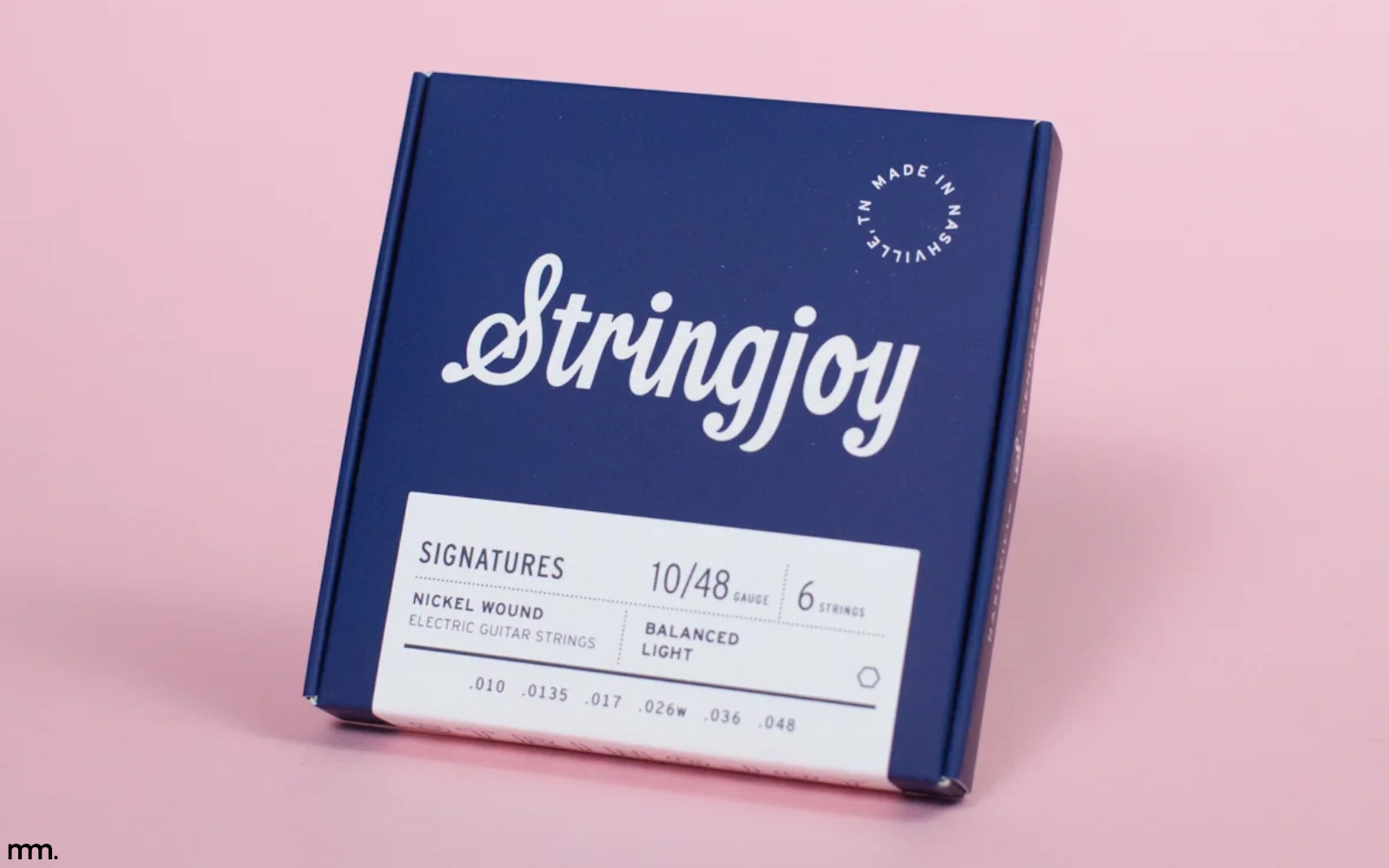
Many of its electric sets use balanced-tension-inspired gauge combinations, aiming for a more consistent playing response across the strings. Take a conventional 10–46 set and compare it with Stringjoy's 10–48 Balanced Light. That slightly heavier low end can provide a firmer feel beneath the picking hand while keeping the upper strings comfortable for bends.
It's a subtle change on paper. Under your fingers, it can be surprisingly noticeable.
There's also the matter of winding quality. A wound string consists of a central core and an outer wrap wire. The precision of that winding, the materials used and the consistency of the finished string all influence its vibration and mechanical behaviour.
No mystical fairy dust.
Just excellent engineering.
Stringjoy Signatures: Electric Guitar Strings Done Properly
Let's begin with the workhorses.
Stringjoy Signatures are nickel-plated steel wound electric guitar strings, designed to deliver the familiar balance of brightness, warmth and versatility that has made this construction a favourite for generations.
The real attraction is the range of gauges.
There's the classic 10–46 set for players who like a familiar feel, alongside the 9–42 Balanced Super Lights for easy bending and fast lead playing. The 9.5–46 Balanced Super Light Plus sits in that lovely middle ground between traditional 9s and 10s.
Then things get interesting.
The 10–48 Balanced Lights offer a little more authority on the lower strings, while 11–50 Balanced Mediums provide a firmer, more substantial response for players who dig in.
Stringjoy also offers 10–52 Heavy Bottom Lights, ideal for guitarists who want comfortable lead playing without sacrificing the weight of palm-muted riffs.
The 9.5–44 Soft Touch set is aimed at players looking for a lighter, more forgiving feel, while the 11.5–54 Husky Medium Plus caters to those who prefer a properly substantial string beneath their fingers.
There's even a Nashville Tuning 10–24 set for creating those beautiful, chiming high-strung guitar textures that can transform a recorded arrangement.
That's what makes this range so appealing.
Stringjoy isn't asking you to change the way you play to suit a packet of strings.
It's giving you more ways to find the set that suits your hands.
Explore Stringjoy Signatures at Musicmaker.
Stringjoy Broadways: Pure Nickel, Vintage Attitude
Now we're heading into classic territory.
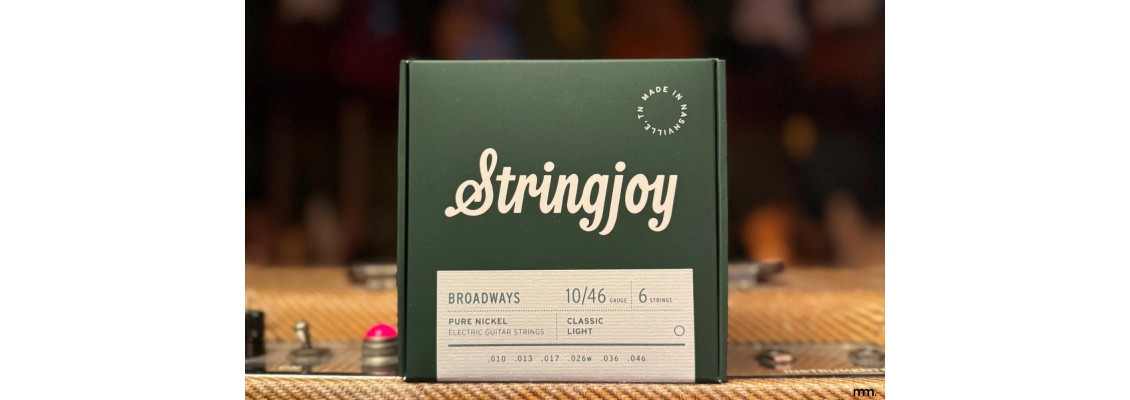
The Stringjoy Broadways Classic Light 10–46 use pure nickel wrap wire, a material associated with the warmer, rounder electric guitar tones of the 1950s and early 1960s. There's an important distinction here.
Most modern nickel-wound electric guitar strings use nickel-plated steel wrap wire. Broadways use pure nickel for the wound strings, giving them a different magnetic and mechanical character. In practical terms, pure nickel sets are often favoured for a smoother top end, rich midrange and slightly softer attack. On a bright Stratocaster, that can be a beautiful combination. On a Telecaster, it can tame a little of the sharpness without sacrificing the instrument's personality. Through a vintage-voiced valve amplifier, there's something particularly satisfying about the way pure nickel strings respond to a touch of overdrive.
If your ideal guitar tone involves old records, a good valve amp and the occasional deeply irresponsible blues bend, you should investigate these immediately.
Stringjoy Orbiters: Coated Strings Without the Compromise
Coated guitar strings have always presented an interesting engineering challenge.
The idea is simple enough: protect the string from sweat, dirt and corrosion so it retains its sound and feel for longer.
The difficult part is doing that without interfering too much with the way the string vibrates.
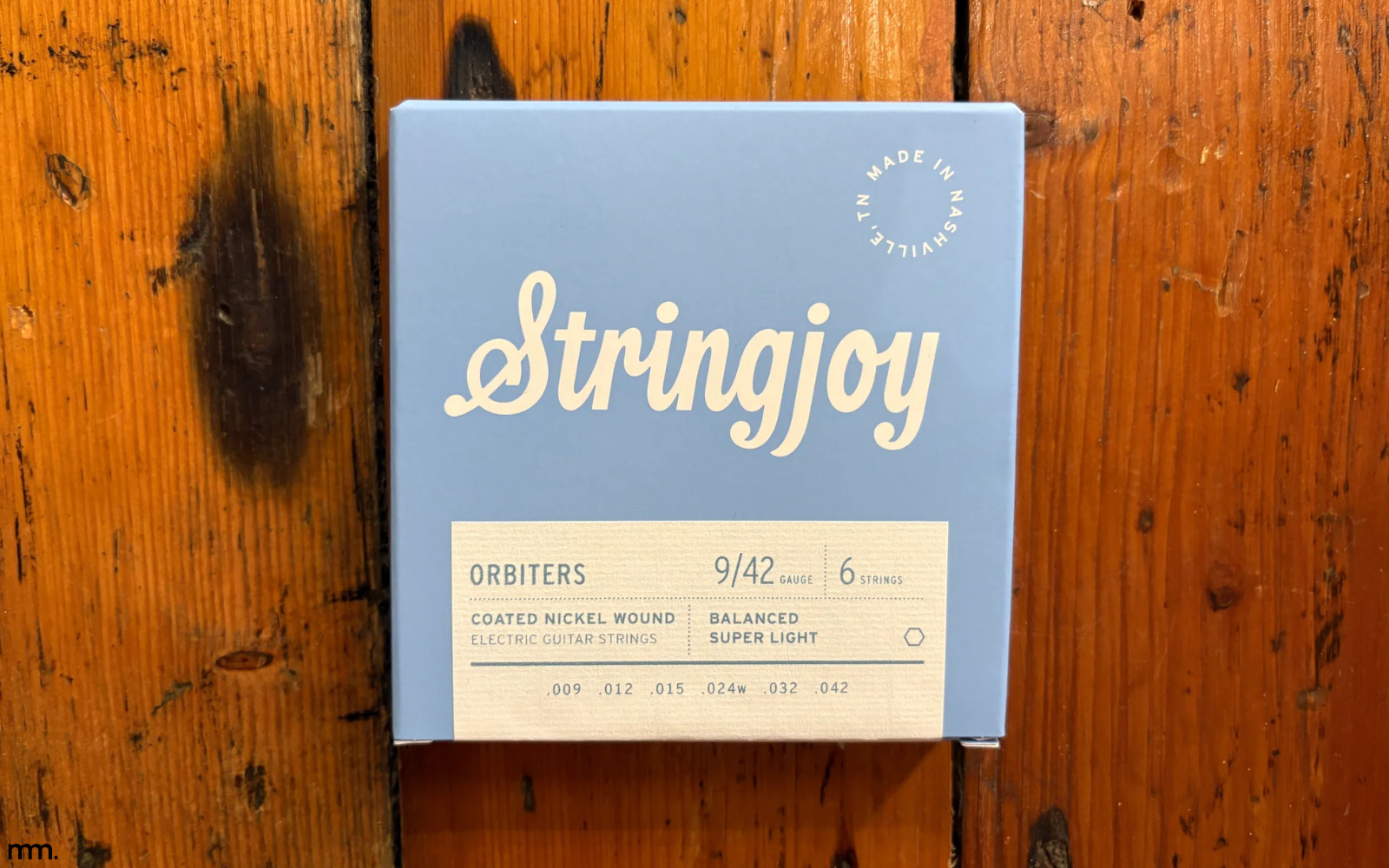
These are coated nickel-wound electric guitar strings designed to provide extended life while retaining the responsive feel and lively tone players expect from a premium uncoated set.
They're particularly appealing for guitarists who play regularly, have naturally corrosive perspiration or simply don't enjoy restringing every five minutes.
The new Musicmaker selection includes 9–42 Balanced Super Lights, 10–48 Balanced Lights and 11–50 Balanced Mediums.
That means you've got the same thoughtful gauge choices found elsewhere in the Stringjoy range, with the additional protection of a coating.
And if you've ever opened a guitar case after a week away and discovered that your once-beautiful strings have developed the texture of an old garden gate, you'll understand the appeal.
Stringjoy Flyers: Flatwounds for the Smooth Operators
Oh, these are lovely.
Stringjoy Flyers are stainless-steel flatwound electric guitar strings, and they're a very different animal from conventional roundwounds.
A typical roundwound string uses circular wrap wire, leaving small ridges along the surface. Flatwounds use a flattened outer winding, producing a smoother feel beneath the fingers. That construction changes the playing experience dramatically. There's less finger noise as you move around the neck, a more rounded attack and a controlled high-frequency response that can be absolutely beautiful for jazz, soul, vintage pop and atmospheric guitar work.
Flatwounds also tend to feel stiffer than comparable roundwound sets, so gauge choice deserves a little extra thought.
Musicmaker has the Flyers 10–48 Balanced Light, 11–50 Balanced Medium and 12–52 Balanced Heavy sets.
They're particularly tempting for hollow-body and semi-hollow guitar players, although there's no law preventing you from putting flatwounds on a Telecaster and discovering something wonderful. In fact, we'd actively encourage it.
Sometimes the most interesting guitar sounds come from trying something that wasn't on your original shopping list.
Stringjoy Naturals, Brights & Foxwoods: Acoustic Heaven
Acoustic guitar strings have a particularly demanding job.
On an electric guitar, pickups and amplification play a major role in shaping the sound. On an acoustic, the strings drive the bridge and soundboard directly, making their construction and tension central to the instrument's response.
That's why changing acoustic strings can be such a dramatic experience.
And Stringjoy has brought three excellent approaches to the problem.
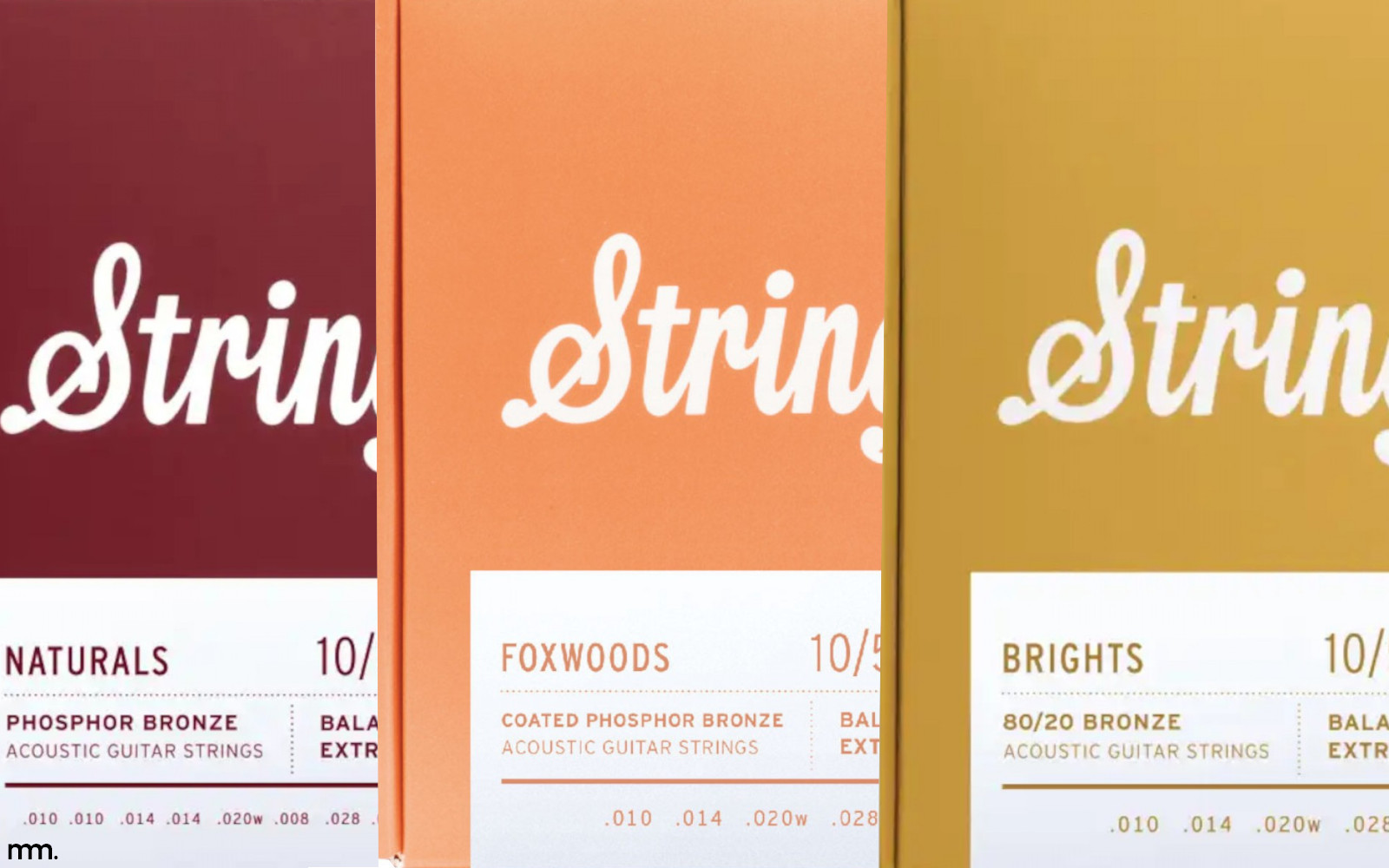
Stringjoy Naturals are phosphor bronze acoustic strings, designed for a rich, balanced response with plenty of harmonic detail.
The range at Musicmaker is gloriously comprehensive, from 10–50 Extra Lights through 11–52 Super Lights, 12–54 Lights and 13–56 Mediums, right up to the substantial 14–59 Heavy Gauge set.
There's also a 12–56 Bluegrass Gauge, with a lighter treble side and heavier bass side, plus the intriguing 10.5–47 Soft Touch set. And for players who love the shimmering textures of high-strung guitar arrangements, Stringjoy offers Nashville Tuning 12–28.
The Stringjoy Brights, meanwhile, use 80/20 bronze wrap wire. This alloy traditionally delivers a crisp, lively attack with plenty of upper-frequency sparkle, making it particularly appealing for strummers and players who want strong note definition. Musicmaker has the Brights 11–52 Super Light and 13–56 Medium gauges.
Then we have the Stringjoy Foxwoods.
These are coated phosphor bronze acoustic strings, designed to combine the warmth and complexity of phosphor bronze with additional resistance to corrosion and tonal deterioration. They're available here in 10–50 Extra Light, 11–52 Super Light, 12–54 Light and 13–56 Medium gauges.
So what's the difference in musical terms?
Naturals offer that familiar, rich phosphor bronze character. Brights bring a little more immediate sparkle and attack. Foxwoods are for players who love a phosphor bronze sound but want to keep it sounding fresh for longer.
Three approaches, one very happy acoustic guitar.
Bass Strings and Mandolin Strings: Nobody Gets Left Behind
Stringjoy hasn't forgotten the people responsible for keeping the entire band standing upright.
The new shipment includes nickel-wound bass strings, including the 45–100 Super Light four-string long-scale set and 50–105 Medium.
Bass strings are a fascinating subject because the relationship between tension, attack and note definition becomes particularly noticeable at lower frequencies.
A lighter set can offer a more flexible feel, while a heavier set may provide greater resistance beneath the fingers. Neither is automatically better; it depends on the instrument, tuning and playing technique.
What matters is consistency.
And then there's the mandolin department.
Stringjoy's Foxwoods coated phosphor bronze mandolin strings have also arrived, in 10–38 Light, 11–40 Medium and 11.5–41 Medium/Heavy gauges.
Mandolin strings work under considerable tension, and their paired courses make tuning stability and tonal consistency especially important.
For Irish traditional players, bluegrass pickers and mandolin enthusiasts who appreciate a clear, lively response, these are a very welcome addition to the Stringjoy family.
Eight strings.
Four courses.
Twice the opportunity to become obsessed with your setup.
Wonderful.
Sweetspot Capos and Acrylic Picks: The Little Things Matter
And because Stringjoy apparently can't resist improving everything a guitarist touches, they've also sent us some rather tasty accessories.
The Stringjoy Sweetspot Adjustable Tension Capo, available in silver and black, is designed to apply the pressure needed for clean fretting without unnecessarily squeezing the strings sharp. That's an important detail. A capo that applies excessive pressure can stretch strings towards the fretboard, affecting tuning and making chords sound slightly sour. An adjustable-tension design gives you more control over that pressure, allowing the capo to work with the guitar's neck profile, string gauge and action.
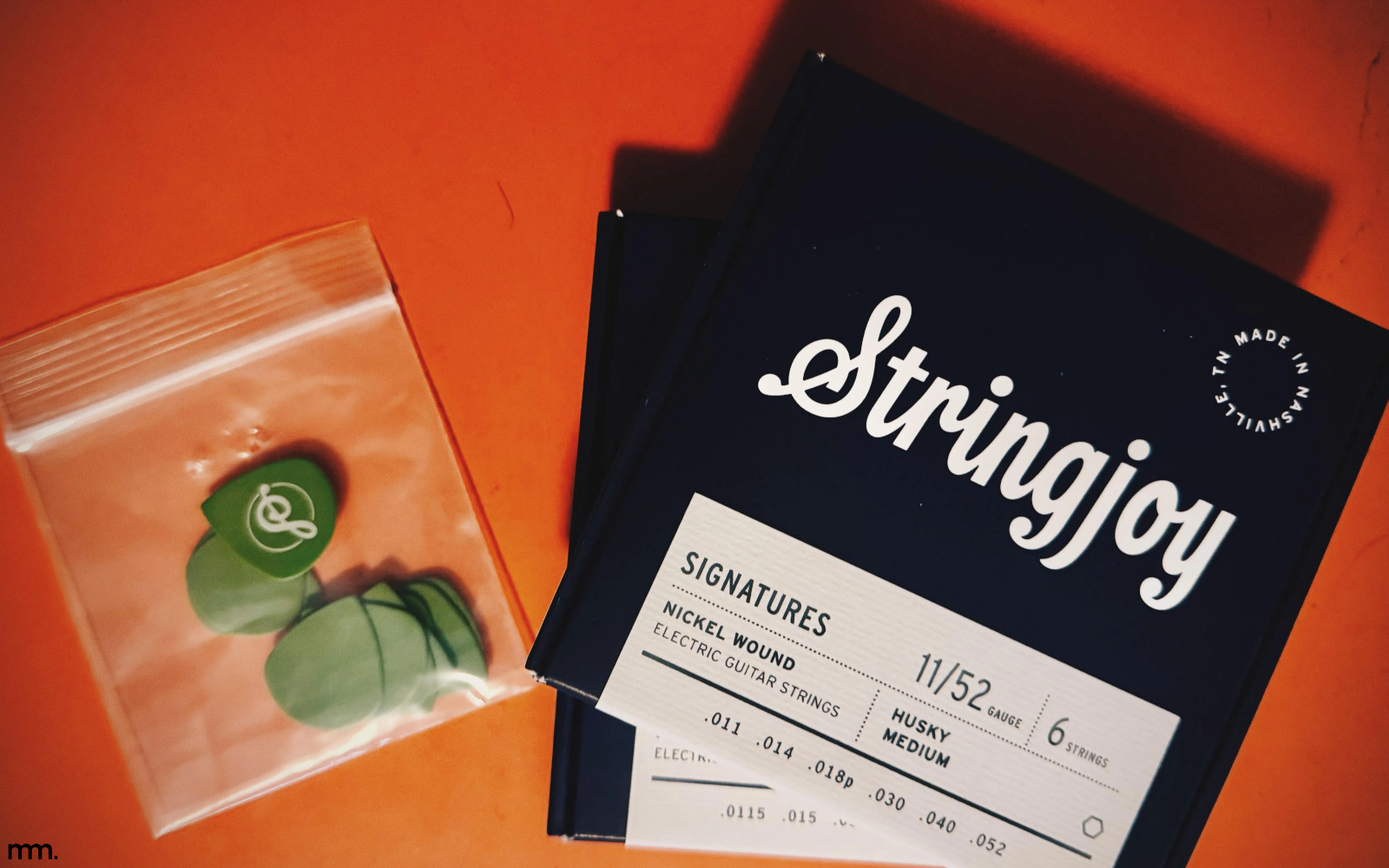
Then there's the Stringjoy Acrylic Sampler 9-Pack.
Picks are another wonderfully underestimated part of the guitar's sound. Thickness, material, edge shape and flexibility all influence the way a pick releases a string. A stiff acrylic pick can produce a very different attack from a thin, flexible celluloid one. Even a tiny change in edge shape can alter the feel of alternate picking or the brightness of a strummed chord. A sampler pack is a brilliant way to experiment without committing to a single design. And if you've spent years using the same battered pick because you found it in a rehearsal room in 2008, perhaps it's time to see what else is out there.
No judgement.
Well, a little.
Which Stringjoy Strings Should You Try First?
Here's our advice. Don't begin by asking which Stringjoy set is the best.
Begin by thinking about what you want your guitar to do differently. If you love the sound of your electric guitar but want a more balanced feel, try the Signatures. If you're chasing warmer, vintage electric tones, investigate the Broadways. If string life is your priority, the Orbiters are a brilliant place to start. If smooth feel and mellow articulation sound appealing, the Flyers deserve a serious look. For acoustic guitarists, Naturals provide rich phosphor bronze character, Brights bring lively 80/20 bronze sparkle, and Foxwoods offer coated-string protection.
And don't overlook the gauges.
Sometimes moving from a 9 to a 9.5, or choosing a slightly heavier bass string, is all it takes to make a guitar feel noticeably more comfortable. There is no universal perfect string. There is, however, a very good chance that your perfect set is waiting somewhere on our newly expanded Stringjoy wall.
From the Musicmaker Workshop: Ireland, Meet Stringjoy
We've been selling guitar strings in Dublin since the early 1980s.
In that time, we've seen trends come and go, materials evolve, manufacturing techniques improve and guitarists develop increasingly elaborate theories about why their favourite set sounds better than everybody else's. And we love every minute of it. Strings are the first point of contact between your hands and your instrument. They influence the feel of every bend, the attack of every chord and the way energy travels through the guitar. A fresh set of great strings can make a familiar instrument feel wonderfully alive again.
That's why we're so excited about this enormous Stringjoy shipment.
Not simply because the packets look beautiful on the wall, although they certainly do. But because Stringjoy represents something we genuinely admire: a company that has taken a humble, essential piece of musical equipment and decided it deserves extraordinary attention.
Better gauge choices. Careful manufacturing. Excellent materials. A willingness to challenge convention.
That's proper guitar-nerd behaviour. And we wholeheartedly approve.
So if you're in Dublin, come and see us at Musicmaker, 29 Exchequer Street, Dublin 2. Have a chat about gauges, tunings, tone and whatever peculiar string-related problem has been occupying your thoughts lately.
And if you're elsewhere in Ireland, you can explore the full Stringjoy range at Musicmaker.
Free shipping around Ireland on orders over €15.
The wall is stocked.
The strings are fresh.
Your guitar is waiting.
Give it something worth vibrating about.
Musicmaker — Independent minds. Serious gear. Glorious noise.