Epiphone Guitar Drop: Six Reasons to Start a Band
The Musicmaker Guitar Drop — November 2026
Britpop royalty, rock 'n' roll aristocracy, a beautifully retro bass and enough humbuckers to upset the local residents' association. The latest Epiphone delivery has arrived at Musicmaker Dublin.
There comes a point in every guitarist's life when the sensible voice inside their head suggests that perhaps they already own enough guitars. It's a perfectly reasonable argument, supported by financial logic, available storage space and the increasingly suspicious expression of their significant other. Unfortunately, that voice has never had to contend with an Epiphone Noel Gallagher Riviera in Dark Wine Red.
The latest Epiphone guitar drop at Musicmaker is a particularly handsome collection of instruments, covering an extraordinary amount of musical territory without wandering into financially terrifying territory. We've got the unmistakable swagger of Manchester's finest, the retro charm of a violin-shaped bass, the gloriously uncomplicated aggression of an SG, the considerable personality of a 1950s-inspired Les Paul and two ES-335s that look as though they've spent their entire lives hanging around recording studios.
These are instruments with stories behind them, but they're also instruments for making new music. Nobody's going to insist you learn the entire Beatles catalogue before purchasing a Viola Bass, and owning an SG doesn't automatically mean you need to invest in a school uniform.
Although we wouldn't discourage it.
Epiphone: A Little History Behind the Beautiful Noise
Epiphone's history stretches back to 1873, with origins in the instrument-making business of the Stathopoulo family. The company eventually became a significant presence in American instrument manufacturing, particularly during the golden age of archtop guitars, when it competed directly with Gibson for the attention of professional musicians.
Gibson acquired Epiphone in 1957, beginning a fascinating new chapter that produced instruments such as the Casino, Riviera and Sheraton. These weren't simply affordable interpretations of existing Gibson designs; they developed musical identities of their own, appearing on some of the most influential recordings in popular music history.
Today's Epiphone catalogue brings together those original designs and instruments inspired by Gibson's most celebrated models. What's particularly interesting about the contemporary range is the attention being paid to construction details, electronics, historical neck profiles and materials. The return of rosewood fingerboards to several current models is especially welcome news for guitarists who appreciate traditional specifications.
Enough history, though. There are guitars to ogle.
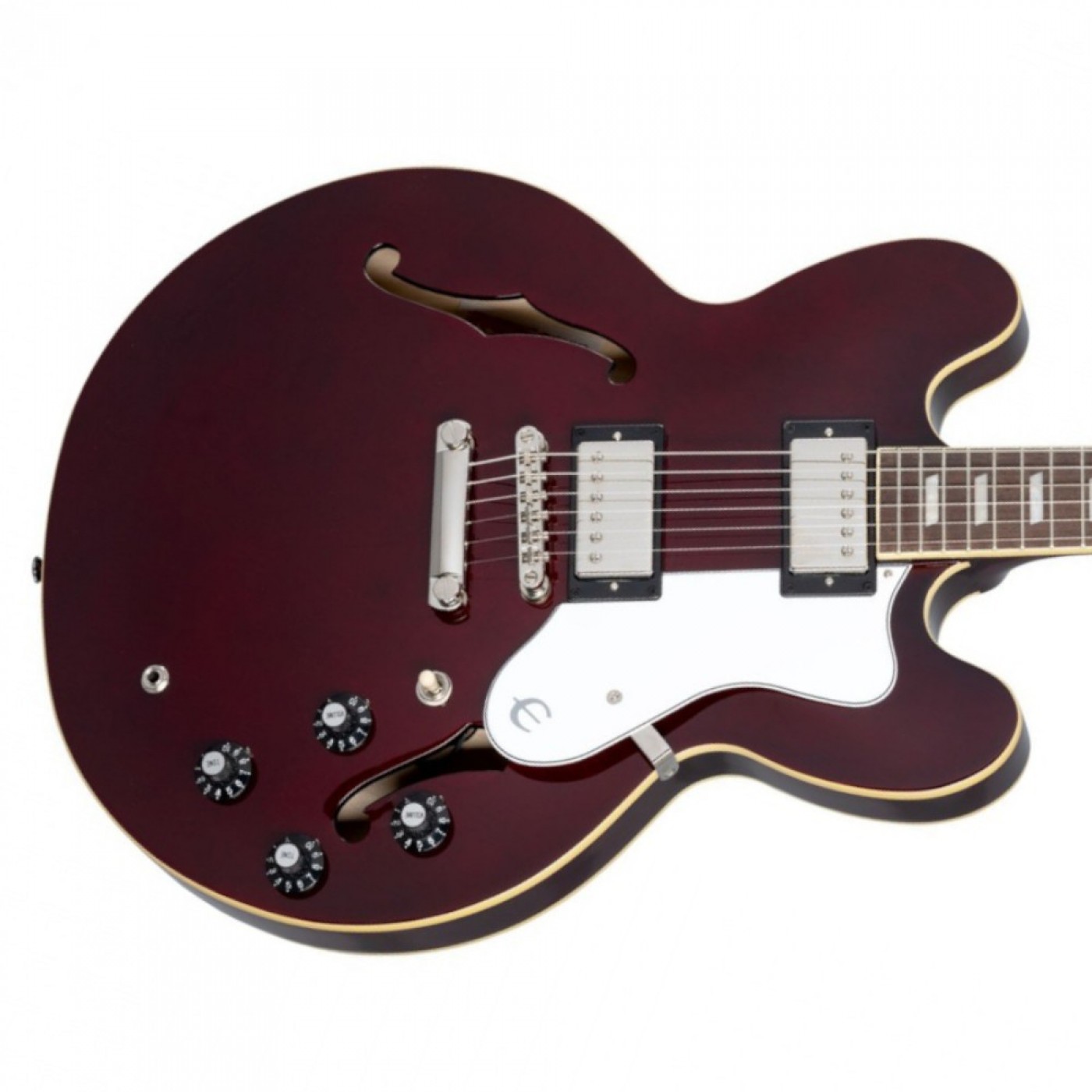
1. Epiphone Noel Gallagher Riviera: Definitely, Magnificently
Dark Wine Red — €999
The Epiphone Noel Gallagher Riviera is an instrument with enough musical baggage to require its own tour bus. Inspired by Noel's original 1983 Riviera, which became closely associated with the early years of Oasis, it captures the wonderfully understated cool of a guitar that helped provide the visual and musical identity of an entire generation.
There's something particularly lovely about the Dark Wine Red finish. It has the character of an instrument that belongs beneath the lights of a sweaty music venue rather than behind glass in a collector's cabinet. The contrasting cream appointments, classic double-cutaway body and period-inspired hardware complete a design that feels unmistakably connected to the 1990s without looking remotely dated.
Underneath all that Britpop nostalgia is a genuinely interesting semi-hollow electric guitar. The five-ply layered maple body incorporates an internal centre block, providing a more controlled response at amplified volumes than a fully hollow design. Its three-piece maple neck uses a comfortable SlimTaper profile, complemented by an Indian laurel fingerboard, 22 medium jumbo frets and a familiar 24.75-inch scale length.
The electronics are particularly interesting because this Riviera differs from the traditional mini-humbucker-equipped versions of the model. Noel's signature instrument features full-sized Epiphone Alnico Classic PRO humbuckers, with individual volume and tone controls for each pickup. CTS potentiometers offer a useful degree of control over the response of the electronics, while a LockTone Tune-O-Matic bridge and stopbar tailpiece provide a familiar and practical hardware arrangement.
That pickup configuration makes the Riviera particularly appealing for guitarists who enjoy substantial chord sounds. Introduce some amplifier overdrive and you can explore the thick, harmonically rich rhythm tones associated with British guitar music, but roll back the volume and there are lovely opportunities for cleaner arpeggios, soulful lead work and jangling indie arrangements.
The guitar also includes a dedicated hardshell case, which is a particularly welcome addition at this price. At €999, it's the most expensive member of this guitar drop, but the signature appointments, construction and included case give it considerably more substance than a famous name printed on the headstock.
The only thing it can't provide is the ability to write an anthem that forty thousand people will sing back at you. That's your department.
Explore the Epiphone Noel Gallagher Riviera — €999.
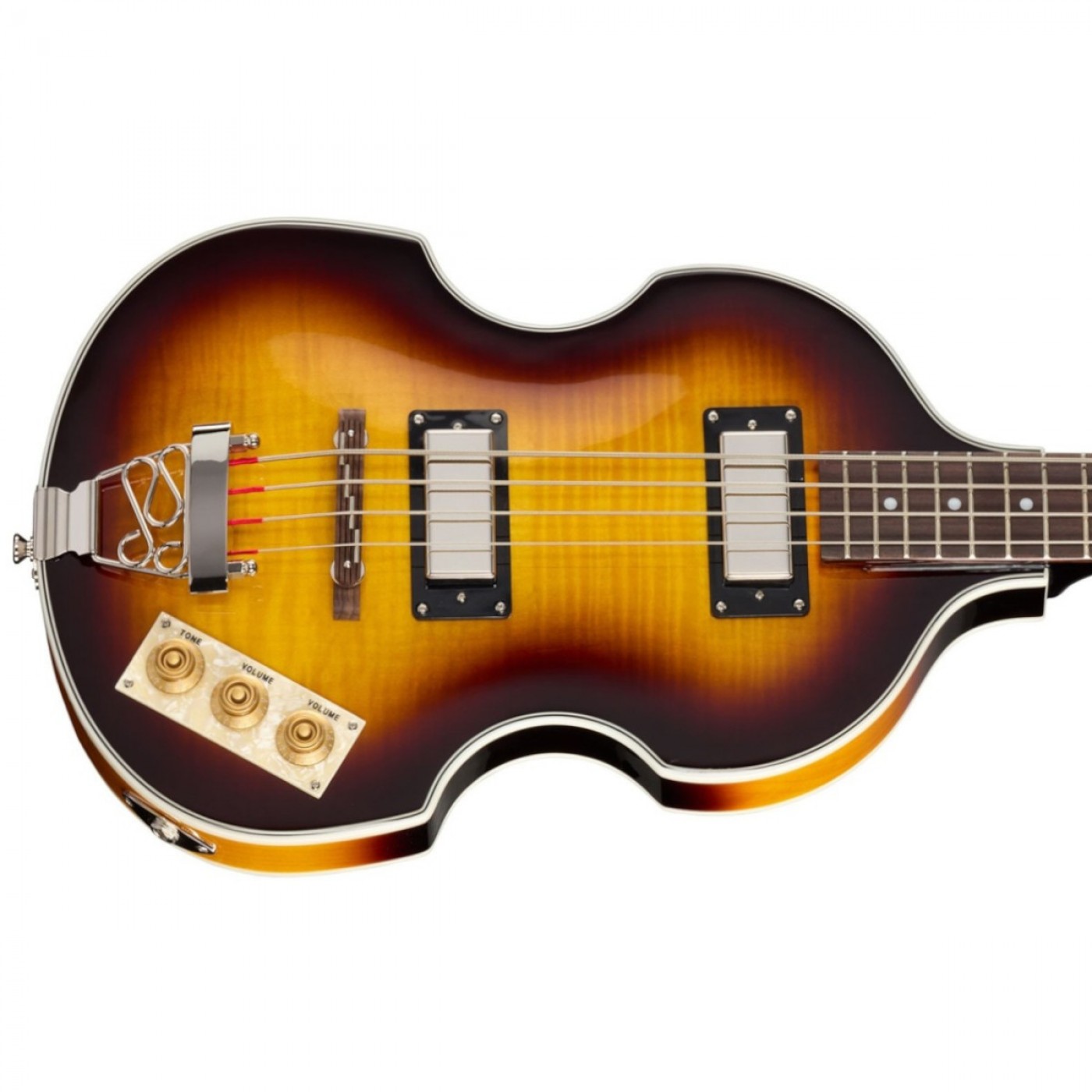
2. Epiphone Viola Bass: Four Strings and Impeccable Trousers
Cavern Burst with Rosewood Fingerboard — €679
Every band needs somebody with sufficient musical maturity to understand the importance of the bass guitar. Thankfully, that individual doesn't necessarily need to dress sensibly, and the Epiphone Viola Bass in Cavern Burst is practically begging to be played with a pair of Chelsea boots and a beautifully questionable haircut.
The Viola Bass embraces the violin-shaped electric bass aesthetic that became inseparable from the British beat music explosion of the 1960s. Although the Epiphone is its own instrument, the broader design immediately evokes an era of melodic bass lines, compact amplifiers, wonderfully inventive songwriting and recording studios that somehow managed to produce extraordinary records with considerably fewer tracks than your average laptop.
Its compact hollow-body construction, layered maple timber and short 30.5-inch scale length make it a very different proposition from a conventional solid-body, 34-inch-scale electric bass. The set maple neck and rosewood fingerboard contribute to a wonderfully traditional specification, while the pair of bass mini-humbuckers and floating bridge arrangement continue the vintage-inspired approach.
The short scale is especially interesting from a playing perspective. With identical strings tuned to identical pitches, a 30.5-inch scale produces approximately 19.5 per cent less string tension than a 34-inch scale. Actual playing feel also depends on string construction, gauge and setup, but that difference in scale helps explain why short-scale basses can feel particularly accommodating beneath the fingers.
The closer fret spacing can make melodic passages and wider stretches more comfortable, while the hollow construction and pickup configuration provide a different tonal starting point from a typical modern solid-body bass.
For anyone chasing those rounded, woody, vintage-inspired sounds, a suitable set of flatwound strings is well worth investigating. Flatwounds use a smooth outer winding rather than the textured surface of conventional roundwounds, typically reducing finger noise and producing a more restrained upper-frequency response. Check string length and winding compatibility before choosing a set, particularly with the Viola's tailpiece arrangement.
Of course, confining this bass to 1960s tribute music would be a tremendous waste. Compact hollow-body basses can be wonderful instruments for contemporary indie, soul, alternative music, jazz-influenced arrangements and studio sessions where the bass needs its own distinctive character without occupying every available frequency.
At €679, this is a rather charming opportunity to own something with a genuinely different personality from the usual solid-body suspects.
Meet the Epiphone Viola Bass Cavern Burst — €679.
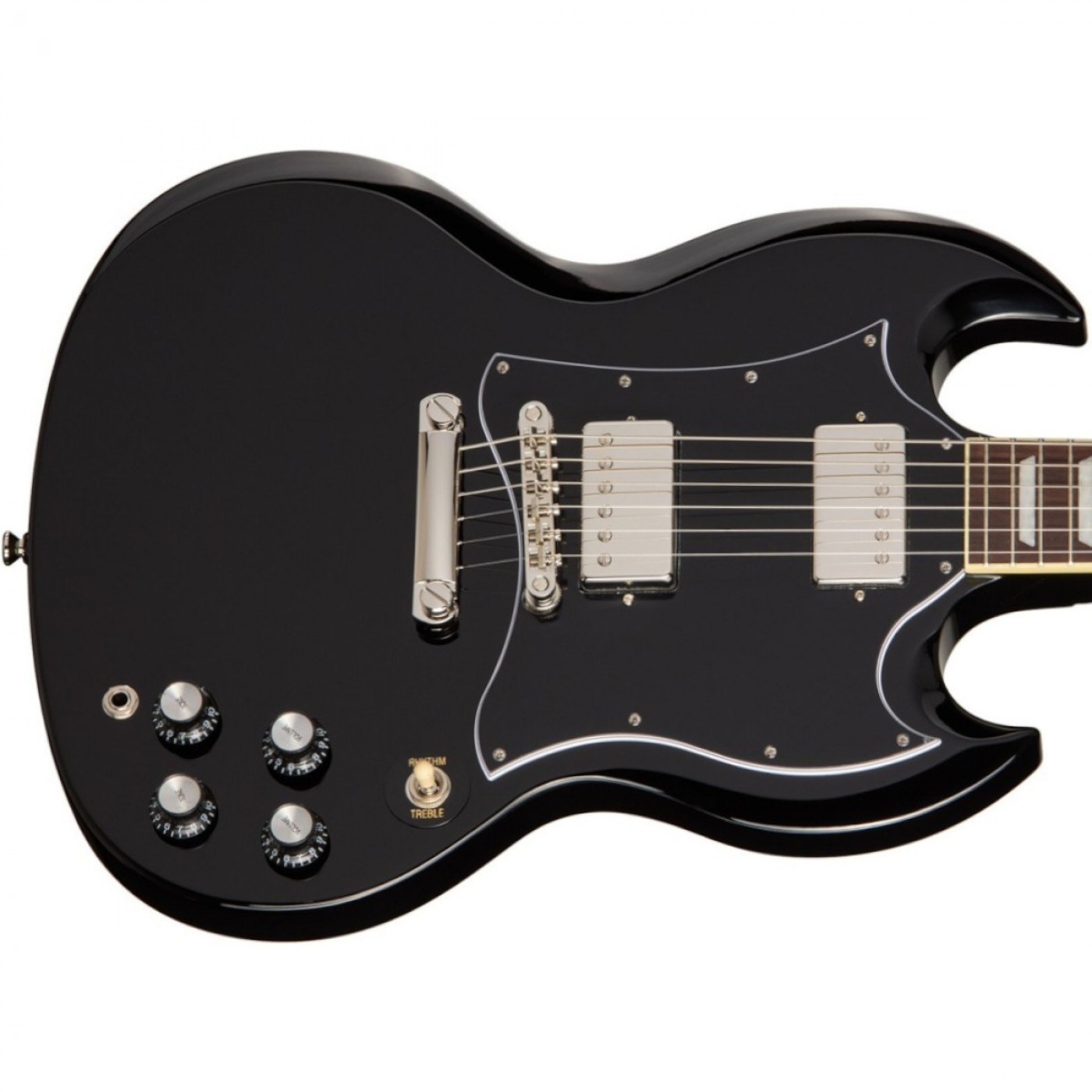
3. Epiphone SG Standard: Black Sabbath, Black Coffee, Black Everything
Ebony — €649
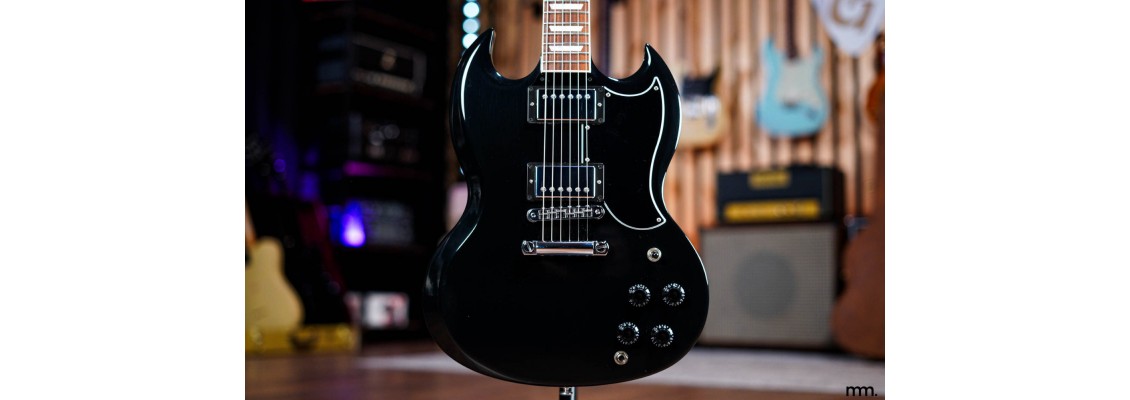
There are guitars that politely introduce themselves, and there are guitars that arrive halfway through the conversation, knock over the furniture and insist somebody turns the amplifier up. The Epiphone SG Standard in Ebony belongs firmly in the second category.
The SG's story begins in 1961, when Gibson introduced a dramatically redesigned Les Paul featuring a thin, bevelled, double-cutaway body. That design eventually became known as the SG, short for Solid Guitar, and proceeded to establish itself as one of the most recognisable silhouettes in rock music.
From Tony Iommi's seismic riffs to Angus Young's beautifully economical brand of musical violence, the SG has appeared wherever guitarists have needed enormous sounds and relatively unrestricted access to the upper reaches of the fingerboard.
The Epiphone SG Standard carries forward that fundamental architecture with a slim mahogany body, set mahogany neck, SlimTaper-inspired neck profile and 24.75-inch scale length. Its 22-fret layout, dual humbuckers, individual pickup controls and Tune-O-Matic-style bridge arrangement keep the instrument wonderfully straightforward.
The SG's relatively thin body is an important part of its physical personality. Compared with a typical traditionally constructed Les Paul, an SG often feels less substantial against the body, and its deep double cutaways provide excellent access to higher frets. That can make it particularly appealing to guitarists who spend considerable time exploring the dusty end of the fingerboard.
The two humbuckers provide a versatile platform for classic rock, blues, punk and heavier styles. The individual volume controls also encourage a particularly useful approach to amplifier interaction: set the bridge pickup for your full driven sound, reduce the neck pickup volume and use the selector switch to move between different degrees of overdrive.
It requires approximately thirty seconds to experiment with this technique and can provide more usable live sounds than purchasing another pedal. We appreciate that this is a dangerous thing for a music shop to admit.
The Ebony finish is exactly what an SG should look like when somebody has decided that colours are largely unnecessary. With its contrasting appointments, batwing-style pickguard and unmistakable body horns, it's a wonderfully uncomplicated statement of rock 'n' roll intent.
At €649, it's also the most affordable guitar in this particular Epiphone drop.
Unleash the Epiphone SG Standard Ebony — €649.
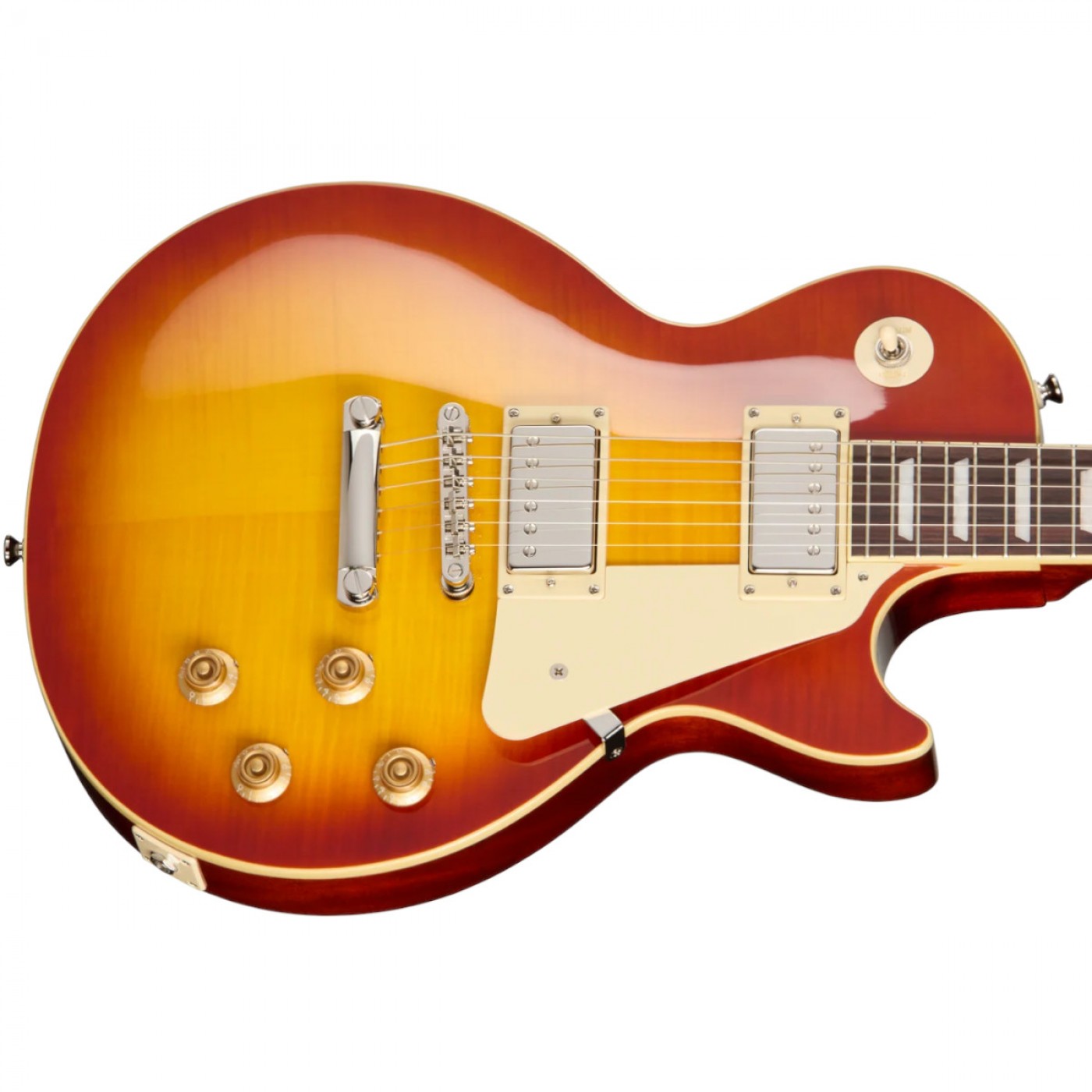
4. Epiphone Les Paul Standard 50s: Glorious, Unreasonable Wood
Washed Cherry Sunburst — €769
The Epiphone Les Paul Standard 50s in Washed Cherry Sunburst is a particularly attractive example of a guitar design that has been encouraging financially questionable behaviour for decades. There's something about a carved maple top, cream pickup surrounds, amber control knobs and that familiar sunburst finish that causes otherwise sensible musicians to begin discussing the possibility of selling things they don't really need.
The Les Paul established its essential identity during the 1950s, with the introduction of humbuckers in 1957 and sunburst finishes in 1958 contributing to the specifications that would subsequently become some of the most sought-after in electric guitar history.
Epiphone's contemporary Standard 50s draws heavily from that period. The mahogany body is paired with a maple cap and figured maple veneer, while the set mahogany neck brings a substantial 1950s Rounded Medium C profile into the equation. The current manufacturer specification includes a rosewood fingerboard, 22 medium jumbo frets, a 12-inch radius and the familiar 24.75-inch scale.
The neck profile deserves particular attention. A fuller neck doesn't automatically make a guitar more difficult to play, despite what some guitarists brought up on ultra-thin shred necks might initially assume. Many players find that a substantial neck provides a comfortable foundation for chord work, expressive vibrato and sustained bends. It's a deeply personal aspect of guitar ergonomics, and one of the best reasons to actually spend time playing an instrument before making a decision.
The current Washed Cherry Sunburst model features Epiphone ProBucker 1 and ProBucker 2 humbuckers. These pickups draw inspiration from the design principles of the original PAF humbuckers, with Alnico II magnets contributing to their vintage-inspired construction.
The traditional four-control layout, CTS potentiometers and 1950s-style wiring encourage a surprisingly interactive approach to shaping the guitar's response. Rather than treating the volume and tone knobs as decorative objects that must permanently remain on ten, try gradually reducing the guitar volume through an overdriven amplifier and listening to how the harmonics, clipping and picking dynamics change.
The current manufacturer specification also includes a long-tenon neck joint and premium gig bag, adding further appeal to an instrument that already offers a considerable amount for €769.
This is the guitar for enormous blues-rock bends, sustained melodic solos, substantial rhythm sounds and those moments when a single well-placed note communicates considerably more than an ambitious collection of twenty-seven badly placed ones.
No pressure, obviously.
Explore the Epiphone Les Paul Standard 50s — €769.
5 & 6. Epiphone ES-335: The Civilised Art of Making a Racket
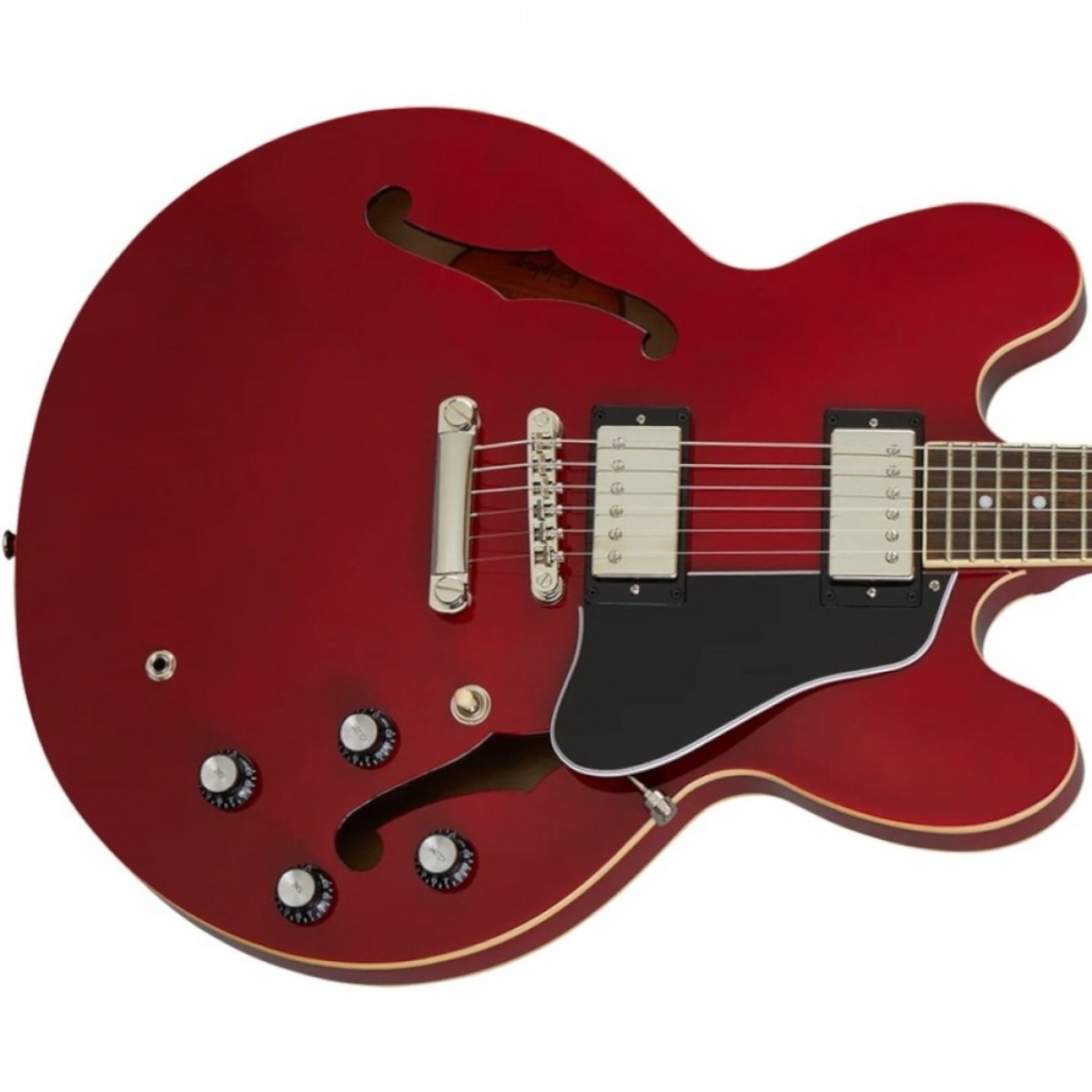
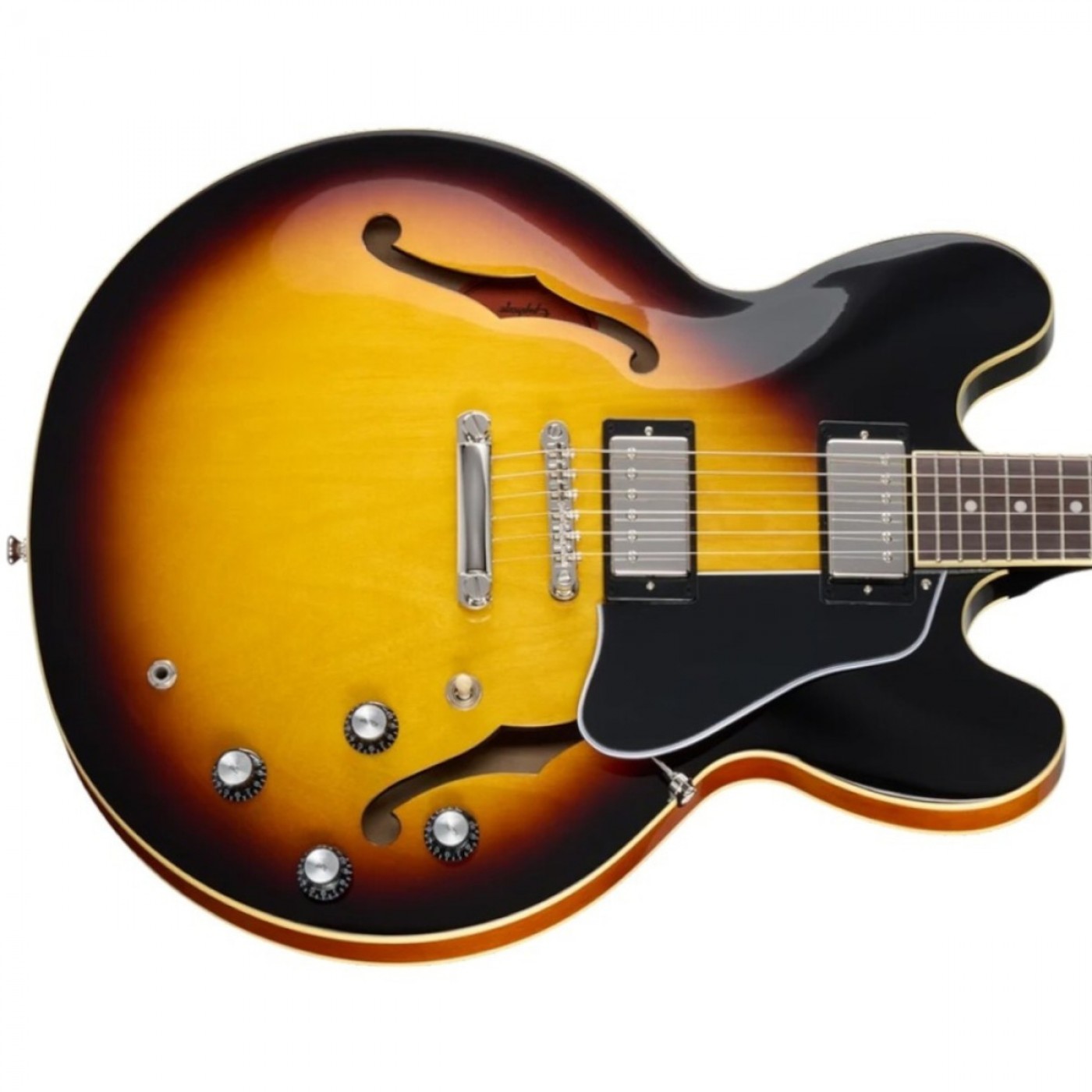
Cherry and Vintage Sunburst with Rosewood Fingerboards — €699 each
There is something wonderfully contradictory about the ES-335. It looks sufficiently sophisticated to accompany a jazz ensemble in an expensive hotel, yet it's equally capable of producing the sort of overdriven guitar sound that encourages people to climb onto furniture.
Introduced by Gibson in 1958, the ES-335 established an enormously influential approach to electric guitar construction. Its combination of hollow body wings and a solid centre block helped address some of the feedback challenges associated with fully hollow electric guitars, while retaining a large, resonant body and a distinctive playing experience.
The list of musicians associated with the design is extraordinary. Chuck Berry helped establish its family of instruments as rock 'n' roll essentials, Larry Carlton explored its expressive possibilities in jazz and fusion, and countless blues, indie and alternative guitarists have subsequently discovered how adaptable the underlying design can be.
The latest Epiphone ES-335 arrivals feature layered maple semi-hollow bodies with solid maple centre blocks, set mahogany necks and rounded C-style neck profiles. Both models feature the particularly welcome return of rosewood fingerboards, with 22 medium jumbo frets, a 12-inch radius and 24.75-inch scale length.
A pair of Alnico Classic PRO humbuckers, individual volume and tone controls, a three-way selector and the familiar Tune-O-Matic-style bridge and stopbar arrangement complete a specification that remains remarkably close to the fundamental principles of the original design.
Why does the centre block matter?
A conventional fully hollow electric guitar can be particularly susceptible to acoustic feedback at high amplified volumes because sound from the speaker can excite the guitar body and strings, creating a repeating feedback loop.
The ES-335's solid central section provides a more substantial mounting structure for the bridge and pickups while reducing some of the body's susceptibility to that behaviour. It doesn't eliminate feedback, nor should we necessarily want it to. Controlled feedback can be an enormously expressive musical technique, particularly when sustained notes begin developing new harmonics.
The semi-hollow construction provides a practical compromise for musicians who enjoy the physical character of a larger-bodied electric guitar but also need to navigate overdrive, louder amplifiers and live performance.
It's also a particularly interesting design for rhythm guitar. The larger body changes the ergonomic relationship between the player and the instrument, and the dual-pickup configuration offers plenty of opportunities to explore cleaner textures, warmer neck-pickup sounds and more assertive bridge-pickup arrangements.
Cherry or Vintage Sunburst?
The Epiphone ES-335 in Cherry is a gloriously classic interpretation of the design, with a finish that immediately evokes decades of electric blues, British rock and extraordinary live performances. It's bold without becoming extravagant and looks particularly spectacular beneath warm stage lighting.
The Epiphone ES-335 in Vintage Sunburst, meanwhile, brings a slightly more old-school recording studio aesthetic to the same fundamental instrument. It looks as though it belongs beside a beautifully worn valve amplifier, preferably with somebody playing a chord interesting enough to make the rest of the band stop talking.
Both are €699, and the choice between them is largely aesthetic. We fully support spending an unreasonable amount of time making that decision.
Into the Nerd Department: Solid, Semi-Hollow or Hollow?
One of the particularly fascinating aspects of this Epiphone delivery is the opportunity to compare three fundamentally different approaches to electric instrument construction.
The Les Paul and SG are solid-body electric guitars. Their bodies provide a relatively rigid mounting structure for the neck, bridge and electronics, making them practical platforms for amplified performance. However, the difference in body thickness, neck joint geometry, weight distribution and neck profile means they can feel remarkably different despite sharing several traditional specifications.
The Riviera and ES-335 employ semi-hollow construction, incorporating hollow chambers around a solid centre block. This gives them a different physical character while retaining a useful degree of control at amplified volumes.
The Viola Bass uses hollow-body construction, extending the comparison into an entirely different frequency register and introducing shorter scale length and a distinctive bridge arrangement.
It's tempting to make sweeping statements about the tonal superiority of one construction method, but electric guitar sound is considerably more complicated than that. Pickup design, pickup position, string selection, electronics, amplification, playing technique and the mechanical properties of the instrument all interact.
The interesting question isn't which construction is objectively better. It's which instrument encourages you to play differently, discover new ideas and enjoy the time you spend making music.
Alnico II, Alnico V and the Myth of the Magical Magnet
The pickups in this guitar drop deserve a little attention, particularly the distinction between the Les Paul's ProBuckers and the Alnico Classic PRO humbuckers fitted to the Riviera and ES-335s.
Alnico is an alloy primarily associated with aluminium, nickel and cobalt, alongside iron and other elements. Different grades have different magnetic properties, which pickup designers can use as part of a wider approach to constructing an electromagnetic transducer.
Alnico II is frequently associated with vintage-inspired humbucker designs, while Alnico V is commonly encountered in pickups designed for a firmer, more assertive response. These associations can be useful when describing broader pickup design tendencies, but the magnet material alone does not determine the finished sound.
Coil construction, winding patterns, inductance, magnetic geometry, pickup height and electrical loading all contribute to how a pickup responds. Two humbuckers using the same magnet grade can behave quite differently because of those other variables.
And here's something worth experimenting with before disappearing down an expensive pickup-replacement rabbit hole: pickup height. Moving a pickup closer to or further from the strings changes the relationship between string movement and the magnetic field, influencing signal level, balance and perceived response.
Small adjustments, made carefully and judged through your own amplifier, can reveal characteristics of an instrument you hadn't previously noticed.
Sometimes the answer to your guitar tone problems is a screwdriver rather than another €200 purchase.
Terrible news for the screwdriver-free among us.
Rosewood Returns: Why Guitarists Are Getting Excited
Several of the instruments in this delivery belong to Epiphone's newer generation of designs featuring rosewood fingerboards. For musicians with an appreciation of traditional guitar construction, that's particularly welcome.
Rosewood has been widely used for electric guitar fingerboards thanks to its hardness, wear resistance, attractive appearance and long-established suitability for the job. Its darker colour and distinctive grain have also become closely associated with many classic guitar designs.
Indian laurel, which has appeared on numerous previous Epiphone instruments, offers many useful characteristics as a fingerboard material. The return of rosewood should not be interpreted as proof that those earlier guitars are somehow inferior, but it does bring current models closer to the traditional material specifications that many guitar enthusiasts enjoy.
As with most discussions about guitar timber, personal preference remains important. Fingerboard condition, fretwork, neck geometry and setup are considerably more useful things to investigate than declaring a particular species of wood the undisputed champion of rock 'n' roll.
The November Epiphone Guitar Drop at a Glance
| Instrument | Construction | Scale length | Price |
|---|---|---|---|
| Noel Gallagher Riviera | Semi-hollow | 24.75″ | €999 |
| Viola Bass Cavern Burst | Hollow-body | 30.5″ | €679 |
| SG Standard Ebony | Solid-body | 24.75″ | €649 |
| Les Paul Standard 50s | Solid-body | 24.75″ | €769 |
| ES-335 Cherry | Semi-hollow | 24.75″ | €699 |
| ES-335 Vintage Sunburst | Semi-hollow | 24.75″ | €699 |
Prices correct at the time of the November guitar drop. Check individual product listings for current availability.
Which Epiphone Belongs in Your Band?
If your musical ambitions involve enormous singalong choruses, layered rhythm guitars and the sort of chord progression that sounds tremendous through a wall of British amplifiers, the Noel Gallagher Riviera deserves a particularly enthusiastic investigation.
For classic rock, punk and blues-driven guitarists who appreciate straightforward electronics and excellent upper-fret access, the SG Standard makes an enormously convincing argument. The Les Paul Standard 50s offers a different physical experience, with a fuller neck profile and substantial traditional construction that will particularly appeal to players who enjoy expressive bends and vintage-inspired specifications.
The ES-335s are arguably the most stylistically adaptable instruments in this delivery. Clean jazz arrangements, blues, soul, indie, rock and alternative music are all very much within their territory, while their semi-hollow construction provides an interesting alternative to a conventional solid-body guitar.
And if you're a bassist who wants something with an altogether different playing experience, the compact Viola Bass is a genuinely fascinating proposition. Its shorter scale, hollow construction and unmistakable aesthetic bring plenty of personality to the low end of any arrangement.
Don't simply buy the instrument associated with your favourite musician. Buy the instrument that makes you want to become somebody else's favourite musician.
Frequently Asked Questions About Epiphone Guitars
What's the difference between an Epiphone SG and Les Paul?
The SG typically features a thinner, double-cutaway mahogany body, while a traditional Les Paul uses a thicker single-cutaway body with a maple top. Both can feature dual humbuckers and a 24.75-inch scale, but their body shapes, neck profiles and weight distribution create quite different playing experiences.
Is the Noel Gallagher Riviera the same as an ES-335?
Both are semi-hollow electric guitars with centre-block construction, but the Riviera has its own design history, neck specification, appointments and model-specific electronics. Noel's signature Riviera features full-sized Alnico Classic PRO humbuckers and is inspired by his original 1983 instrument.
Is the Epiphone ES-335 suitable for rock music?
Absolutely. Its centre-block construction makes it practical for amplified performance, while the dual humbuckers provide useful sounds for clean, overdriven and distorted guitar playing. Semi-hollow guitars have a considerable history in rock and alternative music.
Is the Epiphone Viola Bass short-scale?
Yes. Its 30.5-inch scale is shorter than the conventional 34-inch electric bass scale, offering closer fret spacing and a different string-tension relationship.
Does the Noel Gallagher Riviera include a case?
Yes. The signature Riviera includes a dedicated hardshell case.
Where can I buy Epiphone guitars in Ireland?
Musicmaker stocks Epiphone electric guitars and basses online and at our independent musical instrument shop at 29 Exchequer Street, Dublin 2.
Six Reasons to Get the Band Back Together
What we particularly love about this guitar drop is that every instrument represents a different musical possibility. There's the Riviera's association with monumental British songwriting, the Viola's wonderful retro personality, the SG's uncomplicated rock 'n' roll intent, the Les Paul's traditional construction and the distinctly versatile character of the ES-335.
These are instruments with history, but the most interesting thing about them is the music that hasn't been written yet. Somewhere in this delivery is somebody's first proper electric guitar, somebody's long-awaited upgrade and somebody's spectacularly unnecessary seventh instrument. We welcome all three individuals with equal enthusiasm.
Explore our Epiphone range, browse the electric guitar department and bass guitar department, or drop into Musicmaker at 29 Exchequer Street, Dublin 2, where we've been helping musicians make magnificent noises since 1981.
For more guitar history, explore the story of the Gibson Les Paul. Or visit the heavier end of the series in our Spira Guitar Drop.
Free shipping across Ireland on orders over €15.
Get the band together, book the rehearsal room and stop discussing the album you're eventually going to make. There's a perfectly good guitar waiting for you, and the drummer has probably already arrived.
Serious gear. Glorious noise.