
The Musicmaker Guitar Drop — Edition 001
Eight fresh Taylor acoustics have landed at Musicmaker Dublin. From the wonderfully compact Baby Taylor to the newly redesigned 324ce, this first edition of The Guitar Drop explores what happens when one guitar maker approaches the same six strings from eight different directions.
Guitar deliveries are always exciting. Not the glamorous sort involving velvet curtains, dramatic lighting and somebody unveiling a mysterious instrument to the sound of a string quartet. Nothing quite so theatrical. It's cardboard boxes. Packing materials. Serial numbers. Somebody looking for a Stanley knife. Somebody else already asking which one we're opening first.
And then the cases and gig bags start coming out.
A guitar appears that feels immediately familiar. Another looks a little different from the photographs. Somebody plays a chord and announces that we should all come over and hear something. Productivity takes a brief but entirely understandable dip.
At Musicmaker, we've been doing this since 1981, and the arrival of a fresh batch of guitars still has the ability to derail a perfectly sensible working afternoon.
Which brings us to an idea we've been quietly developing. Welcome to The Musicmaker Guitar Drop.
This is our new recurring Journal series devoted to the interesting instruments arriving through the doors of our shop at 29 Exchequer Street, Dublin 2. Not a catalogue of every new box that turns up, but a closer look at the deliveries that deserve a little more attention. The instruments, the design decisions, the sounds, the peculiarities and the reasons one guitar might make perfect sense for a particular player.
And for our inaugural edition, Taylor Guitars has given us a magnificent excuse to get started.
Eight acoustics. Eight distinct models. A journey from compact travel-friendly instruments to a sophisticated, American-made Grand Auditorium featuring some of Taylor's latest engineering.
There are Baby Taylors, a Big Baby, three GS Minis, an intriguing 24ce and the striking Next Generation 324ce in Shaded Edgeburst.
They're all unmistakably Taylors.
But they have rather different ideas about what an acoustic guitar should do.
The Small Ones Have Plenty to Say
Let's begin at the compact end of the collection.
Because if there's one thing Taylor has demonstrated particularly well over the years, it's that a smaller acoustic guitar needn't feel like a reluctant compromise. Body size changes the way an instrument behaves. A smaller soundbox moves air differently from a full-sized dreadnought. A shorter scale alters string tension at a given pitch and gauge. Body depth, bracing and top construction all influence the instrument's response.
Those differences are real. But different doesn't ever mean inferior. A compact acoustic can be extraordinarily comfortable, quick to respond and beautifully suited to a player who values immediacy over sheer volume.
And Taylor has several interpretations of that idea.
Taylor BT1 Baby Taylor: The Spruce-Topped Adventurer
The Taylor BT1 Baby Taylor in Spruce and Walnut is a brilliant introduction to the idea.
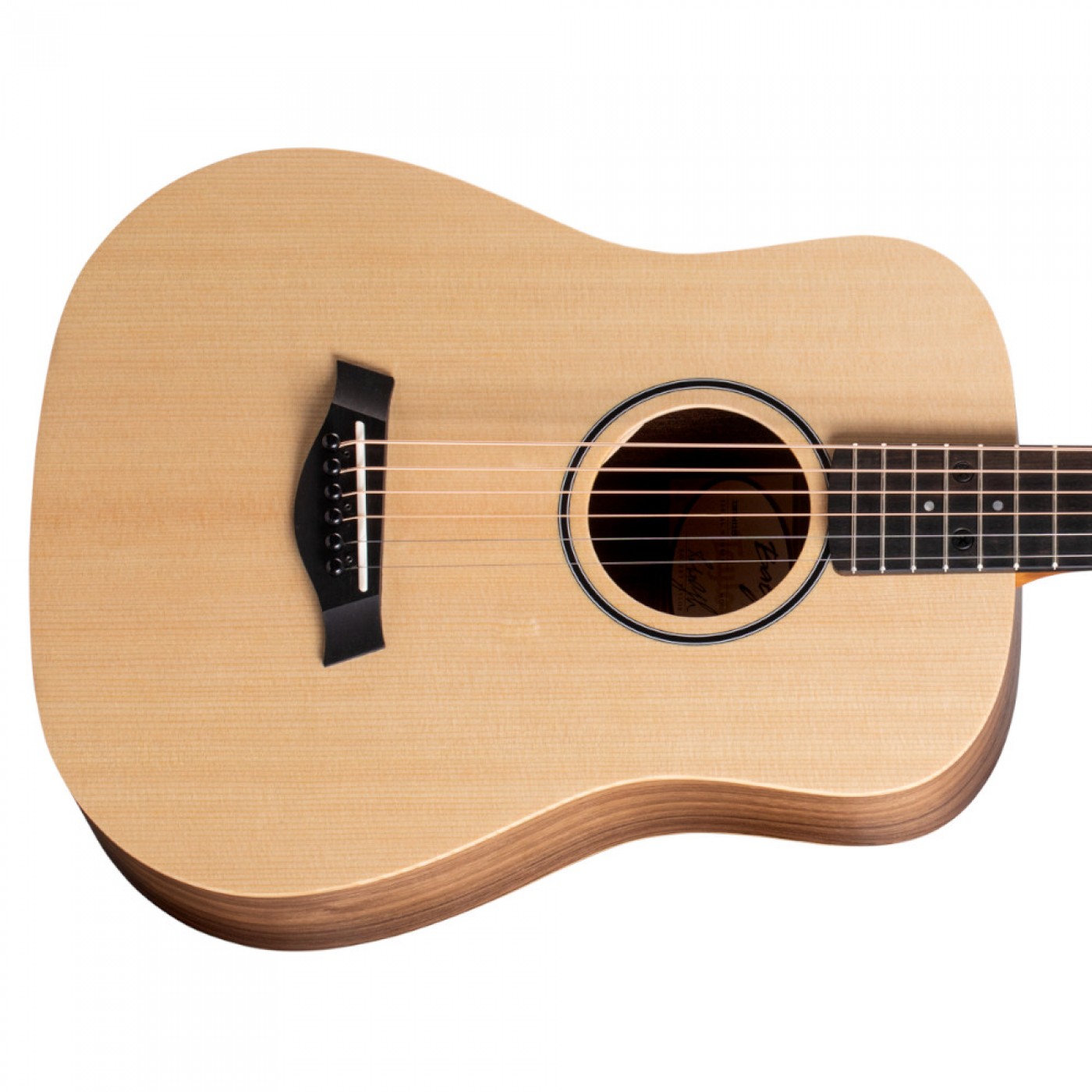
With its three-quarter-size dreadnought-inspired body and short scale, the Baby Taylor feels immediately manageable. That's particularly appealing for younger players, smaller hands and anyone who finds a large acoustic cumbersome.
But the BT1 isn't simply a children's guitar.
Plenty of experienced players enjoy compact instruments because they encourage a different relationship with the music. You can sit comfortably on the sofa, work through a melody without a large body under your arm, or bring the guitar along when a full-sized case feels excessive. The BT1 pairs a spruce soundboard with layered walnut back and sides.
Spruce is a familiar acoustic-guitar top wood because of its useful combination of stiffness, low weight and dynamic responsiveness. It can provide a lively attack and clear note definition, even in a smaller instrument. The layered walnut construction helps keep the guitar practical and relatively robust for everyday use. And the result is a compact acoustic that makes a surprisingly convincing argument for keeping a guitar within arm's reach.
Not every musical idea arrives when you're sitting in a dedicated practice room.
Some of the good ones turn up while you're waiting for the kettle.
Taylor BT2 Baby Taylor: A Different Kind of Warmth
Sitting beside the BT1 is the Taylor BT2 Baby Taylor in Mahogany and Sapele.
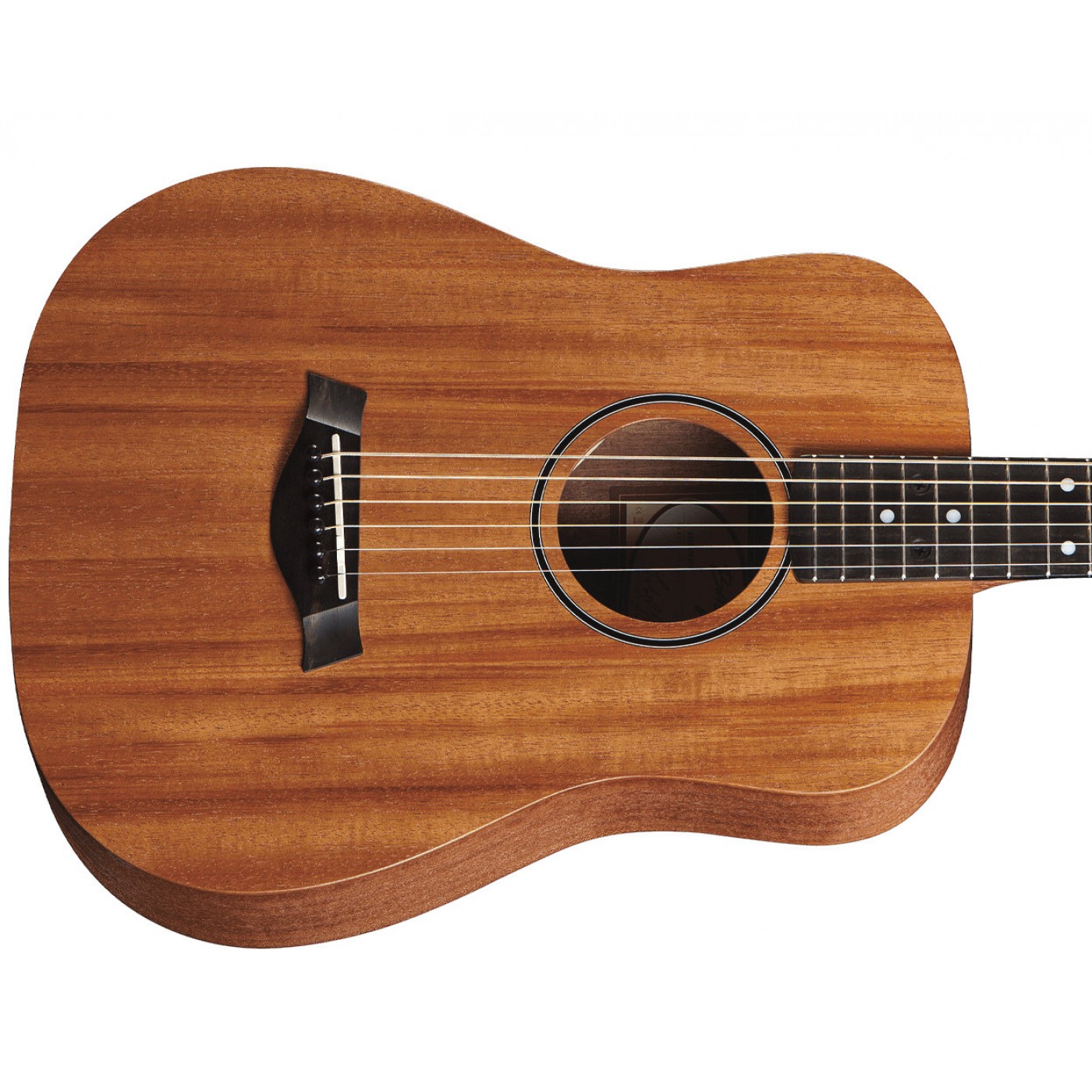
The overall concept is familiar: a compact, accessible acoustic designed to be played frequently and taken places. But the change in soundboard material gives us a genuinely interesting comparison.
Where the BT1 uses spruce, the BT2 features a tropical mahogany top.
Mahogany-topped acoustics are often associated with a more concentrated midrange and a slightly softer initial attack than comparable spruce-topped designs. That can make individual notes feel rounded and cohesive, particularly when playing bluesy fingerpicked phrases, simple chord accompaniments or intimate singer-songwriter material. Of course, timber species alone never tells the whole story. Body construction, bracing, strings and the player have enormous influence.
Still, it's a lovely opportunity to hear how two instruments of similar proportions can approach the same chord differently.
Play a few open chords on the BT1. Then try the same progression on the BT2. Listen to the attack, the sustain and the balance between the lower and higher strings. The comparison is far more interesting than simply asking which guitar is louder.
One might suit your playing immediately. The other might make you rethink how you play.
That's why trying guitars remains such a rewarding experience.
Taylor Big Baby: The Clever Middle Ground
The Taylor BBT Big Baby in Spruce and Walnut occupies a particularly useful position in the range.
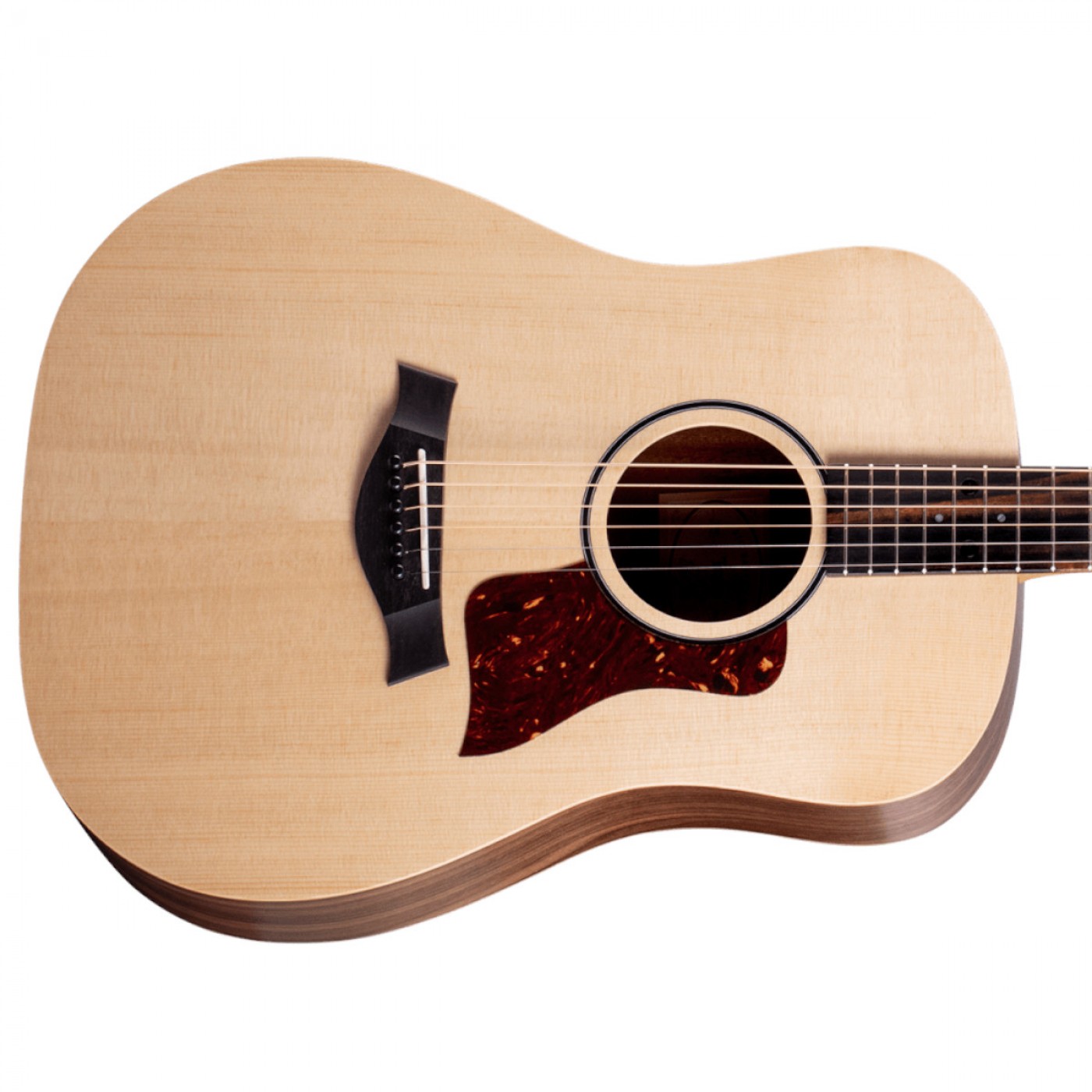
It's bigger than the Baby Taylor, but less imposing than a conventional full-depth dreadnought.
Taylor describes the Big Baby as approximately fifteen-sixteenths the size of a standard dreadnought, with a slimmer body depth and a full 25.5-inch scale length.
That last detail is important.
A shorter-scale guitar changes the feel of the strings. With the Big Baby, you retain familiar full-scale spacing and tension while enjoying a body that's easier to manage.
For somebody who finds a traditional acoustic a little bulky, that's a very attractive combination.
This particular model features a torrefied spruce top and layered walnut back and sides.
Torrefaction is a controlled heat-treatment process applied to the timber. It's intended to alter certain physical properties of the wood and is frequently used by guitar makers seeking particular tonal and stability characteristics.
It doesn't magically turn a new guitar into a seventy-year-old instrument.
But it is a meaningful part of the soundboard's construction, and it's worth understanding rather than treating it as a mysterious marketing word.
In the Big Baby, the spruce top provides a lively foundation for strumming and picking, while the body dimensions offer a useful balance of comfort and acoustic presence.
It's an appealing instrument for developing players who want something more substantial than a three-quarter-size guitar.
It's also a very sensible second acoustic for an experienced guitarist.
Something to leave on a stand, take to a writing session or bring along for a weekend away.
A guitar that doesn't require a committee meeting before you decide to take it out of the house.
And that's a surprisingly valuable quality.
Three GS Minis, Three Different Conversations
Now we arrive at a Taylor design that has developed a particularly enthusiastic following.
The GS Mini.
There's something very clever about its proportions. It takes inspiration from Taylor's Grand Symphony body shape, reduces the dimensions and creates an instrument that feels compact without abandoning the sense of a proper acoustic guitar. The 23.5-inch scale contributes to its relaxed playing feel, while the body provides enough acoustic presence to make it useful for far more than casual travel.
And this particular delivery includes three different versions.
Which is where things get interesting.
Taylor GS Mini Sapele: Clear, Lively and Ready to Play
The Taylor GS Mini Sapele is an appealing starting point.
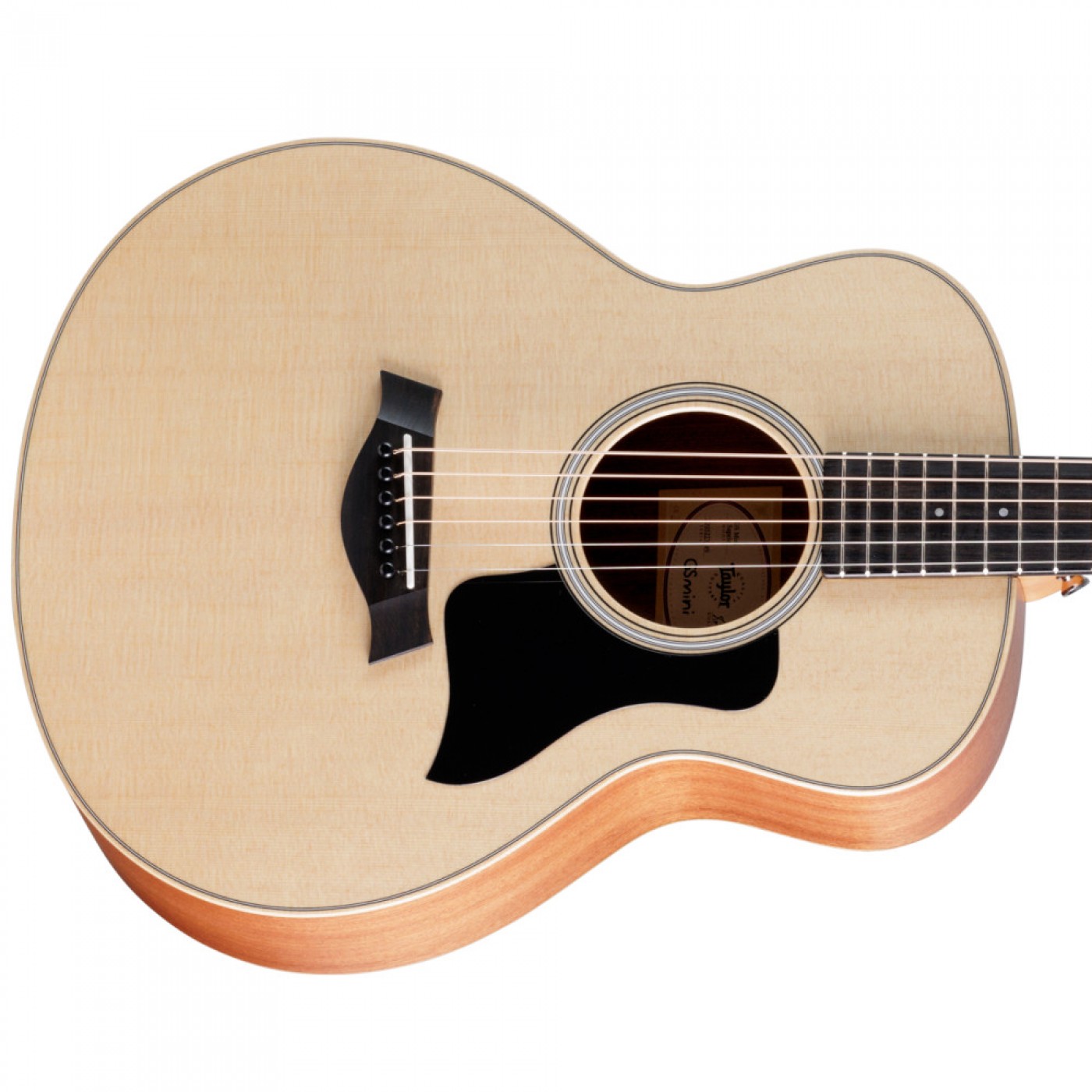
Its spruce top and layered sapele back and sides provide a familiar, versatile combination.
The spruce contributes an articulate response, while the compact body keeps everything immediate and comfortable. This is the sort of acoustic that can make an ordinary practice session unexpectedly enjoyable.
You pick it up to check a chord shape. Then you try a little fingerpicked pattern. Then you remember a song you haven't played in years. Forty minutes later, the original chord shape has been completely forgotten. A good compact guitar does that. And because the GS Mini is comfortable without feeling excessively small, it works for a surprisingly broad range of players.
It's a lovely instrument for songwriting, informal sessions, everyday practice and musicians who want an acoustic that can travel without becoming a logistical exercise.
Taylor GS Mini Mahogany/Sapele: The Earthier Voice
The Taylor GS Mini Mahogany/Sapele takes the same general concept in a warmer direction.
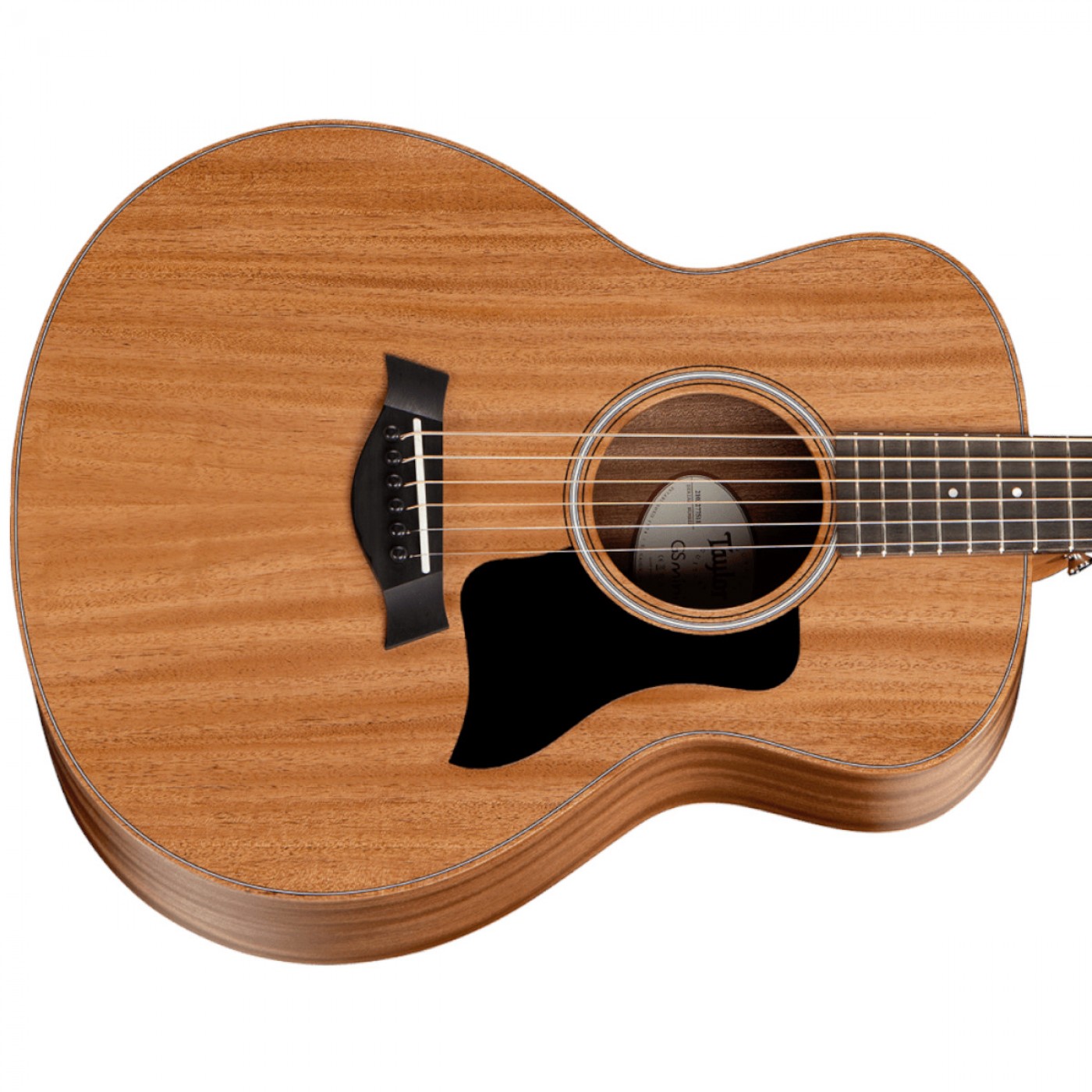
Here, the mahogany top changes the tonal emphasis.
Compared with the spruce-topped Sapele version, the mahogany-topped GS Mini is a particularly interesting option for players who prefer a focused, woody character and a less pronounced initial brightness, which can be lovely for intimate accompaniment.
Imagine a vocal, an acoustic guitar and very little else. You don't necessarily want the guitar producing an enormous wash of high-frequency detail beneath every word. Sometimes a more concentrated, midrange-led sound is exactly what the arrangement needs. The GS Mini Mahogany is also tremendous fun for bluesy playing, rhythmic fingerpicking and simple open-chord songs where the natural attack of the instrument becomes part of the groove.
And because it's still a GS Mini, you retain the comfortable proportions and inviting feel that make the design so appealing.
Same family.
Different personality.
Taylor GS Mini-e Mahogany: Ready for the Stage
Then there's the Taylor GS Mini-e Mahogany.
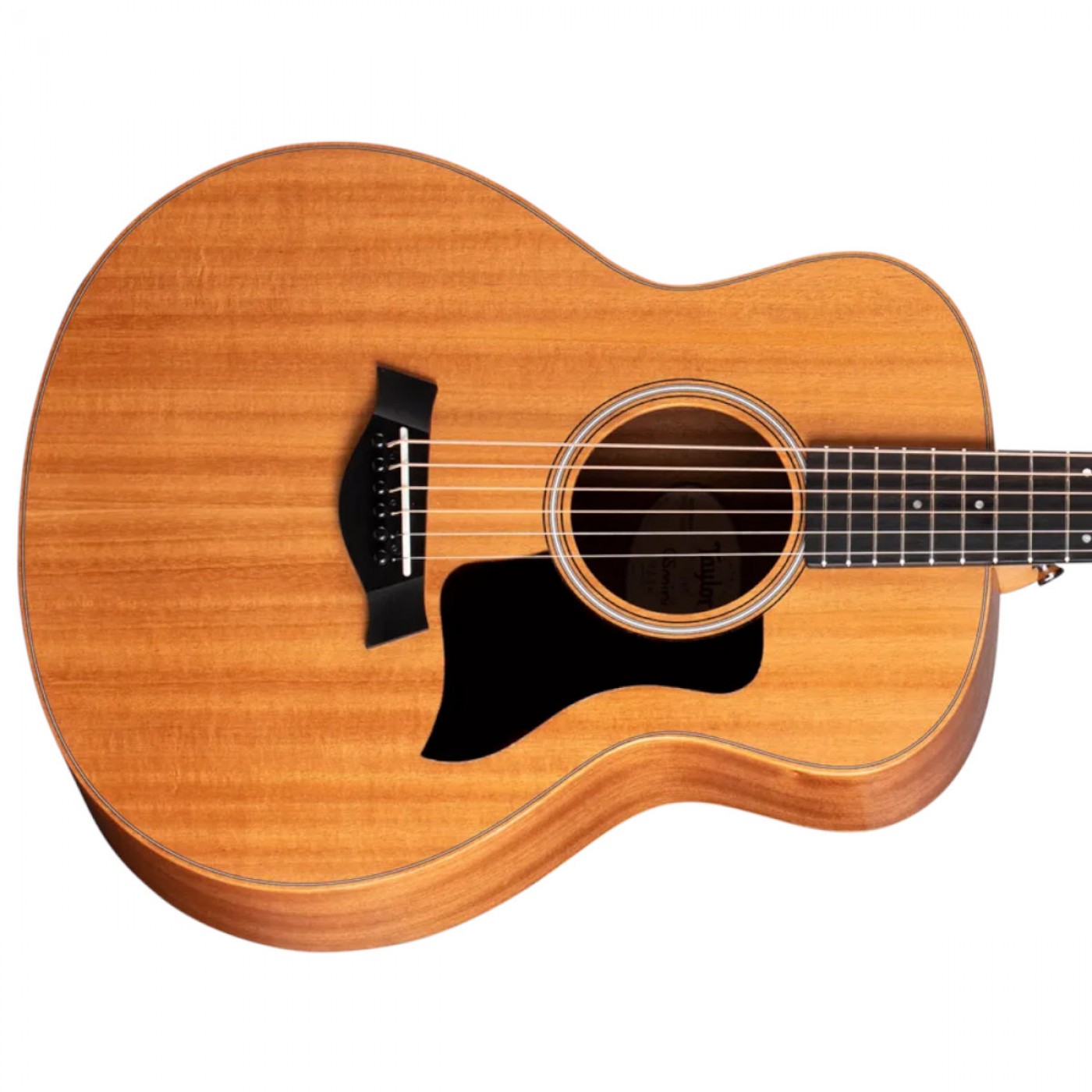
The little letter in the model name makes an important difference.
The “e” identifies an acoustic-electric version, equipped with onboard electronics for amplified use. That's useful for somebody who loves the GS Mini's compact dimensions but wants to connect directly to a suitable acoustic amplifier, PA system or recording setup. It makes the instrument more flexible for live performance, rehearsals and certain home-recording situations.
The mahogany top keeps the warm, focused character associated with this version of the GS Mini, while the electronics open up additional possibilities. You can take it to a small acoustic gig without relying entirely on an external microphone. You can connect it to a suitable audio interface and capture a direct signal. And you can move between unplugged practice and amplified performance without changing instruments.
That doesn't mean an onboard pickup automatically reproduces every nuance of the acoustic sound.
Microphones and pickups capture instruments differently, and each approach has its place.
But the convenience is undeniable.
For a singer-songwriter who plays at home during the week and performs at the weekend, the GS Mini-e Mahogany makes a particularly persuasive case.
Which GS Mini Would We Choose?
That's the wrong question. Or at least, it's the wrong place to begin.
The better question is what you want the guitar to do. If you're drawn to a lively spruce-topped acoustic for general playing, the GS Mini Sapele is a strong candidate. If you prefer the concentrated character of a mahogany top, the GS Mini Mahogany/Sapele deserves your attention. And if plugging in is part of your musical life, the GS Mini-e Mahogany brings a very practical advantage.
The beauty of having all three in the same delivery is that you can compare them directly.
Same broad body concept.
Different materials and features.
Three perfectly reasonable answers.
And not one of them requires a shouting match in the comments section.
Taylor 24ce: A Full-Size Acoustic With a Practical Streak
After spending time with the compact instruments, the Taylor 24ce Mahogany/Sapele brings us into full-sized Grand Auditorium territory.
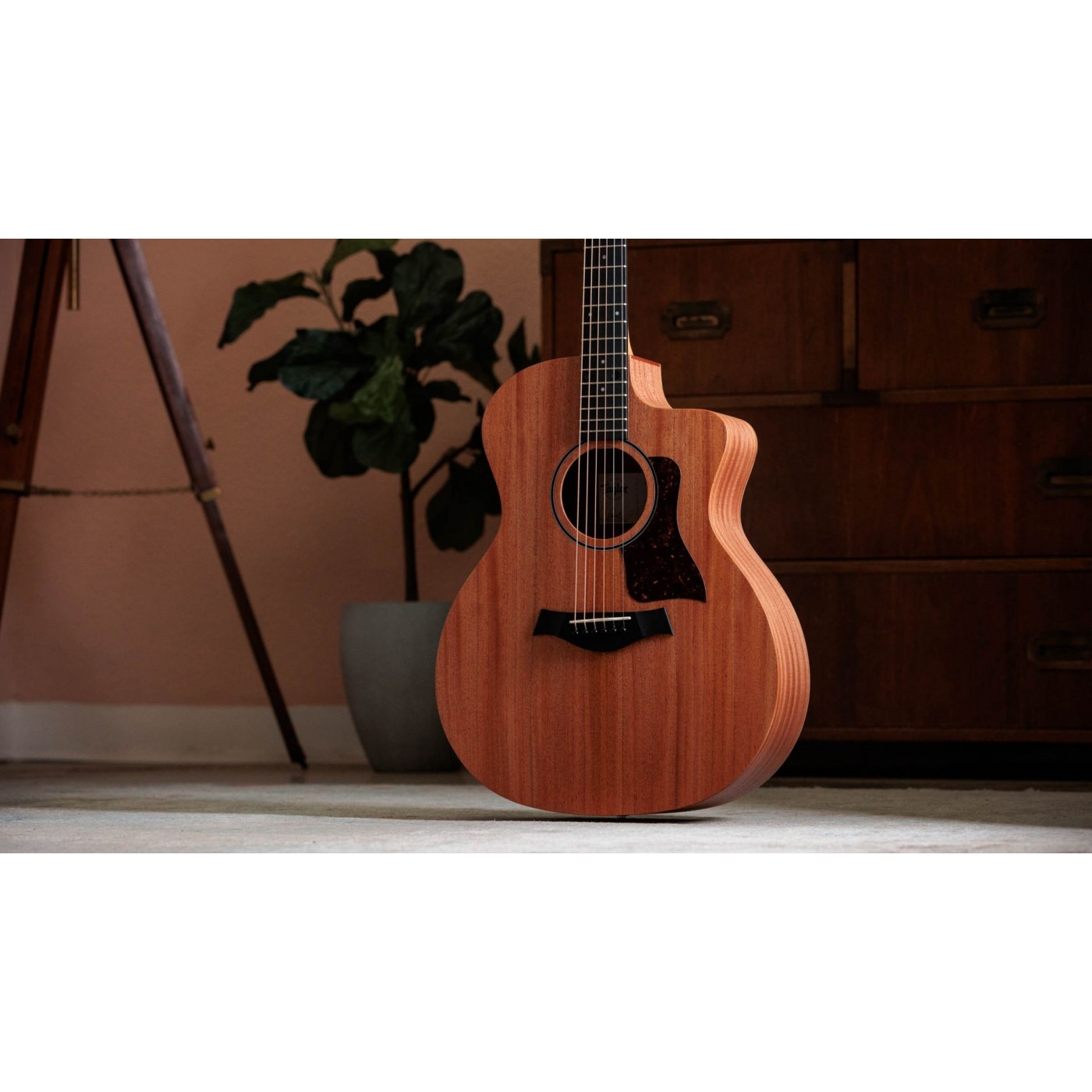
This is an interesting guitar because it combines a familiar Taylor body shape with a warm-toned timber pairing and built-in electronics.
The solid mahogany top and layered sapele back and sides give it a distinctive material recipe. The Grand Auditorium body offers more physical space than the GS Mini, with proportions designed to accommodate a broad range of playing styles. It's a particularly useful shape for somebody who moves between strumming, fingerstyle and melodic lead work.
You can sit behind it with a pick and play a confident rhythm part. You can soften your attack and explore fingerpicked patterns. And the cutaway makes it easier to reach higher positions on the fingerboard when a melody ventures beyond the comfortable territory of first-position chords.
The 24ce also includes Fishman Presys VT electronics, providing a practical route into amplification. That makes it a sensible option for the guitarist who wants one acoustic to cover practice, writing, rehearsal and performance. There's something pleasingly straightforward about that. Not everybody wants a collection of specialised instruments.
Sometimes you want a dependable guitar that feels comfortable, sounds musical and can be connected to a PA when somebody asks you to play a set.
The 24ce makes a strong argument for that approach. And it gives us a useful point of comparison with the final guitar in this delivery. Because both are Grand Auditorium acoustic-electrics with mahogany tops.
But the similarities only tell the beginning of the story.
Taylor Next Generation 324ce: Where the Engineering Gets Interesting
And here we are.
The headline instrument.
The Taylor Next Generation 324ce in Shaded Edgeburst. It's a striking guitar before you play a note. The shaded finish gives the mahogany soundboard a rich, understated appearance, while the Grand Auditorium body and Venetian cutaway retain the familiar Taylor silhouette.
But the real story is inside.
Taylor's Next Generation programme represents a substantial development of the company's acoustic design, bringing together three important innovations: scalloped V-Class bracing, the Action Control Neck and the Claria pickup system. Those aren't merely decorative upgrades. They address three of the most important parts of the acoustic-guitar experience: how the body responds, how the instrument plays and how it behaves when amplified.
Mahogany and Sapele: A Focused Acoustic Voice
The Next Generation 324ce pairs a solid tropical mahogany top with solid sapele back and sides. That distinction matters, especially because earlier 324ce specifications and descriptions can differ from the current model. Mahogany soundboards are often associated with a smooth initial attack, strong midrange presence and a relatively controlled harmonic character.
Sapele contributes its own response, with a useful balance of warmth and clarity. Together, the materials suit a guitar intended to remain articulate through a wide range of playing dynamics. For fingerstyle, that can mean clearly defined notes and a pleasing sense of balance. For strumming, the focused response can help maintain separation rather than allowing everything to dissolve into a wash of overtones. And for a singer-songwriter, that midrange character can sit beautifully beneath the voice.
But wood choice is only part of the equation. The bracing beneath the soundboard has an enormous influence on how the top moves. Which brings us to one of the most significant developments in this guitar.
Scalloped V-Class Bracing
Taylor's original V-Class bracing design was introduced as a different approach to managing the relationship between soundboard stiffness, sustain and tonal response. The Next Generation 324ce uses a scalloped evolution of that architecture.
Bracing is an essential part of acoustic-guitar construction.
The soundboard needs to be strong enough to withstand string tension while remaining free to vibrate efficiently. Make it too rigid and you can restrict movement. Make it insufficiently supported and you create structural problems. The challenge is to manage those competing requirements in a way that produces a musical instrument.
Taylor's scalloped V-Class design is intended to enhance responsiveness, warmth and acoustic output while retaining the pitch consistency associated with the original system.
In practical terms, the aim is a guitar that responds readily to the player, sustains notes convincingly and maintains clarity across the fretboard. Of course, no bracing pattern guarantees that every guitarist will prefer a particular instrument.
The real test remains the same.
Sit down.
Play.
Listen to the balance between the bass and treble strings. Let a chord ring. Then try a quieter passage and see how the guitar responds. Engineering gives us useful reasons to be curious.
Our ears still get the final vote.
The Action Control Neck: A Very Practical Innovation
Now this is a development that deserves attention from anyone who has spent time living with an acoustic guitar. Taylor's Action Control Neck introduces a new approach to adjusting string height. The design uses a long-tenon neck joint and a mechanism accessible through the soundhole, allowing precise action adjustments without the traditional shim-based procedure associated with earlier Taylor neck systems.
Why does that matter?
Because action — the distance between the strings and the frets — has a major influence on playing comfort. A guitar with excessively high action can feel tiring, particularly during long sessions or when playing demanding chord shapes. Set the action too low for the player's technique and string movement, and fret buzz may become a problem.
There's always a balance to find.
And that balance can change with playing style, string choice and environmental conditions. The Action Control Neck makes the adjustment process more straightforward for a qualified technician, helping the instrument remain comfortable and adaptable over time. It's not an invitation to start turning adjustment mechanisms at random. A good setup still requires understanding the relationship between neck relief, string height and the rest of the instrument.
But it's a thoughtful piece of engineering.
One that addresses a real-world concern rather than simply adding another feature to a specification sheet.
Claria Electronics: The Acoustic-Electric Rethought
The third major Next Generation development is Taylor's Claria acoustic pickup system. This replaces the ES2 electronics associated with many earlier Taylor models.
Claria combines an undersaddle pickup design with a dedicated preamp and player-friendly controls. It's intended to provide clear, reliable amplified acoustic tone while giving musicians useful control over the signal. A guitar can sound magnificent in a quiet room and still present challenges when connected to a PA. Stage volume, monitor placement, room acoustics and the frequency response of the pickup all influence the result. A well-designed acoustic pickup system aims to make those situations more manageable.
Claria's approach includes a mid-contour control, allowing the player to shape an important part of the amplified guitar's tonal balance. That can be particularly useful when an acoustic needs to sit alongside vocals, bass, drums and other instruments. It's also a reminder that the modern acoustic guitar isn't simply an unplugged instrument with a socket added afterwards. For many players, amplified performance is part of the instrument's everyday job.
The Next Generation 324ce has been designed with that reality firmly in mind.
Eight Taylors, One Very Interesting Question
Stand back and look at the whole delivery.
At one end, you've got the Baby Taylor BT1 and BT2.
Compact, inviting guitars designed to make acoustic playing accessible and portable.
Then comes the Big Baby, offering a fuller-scale experience in a more manageable body.
The GS Mini family explores the relationship between compact proportions, timber choices and amplification.
The 24ce introduces a full-sized Grand Auditorium with the versatility to handle everyday playing and live work.
And the Next Generation 324ce demonstrates how far Taylor is prepared to go in refining the structure, playability and electronics of an acoustic guitar.
It's a fascinating range because there isn't one single definition of the ideal instrument running through it.
A guitarist who spends most evenings writing songs on the sofa may find a GS Mini absolutely perfect.
A developing player might love the straightforward feel of a Baby Taylor.
A working musician may value the plugged-in practicality of the 24ce.
And somebody looking for a premium acoustic with sophisticated contemporary engineering may be drawn to the 324ce.
Different priorities.
Different musical lives.
Different guitars.
The common thread is Taylor's interest in making instruments that feel approachable and reward regular playing.
And that's something we can get behind.
Come and Explore the First Musicmaker Guitar Drop
The best part of a delivery like this is getting to hear the differences for yourself.
There's only so much a photograph can tell you about the feel of a neck.
Only so much a specification sheet can communicate about the response of a soundboard.
And only so much a description of mahogany, spruce or sapele can tell you about the way a particular guitar reacts to your hands.
Sometimes the instrument you expected to love isn't the one you end up taking home.
That's half the fun.
All eight guitars in this first edition of The Musicmaker Guitar Drop are linked throughout the story, and you can explore the wider Taylor Guitars collection at Musicmaker for even more options.
You can also browse our acoustic guitars or visit us at 29 Exchequer Street, Dublin 2.
We've been opening guitar boxes here since 1981.
We still get excited about what comes out.
And if this first Guitar Drop is anything to go by, we've got plenty more stories ahead.
For another selection from the Taylor department, read our October 2026 Taylor arrivals feature. You can return to The Musicmaker Guitar Drop series hub for the edition index.
Free shipping around Ireland on orders over €15.
The Musicmaker Guitar Drop — Edition 001. November 2026.
Independent minds. Serious gear. Glorious noise.